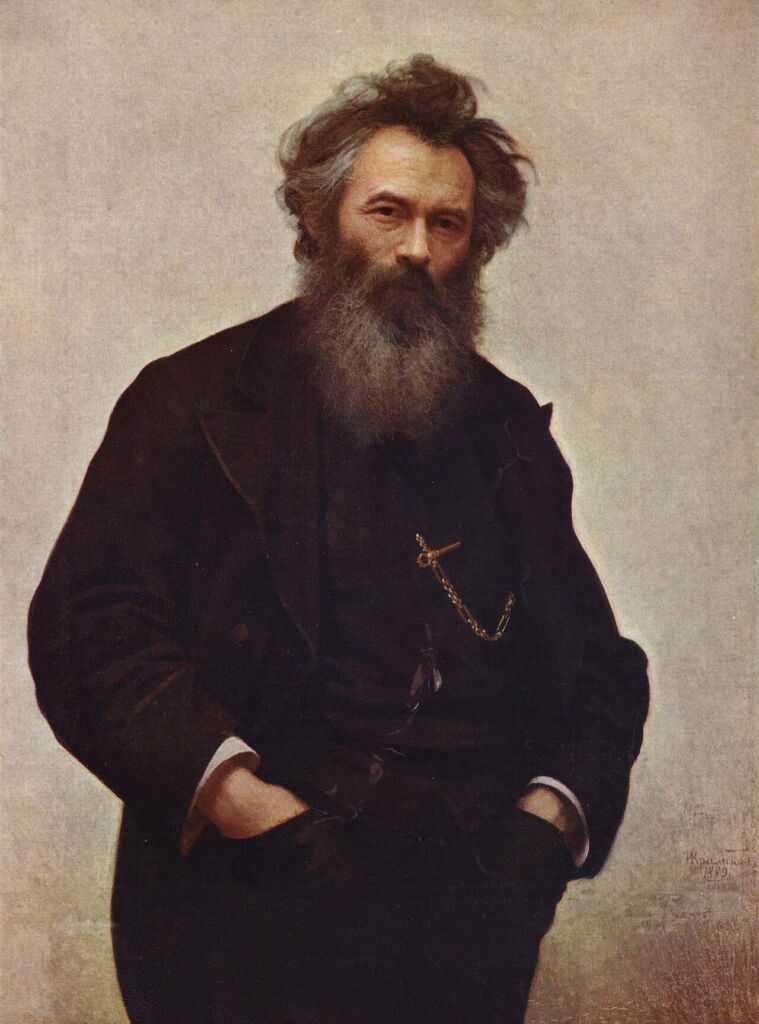
Ivan Shishkin
Ivan Ivanovich Shishkin · 1832, January 25 — 1898, March 20
Biography
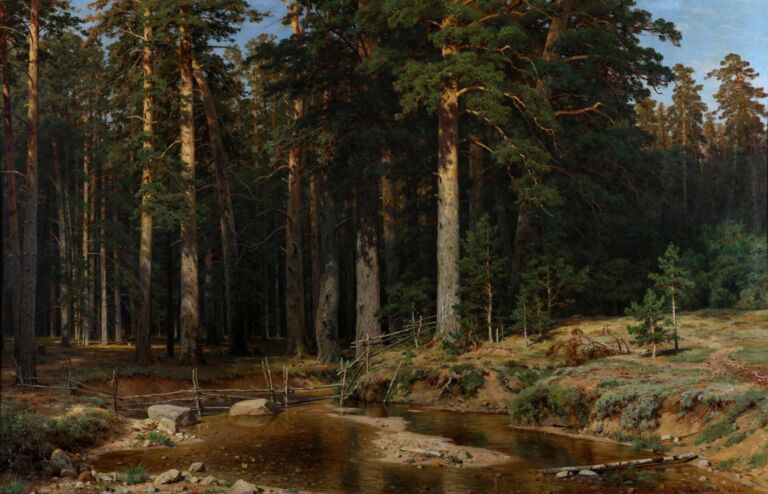
On March 20, 1898, the day after the Russian Museum of Emperor Alexander III opened in St Petersburg, Ivan Shishkin died at his easel, in front of a picture he had just begun. His last large canvas was Mast-Tree Grove, painted early that year from studies made near his native Yelabuga. In 1898 Nicholas II gave it to the new museum.
Shishkin was born on January 25, 1832 (January 13, Old Style), in Yelabuga, a town on the Kama River, into the family of Ivan Vasilyevich Shishkin, a grain merchant. Sources disagree on the year of his birth, but 1832, the year his father recorded, has become the accepted one. The boy completed five years at the Kazan gymnasium and spent several years at home before entering the Moscow School of Painting and Sculpture in 1852. In 1857 he moved to the Imperial Academy of Arts and the class of the landscape painter Sokrat Vorobiev, and within three years he had collected every medal the Academy awarded. The large gold medal came in 1860, for his views of Valaam, the island monastery on Lake Ladoga.
As an Academy pensioner, sent abroad on a scholarship, he went to Munich in 1861. In 1863 he worked in Zurich with the animal painter Rudolf Koller and first tried etching with aqua regia, and in 1864–1865 he painted near Düsseldorf. View in the Vicinity of Düsseldorf earned him the title of academician in 1865. In 1866 he returned to St Petersburg and soon became mentor to the young Fyodor Vasiliev, whose sister Evgenia he married in 1868.
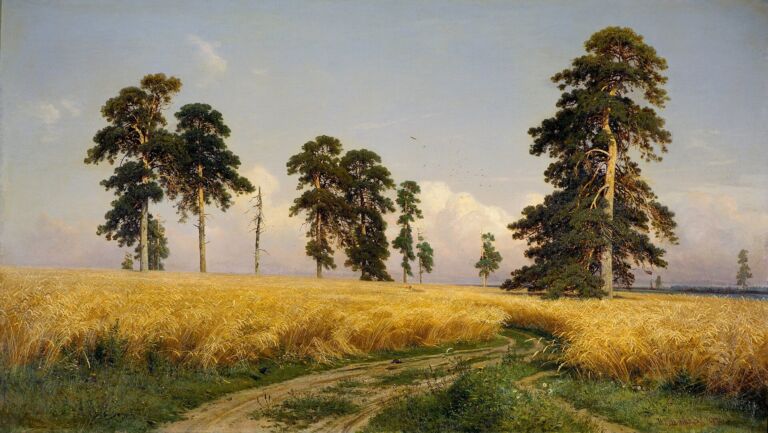
In 1870 Shishkin was one of the founders of the Association of Traveling Art Exhibitions, the Peredvizhniki, and a year later of the Society of Russian Etchers; in 1873 Forest Wilderness earned him a professorship. Then came, one after another, the pictures every Russian knows from school textbooks: Noon. Near Moscow (1869), Pine Forest. Mast-Tree Forest in Vyatka Governorate (1872), Woodland Vistas (1884), In the Wild North (1891). Rye grew out of a trip to Yelabuga with his daughter in 1877; it was shown at the sixth Peredvizhniki exhibition in 1878 and bought by the collector Pavel Tretyakov directly from the artist.
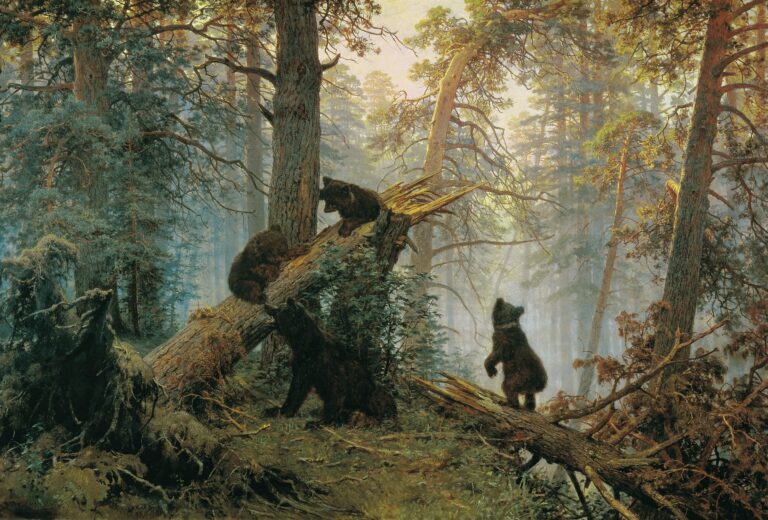
The best-known story concerns Morning in a Pine Forest (1889). The idea was apparently suggested by Konstantin Savitsky, who also painted the bears and signed the canvas next to Shishkin. According to the generally accepted account, Tretyakov bought the picture and erased Savitsky's signature, judging the work to be Shishkin's “from conception to execution.” A reproduction later found its way onto the wrapper of Mishka Kosolapy (“Clumsy Bear”), a popular Russian chocolate candy.
Shishkin trusted knowledge more than mood. He spent what amounted to half his life making studies in the forest, and before starting work he would clear the undergrowth and lop off branches so that nothing blocked his view. For that precision his contemporaries called him the “tsar of the forest.” He gave almost as much time to etching and pen drawing as to painting, and showed his drawings at the Peredvizhniki exhibitions.
His private life was hard. His first wife died in 1874, and in those same years both their sons died in infancy. His second wife, the landscape painter Olga Lagoda, who had been his pupil, died in 1881, soon after the birth of their daughter Ksenia. After the reform of the Academy, in 1894–1895, he headed its landscape studio, but he did not teach for long.
Shishkin was buried in the Smolensky Cemetery; in 1950 his remains were moved to the Alexander Nevsky Lavra. The main collections of his work are the State Tretyakov Gallery, home to Rye and Morning in a Pine Forest, and the State Russian Museum, with Mast-Tree Grove and his Swiss studies of 1863.
Major works
Click a painting to see the details.
-
 01
Morning in a Pine Forest
1889 · State Tretyakov Gallery, Moscow -
 02
Rye
1878 · State Tretyakov Gallery, Moscow -
 03
Mast-Tree Grove
1898 · State Russian Museum, St Petersburg
Related artists
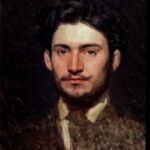 Fyodor Vasiliev
1867–1873 · pupil; brother of his first wife
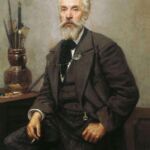 Konstantin Savitsky
1889 · co-author of Morning in a Pine Forest