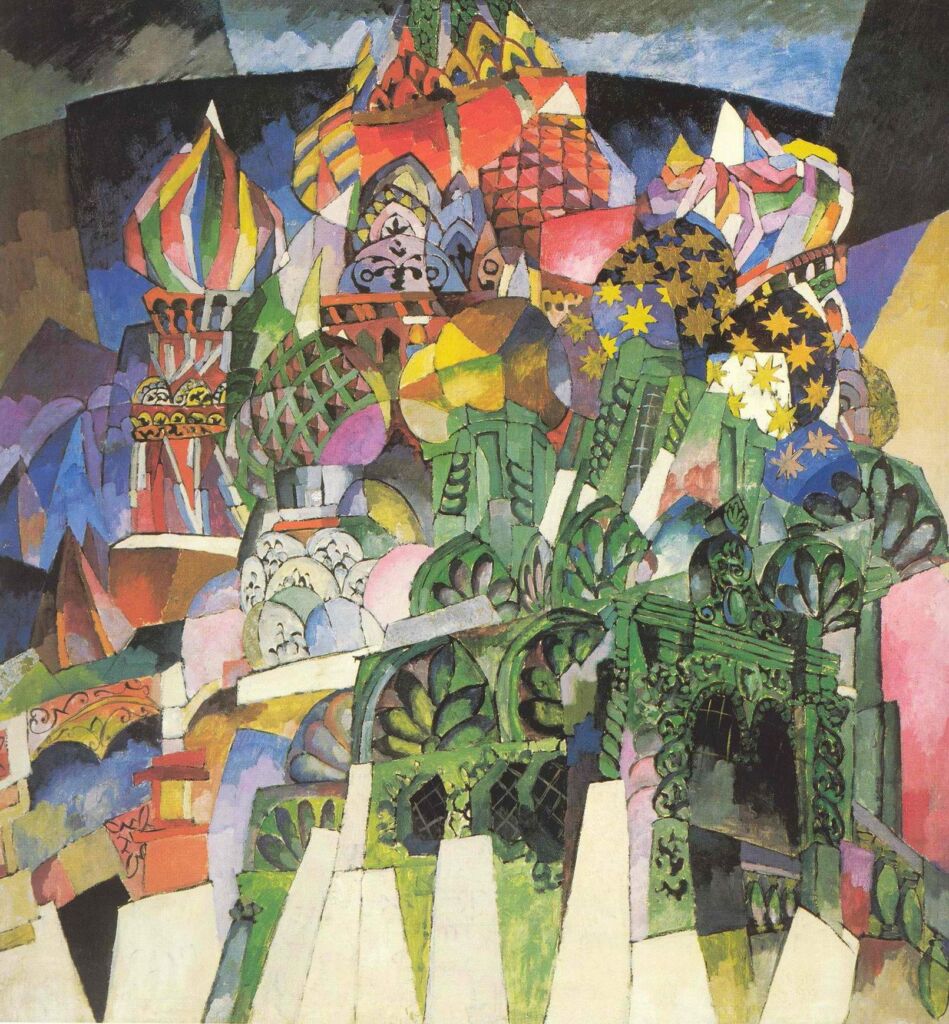
Aristarkh Lentulov, St Basil’s Cathedral, 1913
Cubo-Futurism
1912–1915 · Russia
About the movement
In December 1912 a miscellany appeared in Moscow with a title that sounded like a challenge to a duel: A Slap in the Face of Public Taste. David Burliuk, Aleksei Kruchenykh, Vladimir Mayakovsky and Velimir Khlebnikov proposed to "throw Pushkin, Dostoevsky, Tolstoy, etc., etc. overboard from the Ship of Modernity." These were the poets of the Hylaea group, nearly all of them former or practicing painters. A year later, to set themselves apart from Igor Severyanin's Ego-Futurists in St Petersburg, they began calling themselves Cubo-Futurists. The word itself was a program: from Cubism came the breaking down of form, from Futurism speed and scandal.
Russian artists knew both at first hand. Works by Picasso and Matisse hung in Sergei Shchukin's house in Moscow, and Marinetti's manifestos were translated almost at once. But the Cubo-Futurists copied neither Paris nor Milan. They split the object into facets, like the Cubists, and set those facets in motion, like the Futurists, while taking their color from painted shop signs and the lubok, the Russian folk print. The Union of Youth, registered in St Petersburg in 1910, became the painters' main exhibiting society and an ally of the poets. In painting the leading figure was Kazimir Malevich, who in 1913 called his method "Cubo-Futurist realism."
Malevich's The Knife Grinder or Principle of Glittering (1912–1913, Yale University Art Gallery) unfolds a single figure into several phases of movement at once. Alongside him worked Lyubov Popova, whose Portrait of a Philosopher (1915) is in the State Russian Museum, Nadezhda Udaltsova, Ivan Kliun and Olga Rozanova. Rozanova and Kruchenykh made lithographed books in which verse and image are inseparable. Aristarkh Lentulov, a member of the Jack of Diamonds, applied the same approach to Moscow architecture: in Saint Basil's Cathedral (1913, State Tretyakov Gallery) the church breaks up into glittering planes. Stricter historians place Lentulov in the Jack of Diamonds circle rather than in Cubo-Futurism in the narrow sense.
The defining event was the opera Victory over the Sun, staged by the Union of Youth in December 1913 at the Luna Park theater in St Petersburg. Kruchenykh wrote the libretto, Khlebnikov the prologue, Mikhail Matyushin the music, and Malevich designed the costumes and sets. The audience laughed and whistled, but for art the production proved decisive: Malevich later saw the seed of the Black Square in one of its curtains. That same year he painted Cow and Violin (1913, State Russian Museum), in which a cow superimposed on a violin is deliberate nonsense, an approach he called alogism.
The public took all this as hooliganism, and the Cubo-Futurists did their best to live up to it. They went out in the streets with painted faces, Mayakovsky wore his famous yellow blouse, and their 1913–1914 tour of the empire's cities ended with the police being called. In January 1914 Marinetti himself came to Russia. Instead of fraternizing, the two sides quarreled: Khlebnikov and Benedikt Livshits handed out leaflets against the guest, and Mikhail Larionov proposed greeting him with rotten eggs. The Russian Futurists insisted they were no pupils of the Italians.
Cubo-Futurism lasted only a few years, but its members went further than anyone. At "Tramway V: The First Futurist Exhibition of Paintings" in Petrograd in the spring of 1915, displacements and alogisms still prevailed; at "The Last Futurist Exhibition of Paintings 0,10" in December of the same year, Malevich showed 39 nonobjective canvases and announced Suprematism. Popova, Udaltsova, Kliun and Rozanova followed him, and many later became Constructivists. Without Cubo-Futurism there would be neither the Black Square nor the Russian avant-garde as the world knows it.
Artists
Major works
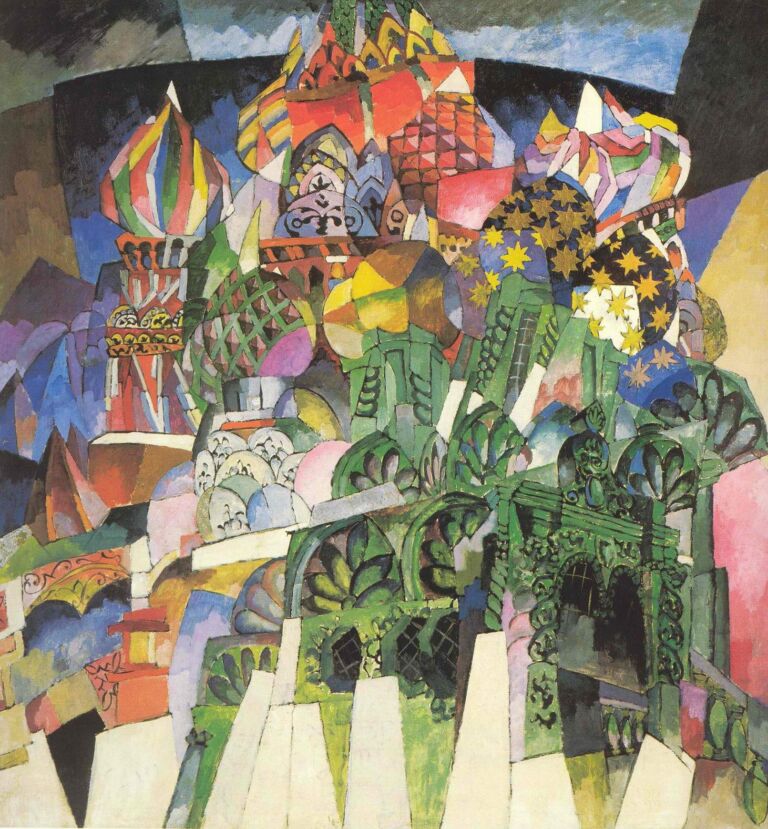 St Basil’s CathedralAristarkh Lentulov · 1913