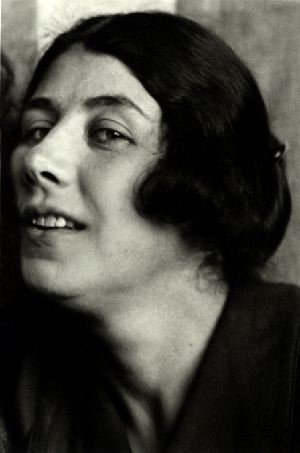
Lyubov Popova
Lyubov Sergeyevna Popova · 1889, Ivanovskoye — 1924, Moscow
Biography
Lyubov Popova lived for thirty-five years, and in the last ten of them she traveled a path that others could not complete in a lifetime: from Cubism to non-objective art, and from there to printed cotton and the theater. It all began in Ivanovskoye, near Moscow, in a wealthy family. She was born on May 6, 1889 (April 24, Old Style); her father, Sergei Popov, was a successful textile manufacturer and a patron of the arts. From the age of eleven she was given drawing lessons at home, among others by the painter Konstantin Orlov, a friend of the family.
In 1906 the family moved to Moscow. Popova attended the Arsenyeva Gymnasium, then studied with Stanislav Zhukovsky, and in 1908 she enrolled in the private studios of Konstantin Yuon and Ivan Dudin. She traveled widely: Italy, France, even Samarkand. In 1912–1913 Popova studied at the Académie de La Palette in Paris under the Cubists Henri Le Fauconnier and Jean Metzinger. Around the same time she worked in a Moscow studio known as the Tower, alongside Vladimir Tatlin and Ivan Aksyonov (some sources give 1912, others 1913). A trip to Italy in 1914 drew her toward Futurism.
From 1914 to 1916 Popova exhibited with the Jack of Diamonds group; in 1915 she took part in the Futurist exhibitions Tramway V and 0.10 in Petrograd, and in 1916 she joined Kazimir Malevich's Supremus group. That same year she began a series of non-objective canvases under the collective title Painterly Architectonics (1916–1918). Three canvases bearing this title are in the Thyssen-Bornemisza Museum in Madrid. In 1918 the series was shown at the Tenth State Exhibition. Also in 1918 Popova married the art historian Boris von Eding and gave birth to a son; a year later her husband died of typhoid fever.
Her path shows painting being taken to its logical limit. From the Cubist fragmentation of the object she moved to pure, overlapping planes of color, and from there to “spatial force constructions,” which became the basis of her teaching at VKhUTEMAS, the Moscow art and design school. From 1920 Popova was a member of the Institute of Artistic Culture (INKhUK).
In September 1921, at the exhibition 5×5=25, she declared together with Rodchenko, Stepanova, Vesnin and Exter that easel painting was no longer needed. After that Vsevolod Meyerhold brought her into the theater: in 1922 Popova designed his production of The Magnanimous Cuckold, and in 1923 Earth in Turmoil. From 1923 she designed fabrics for the First State Cotton-Printing Factory in Moscow.
Popova died on May 25, 1924, two days after her son, and was buried in the Vagankovo Cemetery. On December 21 that same year a posthumous exhibition of seventy-seven of her paintings opened at the Stroganov School; the catalog called her an “artist-constructor.”
Popova's works are in the State Tretyakov Gallery and the State Russian Museum, and abroad in collections including the Guggenheim, which holds Birsk, given by the collector George Costakis in 1981, and the Thyssen-Bornemisza Museum. In 1991 the Museum of Modern Art in New York published a monograph on her by Magdalena Dabrowski. In 2012 a crater on Mercury was named after her.
Major works
Click a painting to see the details.
-
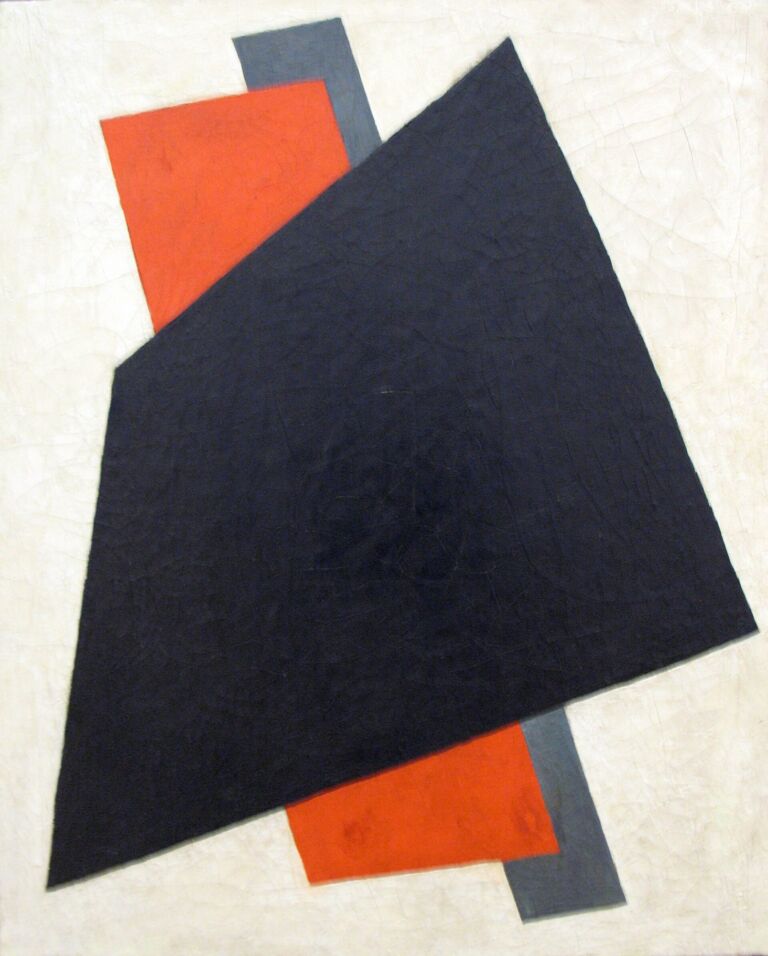 01
Painterly Architectonics
1917 · State Tretyakov Gallery, Moscow
Related artists
 Vladimir Tatlin
1912–1913 · the Tower studio
 Kazimir Malevich
1916 · Supremus group
 Alexander Rodchenko
1921 · fellow exhibitor at 5×5=25