Art movement
Neo-Impressionism
1886 to the early 20th century · France, Belgium
About the movement
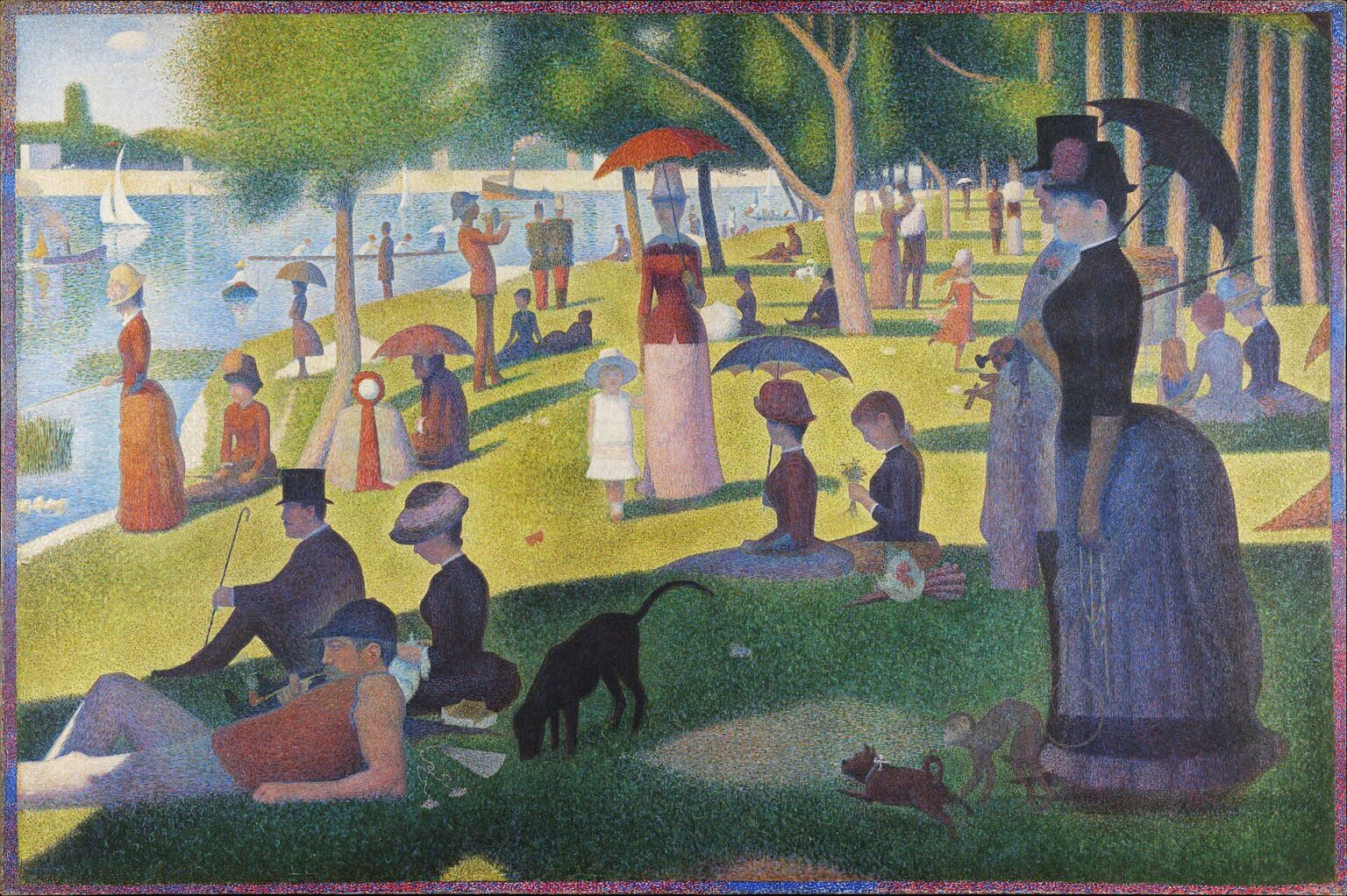
In 1884 the jury of the official Salon rejected the huge Bathers at Asnières by the 24-year-old Georges Seurat. The picture was shown that same year at the newly founded Salon des Indépendants, which had no jury, and there Seurat met Paul Signac. Two years later, at the eighth and last Impressionist exhibition in 1886, he showed A Sunday on La Grande Jatte (1884–1886, Art Institute of Chicago). That year the critic Félix Fénéon, reviewing the exhibition, gave the new method a name: Neo-Impressionism.
Seurat wanted to turn Impressionism into a system. He read the chemist Michel-Eugène Chevreul, with his law of the simultaneous contrast of colors (1839), and the American physicist Ogden Rood, author of Modern Chromatics (1879). Colors were not mixed on the palette but set side by side in small dots of pure pigment, to blend in the viewer's eye and yield more light. The painters themselves preferred the word "Divisionism," from the separation of colors; "pointillism" sounded too technical to them. Against the Impressionists' fleeting impression Seurat set calculation: frozen figures, carefully measured lines, a slow, almost frieze-like composition.
The movement's key pictures are Bathers at Asnières (1884, National Gallery, London), later partly reworked in dots, and the Grande Jatte, to which Seurat added a border of colored dots in 1888–1889. Then came Models (Poseuses, 1886–1888), Circus Sideshow (1887–1888) and The Circus (1890–1891), which was left unfinished: Seurat died in March 1891, at the age of 31. Signac painted harbors and the Mediterranean, spending long periods in Saint-Tropez from 1892 on. Henri-Edmond Cross adopted the method in 1891 and later moved to large, mosaic-like strokes and saturated color.
The appearance of the Grande Jatte at the 1886 exhibition split the Impressionists. Camille Pissarro, the eldest of them, adopted the younger men's method, and Fénéon counted him among its pioneers; by 1890, though, Pissarro had abandoned the dot, finding it too slow and dry. In 1887 the Grande Jatte was shown in Brussels at the exhibition of the avant-garde group Les XX, and Belgian artists such as Théo van Rysselberghe and Henry van de Velde made Brussels the movement's second capital. Early Neo-Impressionism also had ties to anarchist circles: Fénéon and Signac made no secret of it, and in 1894 Fénéon was tried in the "Trial of the Thirty" and acquitted.
After Seurat's death Signac became the movement's chief theorist. His book From Eugène Delacroix to Neo-Impressionism (1899) traced the method back to the color of the Romantics and read as a manifesto. In 1904 Signac invited Henri Matisse to Saint-Tropez; under the spell of that summer Matisse painted Luxe, Calme et Volupté (1904, Musée d'Orsay), and Signac bought the picture. A year later, in 1905, Matisse was already exhibiting ferocious Fauvist canvases in which nothing remained of Neo-Impressionism but pure color.
The Russian connection runs through the Moscow collectors Sergei Shchukin and Ivan Morozov, who bought Signac and Cross; those works are now in the State Hermitage Museum and the Pushkin State Museum of Fine Arts. Through Matisse and Fauvism, the practice of breaking color apart reached the Russian avant-garde. But the movement's main legacy reaches beyond painting: Seurat was the first to turn a picture seriously into an optical experiment. From him descend the Divisionism of the Italian Futurists, the early experiments of Robert Delaunay and Piet Mondrian and, ultimately, the Op art of the second half of the 20th century. The method proved a dead end for one artist but a way out for an entire generation.