Art movement
School of Paris
1900s–1940s · Paris
About the movement
In 1925 the critic André Warnod declared in the newspaper Comoedia that "the School of Paris exists." He meant not a movement but people: the hundreds of foreigners who had come to the capital of art in the first decades of the 20th century. By then the center of their world had moved from Montmartre to Montparnasse. There, in cheap studios and in cafés such as La Rotonde, worked Amedeo Modigliani from Italy (in Paris since 1906), Moïse Kisling from Poland (since 1910), Tsuguharu Foujita from Japan (since 1913) and Jules Pascin from Bulgaria.
It was not a school in the usual sense: there was no shared program, no teacher, no single style. Some of its members are classed with Cubism, others with Expressionism, and still others belonged to no camp at all. Many were Jews from Eastern Europe who gave their names a French form. For many of them Picasso, who first came to Paris from Barcelona in 1900, was a point of reference, though he kept to himself. What bound them together was the city, poverty and living side by side. According to one account, Warnod chose the word "school" as a retort to the hostility toward foreign artists that some French critics made no secret of in the 1920s.
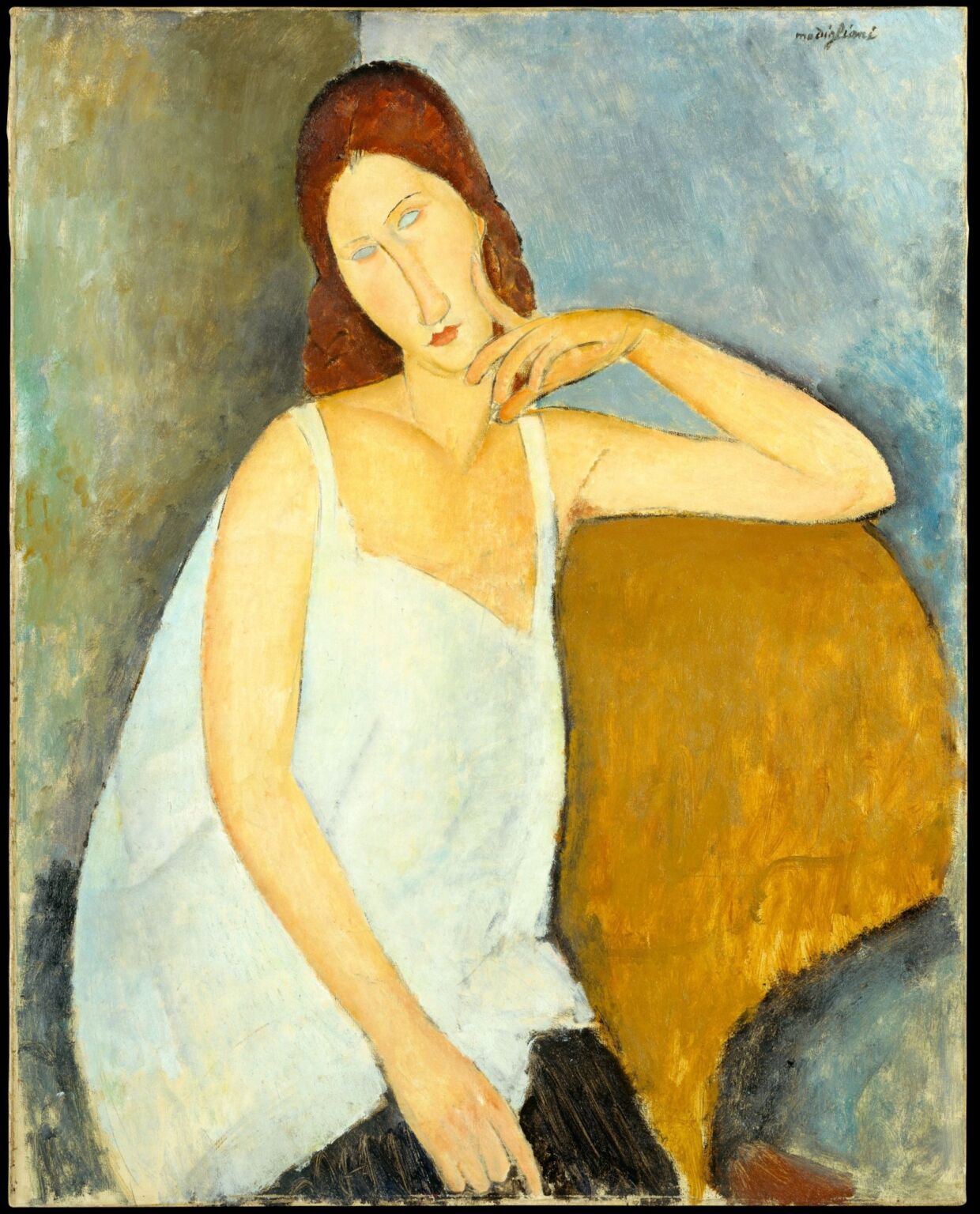
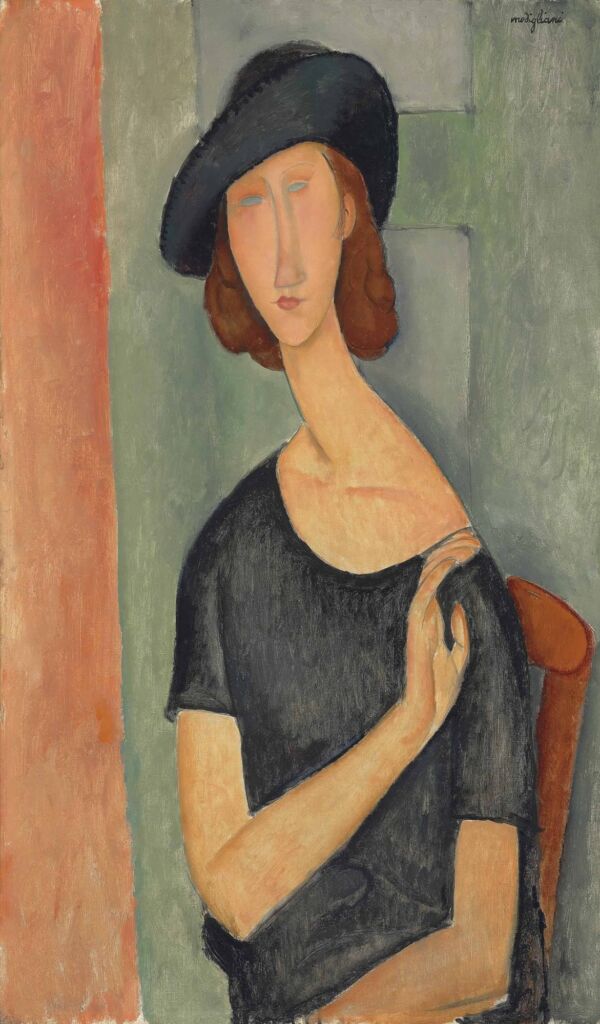
The leading names and works convey this variety better than any formula. Modigliani developed his recognizable elongated portraits; among the last is Jeanne Hébuterne with Hat (1919). A year later he died, and Jeanne took her own life the following day. In his lifetime he had only one solo exhibition, at Berthe Weill's gallery in 1917, and the police demanded that the nudes be taken down. Chaim Soutine painted as if the paint were boiling: the Céret landscapes of the early 1920s and the Carcass of Beef series (1925–1926), inspired by Rembrandt. Marc Chagall brought to Paris the shtetl world of Vitebsk with its flying people, and Foujita the finest line of Japanese ink on a milky-white ground.
Recognition came through dealers. The Polish poet Léopold Zborowski supported Modigliani and Soutine on next to no money, and in the early 1920s the American collector Albert Barnes bought a large batch of Soutine's paintings at once, turning a pauper into a rich man overnight. The Montparnasse of the 1920s became a legend: the cafés Le Dôme and La Coupole, all-night balls, journalists, tourists. A circle of photographers and sculptors formed around the painters, among them Man Ray, André Kertész and Chana Orloff, and the School of Paris became more a milieu than a group.
The School of Paris had a strong Russian strand. Many of its members were born in the Russian Empire and started out at La Ruche ("The Beehive"), a warren of studios and lodgings that the sculptor Alfred Boucher opened in 1902 after buying the wine pavilion from the Exposition Universelle of 1900. Chagall lived there until he left for Russia in 1914; Soutine arrived in 1913 from Smilavichy, near Minsk; Ossip Zadkine, Alexander Archipenko and Jacques Lipchitz worked nearby, and in the neighboring pavilions were Fernand Léger and the young Blaise Cendrars. Marie Vassilieff, a painter from Smolensk, ran her own academy in Montparnasse and, during the First World War, a canteen where hungry artists could eat for pennies.
The occupation of 1940 effectively brought this story to an end. Some of the artists died in the camps, others left for America, and Soutine died in 1943 while hiding from the Nazis. After the war the term "School of Paris" was also applied to a new generation of abstract painters, but the original Montparnasse generation remains an example of how a city can take the place of both manifesto and academy for artists.
Stories