Modigliani’s blank eyes: the clue is in his stone heads
"When I know your soul, I will paint your eyes": the famous line attributed to Modigliani has no source. His blank eyes are easier to trace through his stone heads of 1912 and the four portraits of Jeanne Hébuterne that do look back.
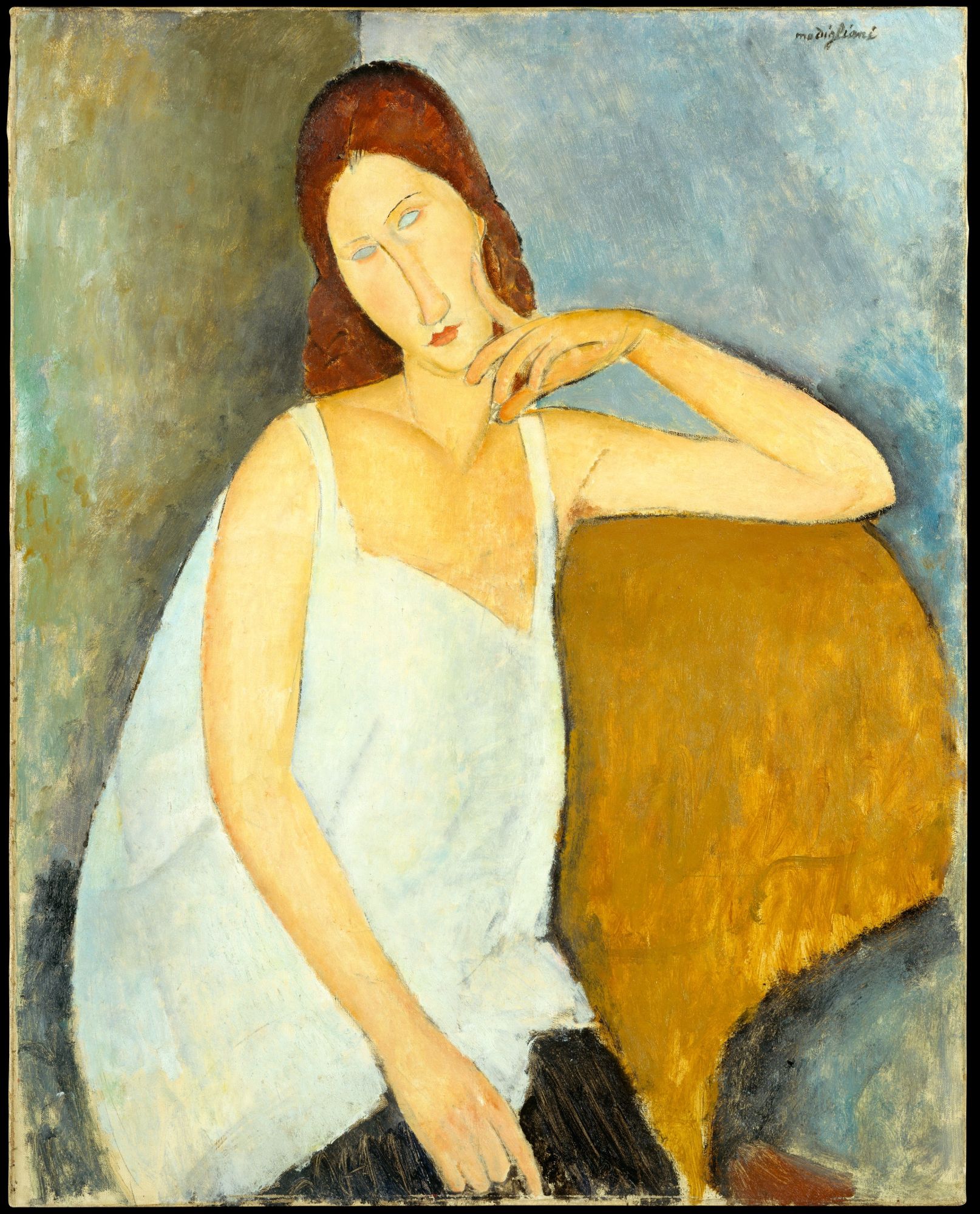
“When I know your soul, I will paint your eyes.” The line is attributed to Amedeo Modigliani, supposedly speaking to Jeanne Hébuterne (or, in other tellings, to an unnamed sitter), and it turns up in countless pieces on his portraits. Yet it has no paper trail: no letter, no memoir, no date. Quotation sites give no source, and neither museum catalog entries nor the technical study of Jeanne’s portraits mention it.
As far as we know, Modigliani never explained the empty eyes. His stone heads show where they came from.
The eyes began in stone
In 1909 Modigliani met Constantin Brancusi and took up the chisel. From Brancusi he learned direct carving, straight into the stone with no clay model. According to the Metropolitan Museum of Art, he made about twenty-five sculptures in his short career, most of them elongated heads.
Until around 1914 he put stone first. The heads drew on traditions far from his own. The Met’s Woman’s Head of 1912 once belonged to Frank Burty Haviland, a painter and collector of African art whose collection Modigliani knew. Other roots run to Cycladic, Sumerian, Egyptian and Greek art. Paris artists also studied the ethnographic collection of the Trocadéro museum.
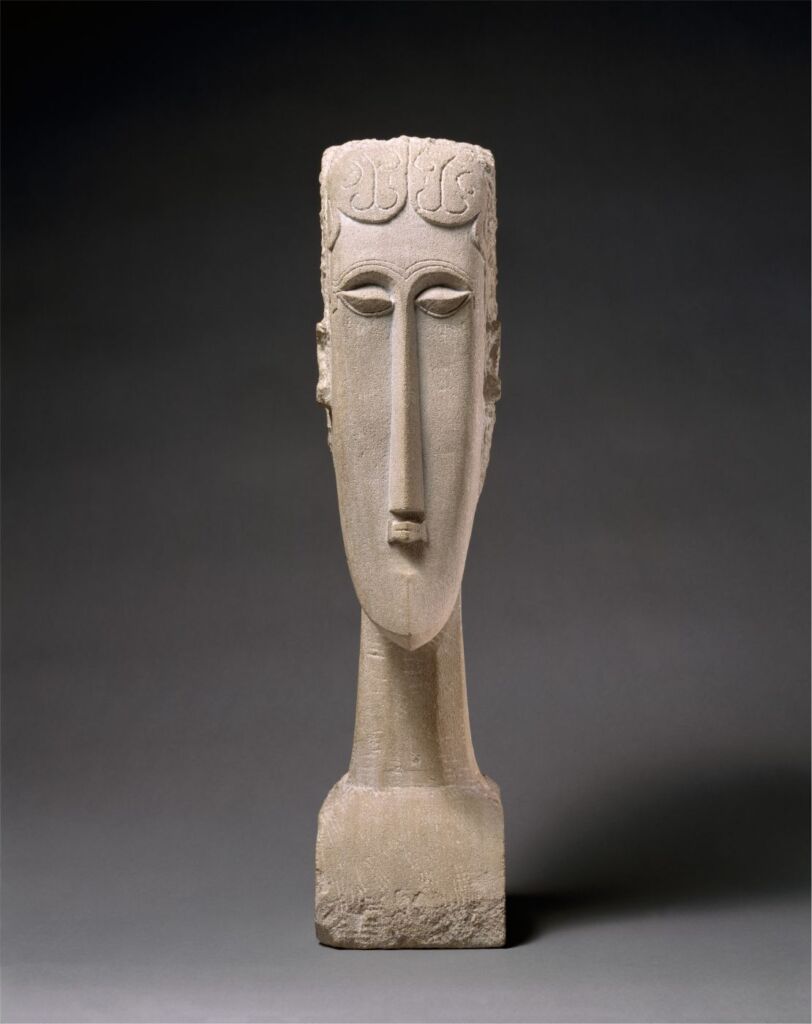
In 1912 he showed seven heads together at the Salon d’Automne. Their eyes are almond-shaped slits: form without a gaze. Back on canvas, the slit moved onto living faces. In the Met’s words, “the style of these abstracted, elongated heads is echoed in his subsequent figure and portrait paintings.”
Twenty-six portraits, four that look back
Modigliani met Jeanne Hébuterne, a young artist, in late 1916 or early 1917. They were probably introduced by the sculptor Chana Orloff, who, like Jeanne, had studied at the Académie Colarossi in Paris.
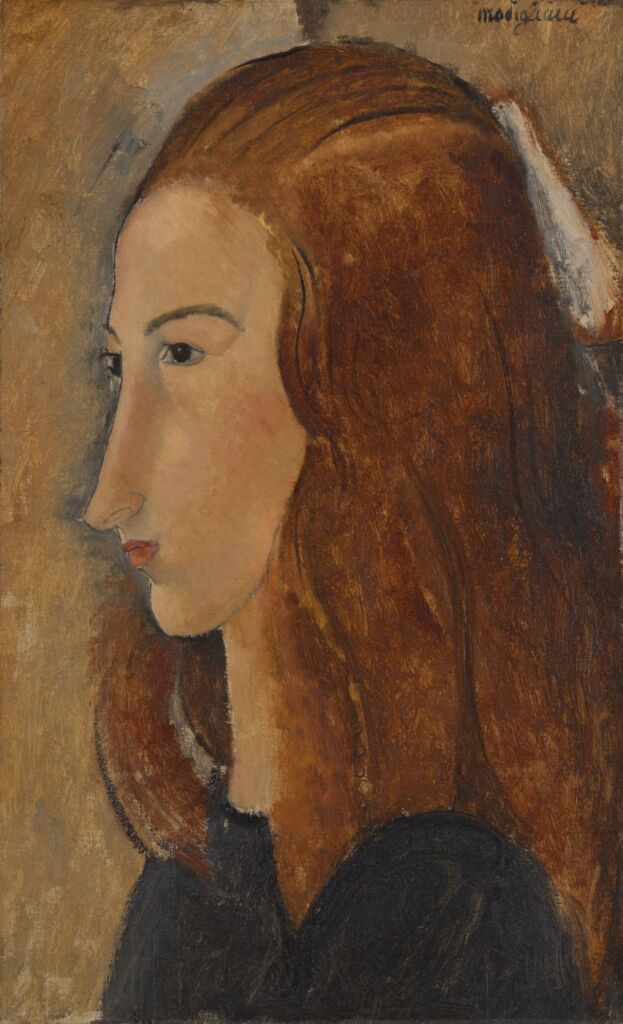
In under three years he painted Jeanne more than twenty times and, as the Met observes, typically emphasized her “thick auburn hair and blue eyes.” Her face and long neck are instantly recognizable, from the New York canvas to Portrait of Jeanne Hébuterne in a Large Hat.
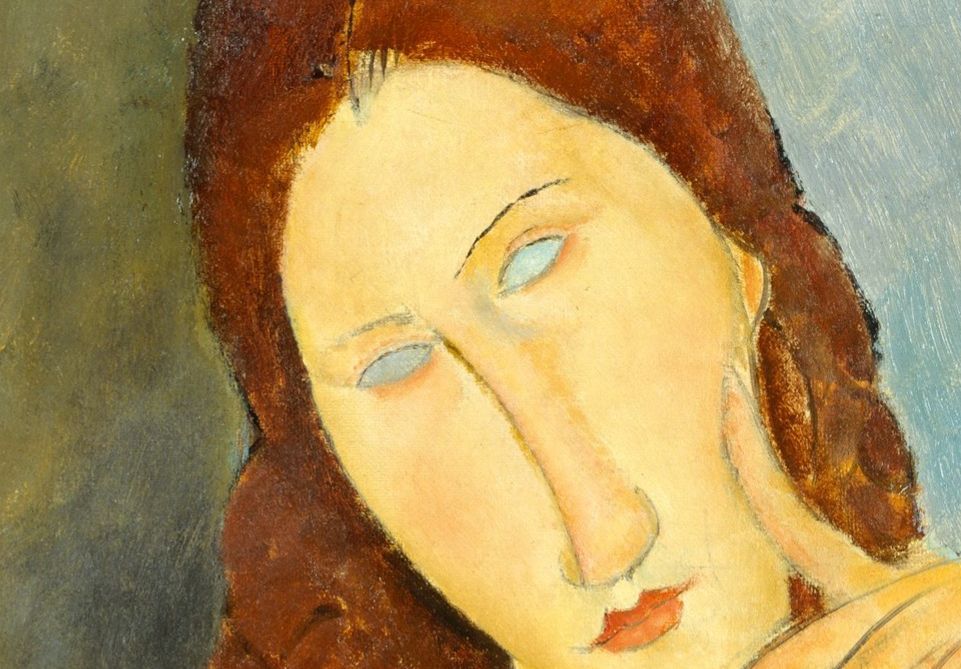
Researchers writing in Tate Papers checked Jeanne’s portraits in Ambrogio Ceroni’s 1970 catalog. Of the twenty-six, “only four delineate the irises and pupils.” Three are in private collections; the fourth is at the Yale University Art Gallery.
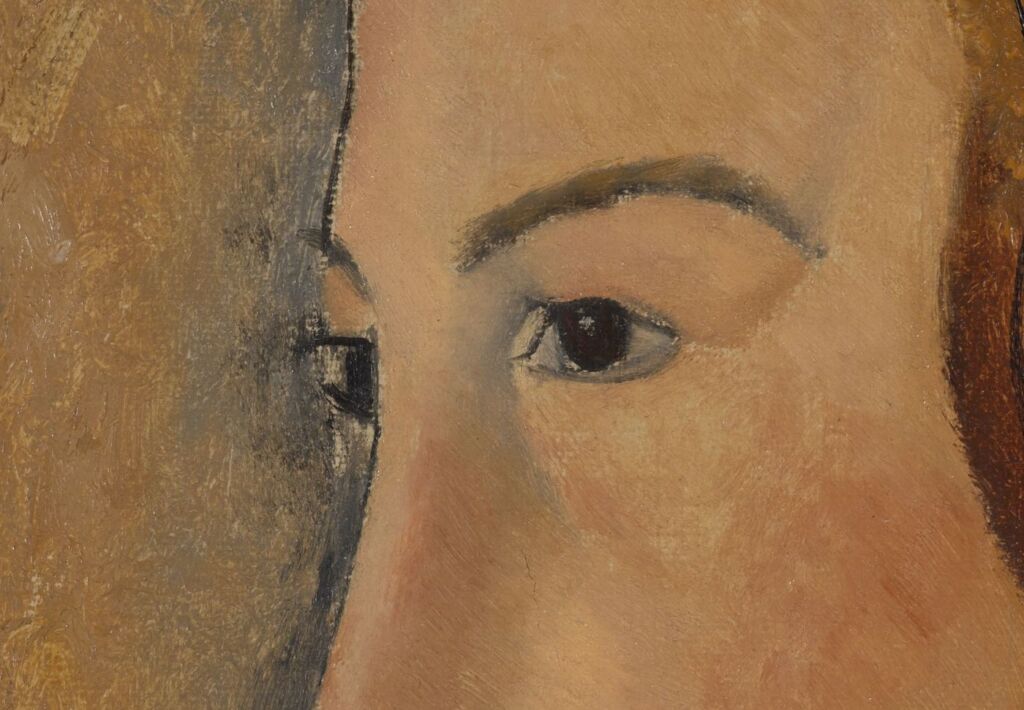
The Yale canvas is small, just 45.7 cm (18 in) tall. The sitter’s left eye is painted “seemingly from observation”: the pupil almost entirely in bone black, the iris warmed with iron ochre. The right eye is three short black strokes. Only here and in two privately owned portraits are her eyes dark.
An eye with the gaze taken out
The researchers dissected a blank eye in a 1919 portrait at the Musée d’Art Moderne in Troyes. Modigliani only partly blended blue and white paint, leaving a marbled effect, outlined the eye in black and, last of all, added a touch of thick green paint at its lower edge.
The team also notes that “light blue seems to have been more faithful to Hébuterne’s eye colour.” The emptiness, then, may have begun with observation: Modigliani took a real color and removed whatever makes an eye look back.
Another clue is at the Barnes Foundation in Philadelphia. In a 1918 profile portrait of Jeanne, infrared imaging revealed faint outlines of irises beneath the blank, pale blue eyes. He had sketched the irises in, then left the eyes empty in the final layer.
The line about the soul may well be a later invention: the painter died in January 1920, and his legend, like the auction records he never lived to see, was made by others. The canvases are more reserved: in twenty-two of the twenty-six portraits, Jeanne’s eyes stayed empty.
Comments
For Hroniki readers
Comments are open to readers with an account. Signing up is free and takes a few seconds.
No comments yet. Start the conversation.