Homer’s The Gulf Stream: the rescue he promised only in a letter
Asked in 1902 what became of the sailor on his boat, Winslow Homer promised a happy ending. Little in The Gulf Stream backs him up.
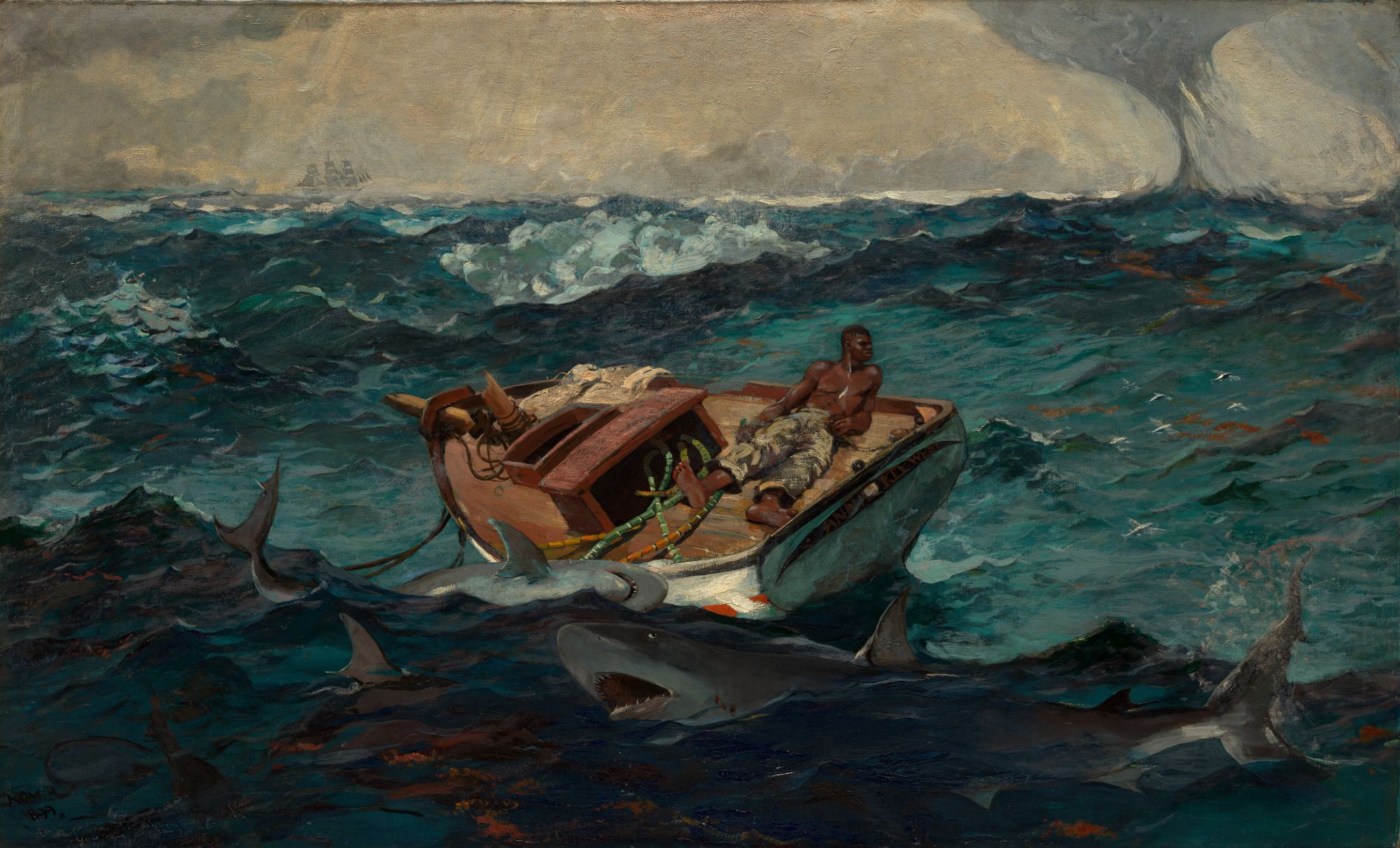
In February 1902 the New York dealers M. Knoedler & Co. passed a question on to Winslow Homer in Maine. It came from women who had seen one of his canvases at the gallery, and it was simple: what happens to the man on the boat?
Homer replied on February 19. “I regret very much that I have painted a picture that requires any description,” he began. Then he gave the ladies their ending anyway. The sailor, he promised, “will be rescued & returned to his friends and home & ever after live happily.”
Almost nothing in the painting backs him up: the only hope is a ship so far off it may never see him. The Gulf Stream, dated 1899 and reworked by 1906, hangs in Gallery 767 of the Metropolitan Museum of Art. The rescue exists on paper.
Ten crossings of the current
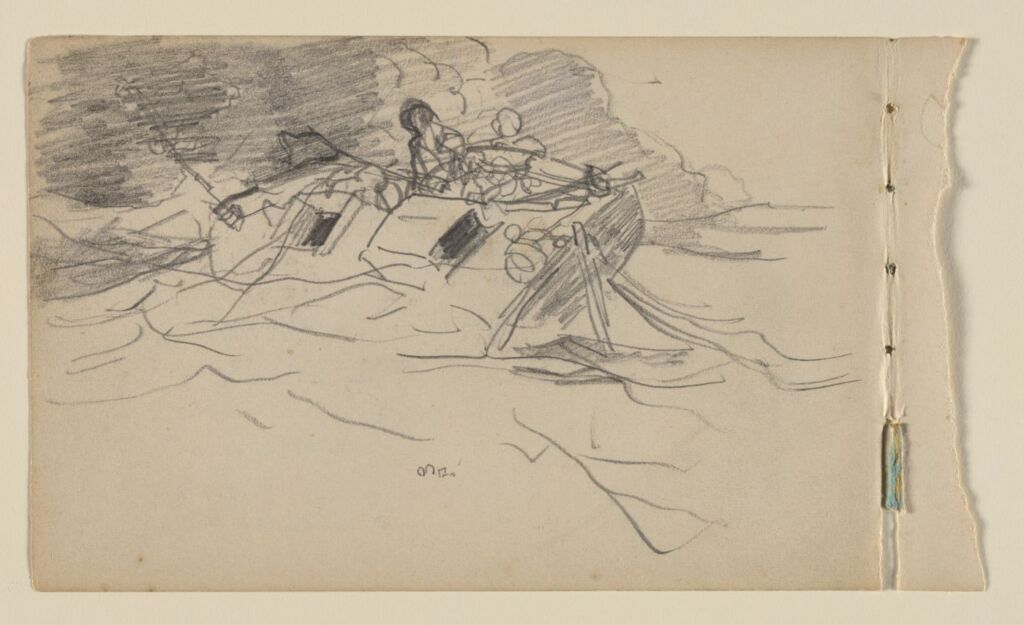
Homer first went to the Caribbean in December 1884, going to Nassau with his father by steamer. In early 1885, probably on the passage between the Bahamas and Cuba, he jotted a pencil note of a dismasted boat in rough water with one or two figures on deck.
The sheet is about six inches (16 cm) wide. The Met, which now owns it, reads it as his first impression of the disaster he would paint fifteen years later.
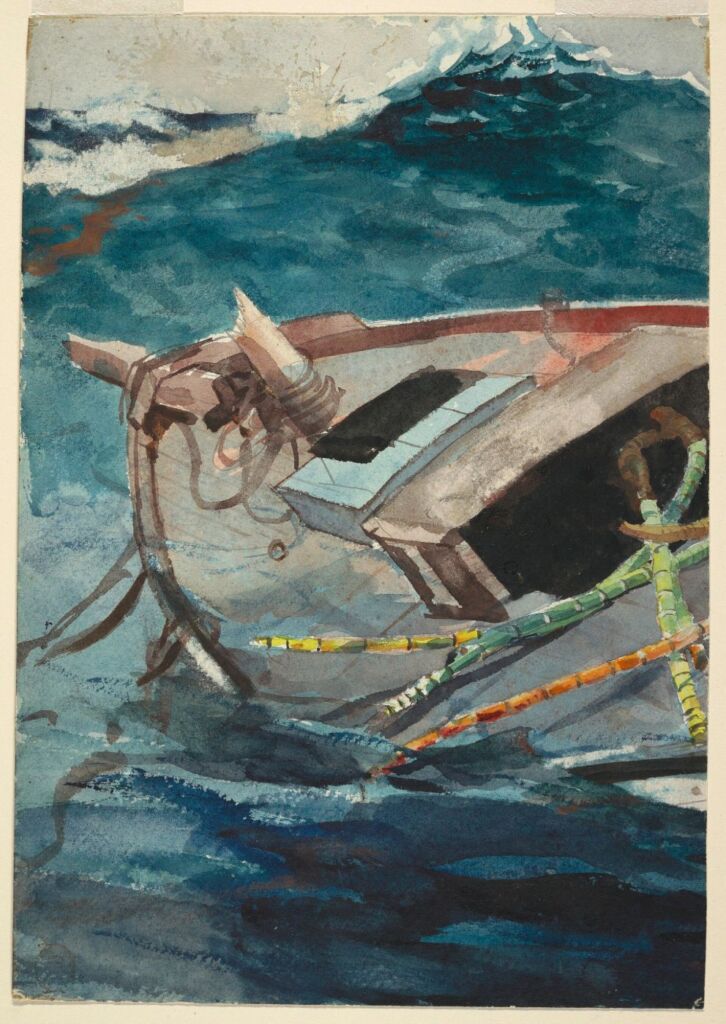
The same winter gave him watercolors of shark fishing and of sharks around a derelict. Then the idea waited. Homer spent the winter of 1898–99 in Nassau and Florida and made new studies, among them a sheet now at Cooper Hewitt where cut sugarcane lies across a tilting deck.
The oil followed at his studio in Prouts Neck. “I have crossed the Gulf Stream ten times & I should know something about it,” he would remind Knoedler’s in 1902.
Twelve feet away
In November 1899, as the canvas headed for its debut at the Pennsylvania Academy of the Fine Arts in Philadelphia, Homer sent viewing advice to its managing director, Harrison S. Morris. “This first shark is 15 ft long & the boat is 30 feet away from him,” he wrote. “Do not smell of this, but stand off!”
He even painted a line of small script under his signature at lower left: at twelve feet, it says, you can see it.
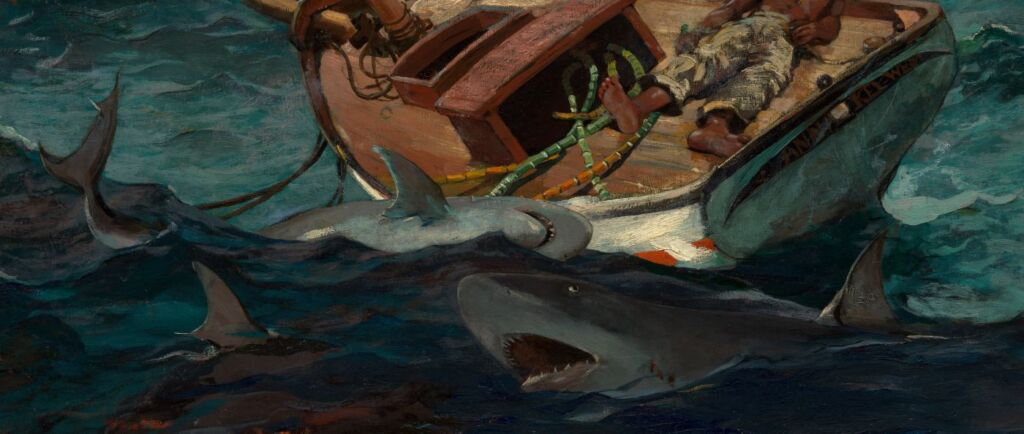
The same letter, published by the scholar Marc Simpson in 2018, made a stranger comparison. The obvious precedent was Géricault’s Raft of the Medusa, the century’s most famous picture of castaways.
Homer reached instead for Turner’s Slave Ship, with its chain cables on the water and its “impossible arms & legs,” and said his own figures counted for about as much in his picture.
Turner’s arms and legs belong to enslaved people thrown overboard. Homer’s figure is a Black sailor alone on a wreck.
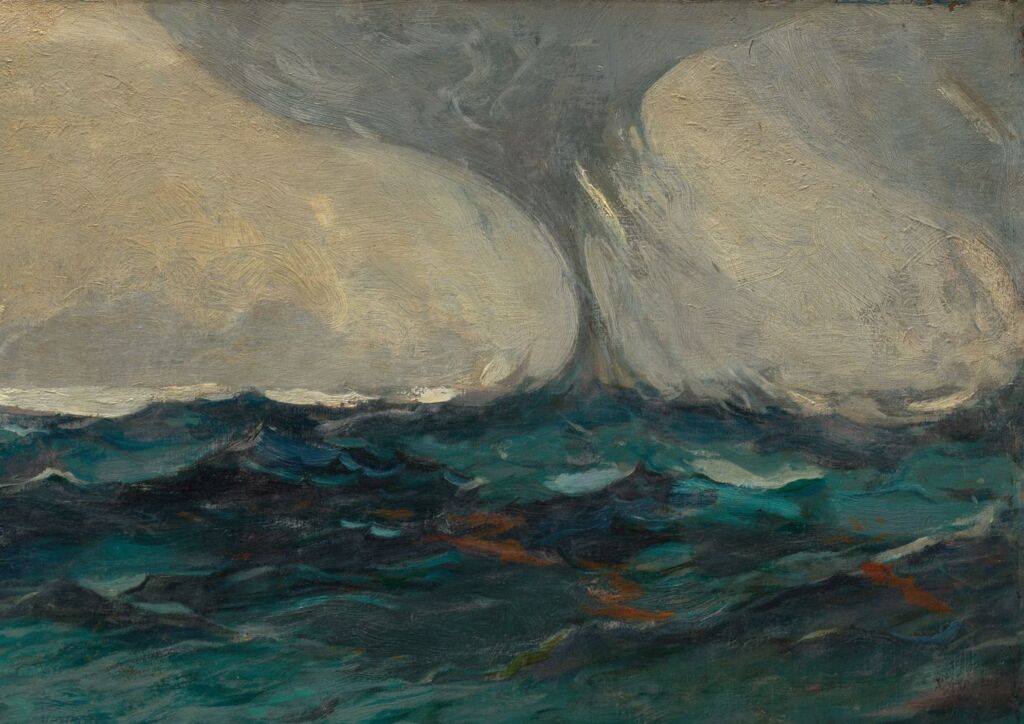
Philadelphia found no buyer. After the show Homer went back into the canvas; he had “improved it very much,” he wrote, with “more of the Deep Sea water than before.”
Comparing it with an early photograph, the Met’s 1985 catalog of its American paintings finds that he also broke the starboard gunwale, made the name on the stern, Anna – Key West, legible and added a ship on the horizon at upper left.
The canvas went to Venice for the international exhibition of 1901. The next spring Homer told a Chicago gallery, M. O’Brien & Son, that his net price was $3,000.
In October 1906 the Met’s trustees declined to buy it. In mid-December, after a petition from artists, they reversed themselves and acquired it through the Wolfe Fund. It was the first painting by Homer to enter the museum.
The figure of little account
For decades the picture was read as man against nature. Later readers looked harder at what Homer had waved away. In Weathering the Storm (2004) the historian Peter H. Wood treated the sugarcane as a pointer to the long history of New World slavery, and found Black disenfranchisement at the heart of the storm.
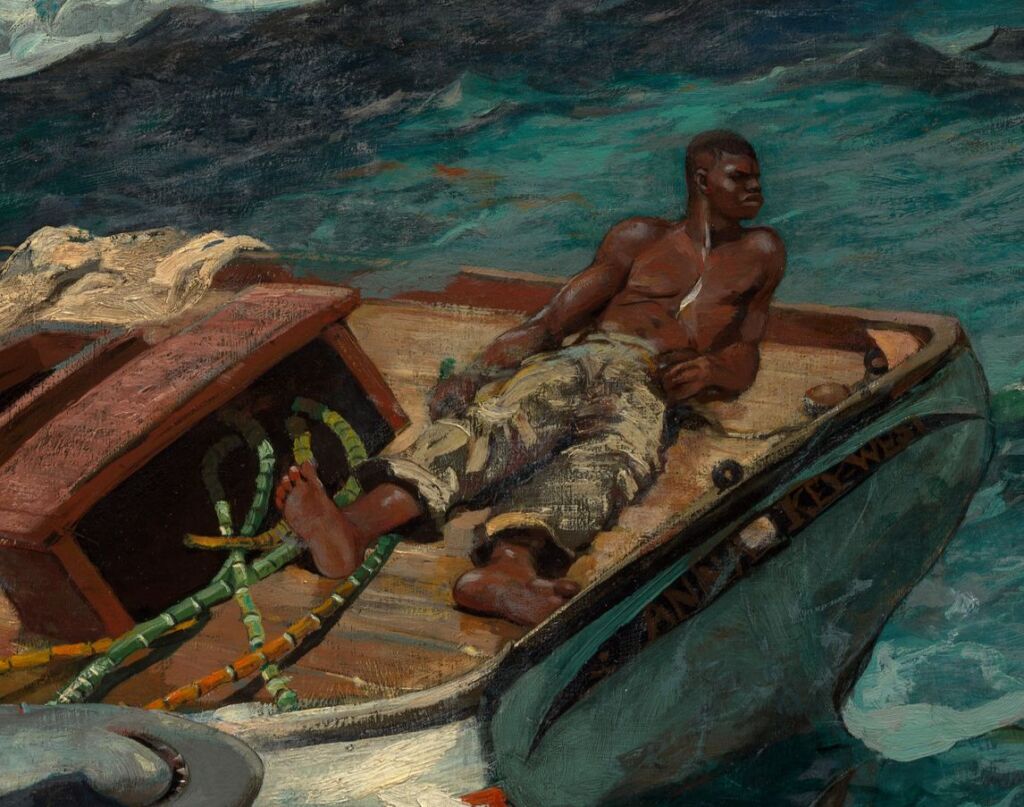
The exhibition Winslow Homer: Crosscurrents at the Met (April 11–July 31, 2022) took the same line. Its curators set The Gulf Stream in the company of Homer’s pictures of newly emancipated Black Virginians and his Bahamas watercolors, and described it as alluding to “the legacies of slavery and American imperialism,” and to Homer’s thoughts on mortality after his father died.
Reviewing the show for The Atlantic in 2022, Susan Tallman found an artist “no longer an oracle of American innocence,” but “recast as a poet of observed conflict.”
In September 2022 the exhibition moved to the National Gallery in London as Winslow Homer: Force of Nature, the first overview of his work ever shown in Britain. The Gulf Stream crossed the Atlantic with it.
Homer’s 1902 letter had one more sentence for the curious: “The subject of the picture is comprised in its title.” The title names a current, not a man. The sharks, the spout, the cane and the far-off ship he left for us to see, from twelve feet back.
Comments
For Hroniki readers
Comments are open to readers with an account. Signing up is free and takes a few seconds.
No comments yet. Start the conversation.