Kramskoy’s Unknown Woman: why we still don’t know who she is
In 1883 Ivan Kramskoy showed a lady in an open carriage under a one-word title, Neizvestnaya (“unknown”). He never said who she was. What is documented about the painting, and what was invented later.
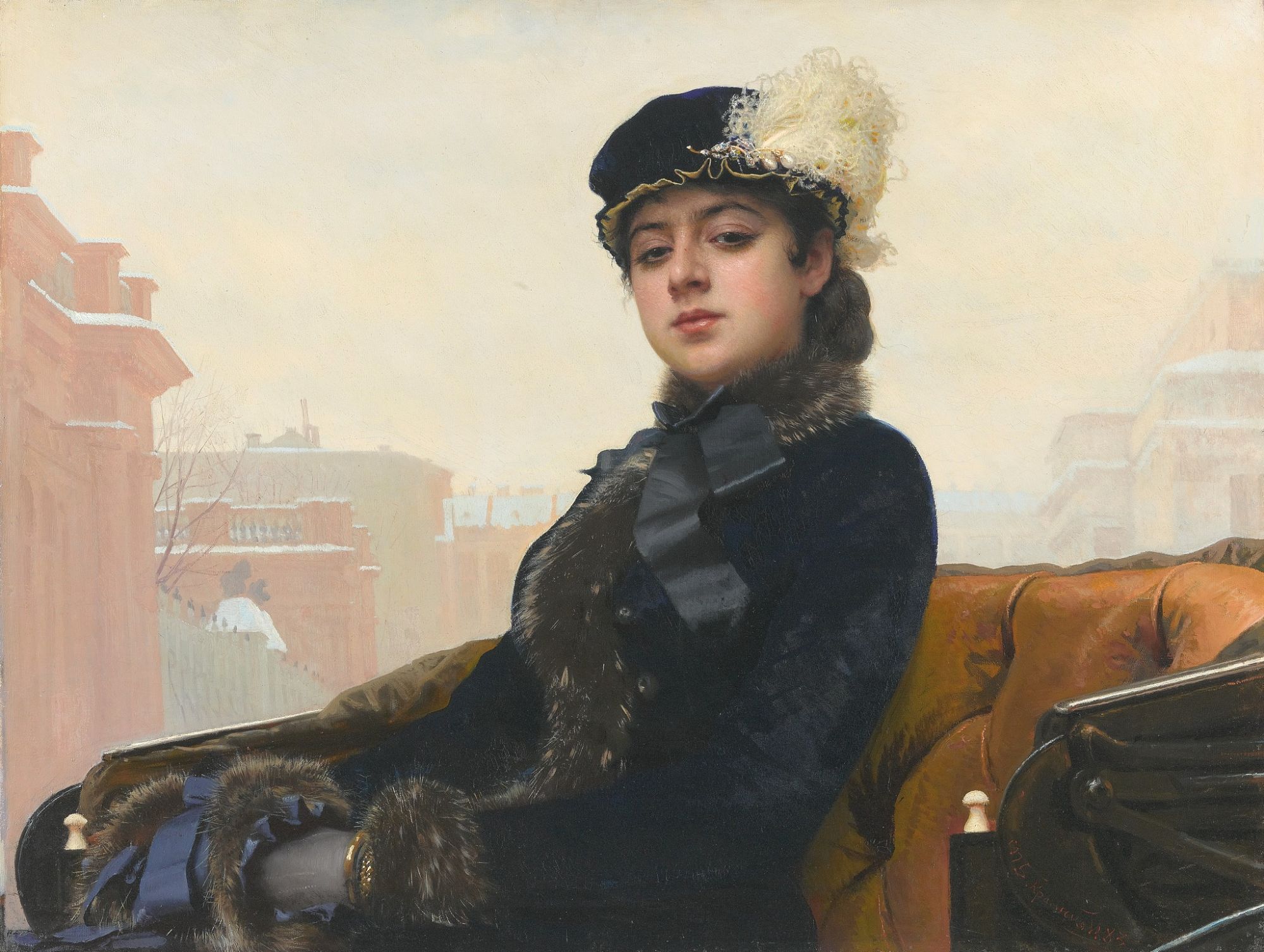
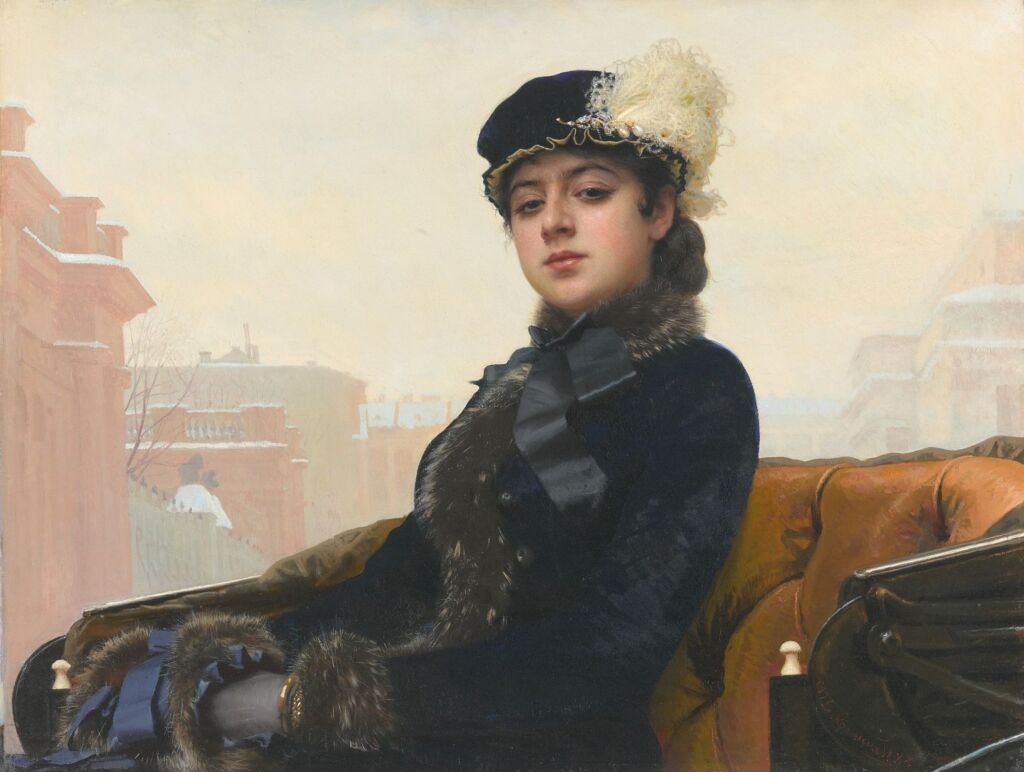
In spring 1883 the Peredvizhniki opened their eleventh exhibition in St Petersburg, and crowds lingered at one canvas. A young woman in an open carriage looked down at them. She had no name. The title was a single Russian word, Neizvestnaya, “unknown” in the feminine; the State Tretyakov Gallery now calls the picture Portrait of an Unknown Woman.
Ivan Kramskoy lived four more years and never said whom he had painted. Half a dozen theories about the model have piled up since, none backed by a document.
The Wanderers’ eleventh exhibition, spring 1883
Kramskoy had helped found the Peredvizhniki, or Wanderers, a society of realist painters who broke with the Imperial Academy of Arts in 1870 and toured their exhibitions from city to city. By 1883 he was also among St Petersburg’s most sought-after portraitists, painting dignitaries, writers and the imperial family.
Twenty years earlier, in 1863, he had led the “Revolt of the Fourteen,” when Academy graduates refused to paint a set competition subject and walked out. The rebel was now a fashionable portraitist, and this painting sits right on that line: it has the gloss of a society commission and the Wanderers’ interest in people polite society preferred not to see.
She was not the only talking point. The same show included Nikolai Yaroshenko’s The Student Girl: a young woman from the Higher Courses for Women walking down the street alone. Both heroines were unescorted, one in velvet and furs, the other in a plain coat, and both annoyed the critics.
Reviewers called the student slovenly and unpleasant to look at, and the lady a cocotte. An odd pair: an emancipated student and, as many concluded, a kept woman. Each was out in the city on her own, and that was what viewers in 1883 found hardest to accept.
The writer Pyotr Boborykin, as later authors report, put the subject plainly: “A lady in a carriage, at the hour of the promenade on Nevsky.” (Nevsky Prospekt was the city’s main avenue and promenade.) The mystery came from the title. Kramskoy could have called it Portrait of a Lady or On Nevsky. He chose a word that made people ask.
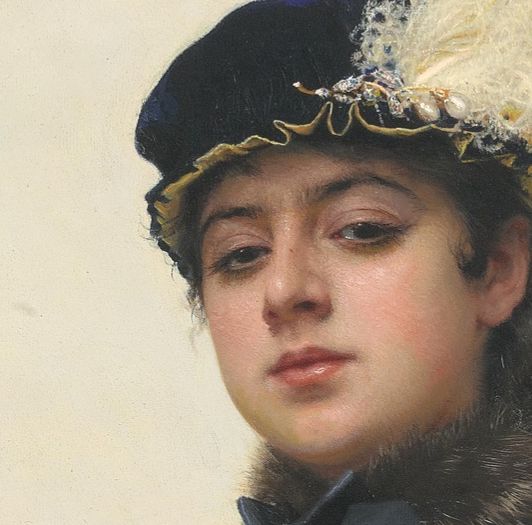
What struck contemporaries first was her gaze. She leans back slightly and looks down at us from the carriage, neither smiling nor looking away. Some reviewers found it insolent.
A Francis hat and a Skobelev coat
Viewers in 1883 read the canvas like a captioned fashion plate. Each item had a name: a velvet “Francis” hat with an ostrich feather, a fur-trimmed “Skobelev” coat, “Swedish” gloves of fine leather. All three names appear on the Tretyakov Gallery’s page for the painting (in Russian).
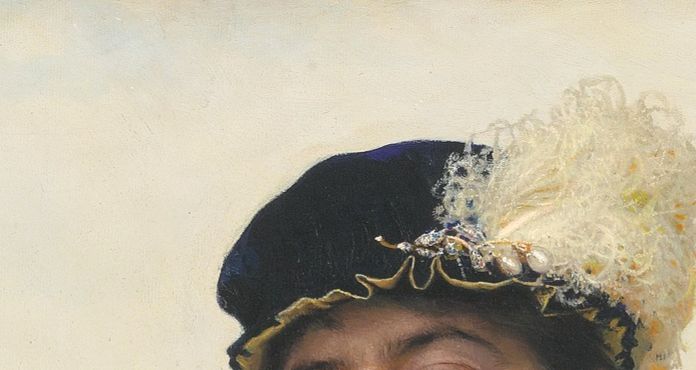
The coat was named for General Mikhail Skobelev, a hero of the Russo-Turkish War of 1877–78 and a popular idol. He died in summer 1882, so the fashion was fresh from the newspapers. She is dressed in the very latest, and every viewer knew it.
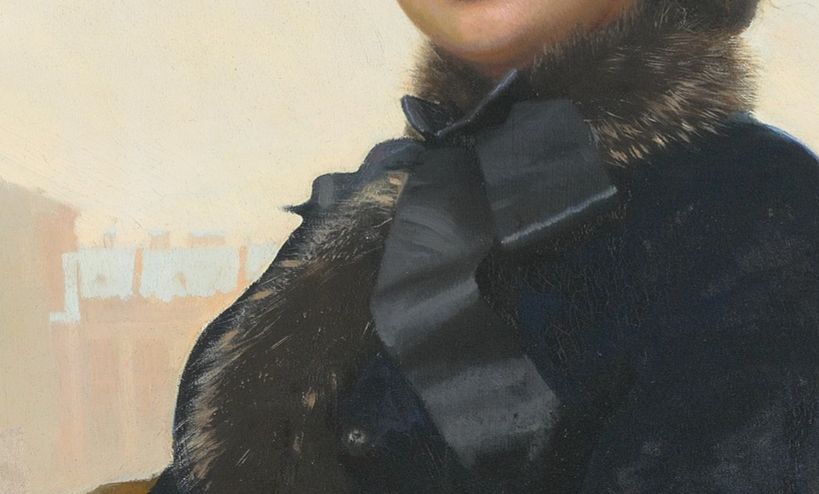
That was what made them uneasy. By the unwritten rules of high society, a lady did not follow fashion to the letter; doing so perfectly was bad form. An outfit that exact suggested a woman who needed to be looked at.
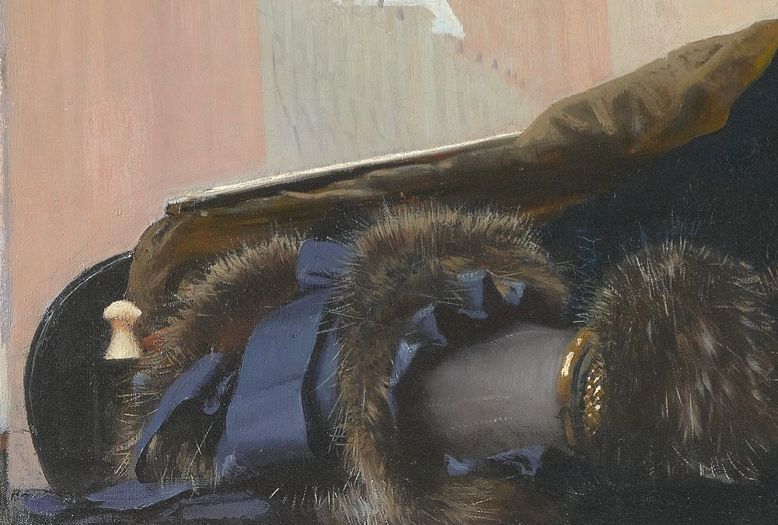
Fine Swedish gloves, calmly folded hands: nobody sits like that in someone else’s carriage. The second signal was the drive itself: a respectable woman did not ride along Nevsky by day in an open carriage without a husband, father or brother. Kramskoy’s heroine does, and looks perfectly content.
Today the codes are lost; we see only a beautiful woman in furs. In 1883 viewers saw a whole biography behind the velvet, and argued over it.
The Anichkov Palace pavilions in a frosty haze
Popular accounts often put the carriage on the Anichkov Bridge. Detailed descriptions read the background differently: behind the woman stand the pavilions of the Anichkov Palace and the Alexandrinsky Theatre.
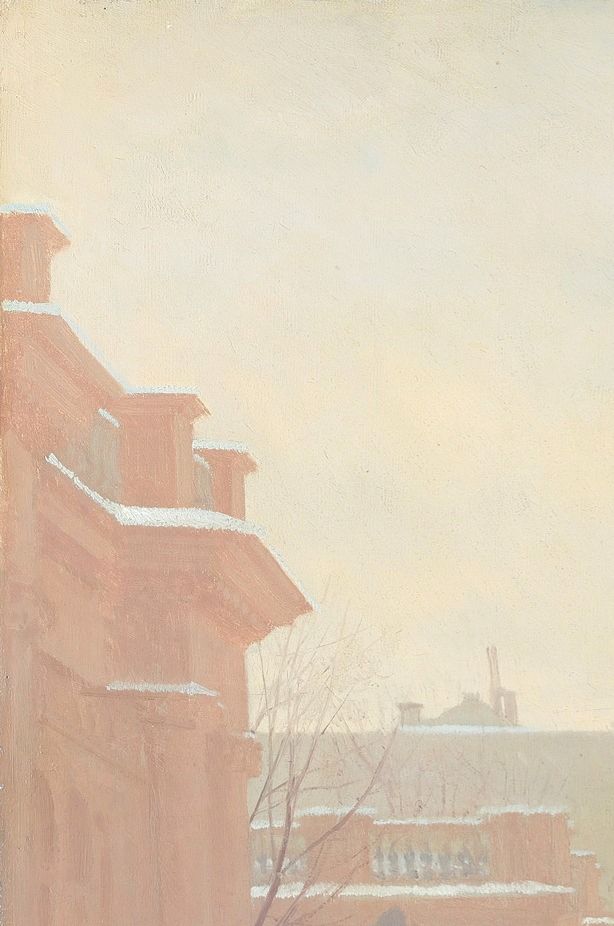
This was the grandest stretch of the city. The Anichkov Palace on Nevsky belonged to the imperial family; the Alexandrinsky was the imperial drama theater. Here St Petersburg put itself on show, and here Kramskoy sent his heroine.
The city itself nearly dissolves. Kramskoy, a master of hard, exact drawing, leaves the buildings in a frosty haze, and Nevsky becomes a pale stage backdrop. Only the face, the fur and the velvet are sharp.
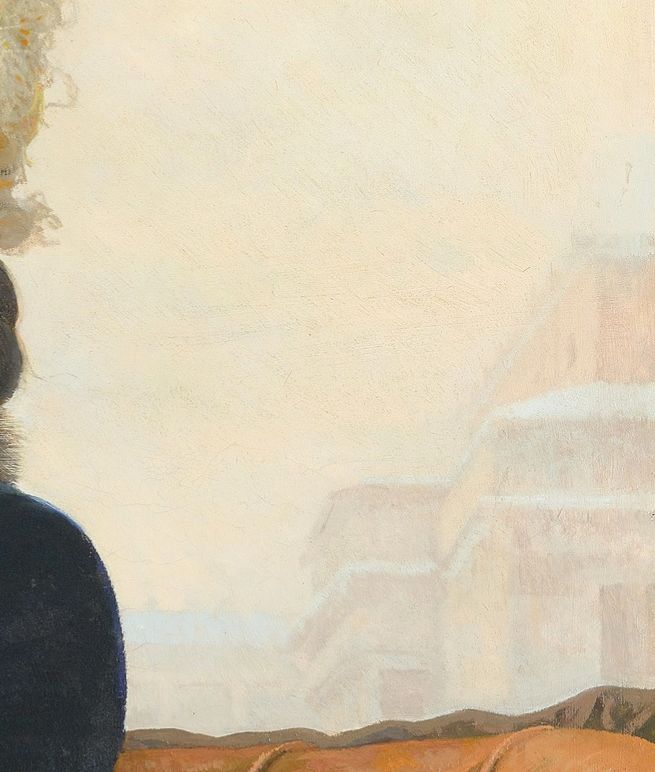
St Petersburg readers knew this theme long before Kramskoy: in his story Nevsky Prospekt, Nikolai Gogol warned that the capital’s main street was not to be trusted. Kramskoy showed the same Nevsky half a century later.
“All is deception, all is a dream, all is not what it seems.” — Nikolai Gogol, Nevsky Prospekt, 1835 (our translation)
A cocotte in a carriage
The critics were quick. The Tretyakov Gallery cites three reviews, all about the woman’s morals. Vladimir Stasov, the Wanderers’ chief champion, called her “a cocotte in a carriage.”
The painter Nikolai Murashko saw “an expensive camellia,” a name for kept women since Alexandre Dumas fils’s The Lady of the Camellias. The critic Pavel Kovalevsky wrote of “one of the spawn of the big cities.” None of them says a word about the painting itself.
Stasov, the Wanderers’ main voice for years, argued with Kramskoy more than once but respected his talent. Here he apparently saw a cousin of the society portraits that paid Kramskoy’s bills in the 1880s, a step away from art with a message. The public was undeterred: the canvas became one of the show’s most talked-about pictures.
A name missing from the letters
Kramskoy wrote a great deal: letters, articles on art, thoughts on what painting is for. Yet the model’s name appears nowhere in his letters or diaries, as the scholar E. Muratova notes. That silence set every legend in motion.
Several explanations have been offered. He worked for the court and the aristocracy; naming a living woman the critics had branded a cocotte would have ruined her reputation and his clientele. Or there was no name, and he painted a type rather than a person. These are guesses, not documents.
The hardiest legend concerns Matryona Savvishna, a peasant woman from the Kursk region who married a nobleman named Bestuzhev. The plot is suspiciously close to Pushkin’s story The Stationmaster. According to Tatiana Karpova of the Tretyakov, quoted by the journalist Vladimir Tikhomirov, no document supports either the story or Matryona herself.
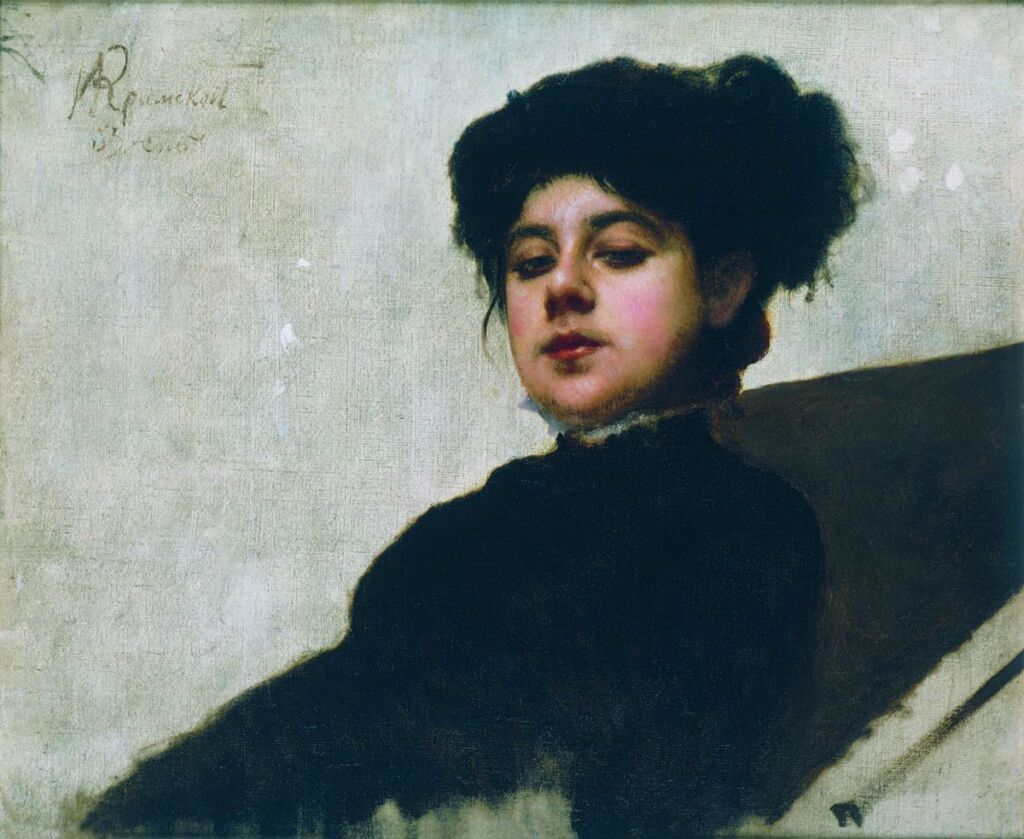
The studies only muddy things. According to a common account, a study in the private collection of Dušan Friedrich in Prague may show the same woman. Tikhomirov, however, describes the Prague sketch as a haughty middle-aged lady who looks nothing like the heroine. Until they are fully published, the studies settle nothing.
Muratova’s 2024 article (in Russian) examines the theory that she was Princess Yurievskaya, the morganatic wife of Alexander II. By her account, in 1880 Kramskoy was commissioned to paint the princess and asked to keep it quiet; after the emperor’s death the commission lapsed. Muratova concludes that the surviving study more likely shows a hired model than the princess.
There is also a simple objection: the painting appeared two years after Alexander II’s death, when the princess had already left Russia. Showing a recognizable portrait of her under the new emperor, to whom Kramskoy was close as a portraitist, would have been risky. Yet the rumored likeness, which the Tretyakov also mentions, outlived her departure and the era.
Another theory names the artist’s daughter, Sofia. Tikhomirov, for one, favors it, but it has no documentary support either.
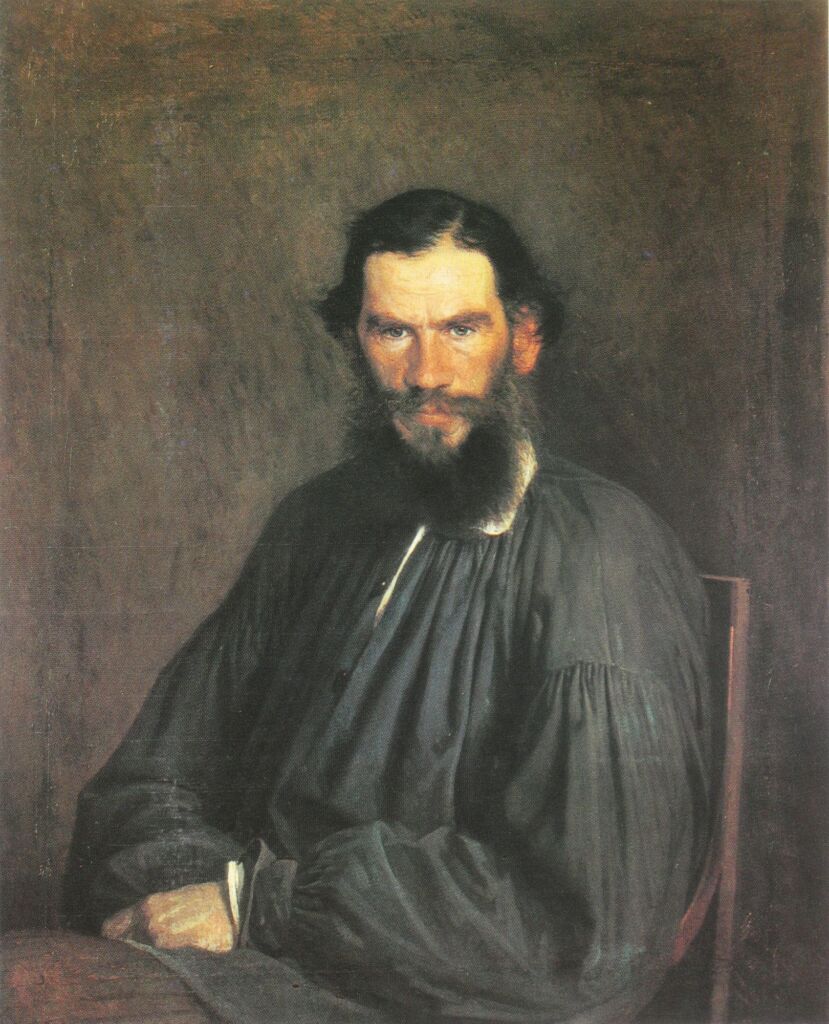
Readers, not Kramskoy, made the link to Anna Karenina, and they had grounds: in 1873 he painted Leo Tolstoy at Yasnaya Polyana while Tolstoy was writing the novel. In the novel, Anna is painted by the artist Mikhailov, often said to share traits with Kramskoy.
The complete novel appeared in 1878, five years before the painting. A woman who had defied society and sat proudly in full view looked too much like Anna, an association Muratova also examines. A second, mistaken name came from Alexander Blok’s 1906 poem Neznakomka (usually translated as The Stranger), and the painting is still often called by it.
Separate documents from legends and little remains: the painting dates from 1883, it was shown at the eleventh Wanderers’ exhibition, and no known document names the model. The peasant girl, the princess and the daughter are theories; Anna Karenina is a literary association. Nobody today can confirm who sat for it.
From Warsaw to Lavrushinsky Lane
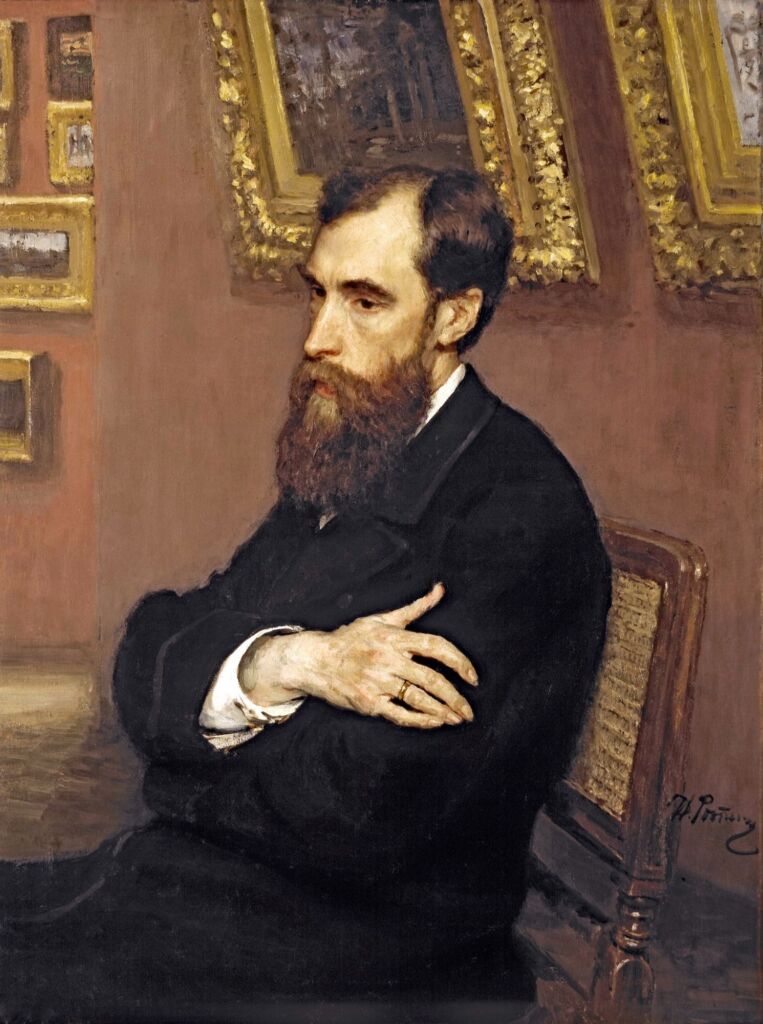
Kramskoy was apparently counting on Pavel Tretyakov, the Moscow collector who acquired his major works. Tretyakov turned it down. The curator Svetlana Kapyrina writes on the Tretyakov Gallery’s portal (in Russian) that the showy heroine simply did not appeal to him.
The painting traveled with the exhibition to Moscow, Kyiv, Kharkiv and Warsaw, then in the Russian Empire, where a buyer named Klyukvist acquired it. Almost nothing is known of him; Tikhomirov says his name surfaces only in papers from Kramskoy’s posthumous exhibition (the artist died in 1887).
By 1894 it belonged to the sugar manufacturer Pavel Kharitonenko and was shown that year in Moscow at an exhibition of private collections held for the First Congress of Russian Artists. Kharitonenko and his wife, Vera, kept their paintings in a mansion on Sofiyskaya Embankment, facing the Kremlin.
After the Revolution the family ended up abroad, the collection was nationalized, and the mansion went to the People’s Commissariat for Foreign Affairs.
In 1925 the painting entered the Tretyakov Gallery, which records it as transferred by the Commissariat from the former collection of Pavel and Vera Kharitonenko. So it ended up, after all, in the gallery of the man who had declined to buy it.
The canvas, in oil, measures 76.1 × 102.3 cm (30 × 40¼ in). It hangs in the Tretyakov’s Historical Building on Lavrushinsky Lane and, in 2025, after the exhibition Peredvizhniki (in Russian), returned to the permanent display.
The Russian Mona Lisa on a calendar
Soviet rule reversed the verdict. The woman accused of immorality in 1883 appeared on calendars and in school textbooks, and earned the nickname “the Russian Mona Lisa,” which the Tretyakov Gallery also mentions.
The reading changed too. Soviet art historians saw not a kept woman but one who defied propriety, almost a symbol of the fight for women’s equality. In the USSR the borrowed name Neznakomka also stuck.
In 2013 a three-dimensional version by the sculptor Alexander Taratynov went up at Tsarskoye Selo, the imperial estate outside St Petersburg: carriage, horses, coachman, and Kramskoy himself alongside. The painting Tretyakov rejected can now be walked around.
Kramskoy could write precisely about other people’s pictures; think of his letter on Alexei Savrasov’s The Rooks Have Come Back. It is all the more striking that about his own he left a single word in place of a name.
A cocotte to Stasov, Anna Karenina to Tolstoy’s readers, an emancipated woman to the Soviet textbook, a Mona Lisa to tourists. Kramskoy endorsed none of these answers. Perhaps that is why the gaze from the carriage still withstands each of them.
Comments
For Hroniki readers
Comments are open to readers with an account. Signing up is free and takes a few seconds.
No comments yet. Start the conversation.