Repin’s Laughing Cossacks: Who Really Posed for the Letter to the Sultan
The scribe is a historian, the ataman a general, the laughing Cossack a conservatory professor. Who sat for Repin's Zaporozhian Cossacks, where the Gilyarovsky legend came from, and whether the letter to the sultan ever existed.
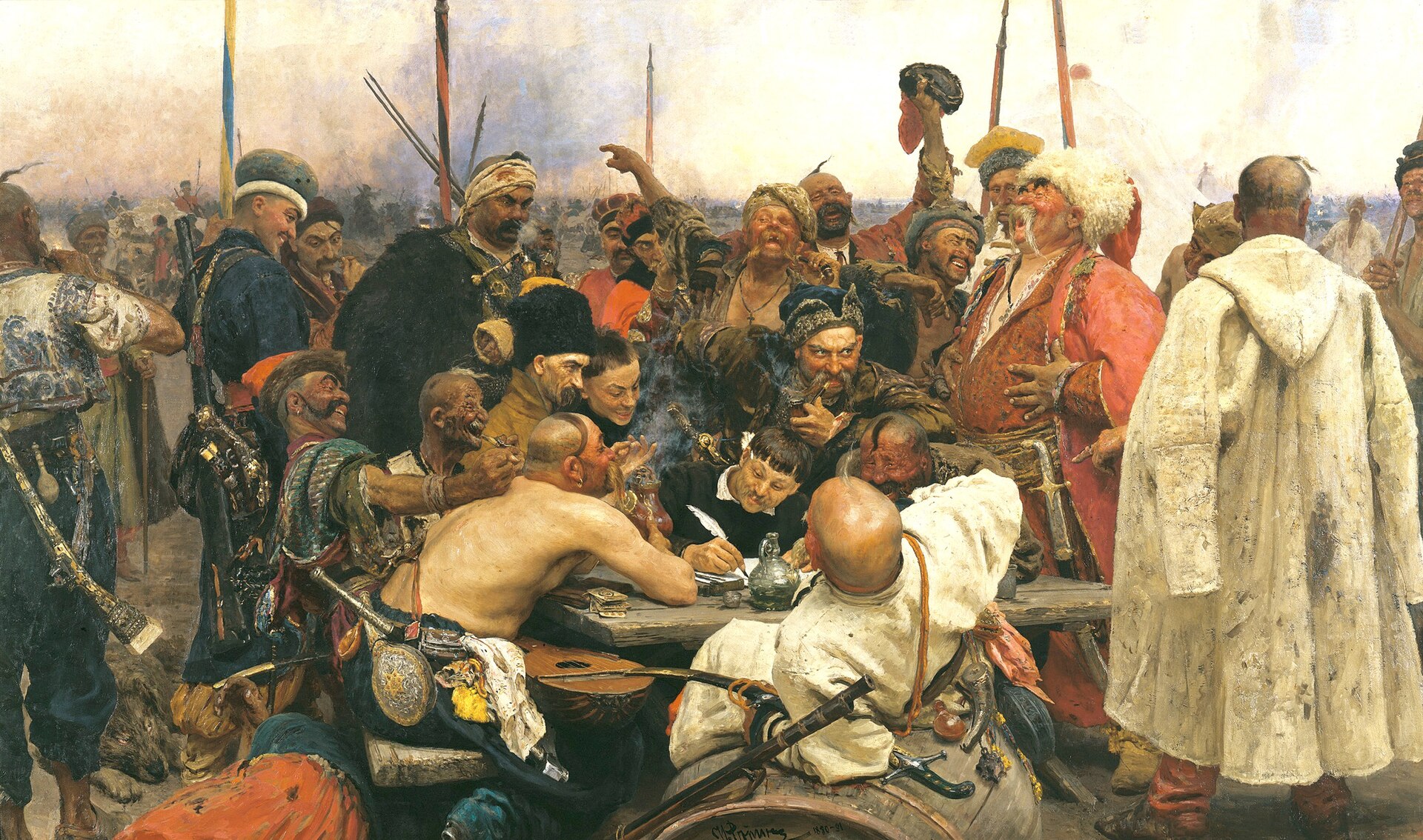
On October 14, 1880, Ilya Repin wrote to Leo Tolstoy that he would probably drop his “Reply to the Sultan” altogether. Tolstoy had just seen the charcoal-scrawled canvas in Repin’s Moscow studio and praised it.
Yet after the visit, Repin confessed, he had never felt so clearly “all their emptiness and insignificance”—meaning his own schemes. Three weeks later he told the critic Vladimir Stasov he could not tear himself away: “it’s all the fault of the Zaporozhians—what a crowd they are!!” Quotations are translated here by Hroniki.
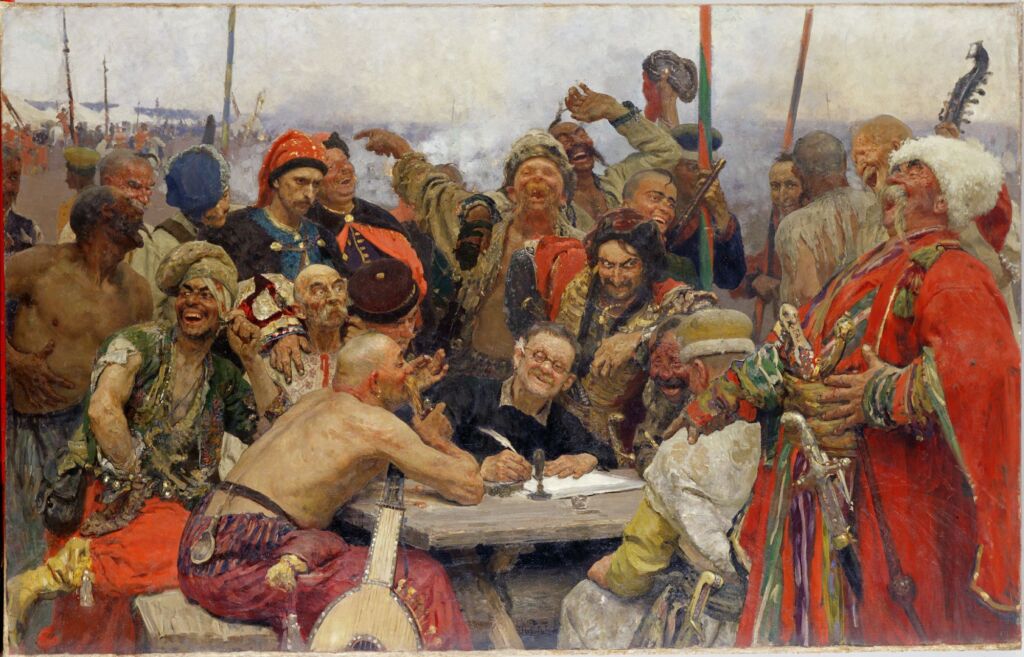
It took eleven more years. Repin’s Zaporozhian Cossacks—better known in English as Reply of the Zaporozhian Cossacks—measures 203 by 358 centimeters (80 by 141 inches). It belongs to the State Russian Museum and hangs in Room 34 of the Mikhailovsky Palace. A smaller second version is in the Kharkiv Art Museum.
The liveliest arguments concern who is sitting at the table. Many Cossacks were painted from real people: a general, a historian, a conservatory professor, a painter, a collector. Some the museum names with confidence; others have attracted legends. And the letter they are laughing over has a story of its own, nearly 170 years older than Repin himself.
A sketch at Abramtsevo
The first pencil sketch is inscribed “Abramtsevo, 26 June 1878.” The Russo-Turkish War of 1877–78 had just ended, and the tale of Cossacks answering the sultan with a letter full of abuse felt topical again. Repin, already famous for Barge Haulers on the Volga, wanted a crowd scene in which every face had its own character.
In the fall of 1880, despite the doubts he had confessed to Tolstoy, the canvas took hold of him again. He told Stasov he had spent two and a half weeks with his Cossacks without a break—”impossible to part with them, a merry people”—and explained why: “Gogol had good reason to write about them; it’s all true! A devilish people!”
In the years that followed, Repin also painted Ivan the Terrible and His Son Ivan and dozens of portraits, and traveled south for material. In 1888 he wrote from Yekaterinodar (today’s Krasnodar) about the “descendants of the Zaporozhians,” who were “very good-natured, hospitable and gentle,” and planned to go on to the Cossack village of Pashkovskaya.
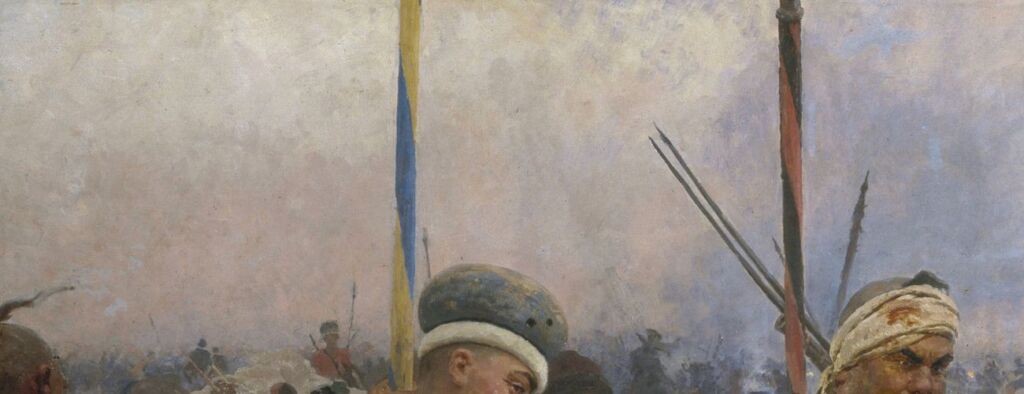
In 1889 he wrote to the novelist Nikolai Leskov that he had “an idea” in the Cossack picture, too. He was always drawn, he said, to “moments when the common life of townspeople” came to the surface—eras in which every small detail carried “an extraordinary lift of spirit, of energy.”
That was what he had to paint: not a battle, but the moment an entire army roars with laughter over a single sheet of paper. A subject without action rests on faces, so Repin hunted for them for years—among people he knew.
The scribe, the ataman and the conservatory professor
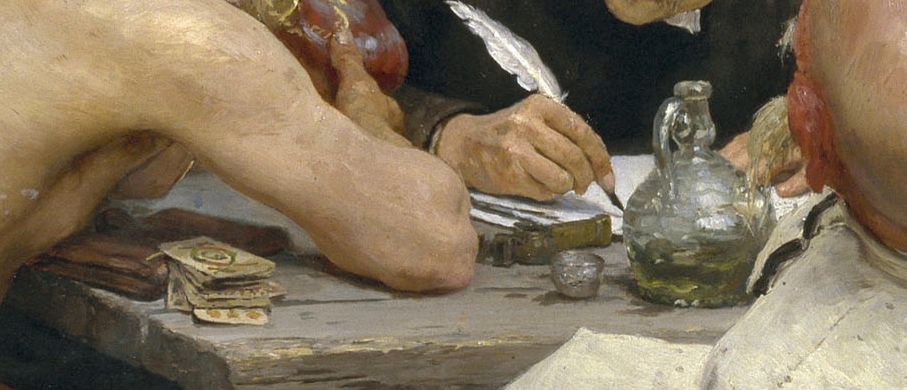
Repin’s most valuable ally was the historian Dmytro Yavornytsky, then spelled Evarnitsky. He knew more than anyone about the Zaporozhian Sich—a self-governing Cossack military community on the lower Dnieper, below its rapids, from the 16th to the late 18th century. He lent Repin books and antiques, then sat at the table himself: the Russian Museum identifies him as the scribe with the quill.
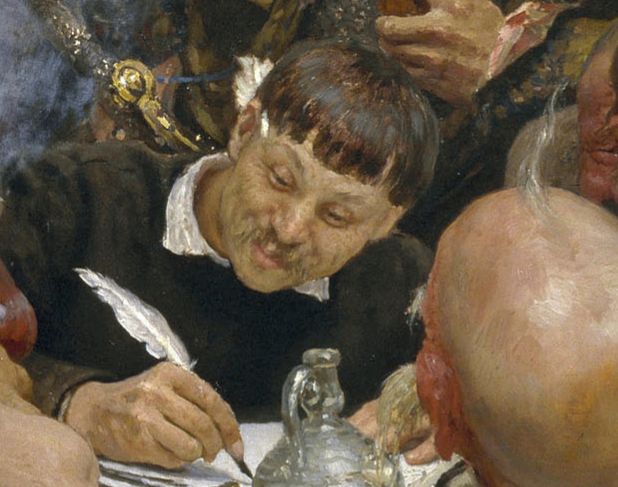
In 1894 Yavornytsky published the text of the legendary letter in a book. The man who had pieced together the Cossacks’ history now wrote down their most famous invention.
The scholar who collected the Cossacks’ history took a seat at their table as their scribe.
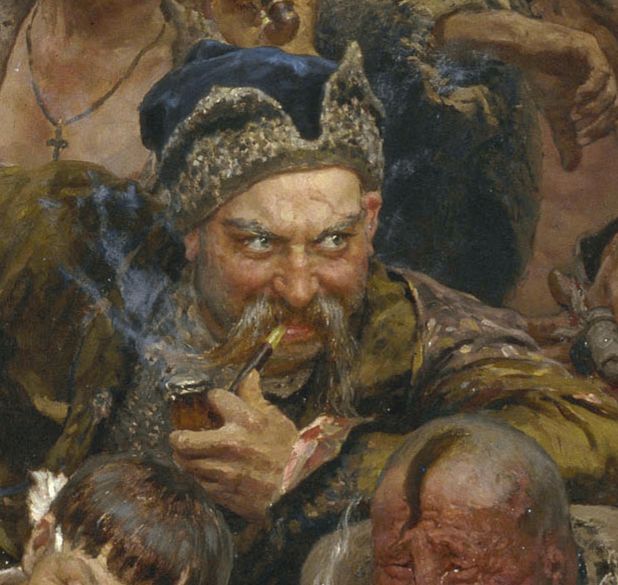
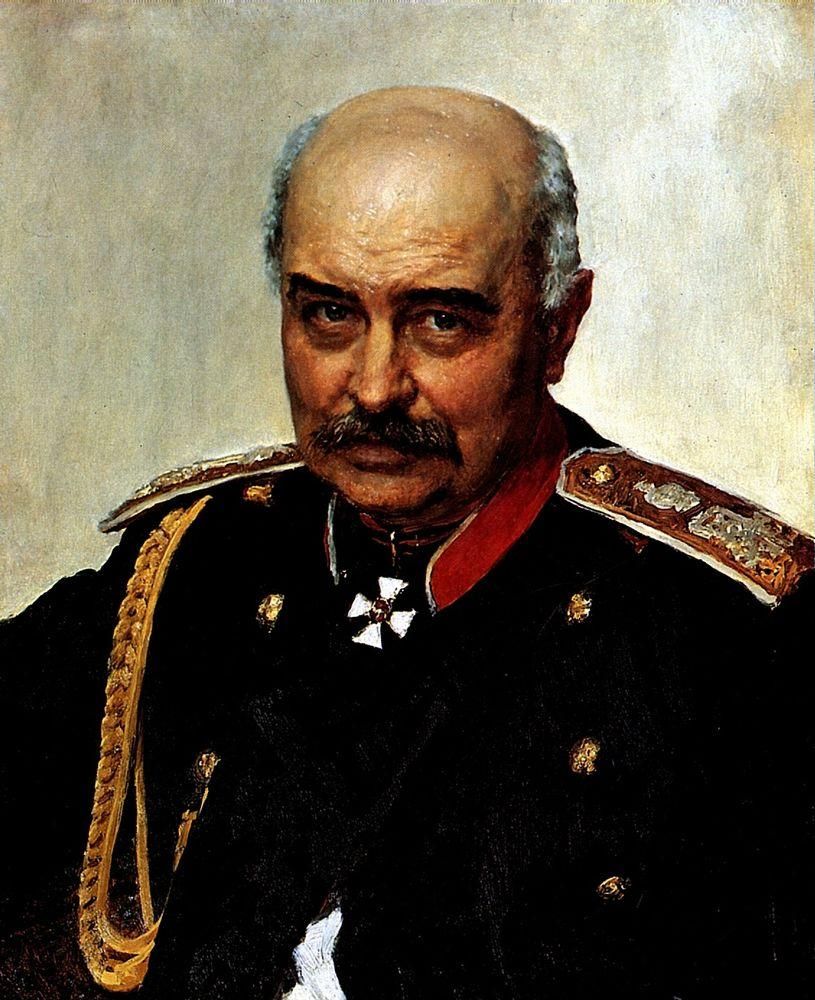
Ataman Ivan Sirko, pipe in hand, was painted from General Mikhail Dragomirov. Repin knew the family, painting both the general and his daughter Sofia. So a career officer ended up dictating insults to the sultan.
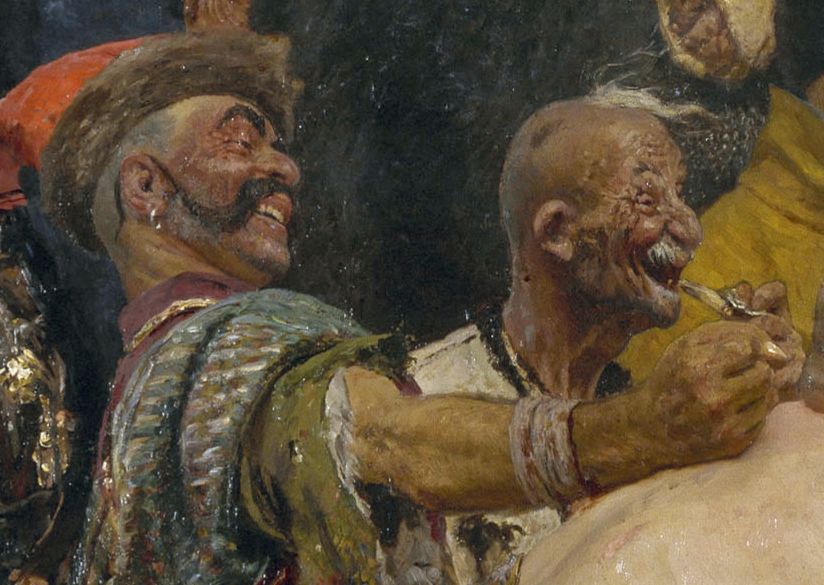
The big man in the red zhupan coat and white fur hat is Alexander Rubets, a professor at the St Petersburg Conservatory, as both Yavornytsky and the museum say. The mustachioed Cossack slapping his neighbor’s back is the painter Jan Ciągliński.
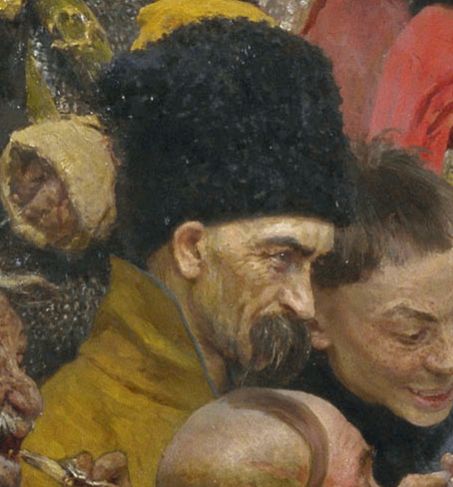
Repin named two more himself. According to the art historian Walther K. Lang, author of an essay on the painting and Gogol, in 1926 the artist could recall the models for only three figures: the scribe, the judge and the yesaul, or captain.
The judge in the tall black hat is Vasily Tarnovsky, a collector of Ukrainian antiquities. The captain is Fyodor Stravinsky, a Mariinsky Theater bass and father of the composer Igor Stravinsky.
The white hat credited to Gilyarovsky
The most stubborn legend concerns that white hat. Many articles name the laughing Cossack as Vladimir Gilyarovsky—Moscow reporter, author of Moscow and Muscovites, strongman and Russo-Turkish War volunteer. It sounds plausible: he was friends with artists and loved Cossack lore.
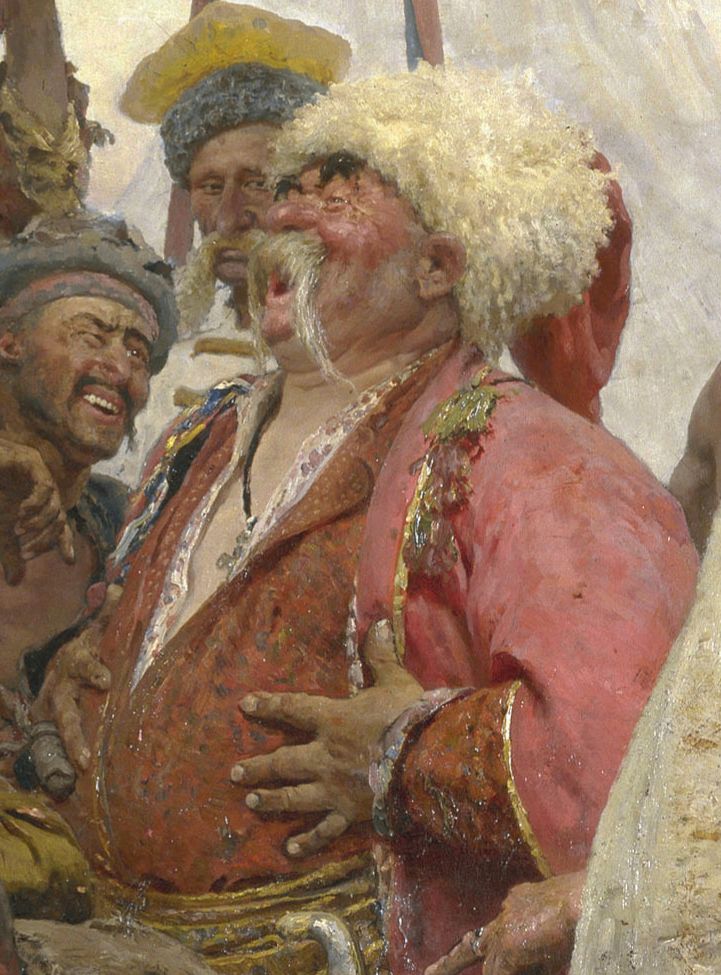
But the story has no primary source. Gilyarovsky does not appear in the lists of models left by Repin and Yavornytsky, and both Yavornytsky and the Russian Museum give the white hat to Rubets.
Still, Gilyarovsky did move in this circle. In his memoir Friends and Encounters he recalls taking Evarnitsky to Tolstoy’s Moscow house. Tolstoy rose, raised his arms and said: “Here they are, the Zaporozhians! Hello!” The legend had something to stand on: Gilyarovsky’s friend really did sit at Repin’s table.
A back, an old man and a horse’s head
By 1891 Repin’s studio had become a place of pilgrimage. After the newspaper Novosti ran “In Repin’s Studio,” an irritated Repin asked Georgy Alekseyev, a collector of Cossack antiquities, to turn down further requests to visit.
The painting changed most in its final year, as Repin repainted its edges again and again. In December 1891 he admitted to the publisher Alexei Suvorin that both corners had held “a horse’s head; and a back in a shirt; and a laughing man—a magnificent figure.” Nothing satisfied him until he settled on “a burly, simple back.”
On the right, he wrote, hangs “not a dressing gown but a kobenyak with a hood”—a heavy woolen cloak, as in a sketch of a Cossack council by the 18th-century historian Alexander Rigelman. Repin treasured “this characteristic back and sunburned, sturdy nape” of the cloak’s owner.
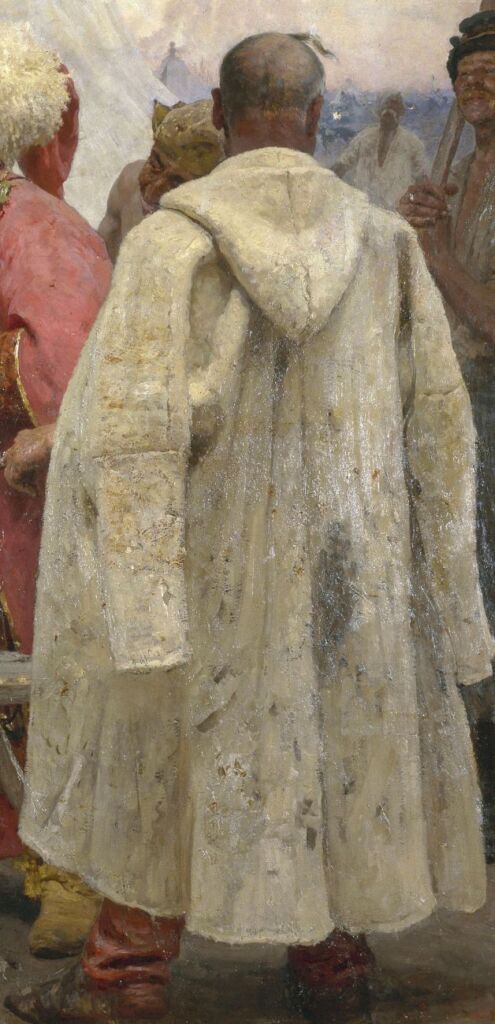
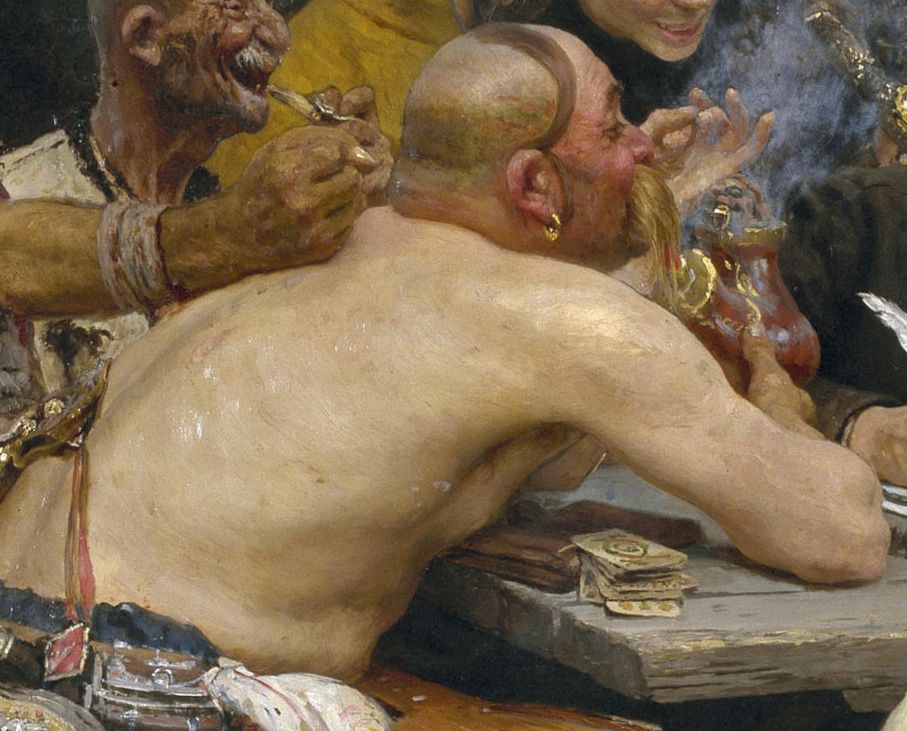
Suvorin thought the Cossack’s bare back was also a late addition. Repin replied: “The bare back was in the picture from the very beginning. You’ve forgotten.” Amid endless revisions, this figure stayed put.
An exhibition surveying twenty years of Repin’s work opened at the Imperial Academy of Arts on November 26, 1891, and ran until January 10, 1892. Suvorin decided that at the last minute Repin had “completely spoiled” the picture “by adding an old man at the table,” and he mistook the cloak on the right for a dressing gown.
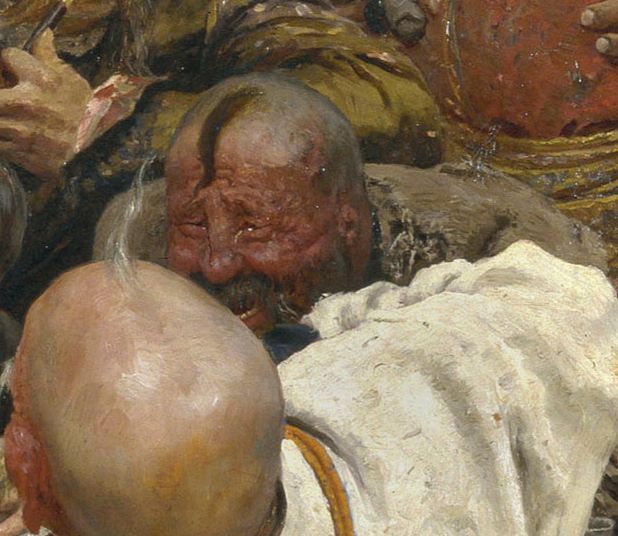
The writer Dmitry Grigorovich, according to Repin, spent a whole evening at the exhibition explaining that the painting was “now worthless, that it has been ruined.” Repin held his ground. “An old man among the Cossacks is a very typical feature,” he wrote to the collector Pavel Tretyakov, recalling the bards and storytellers who lived past a hundred.
The same letter contains a confession: “For two years I regretted one figure and was happy when I finally destroyed it.”
“The emperor is buying my picture”
The exhibition’s success, Repin told Suvorin in December, was “very mediocre”: “Few people come.” He reported the outcome on January 16, 1892, in a letter to Alexander Zhirkevich (in Russian).
Emperor Alexander III had visited the exhibition, examined the works “very attentively and with great interest,” and particularly admired the Cossacks and the portrait of the composer César Cui. Then Grand Duke Vladimir Alexandrovich told Repin the emperor was buying the Cossacks.
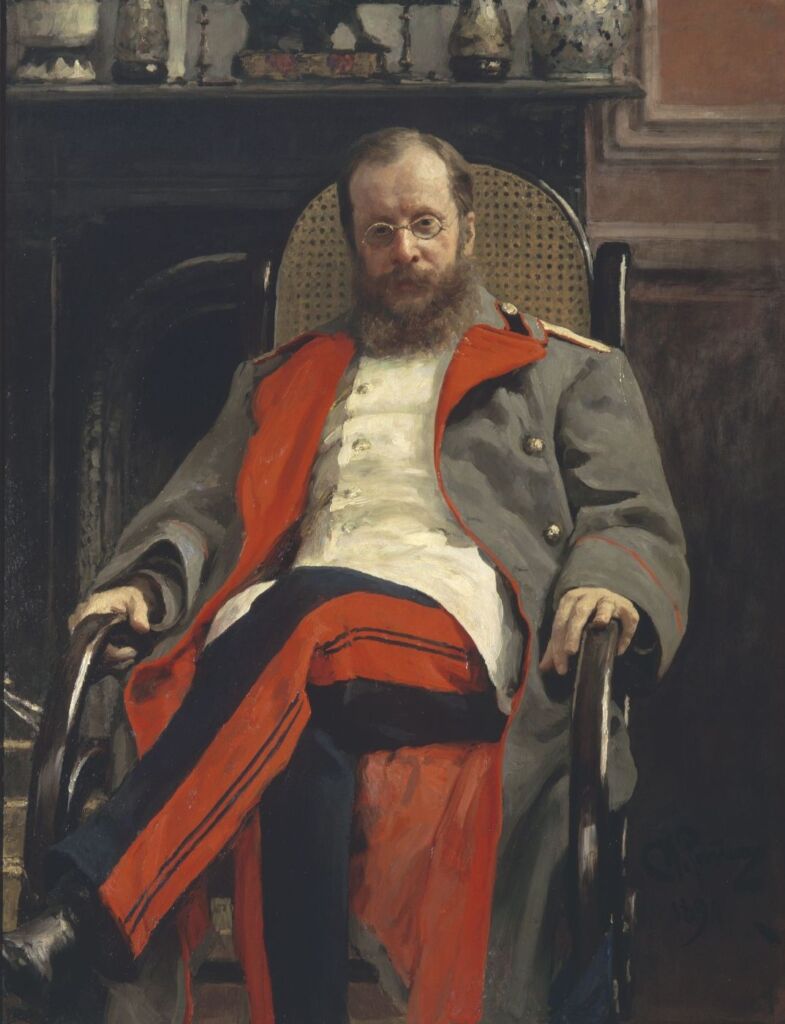
Not everyone was won over. The painter Nikolai Ge, Repin told Stasov in March 1892, “does not understand and does not believe in the Zaporozhians.” Repin answered that before the Sich, captives from these lands had been sold by the tens of thousands in slave markets; he saw the Cossack brotherhood as a defense. Vasily Surikov, by contrast, was “very pleased,” Repin reported.
The price was 35,000 rubles, according to the editors of Repin’s letters in the journal Tretyakov Gallery. Part of it paid for Zdravnevo, an estate in Vitebsk province bought that year for 12,000. The painting hung in the Winter Palace, and in 1897 passed from the Hermitage to the new Russian Museum.
A second canvas goes to Kharkiv
Before he had even finished the first painting, Repin began a second. According to the Kharkiv Art Museum (in Russian), this canvas is smaller than the St Petersburg one: 170 by 267 centimeters. Pavel Tretyakov bought it in 1896, and in 1932 it was transferred to Kharkiv.
The museum calls this version more genre-like and emotional than the St Petersburg canvas, and more freely painted, closer to plein-air work. It adds a caveat: viewers persist in calling one of the Cossacks Taras Bulba, Gogol’s hero, but Repin himself said he never painted Bulba into the picture.
There was also a small oil sketch. In 1892 Repin pointedly reminded Tretyakov that he had once urged him to buy it from an owner in need. Tretyakov declined—then a year later, when it was worth three times as much, bought it at the old price.
The letter nobody has seen
That leaves the letter itself: did the Cossacks ever write it? The Russian Museum’s catalog gives the legend this way: in 1675 the sultan demanded submission, and the Cossacks answered with mockery. Other retellings say 1676, Sultan Mehmed IV and the Cossack leader Ivan Sirko. No original survives—only copies, and they disagree on the year.
The American historian Daniel C. Waugh, who has studied these texts since the early 1970s, traced their ancestry. Boastful “letters of the sultan” addressed to Christian rulers, complete with a long string of titles, were among the most popular genres of anti-Turkish propaganda in Europe from the late 15th century on.
The earliest known version of such a letter, he now concludes, is a German broadsheet printed in 1621 in Olomouc, Moravia. Most of the Russian copies, Waugh argues, are translations of Western broadsheets and newspapers.
The Cossack reply grew out of this stream as a satirical retort. In early copies it comes from the Cossacks of Chyhyryn. In the 18th century, Waugh concluded in a 1978 book, restrained satire was reworked into coarse abuse—the form that spread in the 19th century. Gogol mentions the episode in passing in Taras Bulba.
After Repin, the legend traveled. Guillaume Apollinaire turned the Cossacks’ reply into French verse in his 1913 collection Alcools. In 1969 Dmitri Shostakovich set those verses, in a Russian translation, as “The Zaporozhian Cossacks’ Reply to the Sultan of Constantinople,” the eighth movement of his Fourteenth Symphony. Neither the poet nor the composer ever saw an original.
Authenticity did not interest Repin: he needed a reason to gather men around one table and set them laughing at the sultan. The laughter came out real, even if the paper was an invention.
Comments
For Hroniki readers
Comments are open to readers with an account. Signing up is free and takes a few seconds.
No comments yet. Start the conversation.