School of painting
Venetian school
Late 15th to 18th century · Venice
About the movement
In 1475 the Sicilian Antonello da Messina arrived in Venice, already a master of the oil technique that Italians associated with the Netherlandish painters. Giovanni Bellini was quick to grasp what oil could do: slow-drying paint allowed transparent layers to be laid one over another, producing light that seemed to come from within. His altarpieces marked the beginning of a school that for three centuries made Venice one of the two capitals of European painting.
Florence built a picture with drawing, Venice with color. The Venetians switched early from panel to canvas: it was easier to make in the size required, to roll up and transport, and it stood up to the damp air of the lagoon better than wood. The composition took shape directly in paint, without a detailed cartoon, and corrections were made as the work went on. The method came to be called colorito, and it sparked a debate that lasted for centuries. In his Lives (1568) Giorgio Vasari reported Michelangelo's verdict: Titian was a fine colorist, but it was a pity that Venetians were not taught to draw well. The Venetian Lodovico Dolce had already answered in 1557 with a treatise that ranked Titian above everyone.
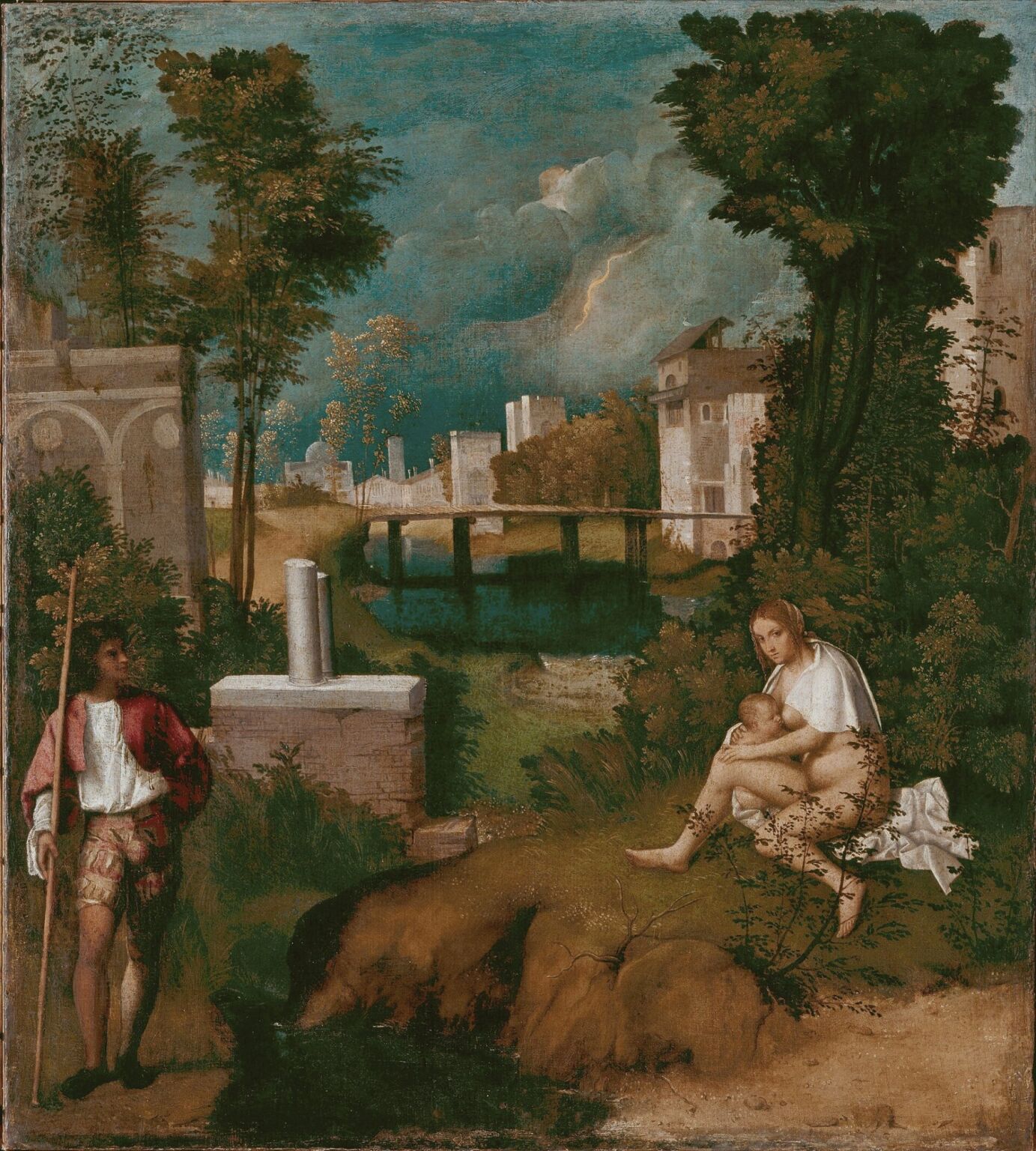
Giorgione was the first to leave a riddle. The Tempest (first decade of the 16th century, Gallerie dell'Accademia, Venice) still has no generally accepted reading of its subject, and the mood seems to matter more to the painter than the story. His Judith (around 1504) came to the Hermitage with the Crozat collection, bought by Catherine II in 1772. Titian, who worked for almost seventy years, became Europe's first star artist: Emperor Charles V knighted him, and the Duke of Urbino received the Venus of Urbino (1538, Uffizi). According to his pupil Palma Giovane, as recorded by Marco Boschini in 1674, the old master finished his late canvases with his fingers more than with the brush. One of his late versions of the Penitent Magdalene (1560s) is in the Hermitage.
The next generation divided the inheritance. Tintoretto made his name with the Miracle of the Slave (1548, Gallerie dell'Accademia), in which Saint Mark plunges headfirst from the sky to free a slave; Venice had never seen such speed. Paolo Veronese painted feasts with dozens of figures. The Wedding at Cana (1562–1563), made for the Benedictine refectory on the island of San Giorgio Maggiore, now hangs in the Louvre opposite the Mona Lisa. In 1573 the Inquisition summoned Veronese over a Last Supper in which jesters, German soldiers and a dog appeared among the apostles. The painter defended the artist's right to take liberties, then simply renamed the canvas Feast in the House of Levi and added an inscription citing the Gospel of Luke. The painting is in the Gallerie dell'Accademia.
In the 17th century Venice hosted more artists from elsewhere than it produced geniuses of its own, but in the 18th it enjoyed a second flowering. Giovanni Battista Tiepolo painted ceilings from Würzburg to Madrid. His Banquet of Cleopatra (1743–1744) was bought for Augustus III, Elector of Saxony, later entered the Russian imperial collection and the Hermitage, and in 1932 was sold by the Soviet government. Since 1933 it has belonged to the National Gallery of Victoria in Melbourne. Canaletto turned the city view into a genre of its own: The Stonemason's Yard (around 1725, National Gallery, London) shows the everyday underside of ceremonial Venice. English travelers on the Grand Tour took his views home with them.
The fall of the Venetian Republic in 1797 drew a line under the school, but not under its method. Rubens and Velázquez learned from Titian's canvases, Eugène Delacroix set Venetian color against academic line, and the Impressionists inherited the very idea that a painting is built with the brushstroke. The quarrel between drawing and color that began between Florence and Venice became one of the threads running through the whole history of European painting.