Degas’s L’Absinthe: the actress and engraver London mistook for drunks
Degas posed two friends in his studio, the actress Ellen Andrée and the engraver Marcellin Desboutin. Seventeen years later, London critics saw two drinkers gone to seed and read the picture as a temperance lesson.
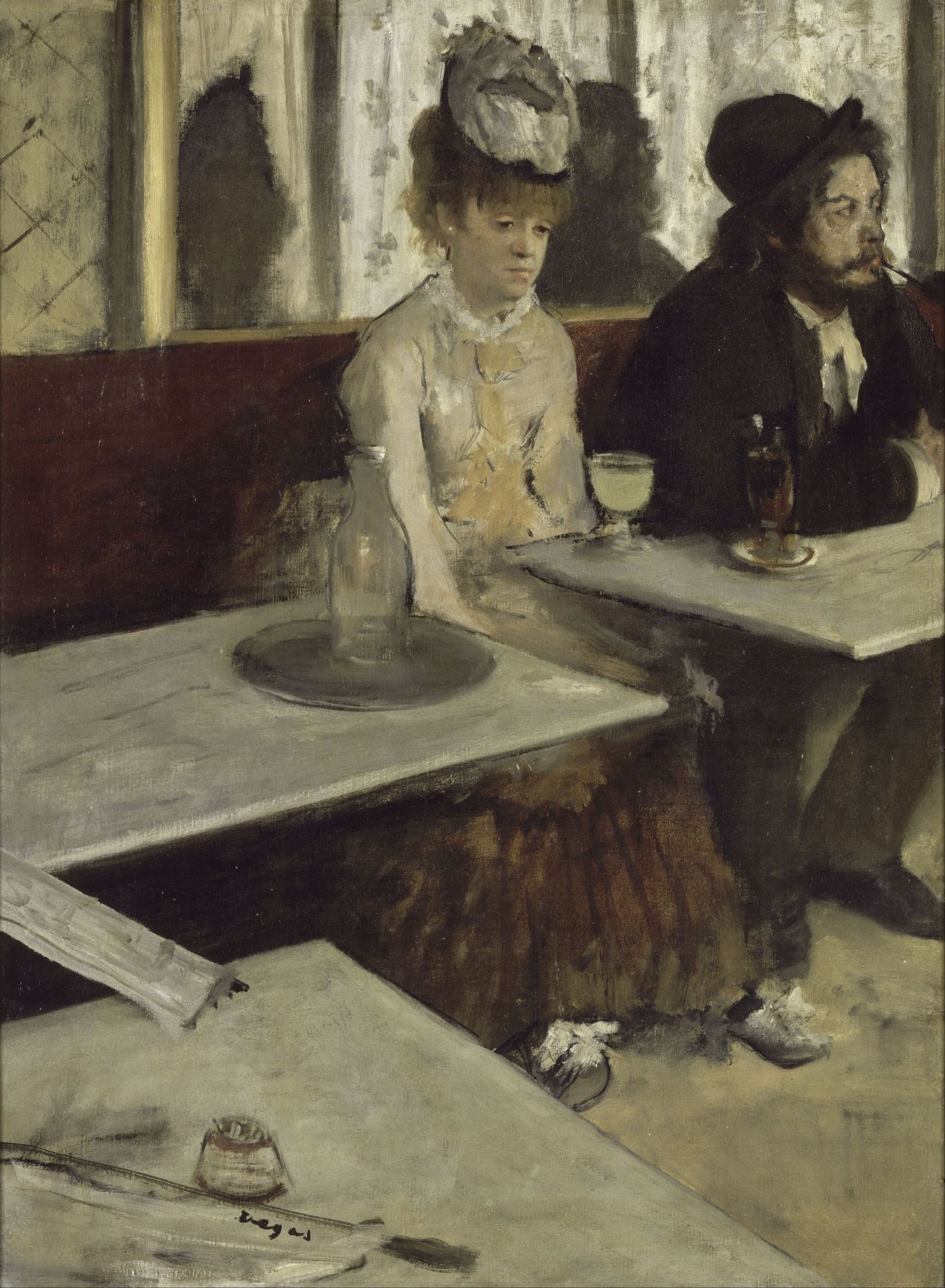
From February 1893, London’s newspapers argued for weeks over a painting of two people in a Paris café who do not look at each other. Some critics saw a temperance lesson; others, “the inexhaustible picture.” Reviewers took the pair for drinkers gone to seed, though Degas had simply posed two acquaintances, an actress and an engraver.
Edgar Degas’s In a Café is better known as L’Absinthe, or The Absinthe Drinker. The oil on canvas is dated 1875–1876 and belongs to the Musée d’Orsay in Paris. The story viewers found in it is not one Degas painted.
An actress and an engraver pose in the studio
The setting is the Nouvelle Athènes on Place Pigalle, where artists and writers gathered. Yet it was painted in the studio, not the café. Degas posed two friends and built a scene that only looks caught by chance.
The woman is Ellen Andrée, a young model who also sat for Manet and Renoir. In the early 1880s she gave up modeling for the stage, and from 1887 she acted with the naturalist Théâtre-Libre in Paris. She belonged to the Nouvelle Athènes circle herself.
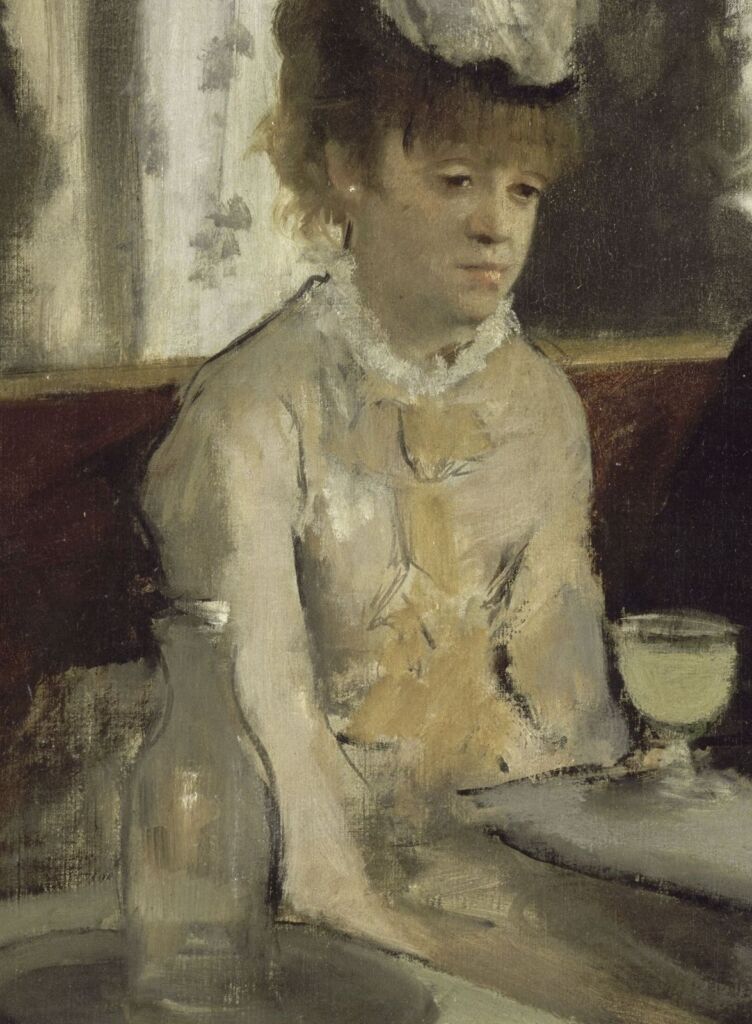
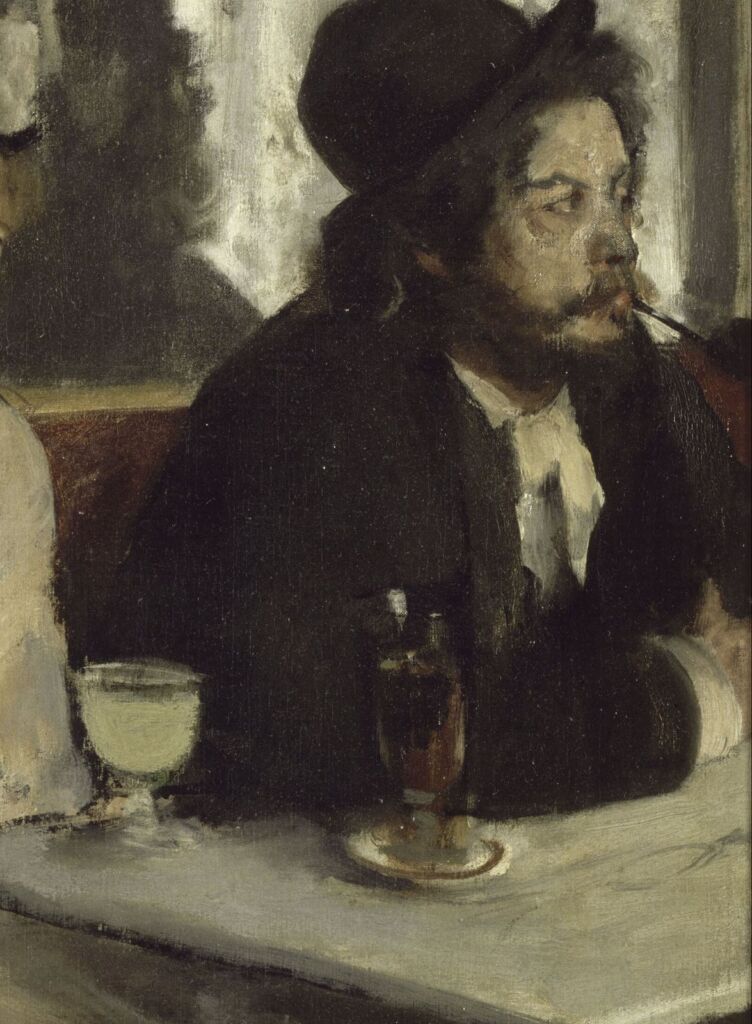
The absinthe that gave the painting its second title stands before her. Her neighbor’s glass is harder to read: the National Gallery of Victoria in Melbourne suggests a mazagran, a cold coffee drink. There is only one absinthe on this table, and it is hers. Seventeen years later, she would take most of the blame.
The man with the pipe is Marcellin Desboutin, a painter and engraver past fifty who had spent long years in Florence. Paris knew him for drypoint portraits, scratched straight into a copper plate.
London reads a sermon into the canvas
Henry Hill, a collector from Brighton, bought the canvas through the London dealer Charles Deschamps as early as 1876. Paris saw it in 1877 at the third Impressionist exhibition, where it hung without being listed in the catalog.
Hill kept it until 1892. At his Christie’s sale, so the story goes, the audience hissed it.
In 1893 it went on show at London’s Grafton Galleries as L’Absinthe. The word handed viewers a ready-made plot: two people ruined by drink.
Fiction had already supplied the plot. The painting is often compared with Émile Zola’s L’Assommoir, a novel about a Paris laundress destroyed by drink. It came out as a book in 1877, the year Paris first saw the café scene.
John Alfred Spender of the Westminster Gazette, the debate’s self-styled “Philistine,” found the scene “one which most of us will be anxious to banish from our minds.” The painter William Blake Richmond declared that “it is not painting at all.” Walter Crane saw “a study of human degradation, male and female.” The people, not the painting, were now on trial.
Degas’s defender was Dugald Sutherland MacColl of The Spectator. “The inexhaustible picture, the one that draws you back, and back again,” he wrote on February 25. He did not deny that it showed “two rather sodden people drinking in a café.” What held him was the painting of the “café table-tops and the mirror and the water-bottle.”
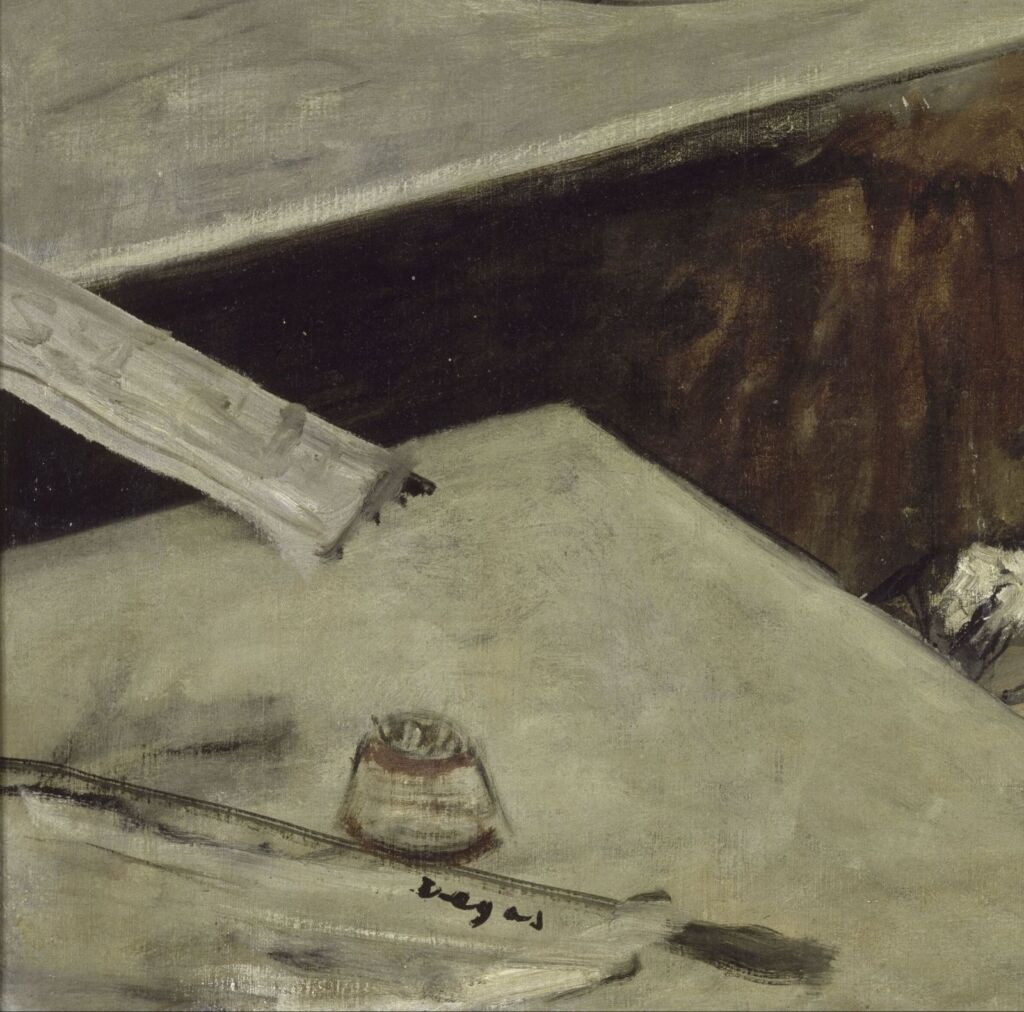
Degas pushed the empty tables toward the viewer and set the figures back. The Musée d’Orsay links this cropping to Japanese prints. As the weeks went on, the quarrel became less about Degas than about what matters more in a picture, its subject or its execution.
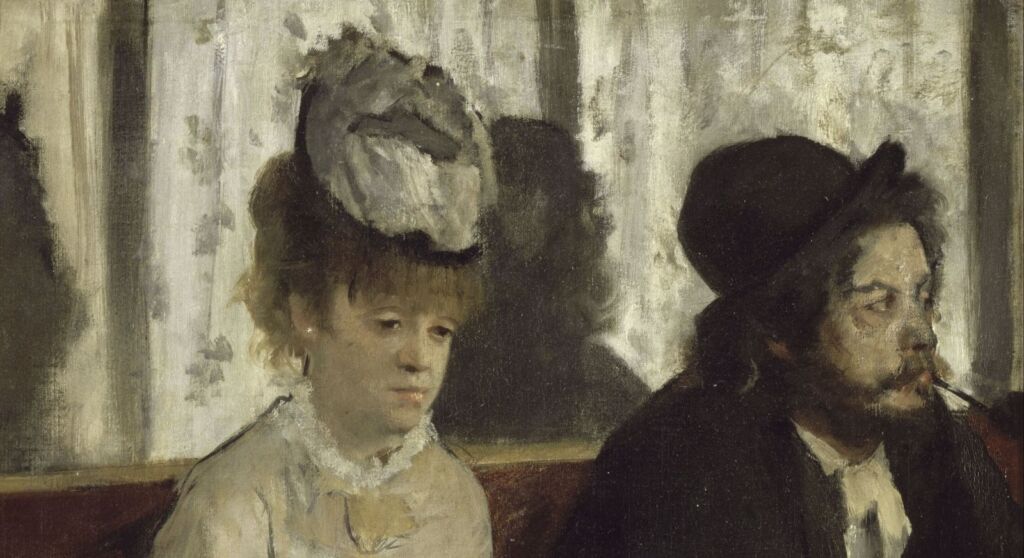
Behind the pair runs a long mirror holding their dark silhouettes. Spender saw only “a glass screen.” MacColl counted it among the picture’s rewards. The two critics read the same detail in opposite ways.
Moore vouches for Desboutin but not for Andrée
The loudest voice belonged to the Irish writer George Moore. He named the engraver and vouched for him: “I have known M. Deboutin [sic] a great number of years, and a more sober man does not exist.”
Moore treated the woman differently. He invented a life for her: the Élysée-Montmartre dance hall until two in the morning, absinthe before breakfast. His verdict: “Heavens! what a slut!” His moral: “The tale is not a pleasant one, but it is a lesson.”
Yet Moore insisted the title was not L’Absinthe but simply Au Café. He rejected the London title, then read the figures through it.
Reprinting the piece later in Modern Painting, Moore called the line about a lesson “the first hypocritical phrase I ever wrote.” The picture, he now said, “has nothing to do with drink or sociology.” The Musée d’Orsay says the painting’s reputation forced Degas to state publicly that his models were not alcoholics. The museum does not say when.
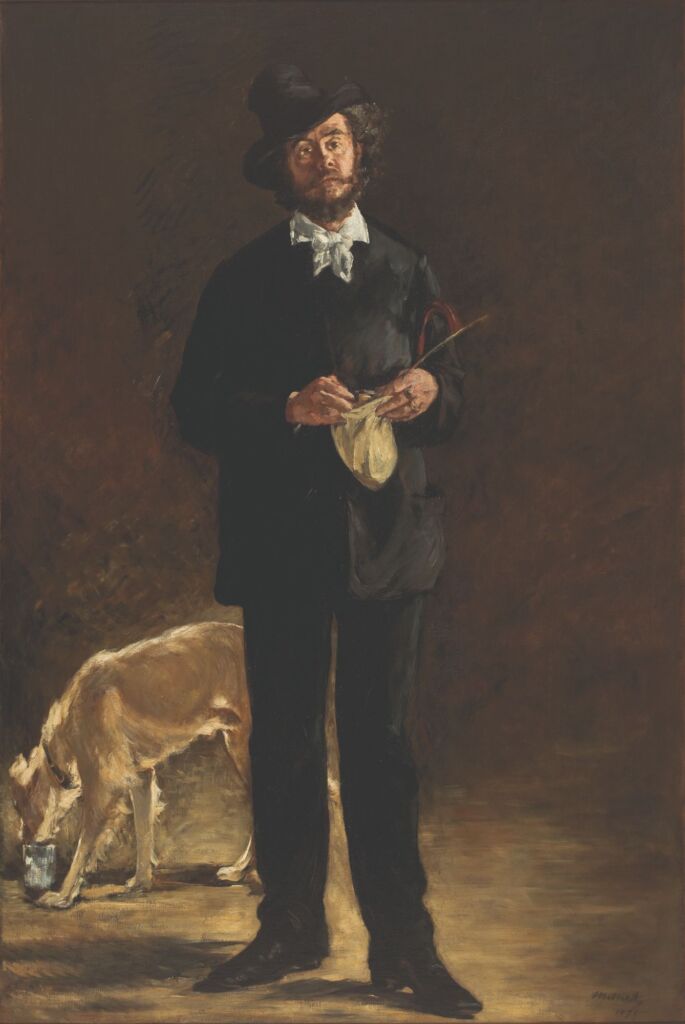
Édouard Manet painted Desboutin in the same years, full length beside a drinking dog, and called the portrait The Artist. It is more than twice as tall as In a Café, which measures 92 by 68 cm (36 by 27 in). No newspaper hunted for a moral there: Desboutin is simply an artist.
That same year, 1893, Count Isaac de Camondo bought In a Café, and in 1911 he bequeathed it to the Louvre. The London title outlived the newspaper war and Moore’s change of heart: it is still the name people search for.
Comments
For Hroniki readers
Comments are open to readers with an account. Signing up is free and takes a few seconds.
No comments yet. Start the conversation.