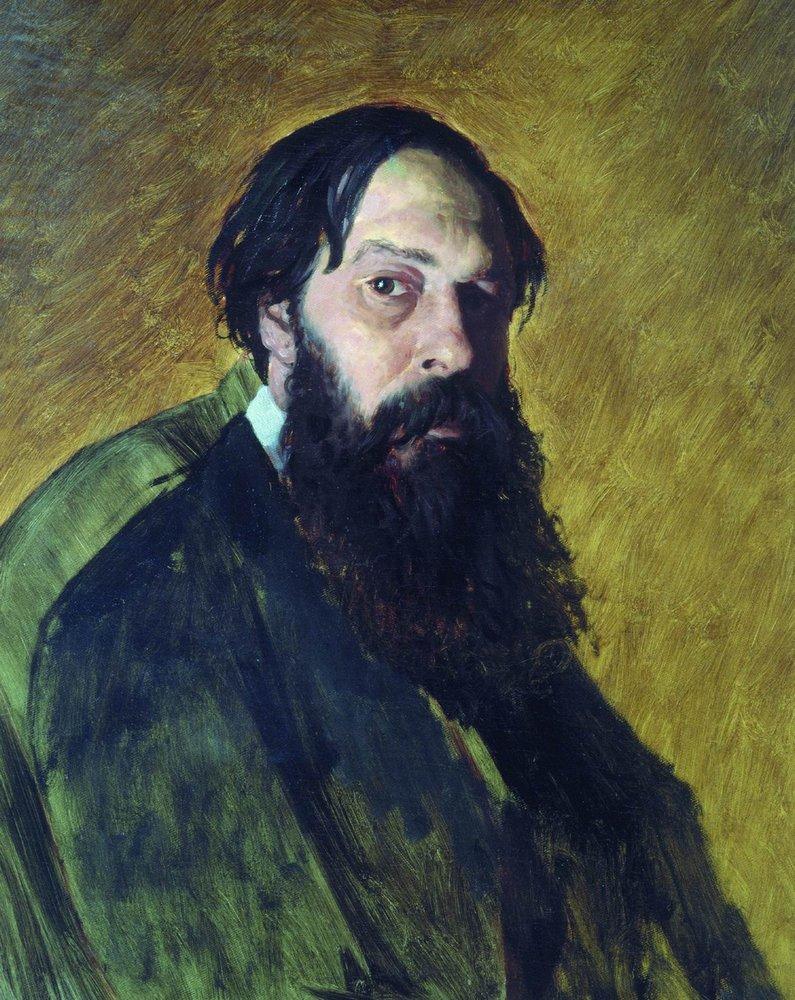
Alexei Savrasov
Alexei Kondratyevich Savrasov · 1830, Moscow — 1897, Moscow
Biography
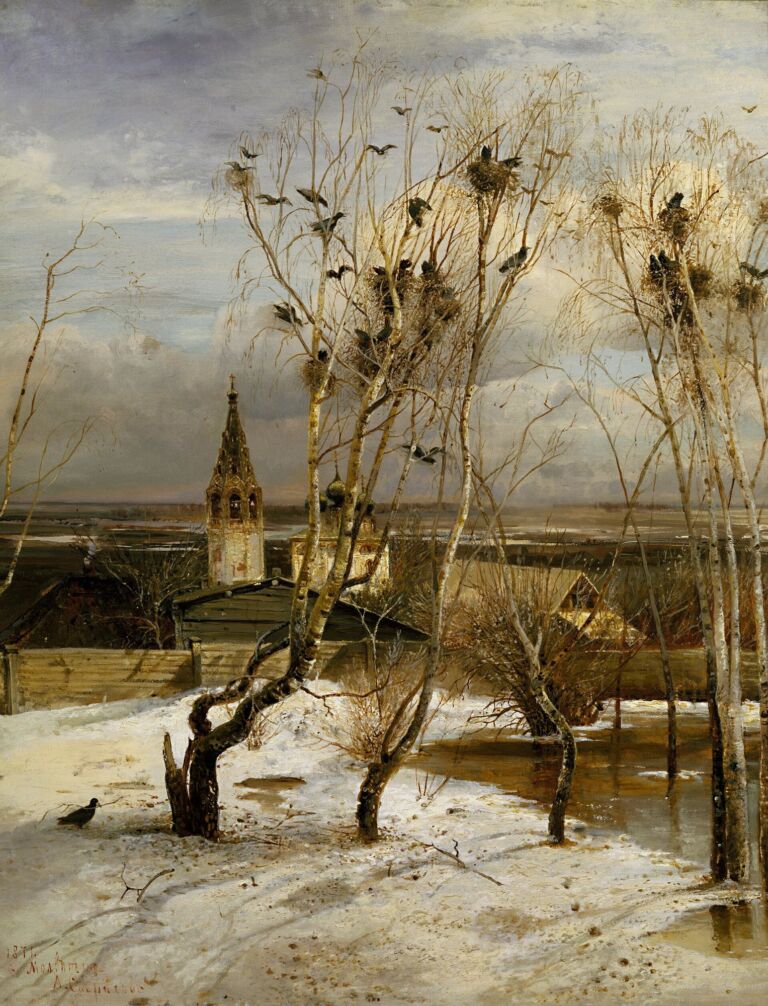
“There is soul only in The Rooks,” Ivan Kramskoy wrote to Fyodor Vasiliev after walking around the first exhibition of the Peredvizhniki, the Association of Traveling Art Exhibitions, in 1871. Alexei Savrasov's small canvas, hung among history paintings and portraits, turned out to be the event of the show and became the starting point of Russian lyrical landscape painting.
Savrasov was born in Moscow on May 24, 1830 (May 12, Old Style), the son of Kondraty Savrasov, a merchant of the third guild. His father expected him to go into the business, but in 1844 the boy entered the Moscow School of Painting and Sculpture, joining Karl Rabus's landscape class. Success came quickly: in 1850 he received the title of non-ranking artist for View of the Moscow Kremlin by Moonlight, and in 1854, at twenty-four, he was made an academician for his views of the countryside around Oranienbaum.
From the late 1850s Savrasov himself ran the school's landscape class. In 1857 he married Sofia Hertz, sister of the archaeologist Karl Hertz. In 1862 he went abroad, visited the International Exhibition in London and saw France, Switzerland and Germany. What he saw in Europe did not make him an imitator: his main subject remained the countryside of central Russia.
His first mature work is considered to be Elk Island in Sokolniki (1869, State Tretyakov Gallery). The Rooks Have Arrived (1871) came out of a trip to Kostroma Governorate: he painted the studies in the village of Molvitino, now Susanino, and finished the picture in his Moscow studio. The collector Pavel Tretyakov bought it, and it has been in his collection ever since. From 1872 orders for replicas poured in, and Savrasov painted several versions himself. Then came Pechersky Monastery near Nizhny Novgorod (1871, Nizhny Novgorod Art Museum), Country Road (1873) and Rainbow (1875, State Russian Museum).
In landscape Savrasov looked for mood rather than grandeur. He was drawn to the in-between moments of the year (the thaw, the spring mud, the first green, a wet road after rain) and to unremarkable motifs that no one before him had thought worthy of a painting. Hence the sense of intimacy: the viewer seems to be standing at the edge of an ordinary village rather than in front of a “view.”
He was one of the founders of the Association of Traveling Art Exhibitions and showed there regularly from 1871 to 1875. But from the mid-1870s his life began to fall apart: the deaths of his children, the breakup of his marriage at the end of 1876, heavy drinking. In 1882 the school dismissed him. By then he had trained pupils of note: Isaac Levitan, whom he considered his favorite, Konstantin Korovin, Mikhail Nesterov. The works of his last years, such as Landscape. Volynskoe Village (1887) and Spring. Vegetable Gardens (1893), were painted in poverty, often hastily and for quick sale.
Savrasov died in Moscow on October 8, 1897 (September 26, Old Style), in a hospital for the poor in the Khitrovka slum, and was buried in the Vagankovo Cemetery. That same year Levitan wrote that “lyricism in landscape painting began with Savrasov.”
Savrasov's major paintings are in the State Tretyakov Gallery and the State Russian Museum, and also in regional collections, among them the Nizhny Novgorod Art Museum. The Rooks Have Arrived, meanwhile, has long been part of the Russian school canon, a rare fate for a landscape.
Major works
Click a painting to see the details.
-
 01
The Rooks Have Arrived
1871 · State Tretyakov Gallery, Moscow
Related artists
 Isaac Levitan
1870s · pupil
 Konstantin Korovin
1870s · pupil