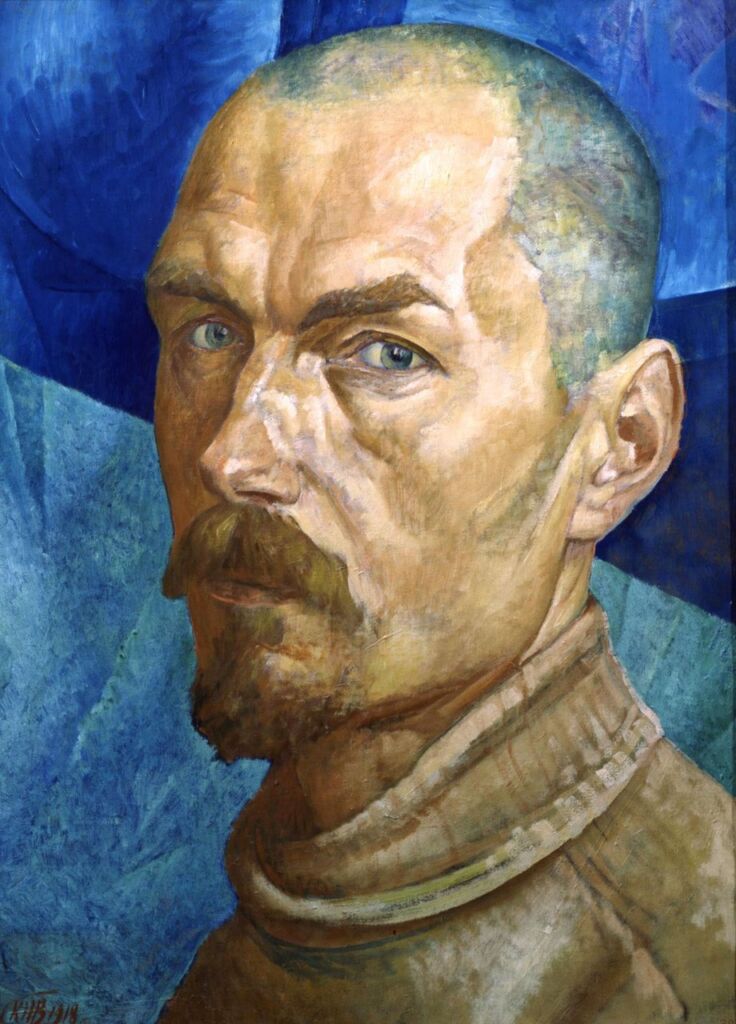
Kuzma Petrov-Vodkin
Kuzma Sergeyevich Petrov-Vodkin · 1878, Khvalynsk — 1939, Leningrad
Biography
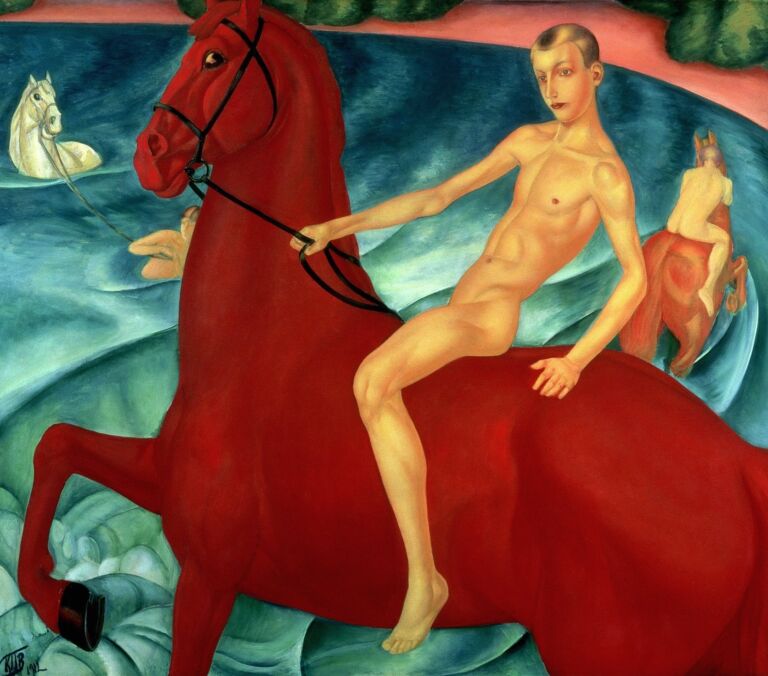
“Horses like that don't exist”: the reproach dogged Bathing of a Red Horse from its first showing. Petrov-Vodkin replied that he had taken the color from the old Russian icon painters. He had known icons since childhood. The son of a shoemaker, born on November 5, 1878 (October 24, Old Style), in Khvalynsk on the Volga, he spent hours as a boy watching two local icon painters at work. His mother was a housemaid in the home of the sister of the landowner Yulia Kazarina, and it was Kazarina who, together with Khvalynsk merchants, later sent him twenty-five rubles a month.
In 1893 he finished the town school and went to Samara to study in Fyodor Burov's painting classes; the teacher's death in 1895 cut his studies short. The architect Robert Meltzer took the young man to St Petersburg, to the Stieglitz School, and in 1897 Petrov-Vodkin entered the Moscow School of Painting, Sculpture and Architecture, where he studied under Valentin Serov until 1905 (Britannica gives 1904). He also attended Anton Ažbe's private school in Munich (1901) and Paris academies in 1905–1908. He traveled a great deal: to Italy in 1905 and North Africa in 1907.
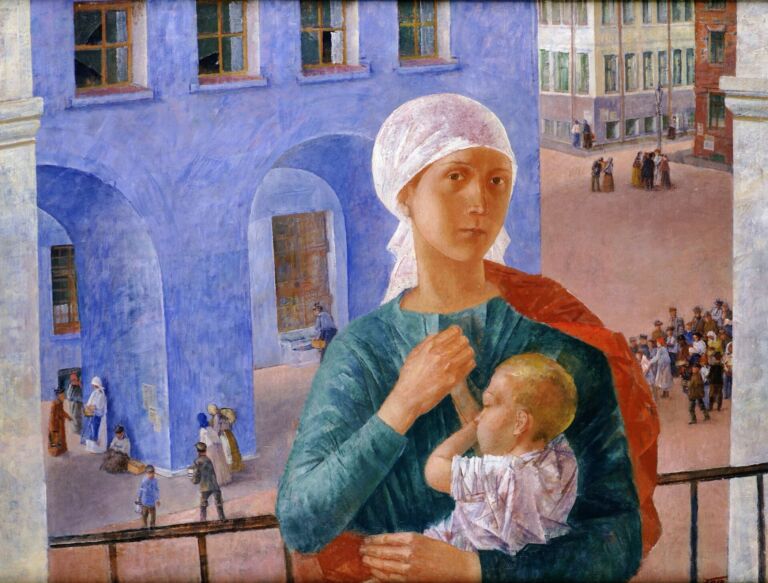
His first painting to cause a stir was The Dream (1910), but real fame came in 1912 with Bathing of a Red Horse at the exhibition of the World of Art, which he had joined a year earlier. The success was overwhelming; contemporaries called the painting a hymn to Apollo. The horse was painted from a farm stallion named Malchik (“Boy”). In 1914 the canvas went to the Baltic Exhibition in Malmö, where the king of Sweden awarded the artist a medal, and then it was stranded in Sweden for decades. It was returned to his family only in 1950; later the collector Kazimira Basevich bought it, and in 1961 she gave it to the Tretyakov Gallery. 1918 in Petrograd (1920), also known as the Petrograd Madonna, shows the revolution without bloodshed or pathos. Two years later came his portrait of Anna Akhmatova (1922).
Petrov-Vodkin's main invention was spherical perspective. His horizon curves and the ground tilts slightly, as if the world were seen from a planetary height; in Bathing of a Red Horse the roundness of the lake is stressed by a cut-off stretch of shore in the corner. Britannica calls him an outstanding master of this device, which resembles a view through a fisheye lens. His color, as he himself admitted, came from icons rather than from nature.
After the Revolution Petrov-Vodkin became one of the leading art teachers in Petrograd. From 1918 to 1933 he taught at the former Academy of Arts in its successive incarnations, from the Free Studios to the Institute of Painting, Sculpture and Architecture. He was one of the founders of the Free Philosophical Association, joined the Four Arts society in 1924 and worked in the theater. In 1930 he was named Honored Art Worker of the RSFSR, and in August 1932 he was elected the first chairman of the Leningrad branch of the Union of Soviet Artists.
He died in Leningrad on February 15, 1939, and was buried in the Literatorskie Mostki, the writers' section of the Volkovo Cemetery. One of his last notable works was a portrait of Lenin (1934). He was sixty.
Today the largest collection of Petrov-Vodkin's work is in the State Russian Museum, while Bathing of a Red Horse hangs in the State Tretyakov Gallery. He began under the influence of Symbolism and Art Nouveau and arrived at a system of his own that cannot be mistaken for anyone else's. The red horse has long been one of the most recognizable images in twentieth-century Russian art.
Major works
Click a painting to see the details.
-
 01
Bathing of a Red Horse
1912 · State Tretyakov Gallery, Moscow -
 02
1918 in Petrograd
1920 · State Tretyakov Gallery, Moscow
Related artists
 Valentin Serov
1897–1905 · teacher