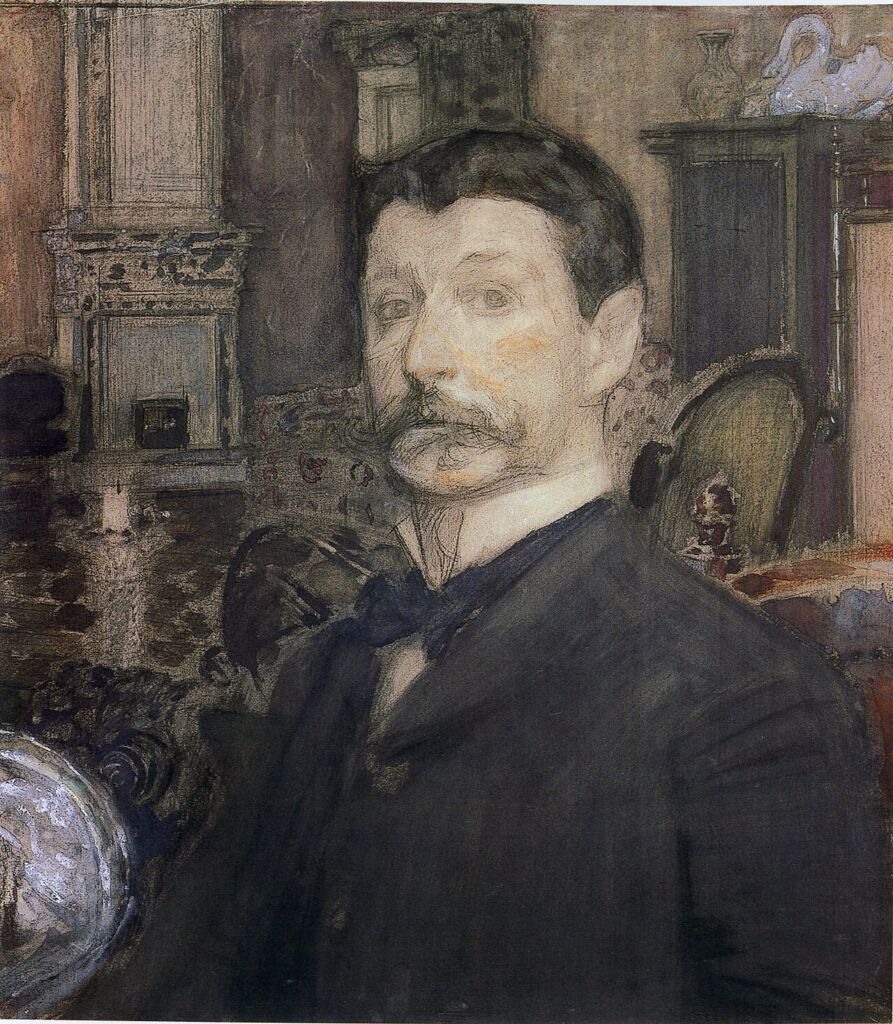
Mikhail Vrubel
Mikhail Alexandrovich Vrubel · 1856, Omsk — 1910, St Petersburg
Biography
Mikhail Vrubel was born on March 17, 1856 (March 5, Old Style), in Omsk, in Siberia. His father, Alexander Mikhailovich, was a military lawyer; his mother died in 1859, when the boy was three. He learned to draw only in fits and starts, at drawing schools in St Petersburg and Odesa. For a profession he followed his father, graduating from the law faculty of St Petersburg University (1874–1880).
While still a student, Vrubel attended evening classes at the Imperial Academy of Arts, and in 1880 he enrolled there himself. From 1882 he studied under Pavel Chistyakov and became friends with Valentin Serov; he never completed the course. In 1884 he was called to Kyiv to restore the medieval murals of St Cyril's Church, and for this work he traveled to Venice to study the mosaics of St Mark's Basilica. The building committee rejected his designs for the murals of St Volodymyr's Cathedral (1887), and in the end he was entrusted only with ornament.
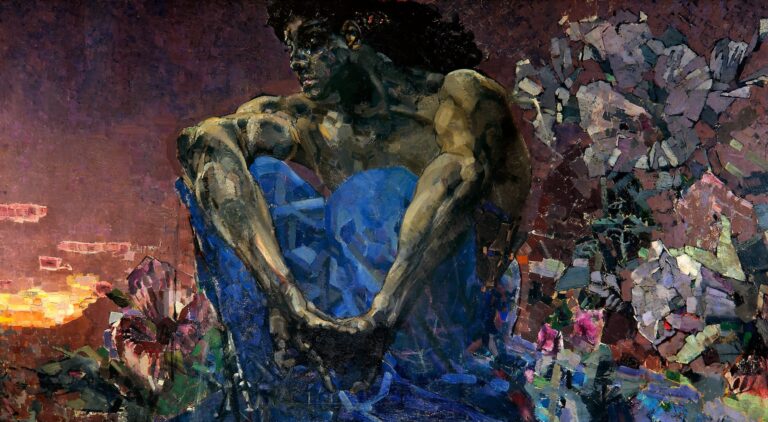
In 1889 Vrubel moved to Moscow and settled in the house of Savva Mamontov, the railway magnate and patron of the arts. There, in his host's study, he painted Demon Seated (1890), his first large canvas and the subject he had been working toward since his Kyiv years. In 1893 he made the triptych The Judgment of Paris for the Dunker mansion. Mamontov drew him into everything at once: Vrubel ran the ceramics workshops at Abramtsevo, Mamontov's estate near Moscow, and designed sets and costumes for the Private Russian Opera.
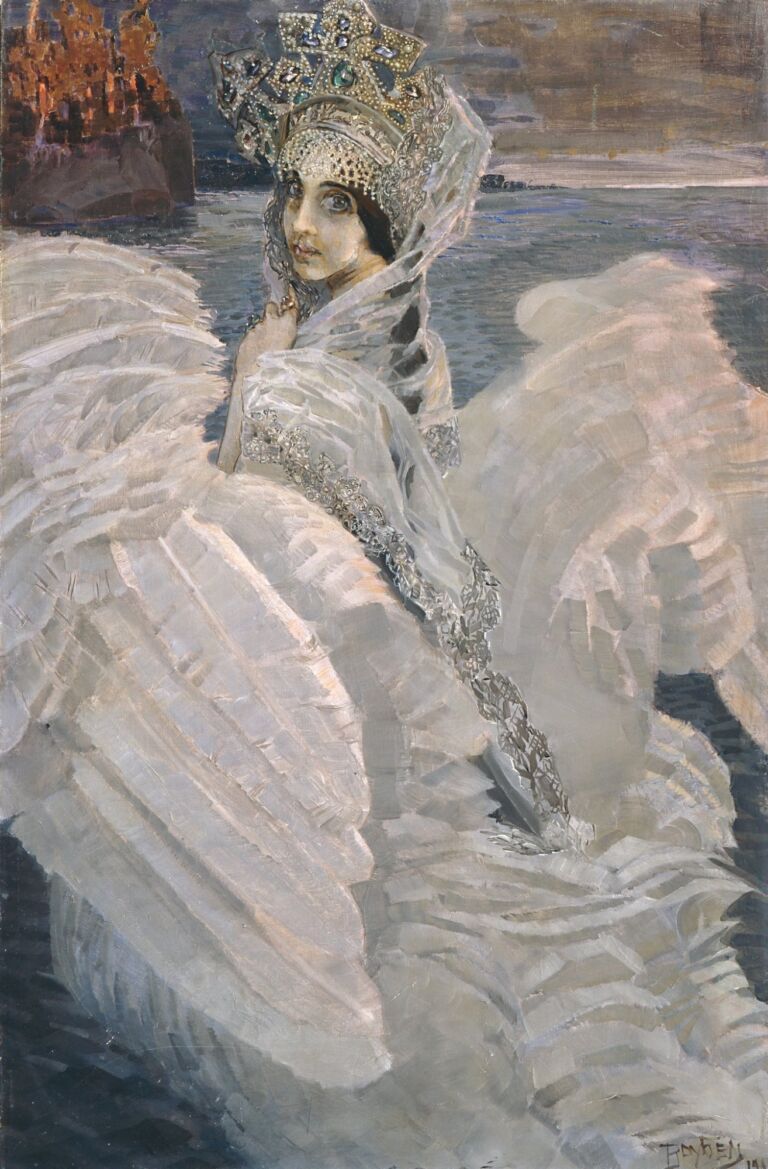
Recognition was hard won. In 1896 his panels The Princess of Dreams and Mikula Selyaninovich were removed from the All-Russian Exhibition in Nizhny Novgorod. That same year he married the singer Nadezhda Zabela, who became his principal model. For The Swan Princess (1900), painted in summer at the Ge family farmstead in Chernigov Governorate, Zabela posed in a stage costume from Rimsky-Korsakov's opera that Vrubel himself had designed. The picture was bought by Mikhail Morozov, and in 1910 his widow, Margarita Morozova, gave his collection to the Tretyakov Gallery. The scandals kept coming: in 1898 his panel Morning was attacked in St Petersburg, and in 1899 his Bogatyr caused an uproar. Yet in 1900 Vrubel won a gold medal at the Exposition Universelle in Paris.
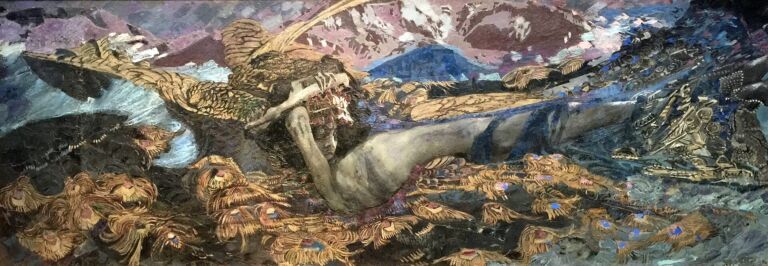
The Demon stayed with him for more than fifteen years, from the fall of 1885 to 1902. Demon Downcast (1902) was shown at the World of Art exhibition in St Petersburg, and according to contemporaries Vrubel came into the gallery in the mornings and went on repainting the canvas after it had been hung. Most critics attacked the picture, but from then on interest in the artist only grew.
In 1902 Vrubel's mental illness became evident, and he was admitted to a clinic. In May 1903 his little son Savva died, and the artist again ended up in hospitals in Riga, Moscow and St Petersburg. In 1905 he was made an academician. In January 1906 he finished his last work, a portrait drawing of the poet Valery Bryusov, and by the end of February he had gone completely blind. He spent his last four years in Dr. Bari's clinic in St Petersburg, while his work traveled to exhibitions: in 1907 fifteen pieces were shown at the International Exhibition in Venice.
Vrubel died there, at the clinic, of pneumonia on April 14, 1910 (April 1, Old Style), and was buried in the cemetery of the Novodevichy Convent in St Petersburg. In 1908 the Tretyakov Gallery and the Russian Museum acquired his paintings, and today they hold the two main collections of his work.
Major works
Click a painting to see the details.
-
 01
Demon Seated
1890 · State Tretyakov Gallery, Moscow -
 02
The Swan Princess
1900 · State Tretyakov Gallery, Moscow -
 03
Demon Downcast
1902 · State Tretyakov Gallery, Moscow
Related artists
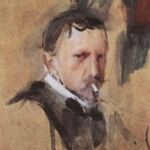 Valentin Serov
1865–1911 · fellow student