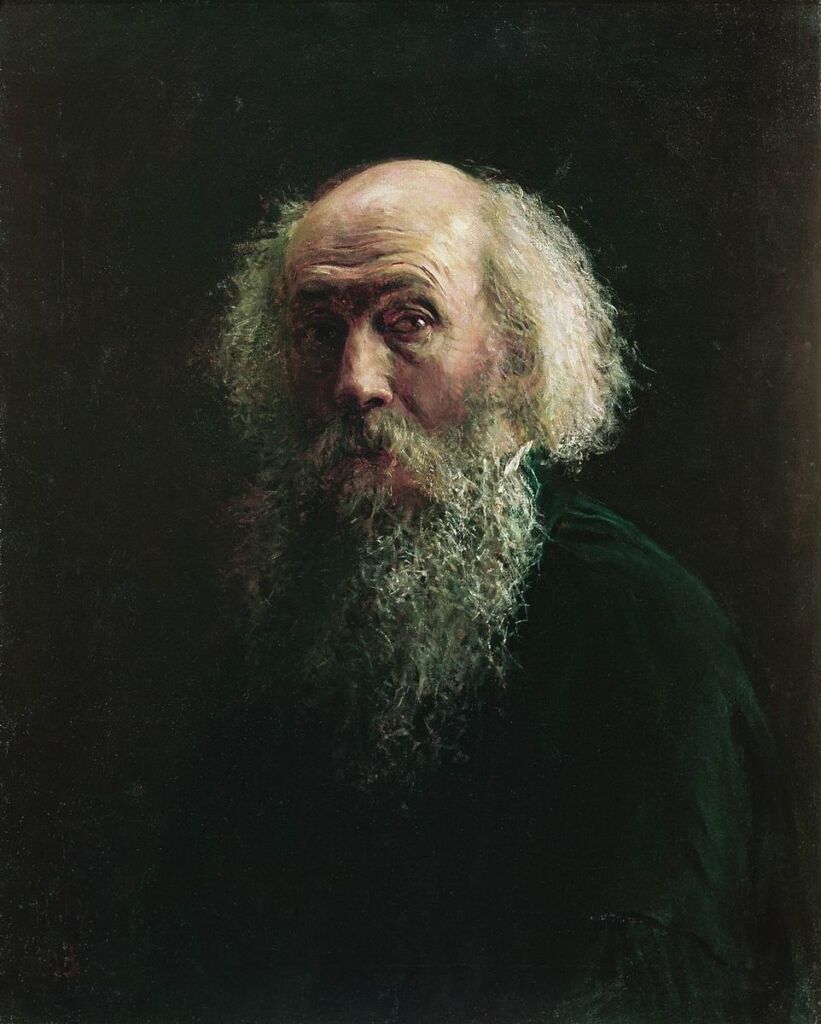
Nikolai Ge
Nikolai Nikolaevich Ge · 1831, Voronezh — 1894, Ivanovsky farmstead
Biography
The artist's great-grandfather was French, and the family name was originally spelled Gay. Nikolai Ge was born into a noble family in Voronezh on February 27, 1831 (February 15, Old Style); his mother died of cholera when he was three months old. In 1841 he was taken to Kyiv to attend the First Gymnasium, where the historian Nikolai Kostomarov taught. On his father's advice he studied mathematics at Kyiv University and then at St Petersburg University, spending his free hours copying in the Hermitage.
In 1850 Ge left the university and entered the Academy of Arts, joining Pyotr Basin's class. Five years later he won the small gold medal, and in 1857 the large gold medal for Saul at the Witch of Endor, which came with the right to travel abroad. In Rome he met Alexander Ivanov, and from 1860 he lived in Florence. For the figure of Christ in his next painting he worked from a photograph of the exiled writer Alexander Herzen taken by Sergei Levitsky; later, in 1867, Ge also painted a portrait of Herzen.
That painting, The Last Supper, caused a storm in St Petersburg in 1863. The official press saw in it “the triumph of materialism and nihilism,” the censors banned its reproduction, and the emperor bought the canvas for his collection. It earned Ge the title of professor, and he was later elected a full member of the Academy. Returning to Russia at the turn of 1869–1870, he became one of the founders of the Society for Traveling Art Exhibitions, the Peredvizhniki. For its first exhibition he painted Peter the Great Interrogating Tsarevich Alexei at Peterhof (1871), which Pavel Tretyakov bought straight from the studio.
Then came an abrupt change of course. Around 1875–1876 Ge bought the Ivanovsky farmstead in the Chernigov Governorate and took up farming and helping the local peasants. In 1882 he met Leo Tolstoy, whose views he shared, and in 1884 he painted his portrait. Tolstoy's idea of faith as a moral choice became Ge's key to the Gospels.
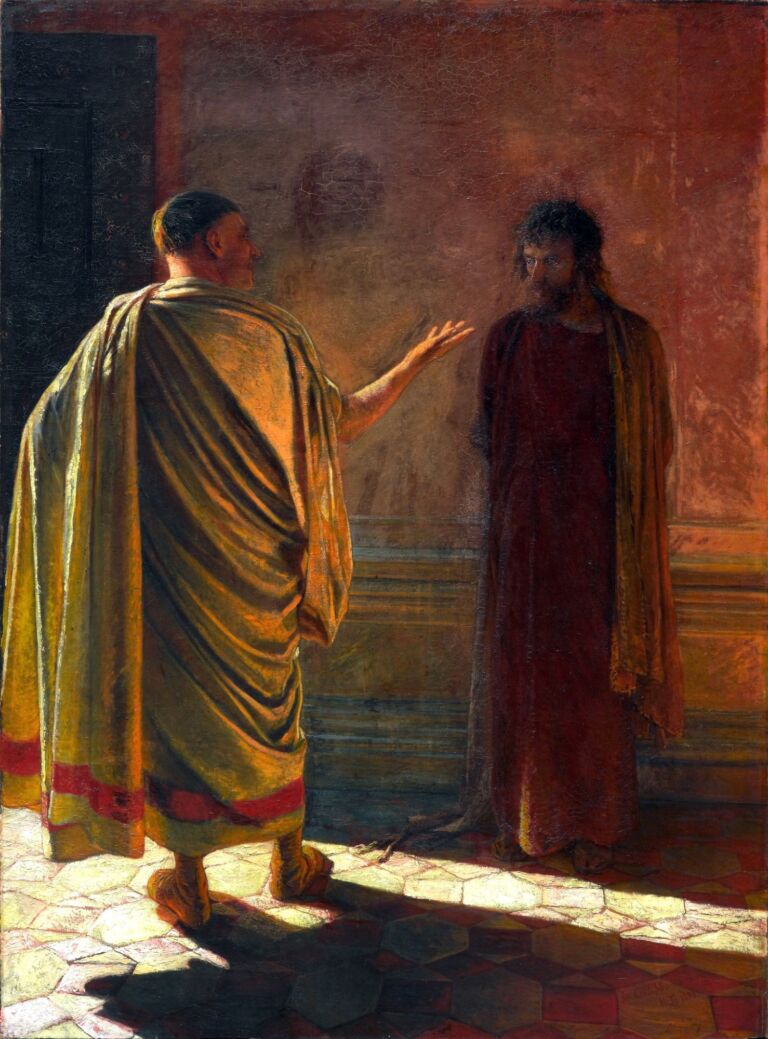
Ge painted his last Gospel cycle not as history but as an argument about conscience. “What Is Truth?” Christ and Pilate (1890) was removed from the traveling exhibition at the demand of the authorities; an admirer of the artist took the canvas on tour to Europe and America, where it made little impression. The Judgment of the Sanhedrin (1892) was barred from the Academy exhibition, Golgotha (1893) remained unfinished, and The Crucifixion (1894) was banned by Alexander III.
The late Ge painted with a free, almost sketchy brush and harsh light, with no concern whatever for a beautiful surface. Even his Italian studies of the 1860s, as Britannica observes, are painted so loosely that they recall Cézanne. Liberal critics led by Vladimir Stasov defended the late works; conservatives called them blasphemous.
Ge died at the Ivanovsky farmstead on June 13, 1894 (June 1, Old Style), soon after The Crucifixion was banned. In 1903 his son gave one of the versions of the painting to the Musée du Luxembourg in Paris; today it is in the Musée d'Orsay.
The main collections of Ge's work are in the State Tretyakov Gallery in Moscow and the State Russian Museum in St Petersburg; there are also works in Kyiv, in the former Museum of Russian Art. In 2011, after lengthy negotiations, the Tretyakov Gallery received a large collection of Ge's drawings that had spent many years abroad.
Major works
Click a painting to see the details.
-
 01
“What Is Truth?” Christ and Pilate
1890 · State Tretyakov Gallery, Moscow
Related artists
 Alexander Ivanov
late 1850s · influence; met in Rome