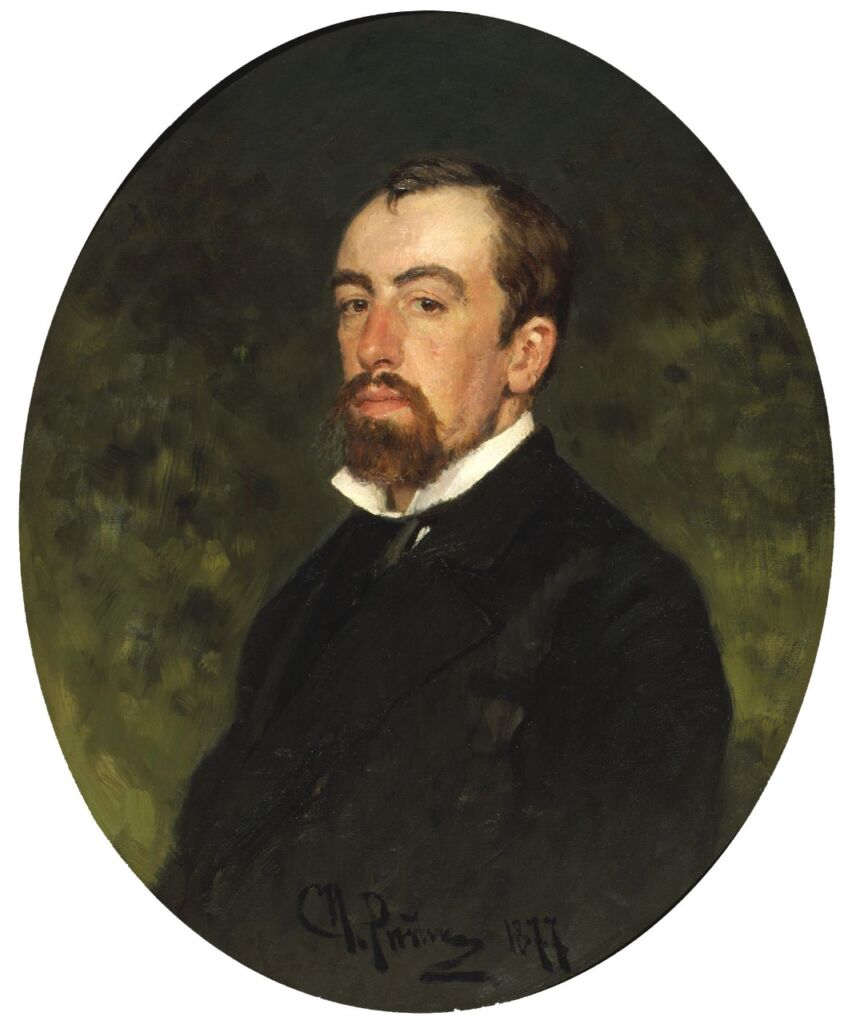
Vasily Polenov
Vasily Dmitrievich Polenov · 1844, St Petersburg — 1927, Borok estate
Biography
In 1871 Vasily Polenov finished two courses of study at once. He passed his law examinations at St Petersburg University and won the Academy of Arts’ Grand Gold Medal for The Raising of Jairus’s Daughter. The son of the diplomat and archaeologist Dmitry Polenov, he was born in St Petersburg on June 1, 1844 (May 20, Old Style). From the age of twelve he took lessons from Pavel Chistyakov; he finished secondary school in Petrozavodsk, and from 1863 attended the Academy as an auditor.
In 1872 Polenov went abroad on an Academy scholarship: Vienna, Munich, Venice, Florence, Naples and a long stay in Paris. There he painted The Right of the Master (1874), which Pavel Tretyakov bought in 1876; that purchase began the gallery’s Polenov collection. The Arrest of a Huguenot Woman earned him the title of academician. In the summer of 1874 Ilya Repin invited him to Veules-les-Roses in Normandy, and there Polenov took up landscape seriously for the first time. Then came war: in 1876 he went to Serbia as a volunteer, and in 1877 he served at the headquarters of the Rushchuk Detachment.
Polenov settled in Moscow in 1877. The following year, at the 6th Peredvizhniki exhibition, he showed A Moscow Courtyard, painted in a side street off the Arbat. Tretyakov bought the picture, and from 1879 the artist was a member of the Peredvizhniki association. Grandmother’s Garden, from the same year, 1878, first went to Sergei Tretyakov and later passed to his brother Pavel. A little later came Overgrown Pond, begun as a study at his parents’ estate at Petrushki.
The great work of his life was the Gospel cycle. The huge canvas Christ and the Sinner (325 by 611 cm) passed the censors only with difficulty: the artist’s title, Who Is Without Sin?, was not allowed in the catalog, and Konstantin Pobedonostsev, Chief Procurator of the Holy Synod, banned the printing of the catalog of the 15th Peredvizhniki exhibition in 1887. The exhibition was rescued by Alexander III, who bought the canvas for 30,000 rubles; it is now in the State Russian Museum. Tretyakov had offered less, and he disliked the short-haired Christ. Polenov completed the cycle From the Life of Christ in 1909, and its exhibition was a great success.
Polenov painted living people and living places, without museum gloss. His small canvases gave rise to what is known as the “intimate landscape.” As early as 1877 Vladimir Stasov heard “two main strings” in his talent: “color and grace.” Alexandre Benois later traced back to the pictures of these years the lyrical strain in Russian landscape painting that he associated with the prose of Turgenev and the poetry of Tyutchev.
From 1882 to 1895 he taught at the Moscow School of Painting, Sculpture and Architecture, where his pupils included Isaac Levitan, Konstantin Korovin, Ilya Ostroukhov, Abram Arkhipov and Alexander Golovin. In 1882 he married Natalia Yakunchikova. He spent long periods at Abramtsevo and designed productions for Savva Mamontov’s Private Opera, from The Scarlet Rose (1893) to Orpheus and Eurydice.
In 1890 Polenov bought the Byokhovo estate on the Oka River and named it Borok; in 1904 his studio there, known as the Abbey, was completed. In 1905, after Bloody Sunday, when troops fired on peaceful marchers in St Petersburg, he and Valentin Serov resigned from the Academy. In 1915 the Polenov House for Folk Theaters opened. At Borok he painted Flood on the Oka (1918–1919). For his 80th birthday in 1924 the Tretyakov Gallery staged his first solo exhibition, and in 1926 he was named People’s Artist of the RSFSR. Polenov died on July 18, 1927, and was buried at Byokhovo, on the high bank of the Oka.
Today the State Tretyakov Gallery holds about 160 of his paintings and 250 works on paper. Christ and the Sinner and The Arrest of a Huguenot Woman are in the State Russian Museum. The Borok estate became the Polenovo Museum-Reserve; its first director was the artist’s son Dmitry.
Major works
Click a painting to see the details.
-
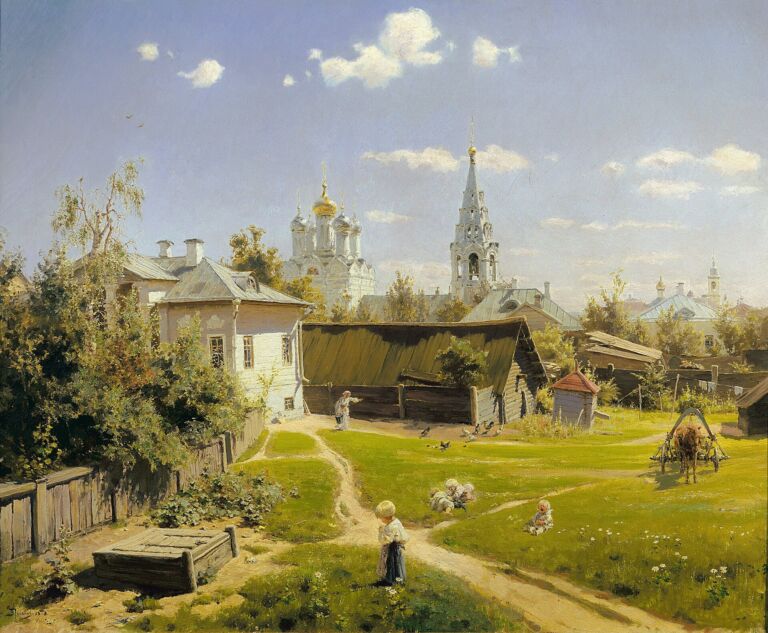 01
A Moscow Courtyard
1878 · State Tretyakov Gallery, Moscow
Related artists
 Ilya Repin
1860s–1870s · fellow student at the Academy; invited him to Normandy
 Isaac Levitan
1880s · pupil
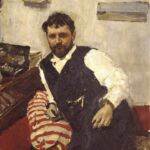 Konstantin Korovin
1880s · pupil
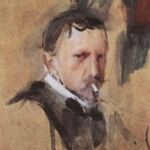 Valentin Serov
1905 · resigned from the Academy together