Art movement
Early Renaissance
Around 1420 to the 1490s · Italy (Florence, Urbino, Padua, Mantua, Venice)
About the movement
In 1401 the Florentine guild of cloth merchants announced a competition for the bronze doors of the Baptistery. Lorenzo Ghiberti won, and the loser, Filippo Brunelleschi, turned to architecture, a defeat that changed the history of art. It was Brunelleschi who, around 1415–1420, staged his famous experiment with a painted panel and a mirror at the doors of Florence Cathedral, showing that the depth of space could be calculated. So it was in Florence, in the 1420s, that the Early Renaissance began: the Quattrocento, as the Italians call the 15th century.
The medieval painter presented sacred history as an eternal truth outside time and place. The new masters wanted viewers to see it as if they were looking through a window. Hence the three pillars of the method: linear perspective with a single vanishing point; anatomy, studied from the living model and from ancient statues; and light falling from one side. In 1435 Leon Battista Alberti set out these rules in his treatise On Painting, and he dedicated the Italian version of 1436 to Brunelleschi.
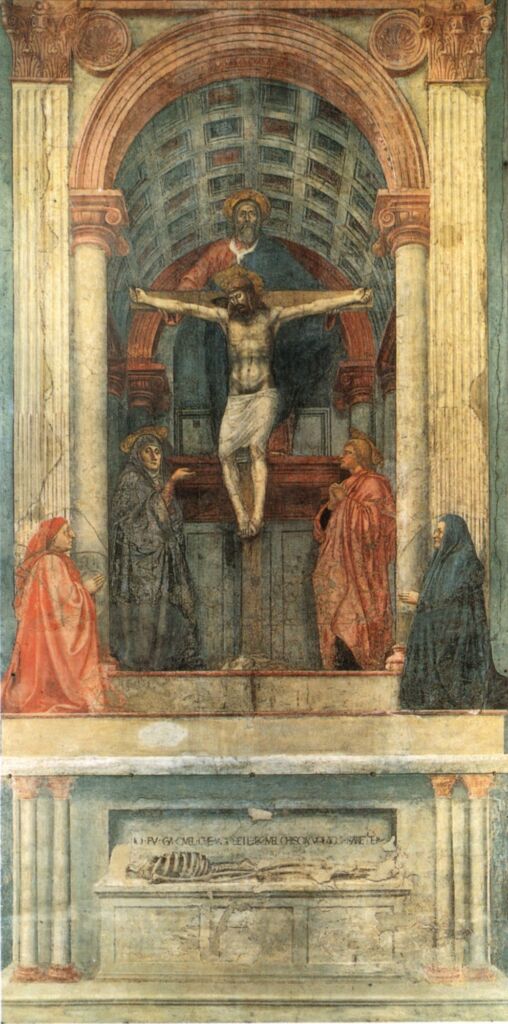
Masaccio was among the first to apply perspective consistently in painting. His fresco of the Holy Trinity in the church of Santa Maria Novella (around 1425–1427) and the frescoes of the Brancacci Chapel, begun together with Masolino, showed that a wall could be turned into space. Masaccio died in Rome around 1428, before he was thirty. The sculptor Donatello did the same in stone and bronze. Paolo Uccello built perspective obsessively, and in the Annunciation at the convent of San Marco (around 1440–1445) Fra Angelico joined the new techniques to monastic quiet. Piero della Francesca drew from perspective a calm, mathematical harmony (his Flagellation of Christ, around 1459–1460, is in Urbino) and wrote a treatise of his own on it. Andrea Mantegna, in Padua and Mantua, turned antiquity into drama in stone; his Lamentation over the Dead Christ (around 1483) is now in the Brera in Milan.
The new art depended on patrons. Cosimo de' Medici, who returned to Florence in 1434, and his grandson Lorenzo the Magnificent paid for churches, libraries and workshops, and collected ancient gems and manuscripts. Similar courts grew up in Urbino under Federico da Montefeltro, in Mantua under the Gonzaga and in Ferrara under the Este. Venice responded later: Antonello da Messina, who arrived there in 1475, brought the Netherlandish oil technique, which he had apparently encountered in Naples. His Saint Jerome in his Study (around 1475) is now in the National Gallery, London.
In Russia the Quattrocento is known above all through the Pushkin State Museum of Fine Arts in Moscow. Ivan Tsvetaev conceived it as a teaching museum of plaster casts, and its Italian Renaissance hall holds copies of reliefs by Ghiberti and of works by Donatello and the della Robbia workshop; for generations of students this was their first encounter with Florentine sculpture. The museum opened in 1912, and exact copies commissioned in Italy stood in for the originals.
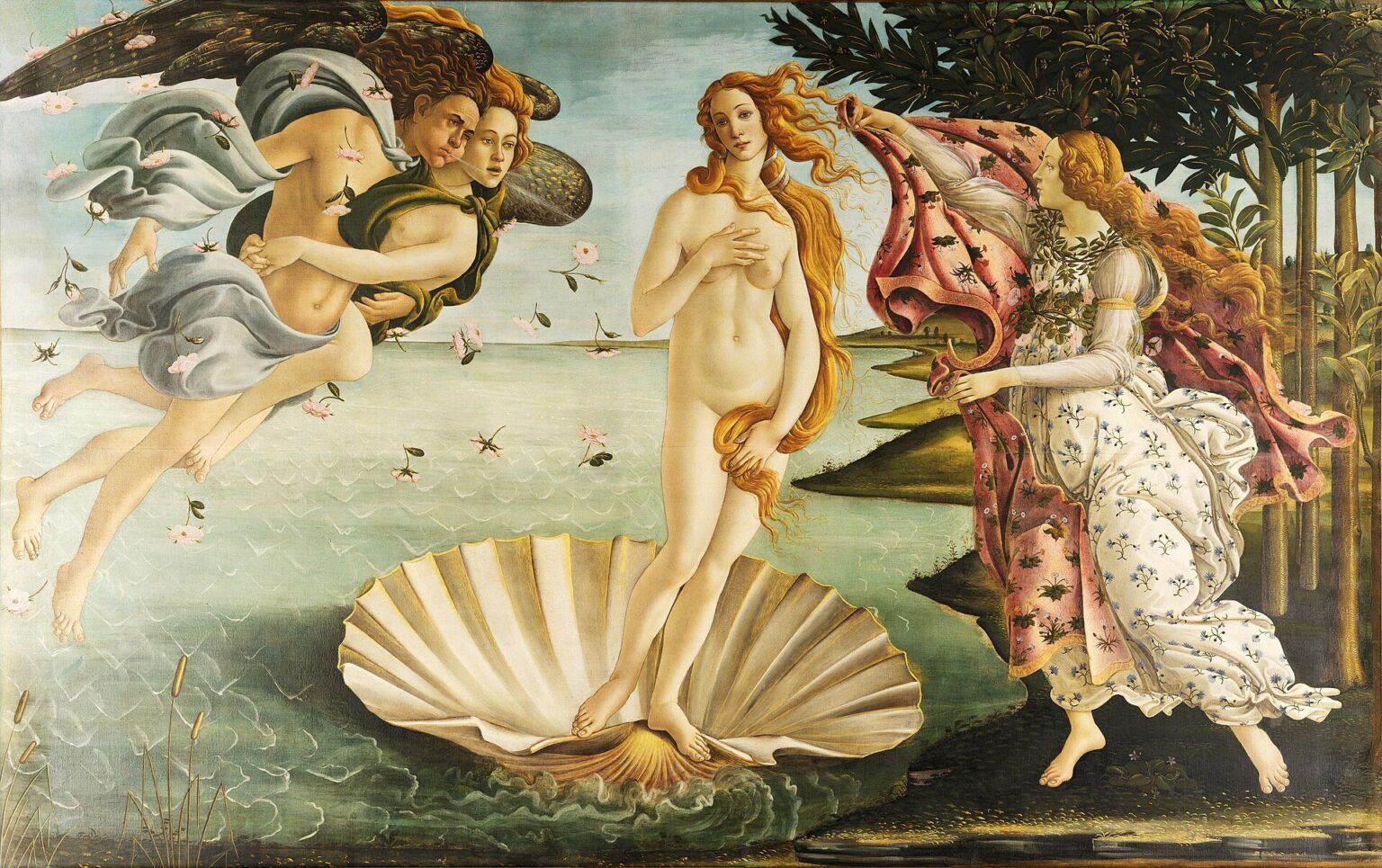
The last great voice of the period was Sandro Botticelli. Primavera (around 1480) and The Birth of Venus (around 1485), both painted in the Medici circle, are now in the Uffizi. In the 1490s, after the death of Lorenzo and the sermons of Savonarola, "bonfires of the vanities" were lit against "pagan" luxury, and Botticelli himself, according to Vasari, turned away from mythology. The next generation took up the legacy of the Quattrocento: Leonardo da Vinci grew up in Verrocchio's workshop, Michelangelo trained under Ghirlandaio, and Raphael worked alongside Perugino. The method discovered in Florence became the common language of European painting for more than four centuries.
Stories