Art movement
Ukiyo-e
17th–19th centuries · Japan
About the movement
In the winter of 1896 an exhibition opened at the Imperial Academy of Arts in St Petersburg that, according to newspapers and memoirs, drew up to eight hundred visitors a day. The naval officer Sergei Kitaev was showing Japanese prints he had collected while the fleet lay at anchor in Japanese ports. For the Russian public it was the discovery of a whole world, one that in Japan itself had long been regarded as cheap street imagery.
That world was born in Edo, present-day Tokyo, in the second half of the 17th century. Ukiyo, the "floating world," was the name for the pleasure quarters: kabuki theater, teahouses, courtesans. The first works were painted screens, but the genre truly came alive in the woodblock print, produced in editions and affordable to townspeople. Hishikawa Moronobu is considered the first master of ukiyo-e; Okumura Masanobu moved from single-color impressions to two-color ones, and in 1765 Suzuki Harunobu introduced full-color printing from many blocks.
A print was a team effort. The artist supplied the drawing, the carver transferred it to a block of cherry wood, the printer chose the colors and the publisher decided what would sell. That is why ukiyo-e kept such a close eye on fashion: in the late 18th century Kitagawa Utamaro became famous for half-length portraits of beauties, while the mysterious Tōshūsai Sharaku issued fewer than 160 prints in 1794–1795, sharp, almost caricatural portraits of actors, and then vanished. Who he was is still debated; according to one theory, he was a Noh actor from the province of Awa.
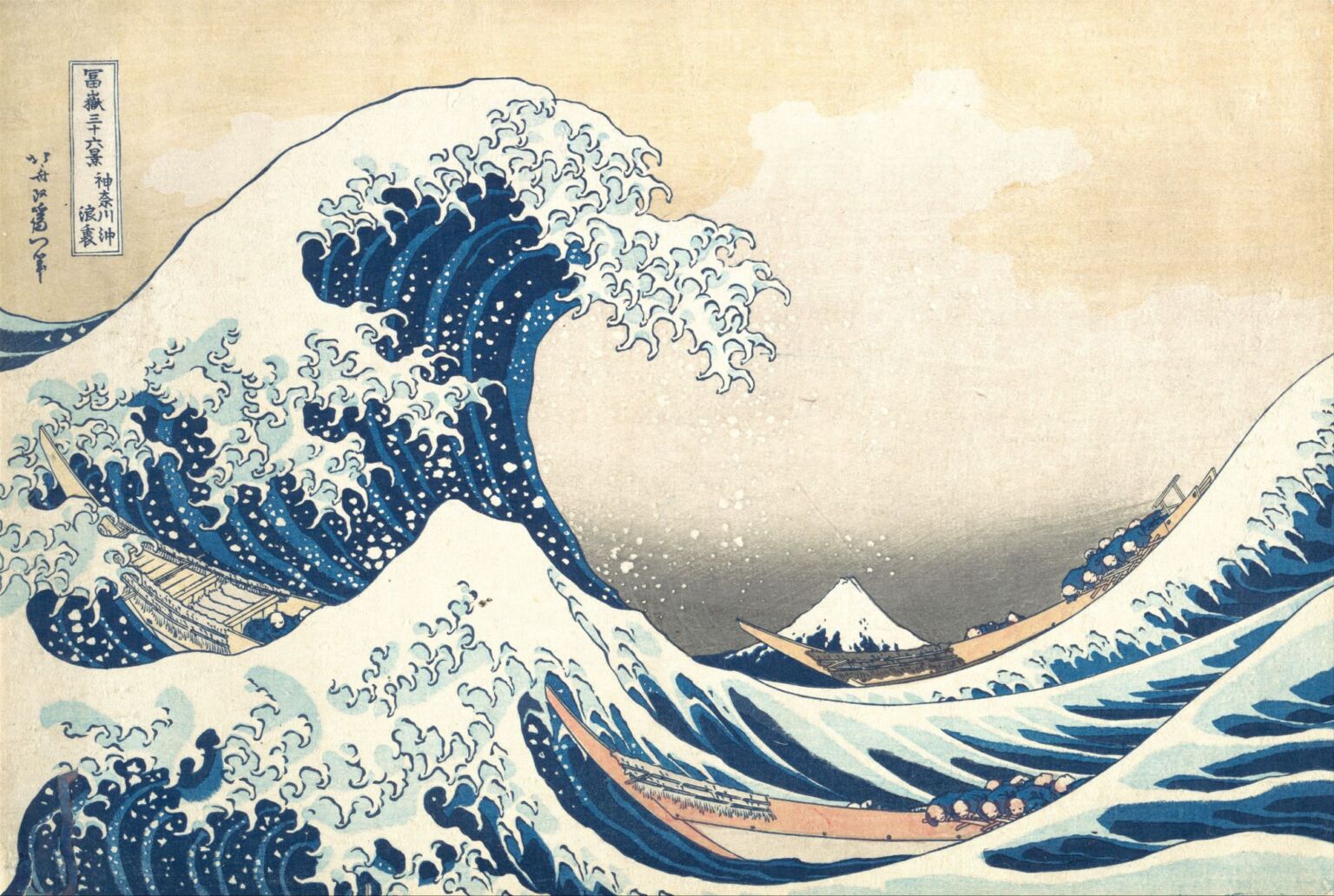
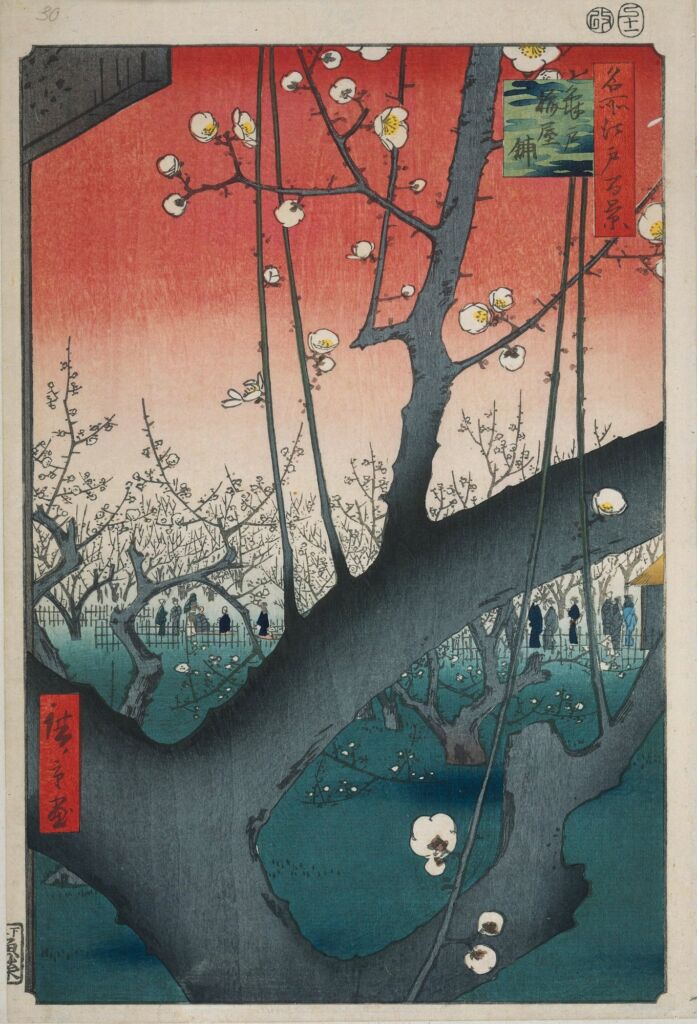
In the 19th century landscape came to the fore. Around 1830–1832 the seventy-year-old Katsushika Hokusai published the series Thirty-six Views of Mount Fuji, which includes The Great Wave off Kanagawa and Red Fuji; one hallmark of the series was imported Prussian blue, a durable, vivid blue pigment. Utagawa Hiroshige answered with The Fifty-three Stations of the Tōkaidō (1833–1834) and, toward the end of his life, One Hundred Famous Views of Edo, which includes Plum Estate, Kameido and Sudden Shower over Shin-Ōhashi Bridge and Atake (both 1857).
When Japan opened its ports to foreigners, prints flooded into Europe and set off a vogue for Japonisme. The Impressionists learned cropped compositions and flat color from them, and in 1887 Vincent van Gogh copied both of these Hiroshige prints in oil; the copies are in the Van Gogh Museum in Amsterdam.
In Russia the story is above all Kitaev's. In 1918 he himself put his collection at roughly 14,000 items, about 8,000 of them prints. His exhibitions were held in St Petersburg (1896–1897), at the Historical Museum in Moscow (1897) and in St Petersburg again in 1905. The state never made up its mind to buy the collection: in 1916 it was deposited at the Rumyantsev Museum, and after that museum closed in 1924 it passed to the Museum of Fine Arts, now the Pushkin State Museum of Fine Arts, where about two thousand prints are currently recorded. The printmaker Anna Ostroumova-Lebedeva also collected Japanese prints: her collection included Hokusai and Hiroshige, and Japanese woodcuts did much to shape her own style. Under her will, the collection went to the State Russian Museum in 1955.
By the end of the 19th century, with photography and Western printing, ukiyo-e faded away as a popular art. But its legacy reached well beyond Japan, from Art Nouveau posters to present-day manga, and the prints themselves have long since ceased to be cheap goods.
Stories