American Gothic: why Grant Wood’s sister insisted she was not the wife
Grant Wood's sister and his dentist posed separately for American Gothic, and Nan Wood Graham spent sixty years insisting she was the man's daughter, not his wife.
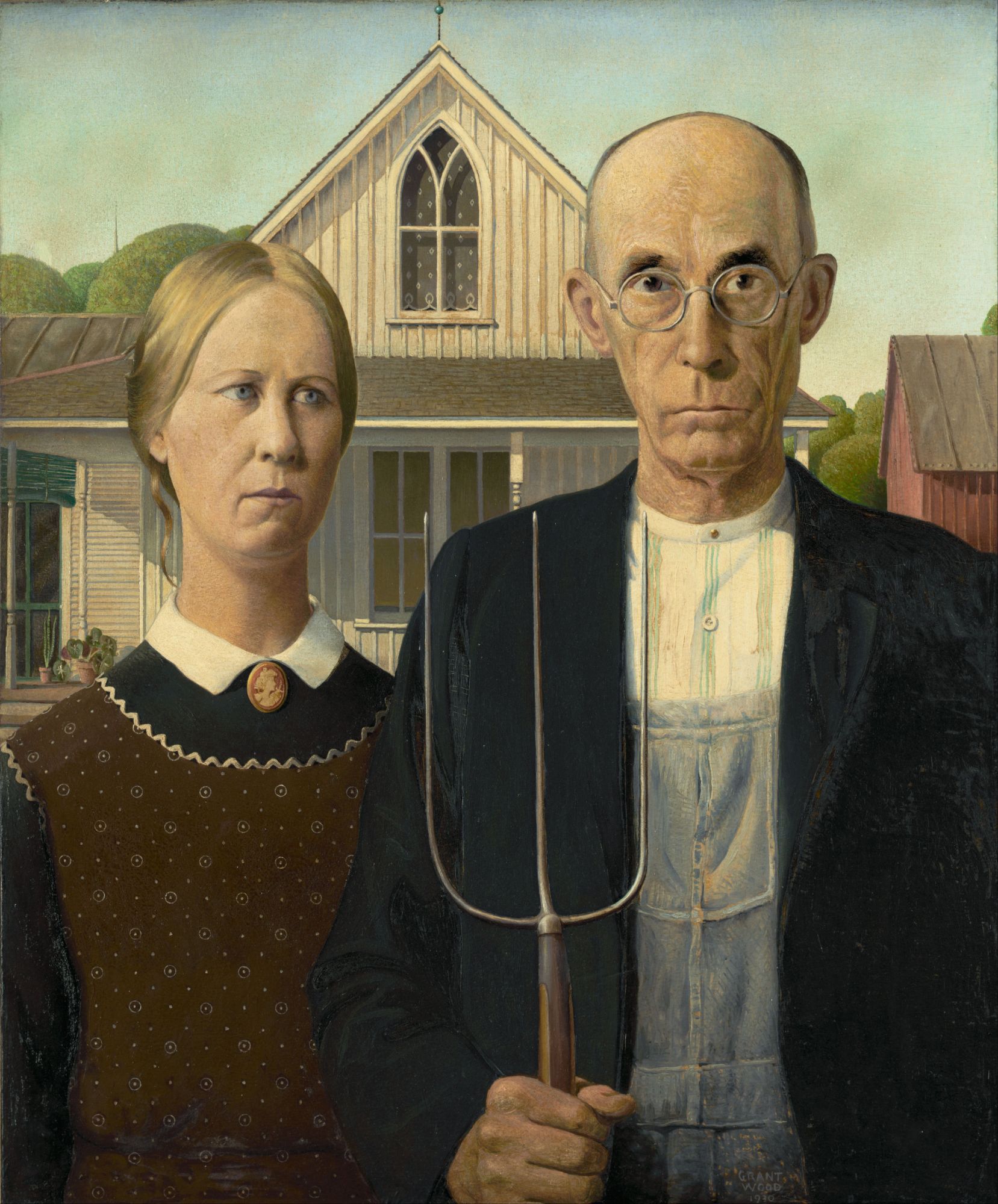
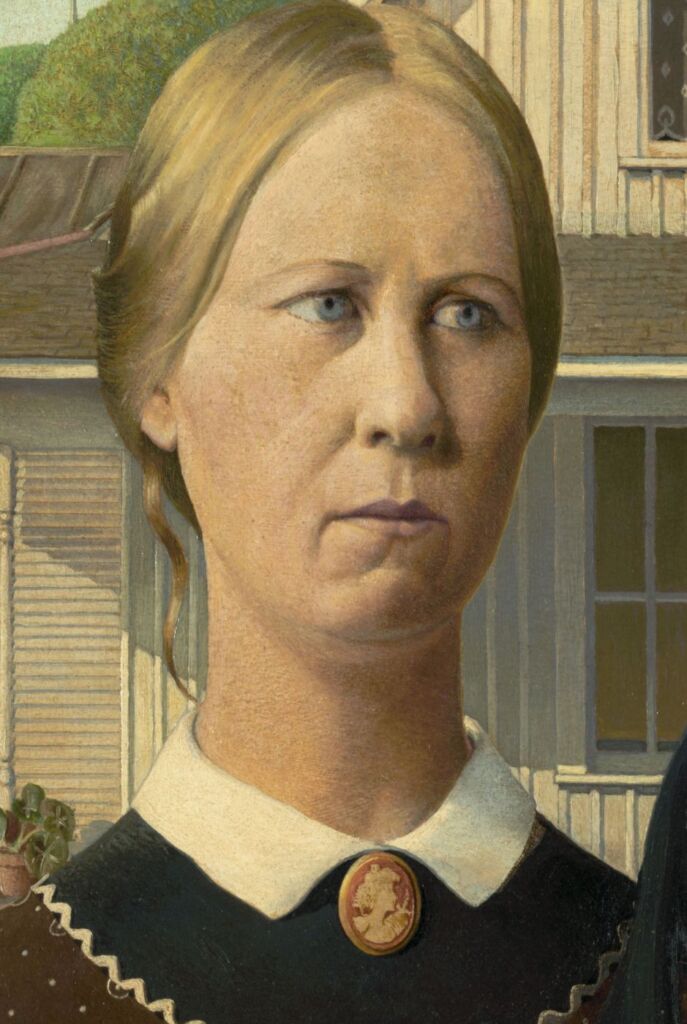
Wanda Corn has spent more than four decades with American Gothic, and her new book, published by Princeton University Press this year, is called The Couple with the Pitchfork. The title is a wink. When Corn talked about the picture with Nan Wood Graham, the woman who posed for it, Nan set her straight: “They’re not a couple. It’s a father and daughter,” as Corn recalled to The Art Newspaper.
Nan was Grant Wood’s sister. The man beside her was his dentist. They never stood together in front of the house, and the house was not theirs. Almost everything a first-time viewer assumes about a painting America has parodied for almost a century turns out to be wrong.
Wood found the house in Eldon and his models in Cedar Rapids
In August 1930 Wood was in Eldon, a small town on the Des Moines River in southeastern Iowa, for an exhibition organized by the director of the Little Gallery in Cedar Rapids. A local young man, John Sharp, was driving him around when Wood asked him to stop in front of a small white frame house. Charles and Catherine Dibble had built it in 1881–82, and its upper gable held a pointed Gothic window, the kind of ornament Wood found “pretentious” on so modest a building, according to the American Gothic House Center.
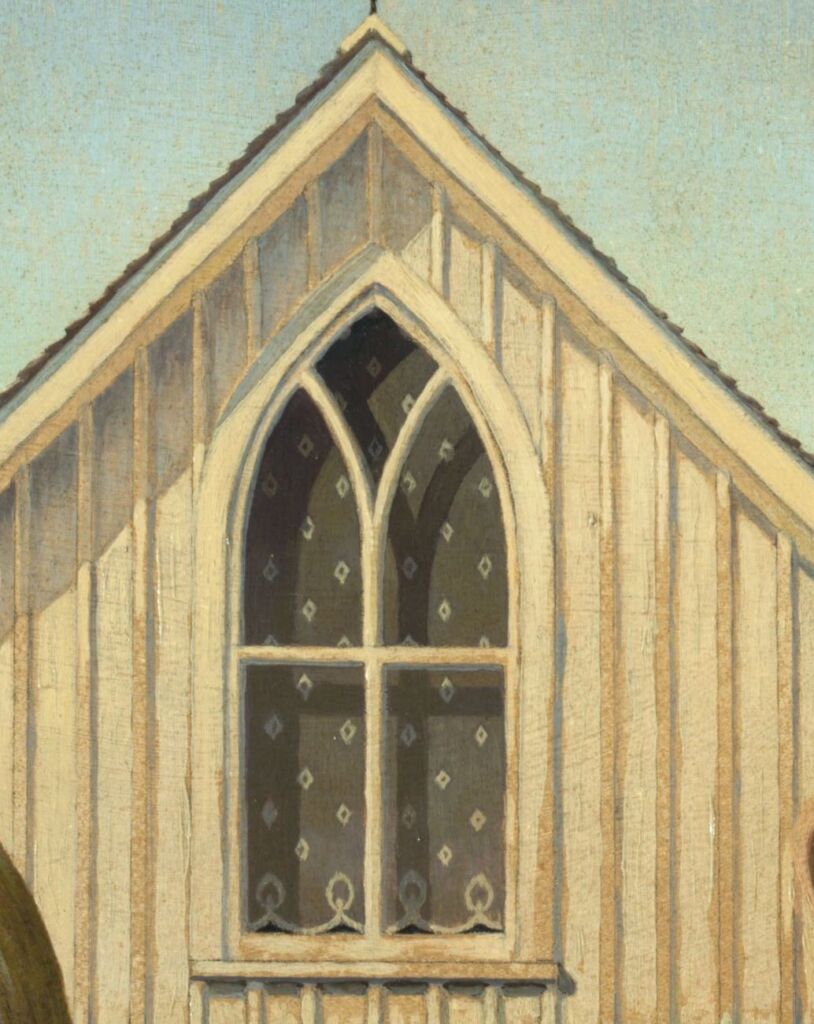
Nobody knows why the Dibbles chose that window. Local lore says it came from a Sears, Roebuck catalog; the house’s own historians think a railroad car of surplus Gothic sashes is likelier. The upper window is hinged, which was how furniture got upstairs. Wood sketched the facade on the spot and asked himself, as the Art Institute of Chicago retells it, who would live in a house like that. His answer was “American Gothic people.”
He found them at home in Cedar Rapids. Nan, about thirty and fashionably dressed, was shown pictures of old Gothic stone carvings from a French cathedral and asked whether she could make her face look as long as theirs. Dr. Byron H. McKeeby, a dentist in his early sixties, sat for the man. They posed separately and were never in the studio together. Unlike Géricault, who brought real survivors of the Medusa into his studio, Wood was not after portraits. Britannica records his claim that he painted types he had known all his life and tried to make them more like themselves than they were.
Chicago gave it a bronze medal; Iowa readers said it would sour milk
Wood finished the panel, oil on beaverboard, 78 by 65.3 centimeters, in his Cedar Rapids studio and sent it to the Art Institute of Chicago’s Forty-Third Annual Exhibition of American Paintings and Sculpture, which opened on October 30, 1930. The jury gave it the Norman Wait Harris Bronze Medal and $300. The museum itself notes that the medal was billed as third prize but, by cash value, ranked closer to fifth. In November the museum bought the painting from the artist for $300, and it entered the Friends of American Art Collection.
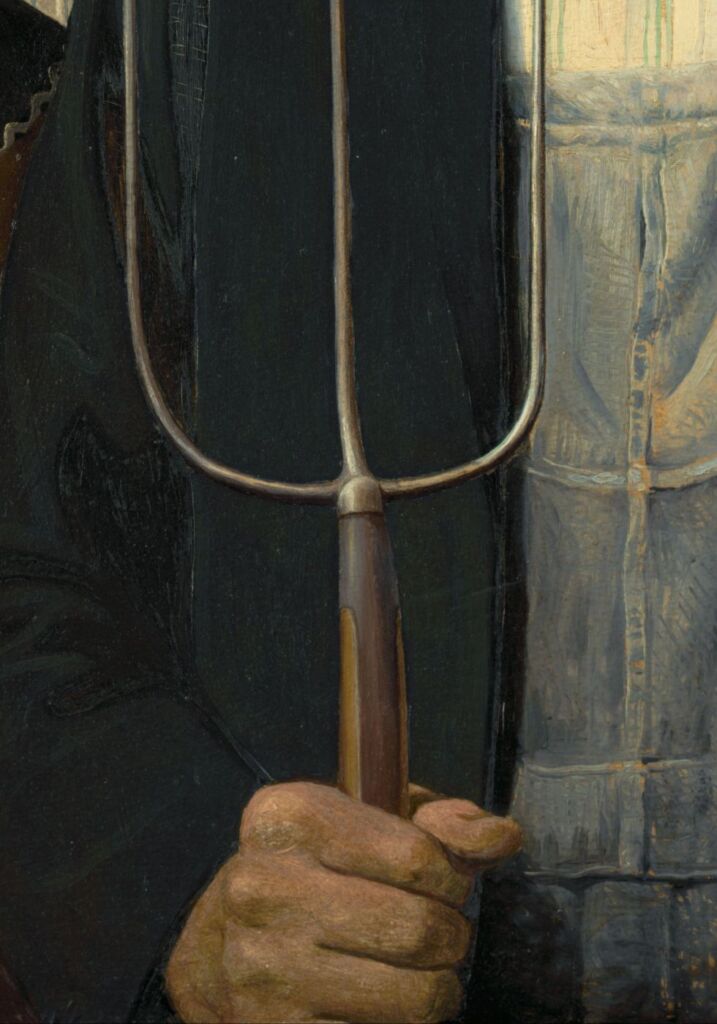
Iowa was less pleased. On November 16 the Des Moines Register ran the image under a syndicator’s title, “An Iowa Farmer and His Wife.” Two weeks later Mrs. Earl Robinson of Collins wrote in that the woman’s face “would positively sour milk” and suggested hanging the portrait in a cheese factory. Other farm wives protested that they had tractors and had long since moved past the three-tined pitchfork.
Wood answered in the same paper on December 21. The figures, he wrote, were “not farmers but are smalltown” people, and pinning them to Iowa was unfair. In the same section a letter appeared from “Mrs. E. E. Graham, Cedar Rapids.” The Register did not mention that she was the painter’s sister. She explained that she was meant to be the man’s daughter, not his wife, and that she still considered posing “a great honor.”
Nan Wood Graham never stopped correcting the record
Wood himself did not keep the story straight. In a 1933 article he wrote about inducing his “maiden sister” (she had in fact been married since 1924) to pose and then finding “a man to represent the husband,” as American Heritage pointed out in 2001. In a letter quoted by the State Historical Society of Iowa, he called the woman the farmer’s “grown-up daughter.” Scholars still split along the same line: Corn reads a father and daughter, while James M. Dennis argued for husband and wife.
Nan picked a side early and kept to it for sixty years. The painting made her a public figure, and she guarded it closely. In 1977 she sued Hustler over a topless parody, claiming defamation and invasion of privacy, and lost. She once said that without the picture her life would have been “very drab,” and that she would otherwise have been remembered as “the world’s worst stenographer.” She died in 1990.
The two people she corrected so often still hang in Gallery 263 of the Art Institute of Chicago. The Dibble House, listed on the National Register of Historic Places in 1974, was donated to the State Historical Society of Iowa in 1991. Visitors may not go inside, but they can stand where the pair would have stood. Whoever poses beside them, a spouse or a parent, reopens the question Wood never quite settled.

Comments
For Hroniki readers
Comments are open to readers with an account. Signing up is free and takes a few seconds.
No comments yet. Start the conversation.