Raphael’s Sistine Madonna: how a provincial altarpiece won over Russia
For nearly 250 years hardly anyone came to Piacenza to see Raphael's Sistine Madonna. Then a Russian poet called it a vision, Dostoevsky hung its photograph above his sofa, and in 1955 Moscow lined up all summer to see it.
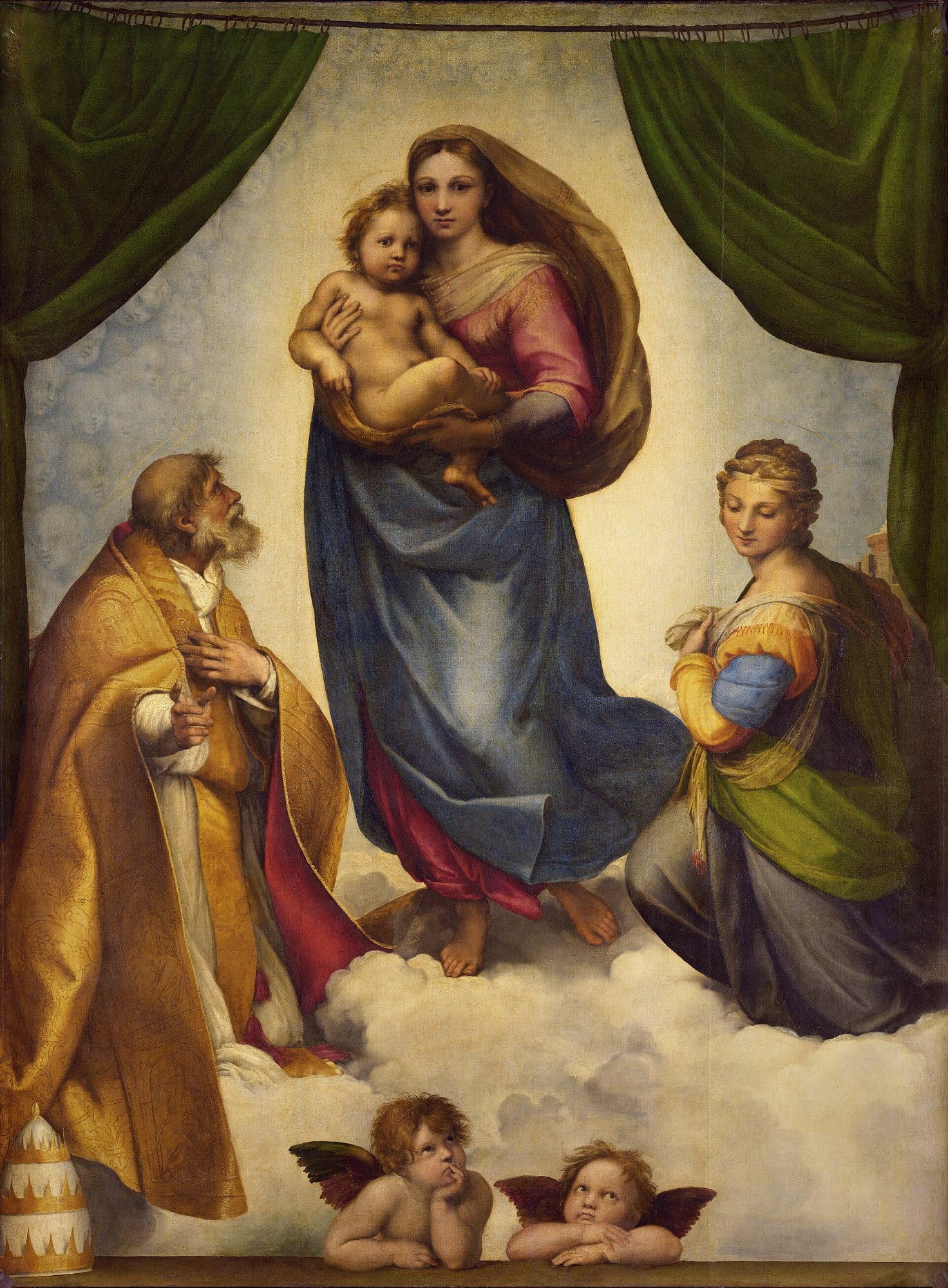
For almost 250 years, Raphael’s Sistine Madonna stood on the altar of a monastery church in Piacenza, and hardly anyone came to see it. Then it was sold to Dresden, and Europe started talking.
The poet Vasily Zhukovsky counted an hour before it among the happiest of his life, Fyodor Dostoevsky hung its photograph above his sofa, and in 1955 Muscovites lined up all summer to see it.
An altarpiece for the monks of Piacenza
In July 1512 word reached the Vatican that Piacenza was passing to the Papal States. Most likely it was then, according to the Dresden State Art Collections (in German), that Pope Julius II commissioned Raphael to paint an altarpiece for the city’s Benedictine church of San Sisto.
Raphael chose canvas over panel, though the picture is large: 269.5 by 201 centimeters, nearly nine feet tall. Arnold Nesselrath of the Vatican Museums thinks canvas was chosen because the picture had to travel far from Rome.
Julius II died in February 1513. The picture was probably finished by then, but he never saw it on the altar, where it seems to have stood by the church’s consecration in 1514 at the latest.
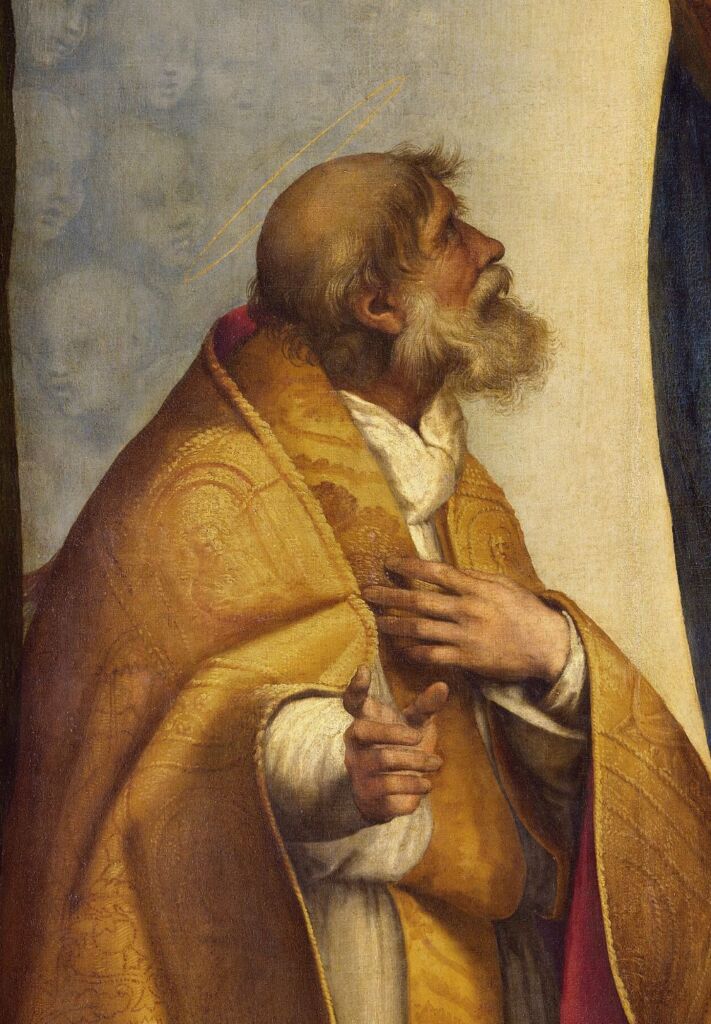
The saints probably came with the commission. Pope Sixtus II and Saint Barbara were the patrons of San Sisto, and Sixtus was also revered by the della Rovere, Julius II’s family.
The painting is named for this saint, Sisto in Italian, not for the Sistine Chapel. The old man looks up at the Madonna but points outward, toward the worshipers before the altar.
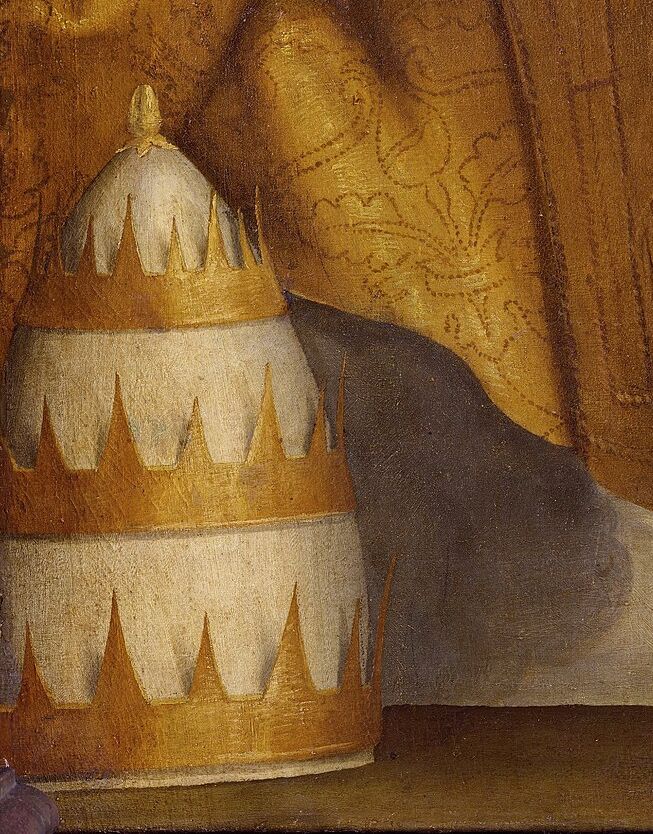
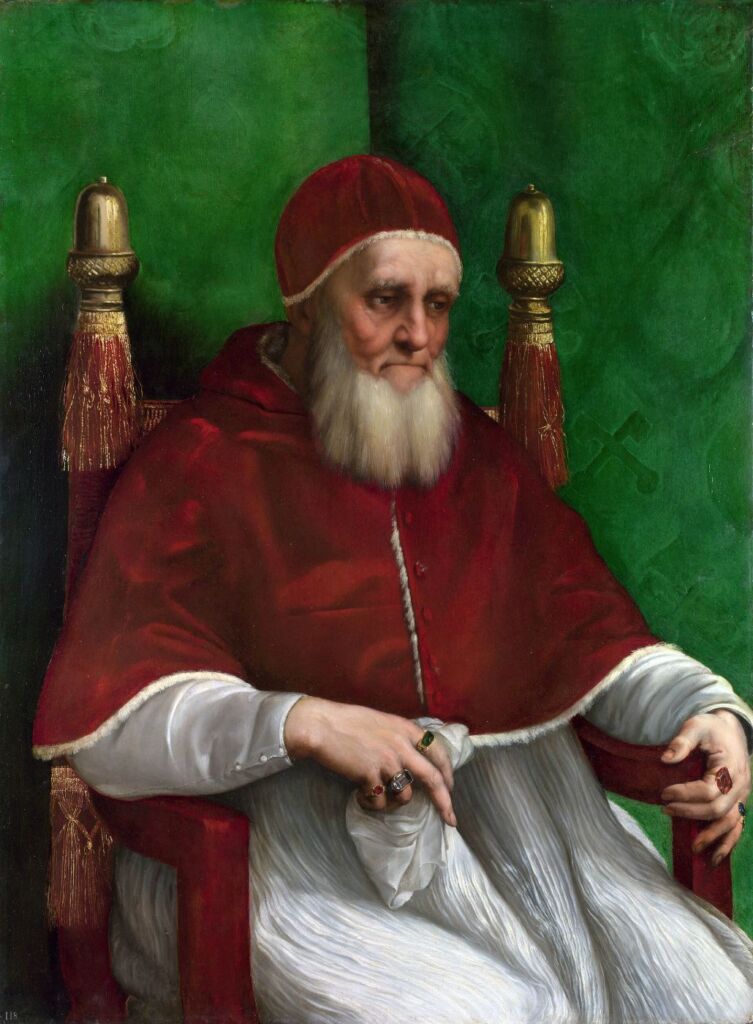
Sixtus has set his tiara on the parapet at the bottom edge. Its tiny acorn finial, as Nesselrath points out (in German), is the emblem of the reigning pope: rovere means “oak” in Italian. The same golden acorns crown the chair in Raphael’s portrait of Julius II. Sixtus died in the third century, yet his tiara bears the badge of Raphael’s patron.
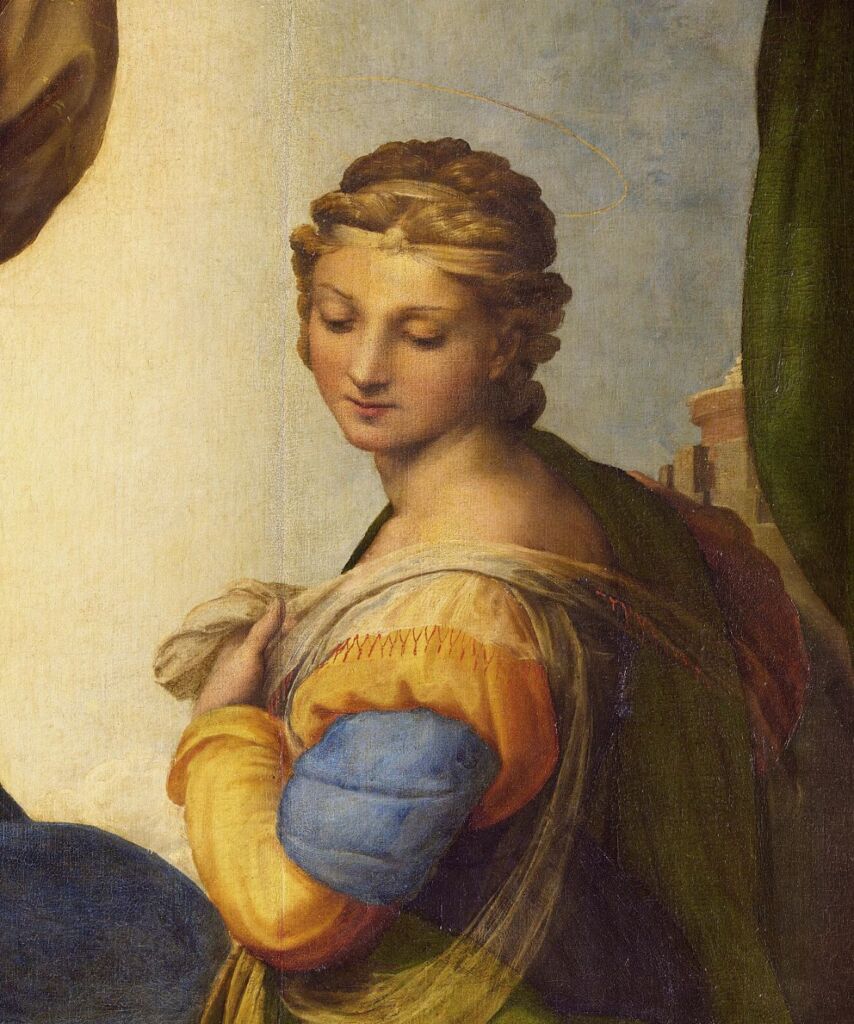
Barbara lowers her eyes toward the little angels at the bottom edge, where the world of the worshipers began.
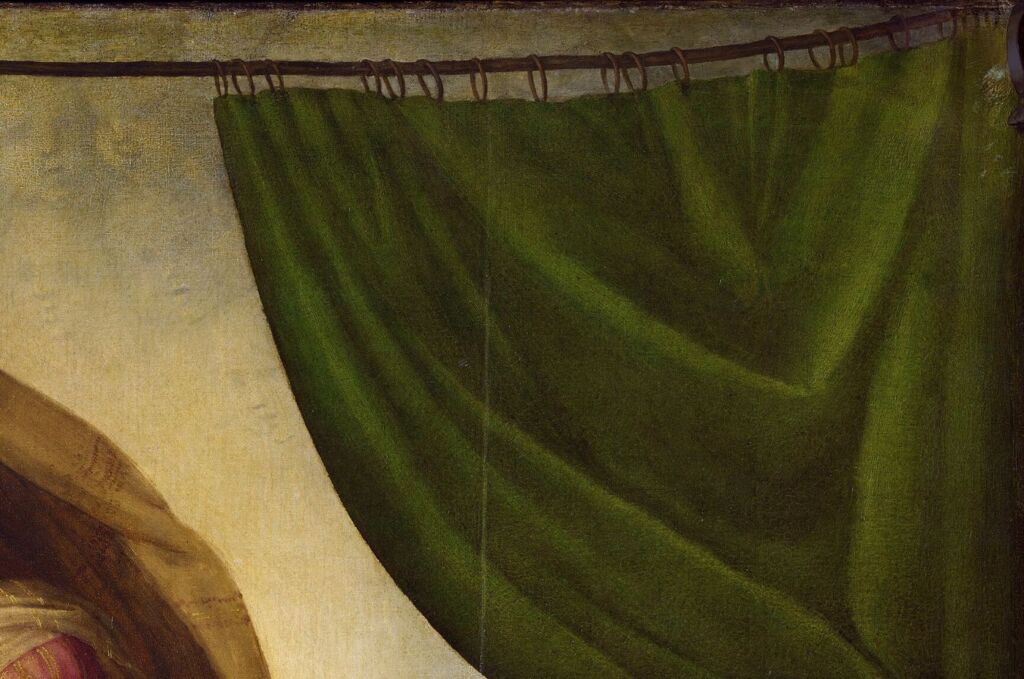
The most ordinary detail is the curtain rod along the top edge, with a green curtain on its rings, just pulled open. For Nesselrath, the curtain is what makes the scene real: the apparition is happening now, in front of the viewer.
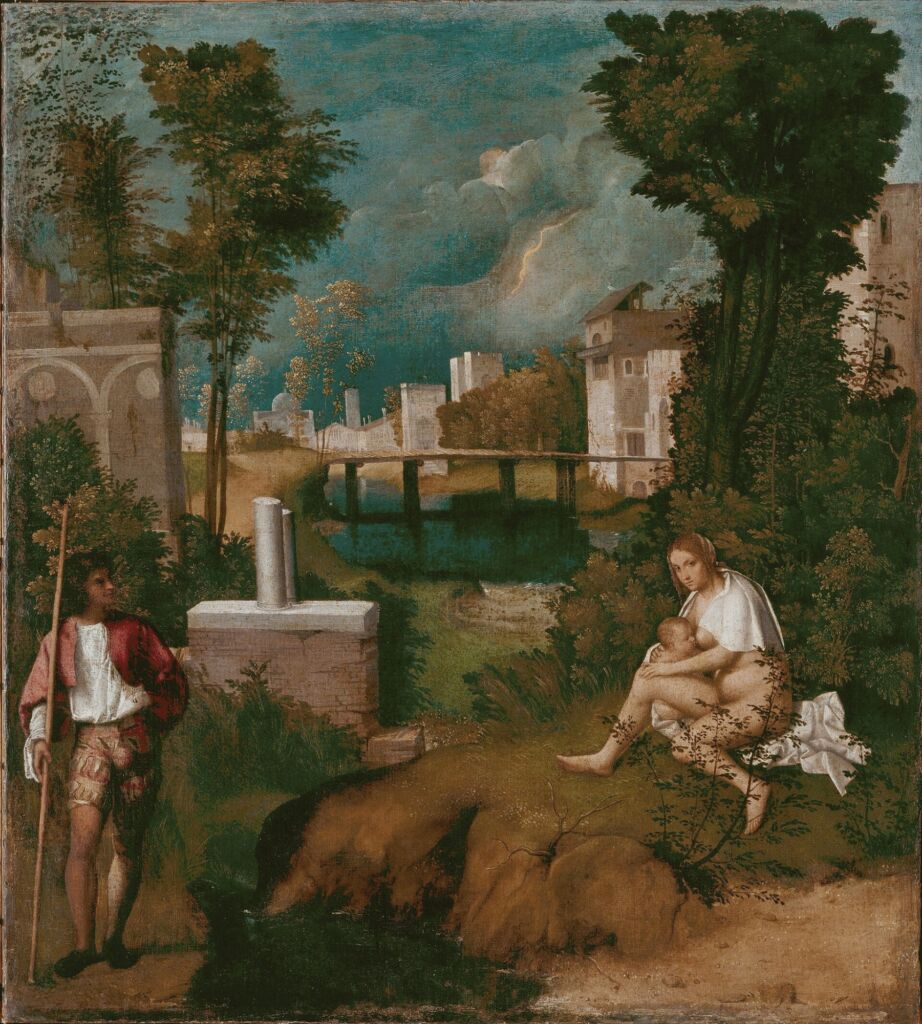
Nearly two years of haggling
For the next 240 years the painting stayed in Piacenza. Then came Augustus III, Elector of Saxony and King of Poland, who wanted a genuine Raphael, a big one, to crown his collection.
Talks with the monks dragged on for almost two years and nearly collapsed more than once. On March 1, 1754, the Sistine Madonna finally reached Dresden. Sources give prices from a few tens of thousands of scudi to over 100,000 francs, so no single figure is reliable.
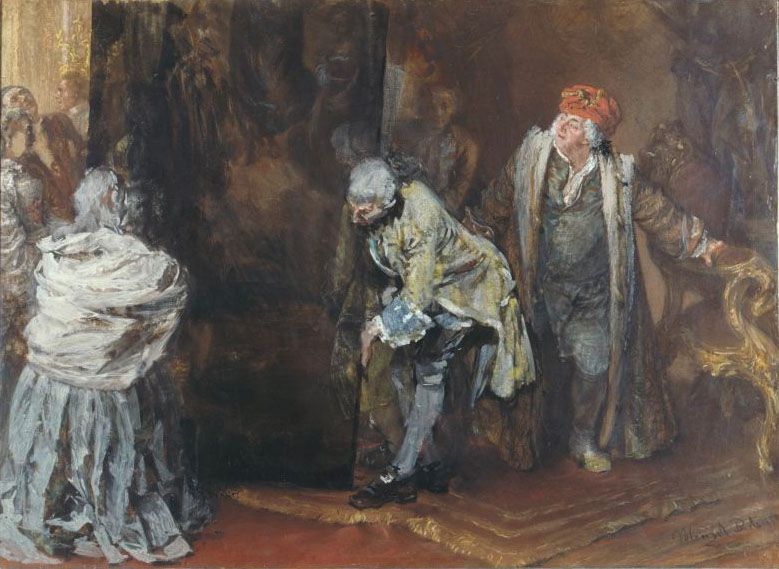
The arrival, by contrast, has just one legend. As the canvas was carried into the palace, the king supposedly pushed his throne aside to make room for it: “Make way for the great Raphael!” No document records the scene, and one simple fact argues against it: since 1747 the gallery had occupied a separate building, the former stables, far from any throne room.
The 19th century loved the story anyway, and in the 1850s Adolph Menzel painted it. Real fame came only half a century after the purchase, when Neoclassicists and Romantics rediscovered the picture around 1800.
A sky made of faces
From a distance, the background looks like a bright, cloudy sky. Up close, the sky is a crowd.
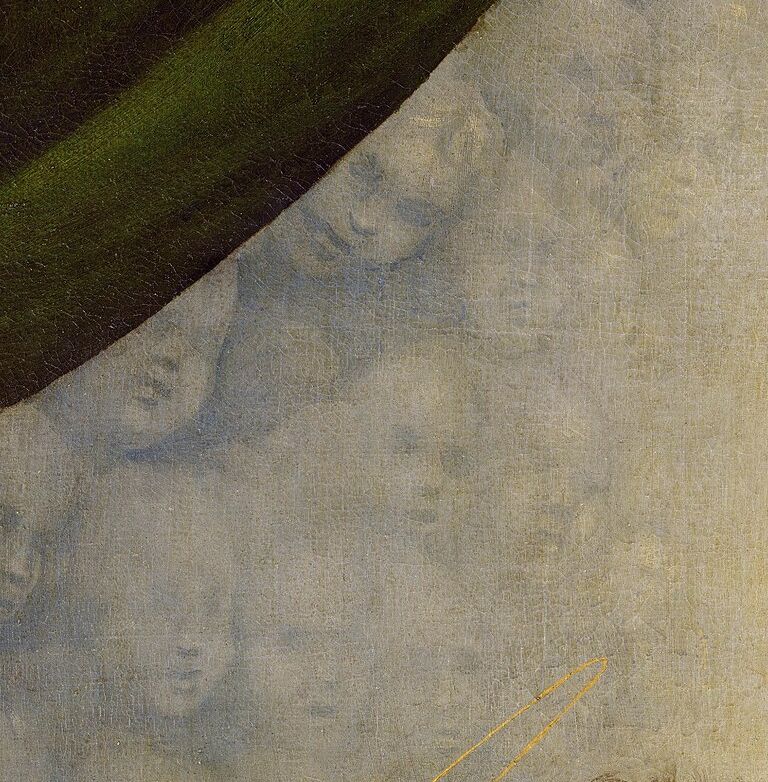
Dozens of angel heads emerge from clouds of almost the same color. Raphael leaves them unfinished, so faces appear and dissolve back into cloud. Behind the curtain there are no walls, no landscape, only light.
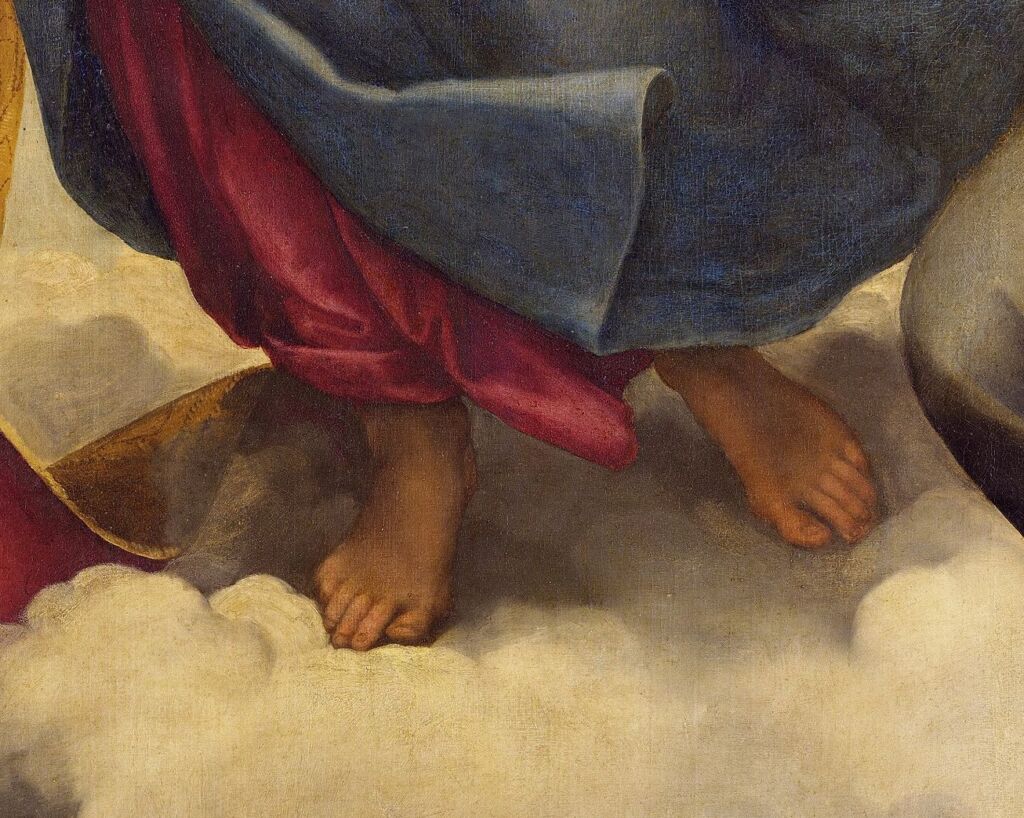
No steps, no throne, only a cloud her feet sink into slightly. The Madonna is walking toward us.
Two at the bottom edge
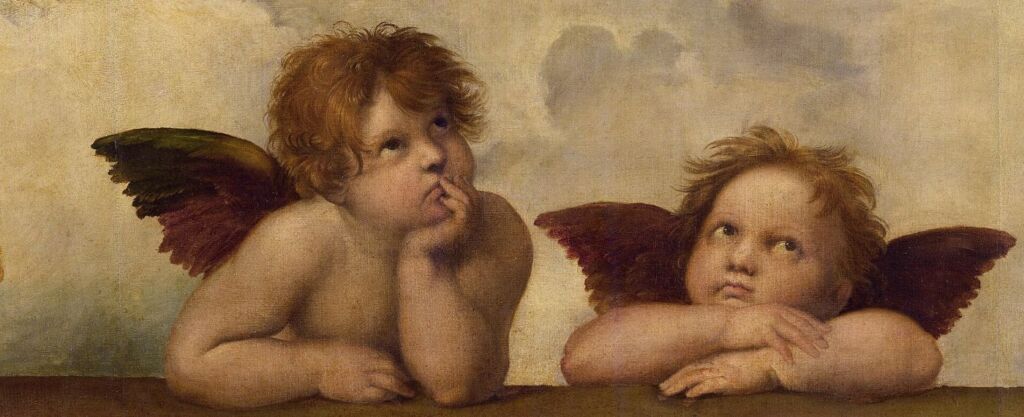
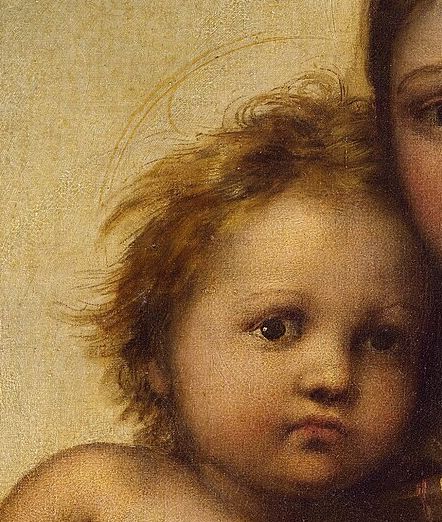
Raphael painted the two cherubs last, apparently for the sake of the composition. Britannica passes on a prettier story: the models were children the artist saw while he worked. Nothing confirms it.
Around 1800 the cherubs were first copied on their own, though Russian visitors of the early 19th century still looked at them with reverence. The sculptor Samuil Galberg, visiting in 1818 with fellow graduates of the Imperial Academy of Arts in St Petersburg, likened them to children of eternal light and admitted that here he first recognized Raphael as the greatest painter.
Then the cherubs took on a life of their own, on postcards and stamps, wrapping paper and T-shirts. Today they rank among the best-known images in art history, though many who recognize them at a glance could not say at whose feet they sit.
An hour with the Madonna
Zhukovsky, Russia’s leading Romantic poet and a tutor at the imperial court, came to Dresden in April 1821 and visited the gallery six times. It annoyed him that the painting was lost among its neighbors, with nowhere to sit before it. Then he got it to himself: “I was alone; all around me was quiet.”
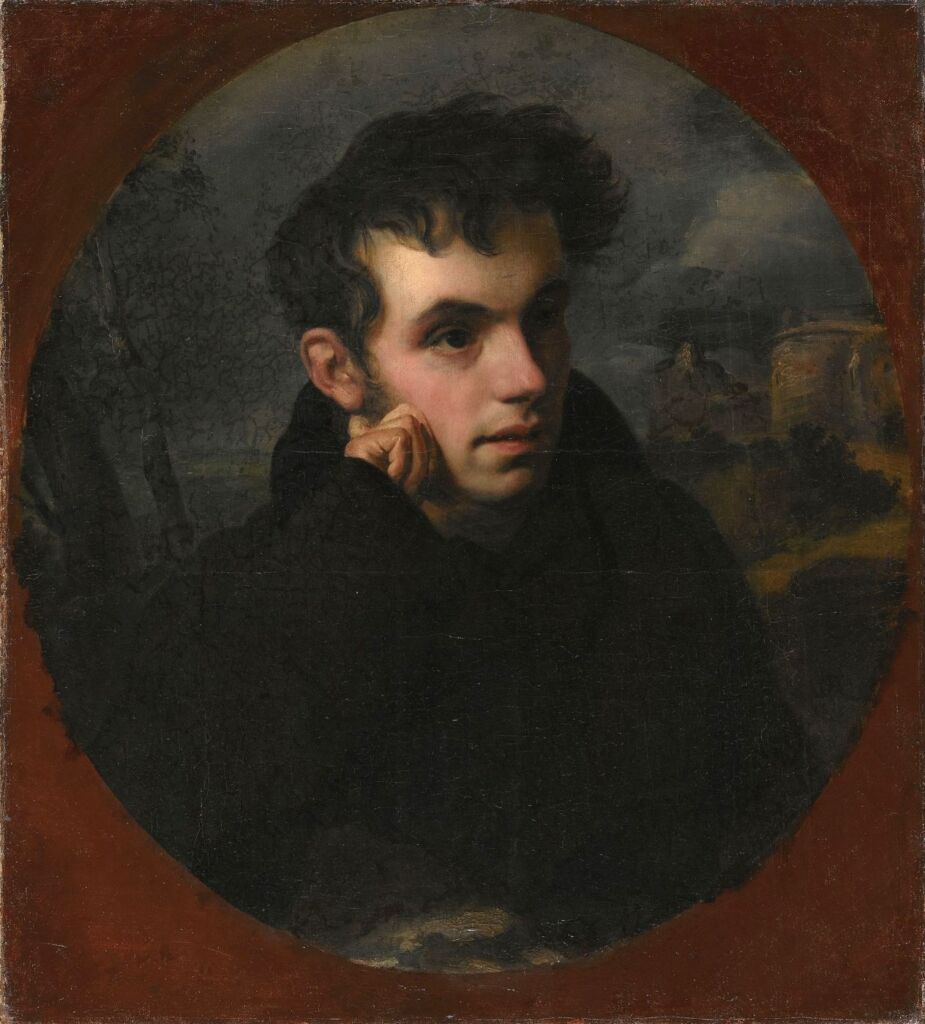
“The hour I spent before this Madonna belongs among the happy hours of my life,” he wrote in June 1821 to Grand Duchess Alexandra Feodorovna, the future empress (Russian quotations without a named translator are translated here by Hroniki). He retold the German Romantic Wilhelm Heinrich Wackenroder’s legend that Raphael saw the image in a dream. “Surely some angel woke him,” Zhukovsky remarks. Then, more briefly: “This is not a picture but a vision.”
The vision appears, he explains, only when “you see neither the frame nor the other pictures.” Hence his irritation with the crowded hang.
An excerpt, printed in the almanac Polar Star for 1824, contains the phrase “the genius of pure beauty was with her.” Four years after the letter, the same words surfaced in Alexander Pushkin’s “I remember a wonderful moment,” one of Russia’s best-loved poems.
Raphael painted an altarpiece for one church in a provincial town. Four centuries later, people stood in line for it more than 1,200 miles from Piacenza.
The painting moved Leo Tolstoy, too. In 1857 he spent under two days in Dresden and wrote in his diary that he had stayed cold to everything except the Madonna; later a lithograph of it hung in his study. His feelings changed with age: in 1902, the philosopher Sergei Bulgakov recalled, the mere mention of the Madonna enraged him.
Dostoevsky put Raphael above all painters, and his wife, Anna, recalled that he considered the Sistine Madonna Raphael’s “highest work.” He first saw Dresden in 1862; in spring 1867, when the newlyweds lived there, he took Anna to the picture. She wrote in her diary: “What beauty, what innocence and sadness in that divine face.”
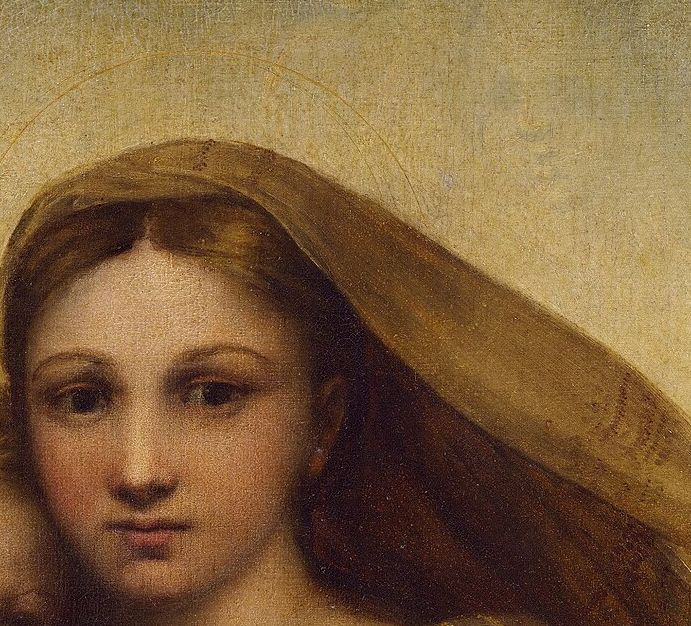
And she added: “Fedya finds sorrow in the Madonna’s smile.” Dostoevsky had already lent that sorrow to a character. In Crime and Punishment, Svidrigailov says of his very young fiancée: “the Sistine Madonna’s face has something fantastic in it, the face of mournful religious ecstasy” (in Constance Garnett’s translation).
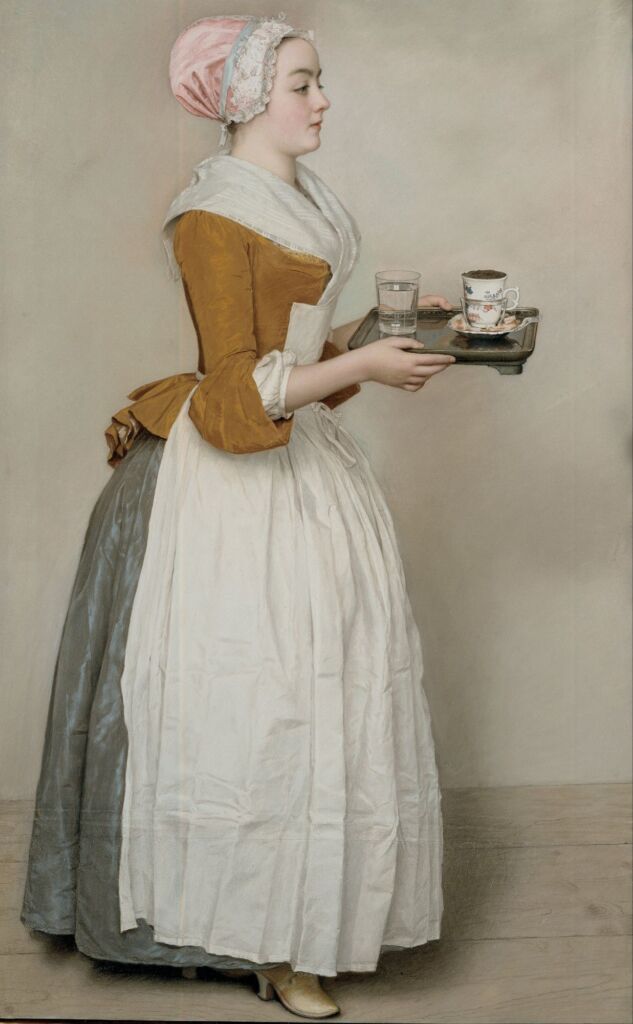
In the same gallery he lingered before Titian’s The Tribute Money and loved Liotard’s The Chocolate Girl. His tastes ran wide: that summer in Basel he could not tear himself away from Holbein’s The Body of the Dead Christ in the Tomb.
The photograph above the sofa
Dostoevsky could never find a good large photograph of the Madonna, abroad or in St Petersburg’s print shops. He once complained of it to Countess Sofia Andreyevna Tolstaya, widow of the poet Aleksey Tolstoy, not Leo Tolstoy’s wife of the same name. Some three weeks later, Anna recalls (in Russian), the philosopher Vladimir Solovyov arrived with an enormous cardboard package.
Inside, in mid-October 1879, was a photograph from the countess’s friends in Dresden: the Madonna life-size, without the saints and angels. Anna had it framed in dark oak and hung it above the sofa where her husband slept, in time for his birthday at the end of the month.
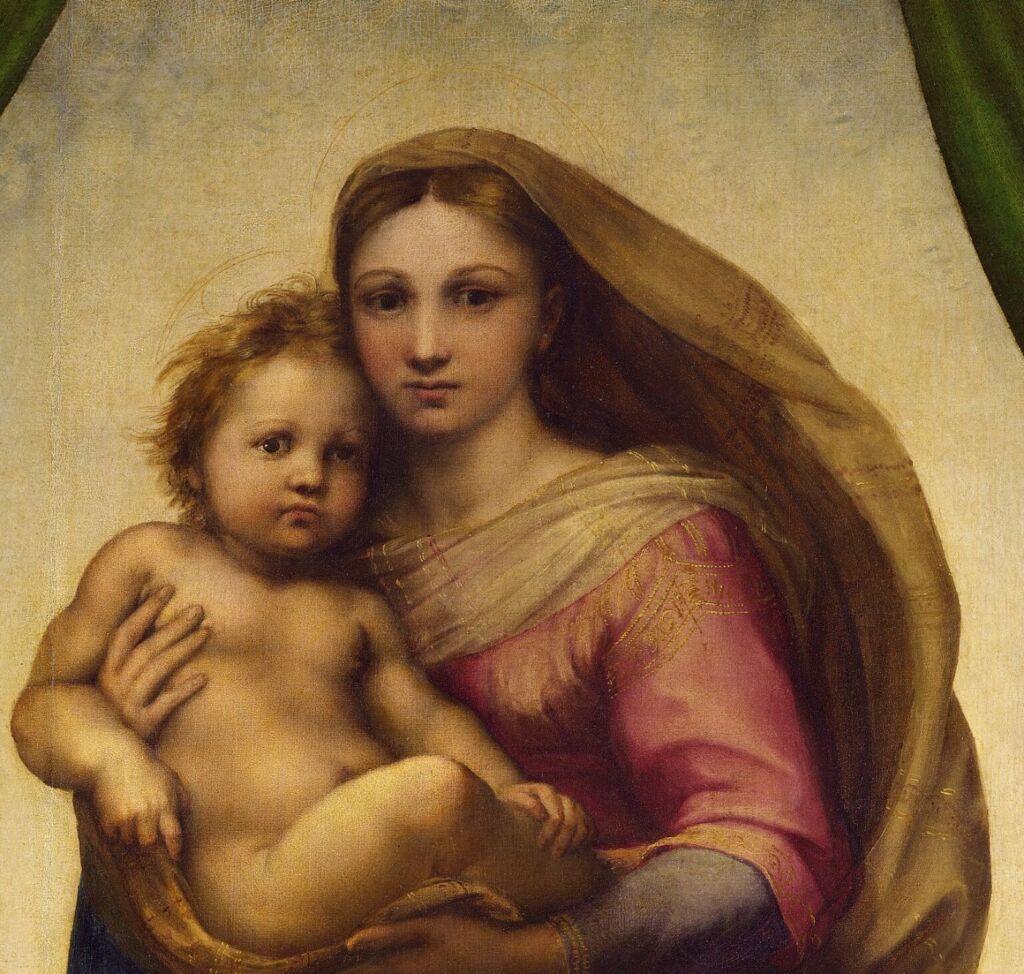
More than once she found him before it “so deeply moved that he did not hear me come in.” Beneath this Madonna, on that same sofa, Dostoevsky died in 1881.
The photograph was later lost. It passed to the writer’s son, whose Petrograd apartment stood empty for years, and there the trail ends. The State Hermitage has a print that researchers consider very likely the one, but its provenance is unknown. A copy hangs above the sofa in the memorial study of the Dostoevsky Museum in St Petersburg.
A tunnel, Moscow and the road back
During the war the Dresden gallery was emptied into storage sites outside the city. The Sistine Madonna was hidden in a tunnel in Saxon Switzerland, south of Dresden, and so escaped the February 1945 bombing that destroyed the city center.
In spring 1945 Soviet soldiers found the hiding places. Here the accounts diverge. In the Soviet version, the paintings were rescued from damp tunnels where they faced ruin; historians and some of the searchers later objected that the tunnel had been dry. Either way, that year the painting left for Moscow with other “trophy” masterpieces.
In August 1945 the Dresden collection was taken into the Pushkin Museum of Fine Arts, and among those who received it was young Irina Antonova, later the museum’s director. For ten years the pictures were hardly shown but were restored, and the painter Pavel Korin played a large part in that work. He also made a small tempera copy of the Madonna on paper, 23 by 17 centimeters, now in the State Tretyakov Gallery.
Antonova later said the painting was forever bound up, in her memory, with her country’s deliverance. It had waited out the war in a tunnel and come to a city that had barely survived it.
After Stalin’s death, the collection was to be returned to Germany. First it was shown to Muscovites: from May 2 to August 20, 1955, huge lines formed for the Madonna. The writers Vasily Grossman and Leonid Volynsky each tied the painting to their own fate. Grossman’s essay “The Sistine Madonna,” unpublished in his lifetime, argues that nothing is higher than what is human in a human being.
That same year the painting went back to Dresden. Today it hangs in the Gemäldegalerie Alte Meister, in Gottfried Semper’s building at the Zwinger.
Zhukovsky complained that the Madonna got lost among her neighbors. Since 1955 the approach to her has been laid out as in a church, like the one Raphael painted her for. She is in no danger of getting lost again.
Comments
For Hroniki readers
Comments are open to readers with an account. Signing up is free and takes a few seconds.
No comments yet. Start the conversation.