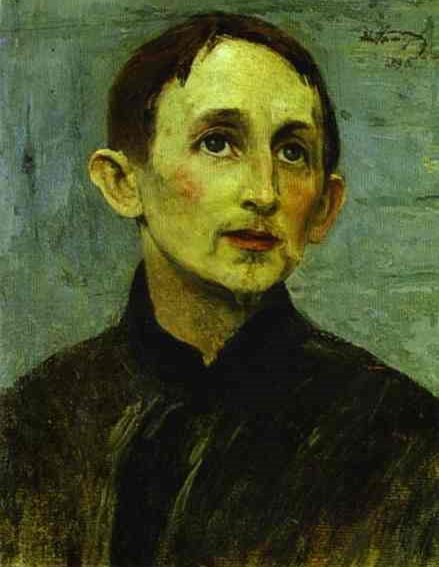
Apollinary Vasnetsov
Apollinary Mikhailovich Vasnetsov · 1856, Ryabovo village — 1933, Moscow
Biography
He never studied at the Academy of Arts. The son of a priest from the village of Ryabovo near Vyatka, Apollinary Vasnetsov was born on August 6, 1856 (July 25, Old Style), and was orphaned at thirteen. He graduated from the Vyatka church school, took Sunday lessons from the exiled Polish artist Michał Andriolli, and in 1872 left for St Petersburg to join his elder brother, the painter Viktor Vasnetsov. For three years he lived among his brother’s friends and learned from them: Vasily Polenov, Ilya Repin and the sculptor Mark Antokolsky.
Then came an abrupt turn. In 1875, under the influence of Populist ideas, Vasnetsov qualified as a village schoolteacher and gave up painting. He came back to it in Moscow, where he moved in 1878. From 1882 he spent his summers at Akhtyrka near Abramtsevo, close to the circle of the patron Savva Mamontov, and in 1885 he began working as a stage designer for Mamontov’s Private Opera.
His first success came in 1883. At the Peredvizhniki exhibition he showed a small landscape, A Gray Day (it also goes by a variant Russian title, Sery denyok), and Pavel Tretyakov bought the canvas. Vasnetsov became a member of the Peredvizhniki association in 1888. His Homeland (1886) also entered the Tretyakov Gallery. In 1900 he was elected an academician, and in 1903 he was among the founders of the Union of Russian Artists. In 1908 he designed Rimsky-Korsakov’s Sadko and The Legend of the Invisible City of Kitezh for the Mariinsky Theatre.
But his central subject was a Moscow that no longer exists. The All Saints Stone Bridge. Moscow in the Late 17th Century (1901) reconstructs a bridge dismantled in the mid-19th century, drawing on plans from the time of Peter the Great, old engravings and archaeological finds. The same year he painted Old Moscow, now in the State Russian Museum. In the early 1920s, commissioned by the Moscow Municipal Museum, today’s Museum of Moscow, he created a cycle on the city from the 12th to the 19th century; it includes The Old Mouth of the Neglinnaya River (1924).
Vasnetsov worked almost like a scholar. He visited excavations, climbed down into sewer trenches and studied old masonry and wooden road surfaces. Each Moscow composition came with a sketch, a plan and an explanatory text. He combined charcoal, watercolor and Italian chalk to achieve precision in architectural detail. Alexandre Benois called him an “artistic archaeologist,” and there was no irony in the phrase.
Historians of Moscow accepted him as one of their own. In 1901 he became a corresponding member, and in 1906 a full member, of the Imperial Moscow Archaeological Society. From 1901 to 1918, succeeding the late Isaac Levitan, Vasnetsov ran the landscape studio at the Moscow School of Painting, Sculpture and Architecture. From 1918 he headed the Commission for the Study of Old Moscow.
He spent his later years in an apartment in Furmanny Lane, where he had lived since 1903. In 1931 he protested against the demolition of the Cathedral of Christ the Savior in a letter to Izvestia; sources disagree on whether it was published. Apollinary Vasnetsov died on January 23, 1933, and was buried in the Vvedenskoye Cemetery.
The most valuable part of his paintings and drawings is held by the Museum of Moscow, which he helped to found. His pictures are also in the State Tretyakov Gallery and the State Russian Museum. Since 1965 his apartment at 6 Furmanny Lane has been a memorial museum and a branch of the Tretyakov Gallery; it holds more than nine thousand items, including about two hundred paintings.
Major works
Click a painting to see the details.
-
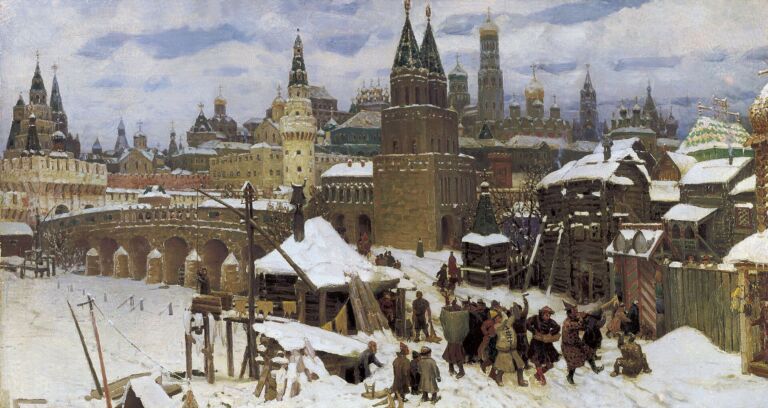 01
The All Saints Stone Bridge. Moscow in the Late 17th Century
1901 · Yaroslavl Art Museum
Related artists
 Viktor Vasnetsov
1872–1926 · elder brother, mentor
 Vasily Polenov
1872–1875 · teacher
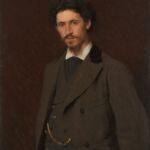 Ilya Repin
1872–1875 · teacher
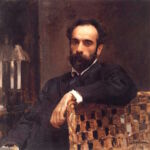 Isaac Levitan
1901 · predecessor at the landscape studio of the Moscow School of Painting