The Ninth Wave: Aivazovsky and the wave that sailors feared most
The most famous storm in Russian painting: where its title comes from, how Aivazovsky painted the sea from memory, why his contemporaries argued about him, and where to see it after its first full restoration.
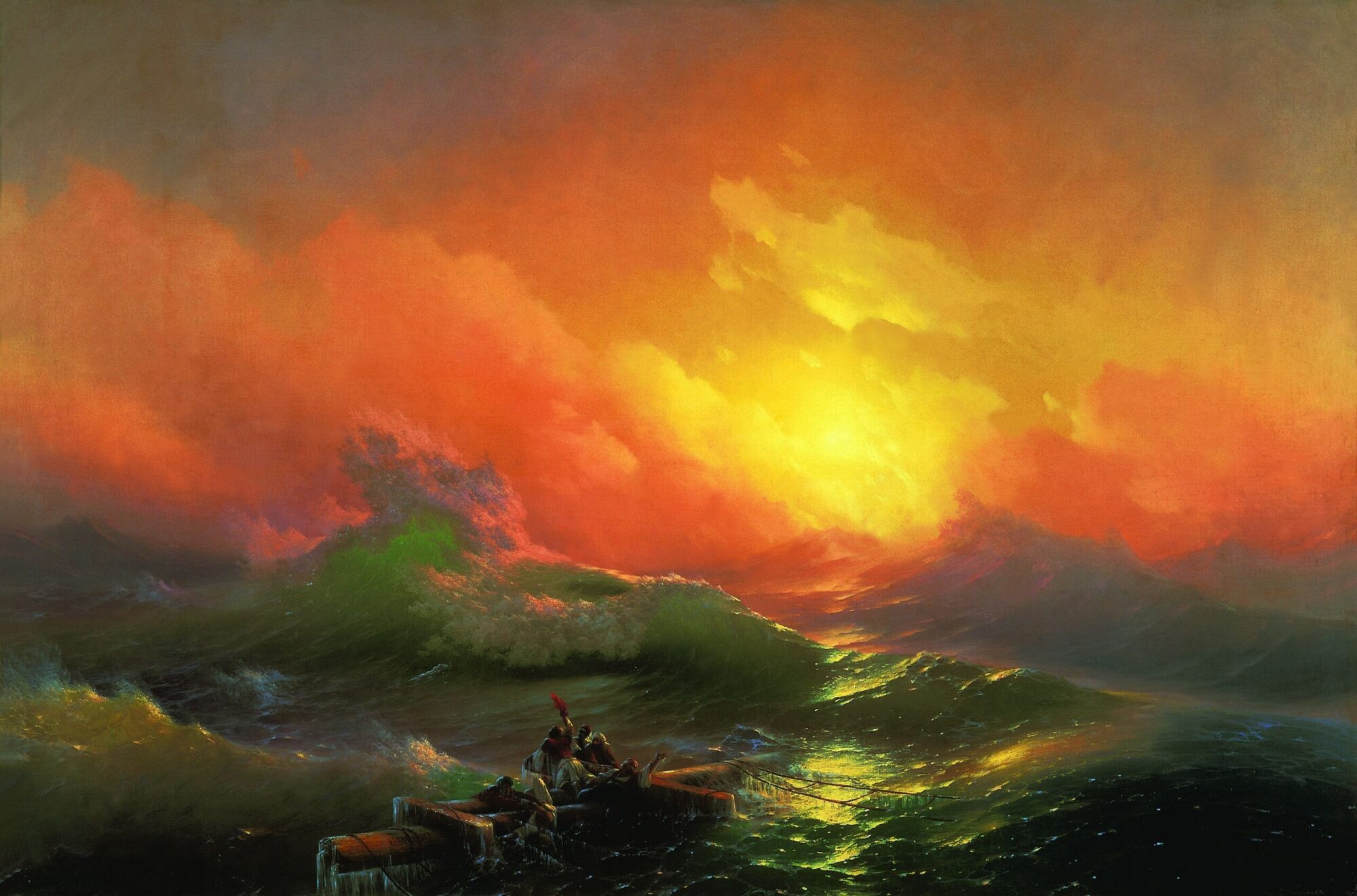
In 2026, The Ninth Wave came down from the wall of Room 14 in the Mikhailovsky Palace and went to the Benois Wing, not on loan but for the first full restoration in its history. In Russia it is about as familiar as a painting gets, yet up close it turned out to be an ordinary old object, with craquelure, cracks and yellowed varnish. After about four months of work it went back on view on October 16, 2026, which makes this a good moment to look at it again: not as a postcard but as a painting with an author, a date, an audience and a history of its own.
Ivan Aivazovsky painted it in 1850, oil on canvas, 221 × 332 cm (87 × 131 in), inv. Zh-2202. Its owner, the State Russian Museum in St Petersburg, calls it his most popular and best-known work.
What comes after the ninth wave
The title comes from a sailors’ belief: storm waves come in a series, and the ninth is said to be the strongest and most dangerous. The number is a convention. The Great Soviet Encyclopedia (in Russian) notes that the ancient Greeks feared the third wave most and the Romans the tenth. In some seafaring traditions, the fatal wave is the seventh.
In Russian the phrase left the sea long ago. The same encyclopedia defines it (translated by Hroniki) as a symbol of “formidable danger or the highest surge of a mighty, irresistible force” in art, journalism and everyday speech. Poets of the 19th century and revolutionary writers of the early 20th took it up. Margarita Aliger used it in her poem Zoya, Ilya Ehrenburg as the title of his 1951–52 novel, The Ninth Wave, and Ilf and Petrov parodied it in The Golden Calf. But it was Aivazovsky who made the image visible: for most Russians the phrase calls up his painting.
The belief has a second half, less often remembered: after the strongest wave, the storm is supposed to die down. Aivazovsky shows neither the storm’s height nor its end but the moment between: the worst is still to come, but after it the calm may begin.
Painted from memory
By 1850 Aivazovsky, 33, was famous. An academician since 1845, he lived in his native Feodosia, on the Crimean coast, and in 1847 became a professor at the Imperial Academy of Arts, the state academy that trained and ranked Russia’s artists. His European fame dated from a long stay abroad in the 1840s. Biographers rarely discuss The Ninth Wave without one episode from those years: in the Bay of Biscay his ship hit a violent storm, and the papers reported him dead.
The storm was real, and the obituary premature. But we have found no statement by Aivazovsky himself that The Ninth Wave grew out of that experience. Later writers made the link, so treat it as a hypothesis. Besides, several years passed between the storm and the painting. What is documented is that he almost never painted the sea from life. Its page in the Russian Museum’s collection (in Russian) quotes him: “the movements of the living elements elude the brush: to paint lightning, a gust of wind, the splash of a wave from life is unthinkable.” A scene, he said, took shape in his memory “the way a poem’s subject comes to a poet.”
People noticed the method early. In 1837 Nestor Kukolnik’s Khudozhestvennaya Gazeta (The Arts Gazette) described the young artist watching the sea at Peterhof: “greedily, like an ant, he stocked up on memories” (translated by Hroniki). Almost half a century later, in an 1885 essay for the journal Nov, Spiridon Caccioni quoted Aivazovsky (here and below in The Tretyakov Gallery Magazine‘s translation): “Besides my hand and my imagination, my paintings are always created with the aid of my artistic memory also.”
Working from memory also explains his prodigious output. Encyclopedias credit him with about 6,000 paintings, a figure often traced back to the artist’s own count, but it is an estimate: no complete scholarly catalog of an output that large exists. The same goes for the popular story that The Ninth Wave took eleven days to paint: it has no primary source. His contemporaries wrote about his speed; the exact count of days is closer to legend.
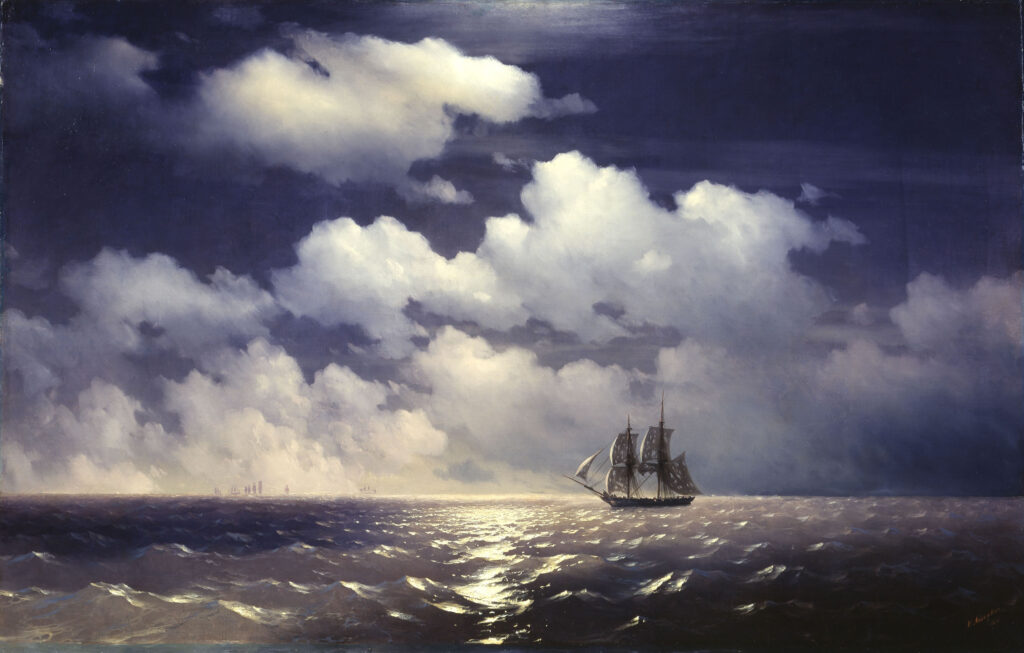
In 1848, two years before The Ninth Wave, Aivazovsky painted the brig Mercury after its victory over two Turkish ships, also in the Russian Museum. There it is all military glory: flags, a ship under full sail. The Ninth Wave is the reverse: no fleet, no victory, not even a ship.
The ship is already gone
The disaster happened before the painting begins. Low and a little left of center, a handful of people clings to a broken mast. Tiny against the sea, they still draw the eye back: this is the only spot where the storm has witnesses.
Above them, on the left, curls the wave that named the painting. It hangs over the people; you feel the danger before you grasp it. Popular analyses note that the crest resembles shore surf more than an open-ocean wave. Aivazovsky needed menace overhead, not hydrodynamic accuracy.
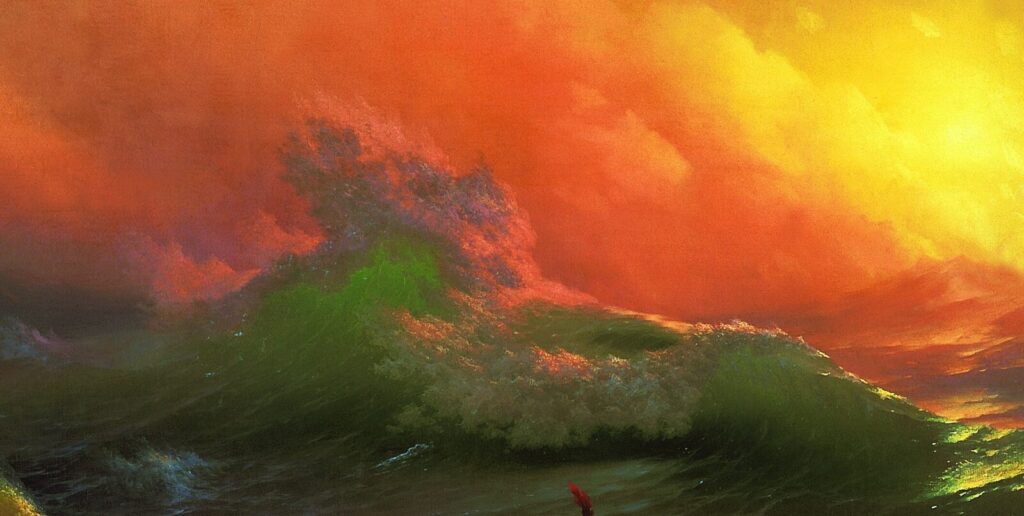
One survivor holds a red cloth over his head, as if signaling. To whom is unclear: there is no sail or shore on the horizon. This tiny scrap holds the whole color scheme together. The red returns in the sky, tying the people on the mast to the light.
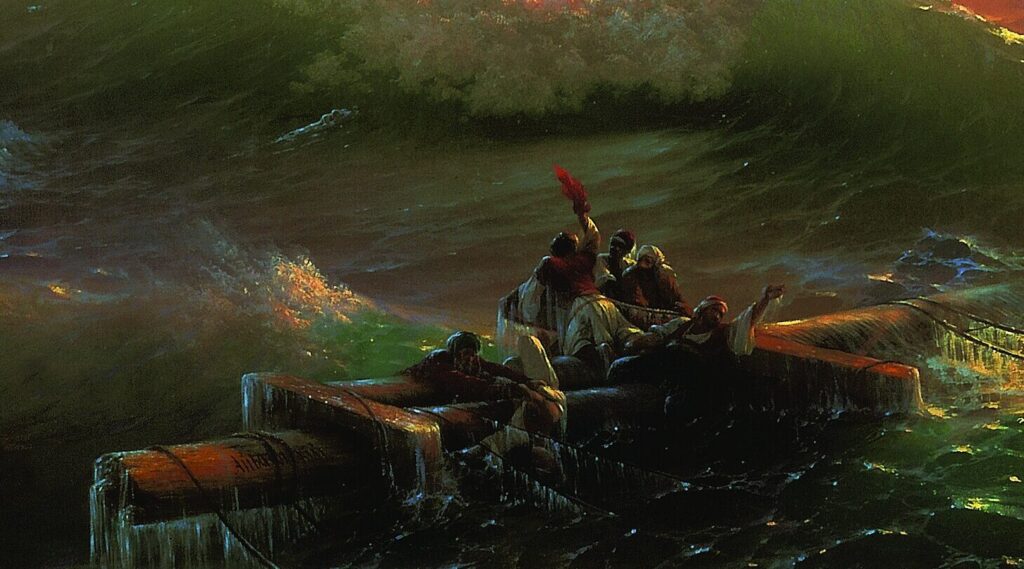
The light comes from the center, slightly right, where the sun breaks through spray and cloud. The sky burns red, orange and gold, surprisingly warm for a shipwreck. The Russian Museum calls it “the light of hope” breaking the darkness of night, and reads the picture not as a scene of death but as a story of the will to survive triumphing over the ocean. The warm sky, the raised signal and the old belief that this is the last and worst wave all feed that hope.
Up close, near the crests, the water inside the waves turns translucent and greenish, letting light through. It was his signature effect, praised by contemporaries: 1850s reviewers already admired “that transparency of the air” and the truthful “life of the sea.”
There is almost no horizon. Where sea meets sky, everything dissolves in spray, and the space closes in. The people have nowhere to swim, the eye nowhere to go but toward the sun.
Aivazovsky chooses neither the height of the storm nor its end but a split second on the edge: the worst is still ahead, but beyond it the calm may already begin.
A tsar bought it, Dostoyevsky had doubts
Success came fast. Nicholas I bought the painting for the Russian Gallery of the Imperial Hermitage, so it went straight into a state collection, not a private home. The often-repeated online story that Pavel Tretyakov, the Moscow merchant whose collection became the State Tretyakov Gallery, wanted it does not fit the dates. According to the Tretyakov Gallery itself, Tretyakov bought his first painting by a Russian artist only in 1856, when The Ninth Wave had been in the imperial collection for six years.
It is often compared in popularity with Karl Bryullov’s The Last Day of Pompeii; fittingly, both hang in the Russian Museum’s Academic Hall.
Natalya Kalugina surveys his 19th-century critics in an article for The Tretyakov Gallery Magazine. The sculptor and critic Nikolai Ramazanov caught the tone of the 1850s in Moskvityanin in 1854: “None of our artists portrays as accurately as does Aivazovsky the life of the sea.”
The praise was not unanimous. Reviewing the 1861 Academy exhibition, Fyodor Dostoyevsky compared Aivazovsky to Alexandre Dumas père: “Ordinary things, they despise,” he wrote, and their compositions were “certainly quite fascinating.” It was not a compliment: that was how one talked about a master of effects. In the same review, about another canvas, Storm over Yevpatoria, he admitted it was “just as wonderful as are all his storms” and added that here, in storms, he was “a master without competition.”
The split lasted to the end of the century. Crowds packed his shows, while realist critics accused him of a weakness for outward effects. In 1885 Caccioni found a formula that settles the argument: not a marine painter but “a painter of the elements.” The Ninth Wave fits that formula best: here the sea is not scenery but a character.
One shipwreck, told many times
People alone against the sea run through his whole career, and The Ninth Wave is less an exception in that line than its peak. Beside it, you see how differently he handled the same situation.
The Wreck of the Ship Ingermanland in the Skagerrak shows a real disaster: in August 1842 a ship of the line was wrecked off the Norwegian coast, killing 389 people. It hangs in the Central Naval Museum in St Petersburg.
In 1889, almost forty years later, he returned to the shipwreck in the huge Wave, 304 × 505 cm (120 × 199 in), also in the Russian Museum. The mood is the opposite: low leaden clouds, a cold palette, a sinking ship and drowning sailors, with no promise of dawn. The museum points out that he was 72 when he painted it and that the picture already leans toward realism.
The Survivors (1895, private collection; the Wikimedia Commons title) takes the same subject but puts the outcome in the title: these people survived. Among the Waves (1898), one of his last large storms, came two years before his death. It belongs to the Aivazovsky Art Gallery in Feodosia, the town where he spent most of his life and where he painted The Ninth Wave.
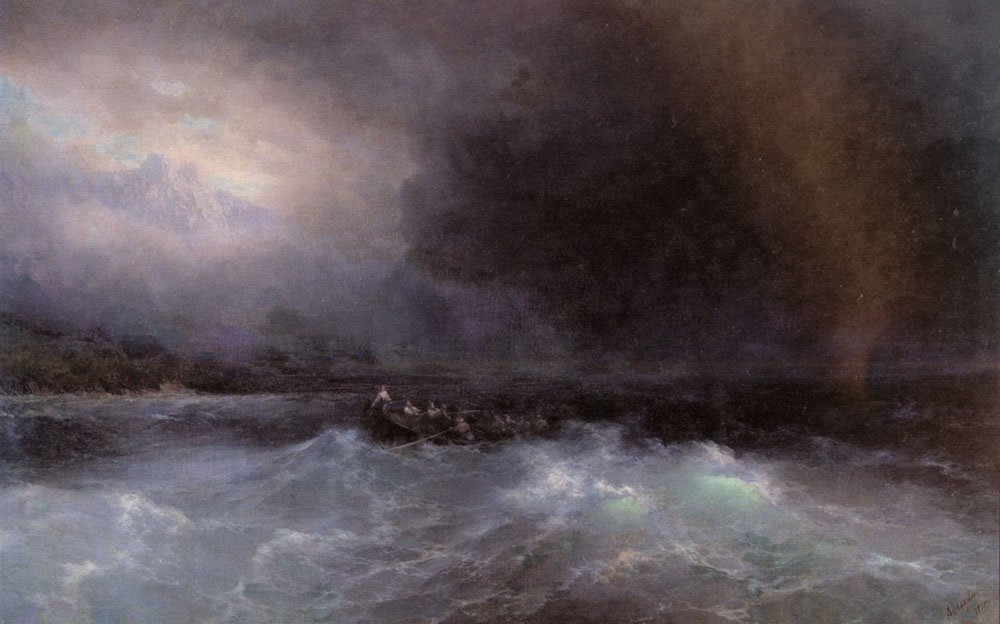
Side by side, The Ninth Wave and Wave show the artist’s whole path, from a Romantic faith in rescue to a sober, almost documentary view of the elements.
A long life in the Mikhailovsky Palace
In 1897 the painting moved from the Hermitage to the Russian Museum of Emperor Alexander III, becoming one of the first works in its collection; the museum opened to the public in 1898. Its gilded, carved frame came with it. The frame was restored alongside the painting: more than 100 lost carved pieces were recreated in linden wood and gilded.
It usually hangs in the Academic Hall, Room 14, next to Bryullov. In summer 2016 it went to Moscow for the Tretyakov Gallery’s retrospective for Aivazovsky’s 200th birthday, seen by about 555,000 people, then a record for the gallery’s temporary exhibitions. In 2025 it opened the exhibition Oh, Sea, Sea! in the Benois Wing, on three centuries of Russian marine painting.
In 2026 the painting underwent its first full scientific restoration; earlier work had been local. The project took about four months and began with technical studies: chemical, biological and X-ray analysis. Conservators consolidated the ground and paint layer across the whole surface, secured the flaking areas and restored the varnish. The work was done in an open studio in the Benois Wing, where visitors could watch. Since October 16, 2026, The Ninth Wave has been back on view (in Russian) at the Russian Museum’s exhibition for Aivazovsky’s 210th anniversary: about 200 works, including paintings from Russia and Belarus and three large works from the Admiralty collection never shown before. The show runs until May 10, 2027.
Up close, the canvas breaks into details: the clear water, the red rag, the fingers gripping the mast. From the far wall, the sun pulls everything into a single movement, from the dark wave on the left toward the light on the right. Until May 10, 2027, visitors can stand at both distances again. For Russian landscape after Aivazovsky, a good next stop is Ivan Shishkin’s Morning in a Pine Forest, in Moscow’s State Tretyakov Gallery.
Comments
For Hroniki readers
Comments are open to readers with an account. Signing up is free and takes a few seconds.
No comments yet. Start the conversation.