Why Liotard’s Chocolate Girl has rarely left Dresden in 280 years
Pastel can be damaged by a mere shake, and Jean-Étienne Liotard's The Chocolate Girl has spent nearly its whole life in Dresden. How this sheet on parchment was made, and why there is a glass of water on the tray.
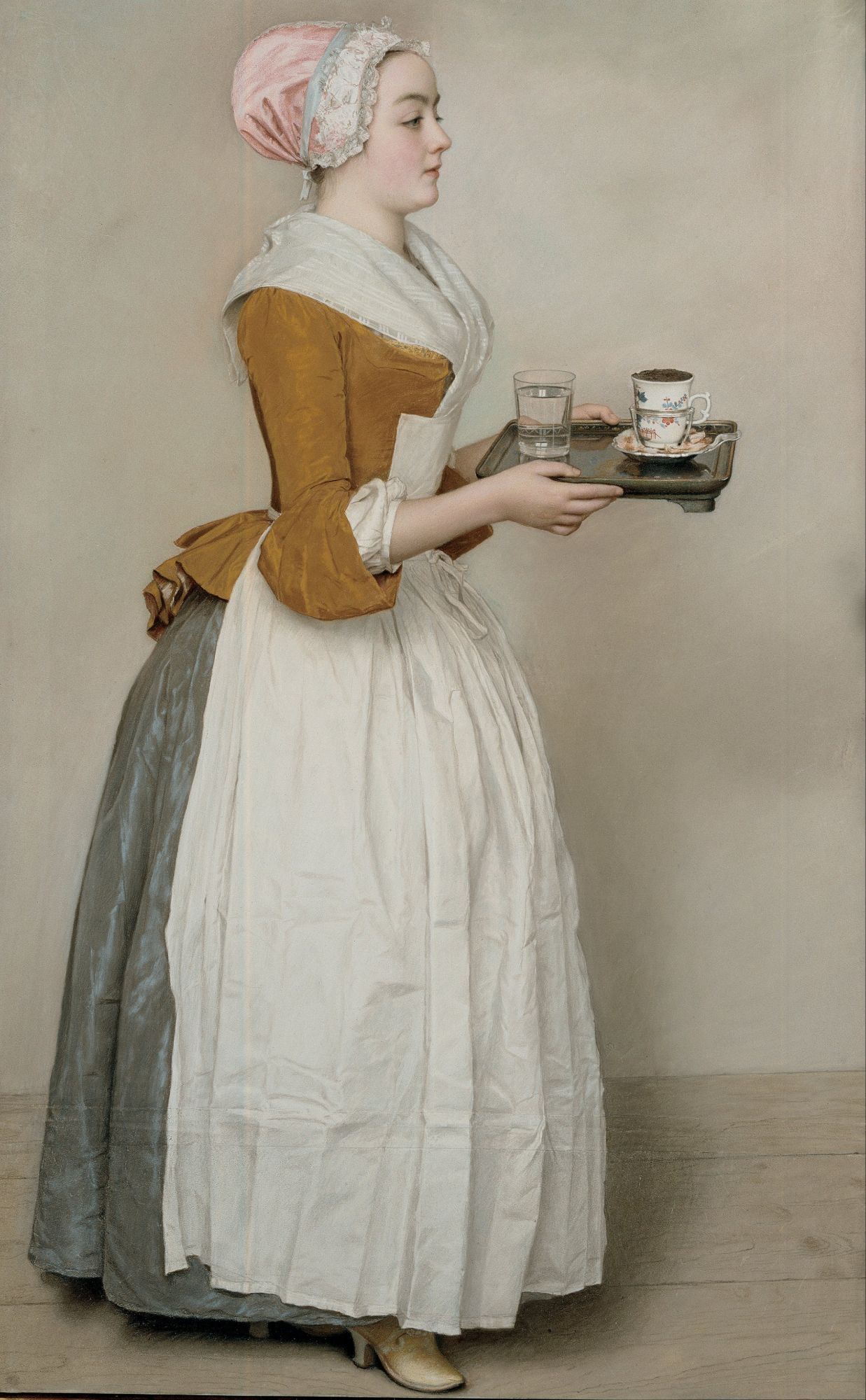
You can ruin a pastel without touching it: a shake is enough. Museums are reluctant to let such works travel, and Jean-Étienne Liotard’s The Chocolate Girl has spent nearly its whole life in Dresden, where it was bought in 1745. The young woman with the tray, drawn around 1744 (in German), still hangs there, in the Gemäldegalerie Alte Meister.
Pastel is almost pure pigment. The stick holds just enough gum, a plant binder, to keep it from crumbling, and the color does not sink into the support like oil; it sits on top like pollen. London’s National Gallery calls pastel an extremely fragile medium, sensitive to both light and movement.
Liotard made The Chocolate Girl on parchment, finely prepared animal skin. Its velvety surface grips the pigment and gives his pastels their famous porcelain smoothness, but parchment molds easily. Technical studies for a 2018 Dresden exhibition revealed how the sheet is built: carefully prepared underlayers, dense color, and the brightest highlights in tiny touches of gouache.
Its size does not help either: 82.5 × 52.5 cm (about 32½ × 20¾ in). That is large for a pastel, bigger than most of Liotard’s works, and it was given a carved gilt frame far grander than his usual ones. Fragile pigment in a heavy frame means every jolt on the road is a risk.
A glass of water and a Japanese-style tray
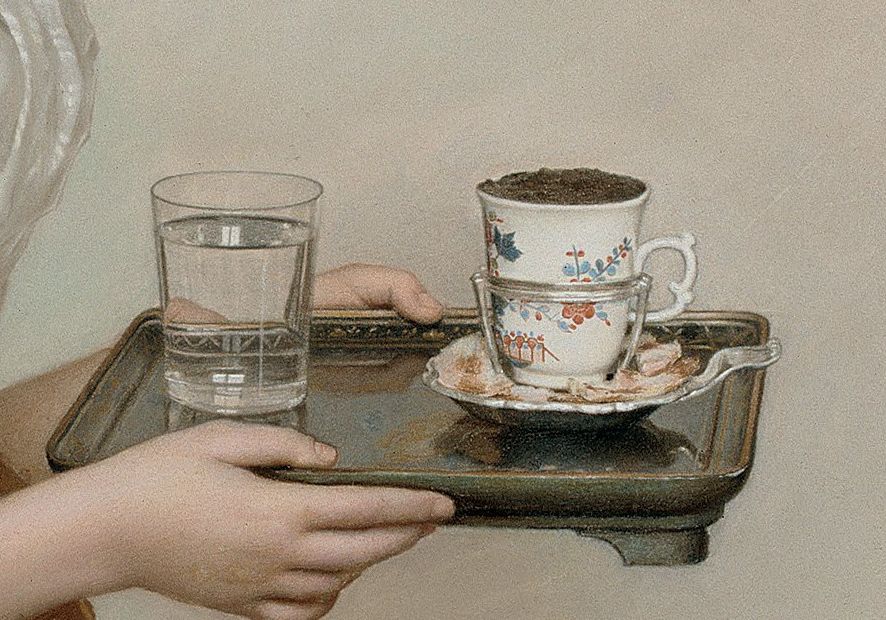
The glass of water is not decoration. In the 18th century thick chocolate was drunk with water, and the drink was expensive, so the cup is likely meant for someone of rank. Francesco Algarotti noticed the reflections as early as 1751: the room, he wrote, is lit by two windows, and both are reflected in the glass.
The tableware speaks of money too. According to the Dresden gallery, the lacquer tray and the porcelain cup follow Japanese models, that is, costly imports or copies of them. The cup sits in a silver holder with a ring, known as a trembleuse, which kept it from sliding off the saucer. Coffee and chocolate, the National Gallery in London notes, were exclusive luxuries, often taken at breakfast by those who could afford them.
It was Algarotti who bought the pastel. He bought paintings for Augustus III, Elector of Saxony and King of Poland, and in February 1745, in Venice, he paid Liotard 120 sequins (Venetian gold coins). There was no commission: the artist apparently made it on his own in Vienna and brought it with him. Liotard had come to Vienna in 1743 to paint Empress Maria Theresa and her family. Before that he had spent several years in Constantinople and returned in Eastern dress, which earned him the nickname “the Turkish painter.”
Algarotti called Liotard “a Holbein in pastel” and claimed that even Rosalba Carriera, the leading pastelist of the age, thought it “the most beautiful pastel ever seen.” Nearly three centuries later, Carriera’s words became the title of the 2018 Dresden exhibition.
A housemaid without a name
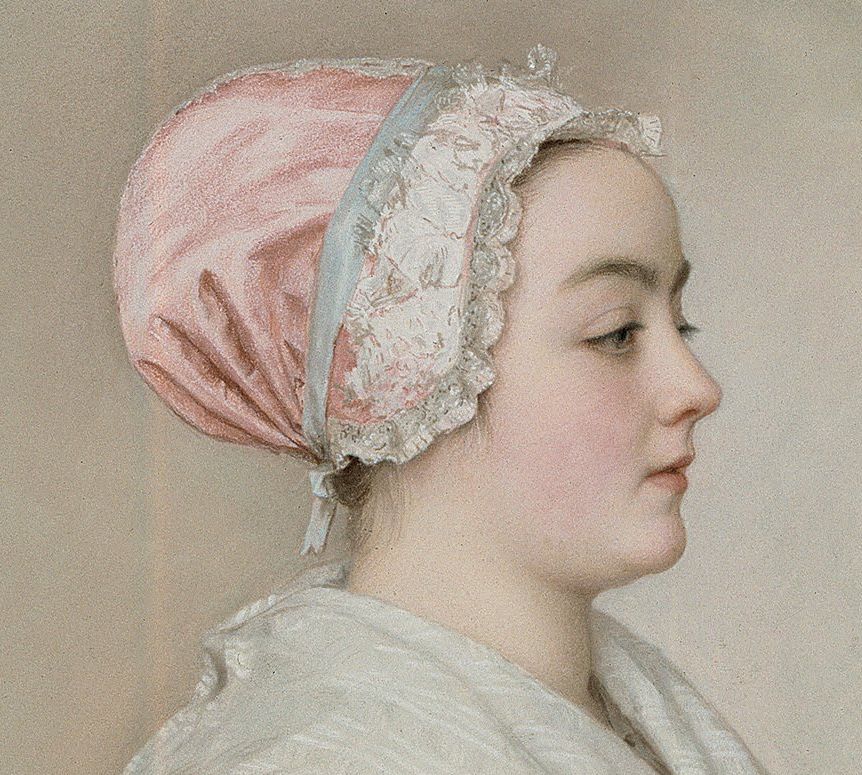
No one knows who posed. The museum calls her an unidentified housemaid. Legend names her Anna Baldauf and marries her off to Prince Dietrichstein. There are no documents, and the versions disagree even on whose daughter she was, a Viennese coachman’s or a banker’s. Back in 1864 a Dresden guidebook warned against confusing the model with the Anna Baldauf who married Dietrichstein in 1802.
She has no name, but she has countless copies. From the 19th century on, the girl with the tray turned up in folk art and advertising, and the Meissen manufactory made a porcelain figurine of her. In 1862 Walter Baker & Company of Dorchester, near Boston, adopted her as its emblem under the French name La Belle Chocolatière. As illustrated advertising boomed in America, her silhouette appeared for decades on cocoa tins, in magazines and on trade cards. The National Museum of American History keeps one of those tins.
The fragile sheet did make one more long journey. It sat out World War II in the casemates of Königstein Fortress; afterward it was taken to the Soviet Union with the rest of the Dresden collection and came back in 1955. When the gallery gave it its own exhibition in 2018, the others did the traveling: museums and private collections lent about forty works to hang beside it, among them the Louvre, the British Museum, the Rijksmuseum and the Getty. The show, with more than a hundred works, also made room for the picture’s second life in advertising: the images and copies that carried an anonymous Dresden housemaid’s face around the world while the sheet itself hardly left the city.
Comments
For Hroniki readers
Comments are open to readers with an account. Signing up is free and takes a few seconds.
No comments yet. Start the conversation.