The figure a critic wanted painted out of Perov’s Hunters at Rest
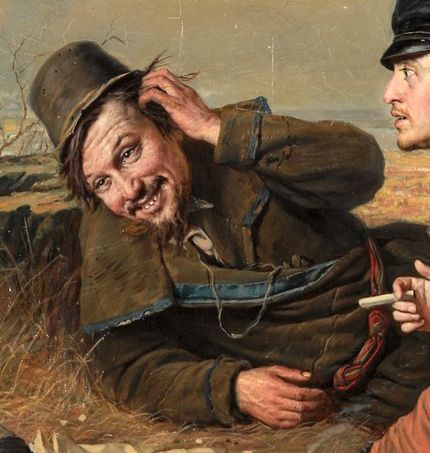
The satirist Mikhail Saltykov-Shchedrin advised Perov to paint one figure out of Hunters at Rest. According to tradition, he and the two hunters beside him were modeled on the artist's friends.
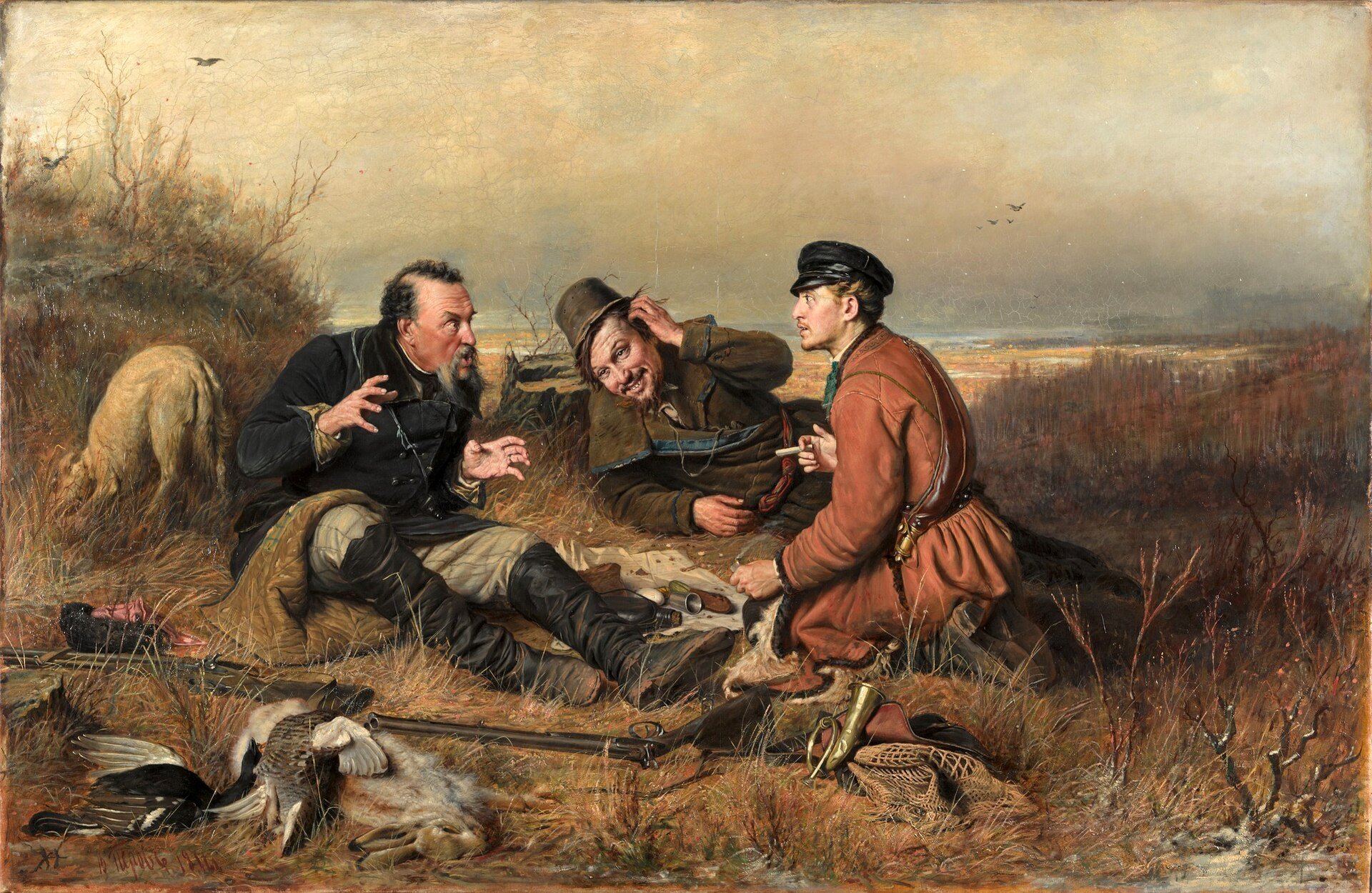
In December 1871 a reviewer signing himself “M. M.” in Otechestvennye Zapiski (Notes of the Fatherland) offered Vasily Perov a simple edit: paint out one man. The reviewer was the satirist Mikhail Saltykov-Shchedrin, as readers learned seven years later. By tradition, the man he wanted removed was modeled by a friend of the artist.
Perov showed Hunters at Rest that year at the Imperial Academy of Arts in St Petersburg, in the first exhibition of the Peredvizhniki, or Wanderers. Pavel Tretyakov bought it for his collection, now the State Tretyakov Gallery. One man lying, two listening needs no label; the real question is who sat for Perov.
Models from the same hunt
A keen hunter, Perov is generally believed to have used his hunting companions as models. No document confirms it; the names rest on tradition alone.
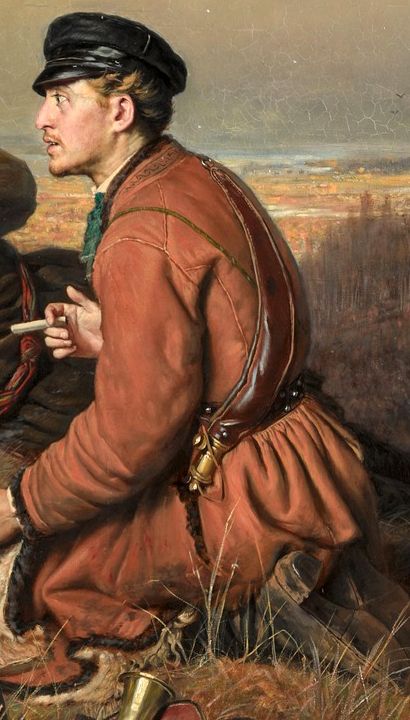
The group usually met before hunts at the home of Nikolai Nagornov, a 26-year-old civil servant. He became the novice who believes every word.
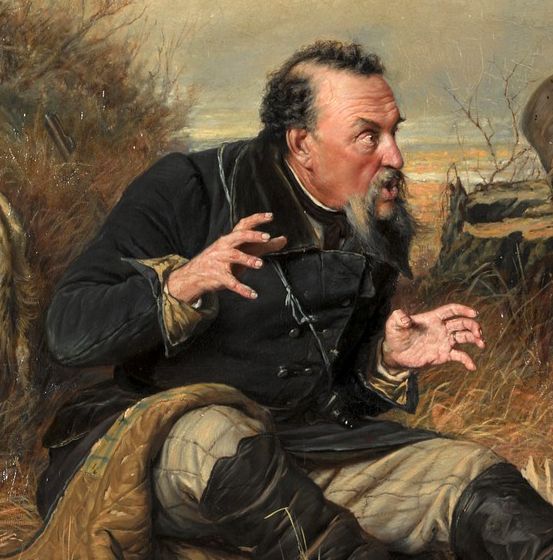
The storyteller was Perov’s friend Dmitry Kuvshinnikov. On canvas he lies with gusto; in life he was a police doctor. His wife, Sofia, kept a literary and artistic salon in Moscow, and more than twenty years later the couple came to be seen as models for Anton Chekhov’s story “The Grasshopper.”
The third was Vasily Bessonov, a doctor and amateur painter, whom Perov dressed as a peasant. Of the two listeners, only he doesn’t buy it. This was the figure Shchedrin disliked.
An actor speaking aside
Shchedrin did not savage the painting. Each figure alone, he wrote, was “the height of perfection.” Together they looked staged, as if an actor stood by “whose part requires him to speak aside: this one is the liar, and that one the dupe” (translated here and below by Hroniki).
Shchedrin’s actor was the “coachman” lying by the hunters, inviting the viewer “not to believe the lying hunter and to have some fun at the credulity of the novice hunter.” This, by tradition, is Bessonov. Without him, the critic argued (in Russian), the painting would only gain. He all but laid down a rule: “Artistic truth must speak for itself, not with the help of commentaries and interpretations.”
Perov got off more lightly than it seems. The same review praised his portrait of the playwright Alexander Ostrovsky and, among the landscapes, “a charming little picture,” Alexei Savrasov’s The Rooks Have Returned. His one complaint was the extra hint.
Shchedrin had a precise word for it. What somewhat harmed Perov, he wrote, was “a certain measure of premeditation.” He still called Perov “also a highly gifted artist” and said the exhibition as a whole “makes the most pleasant impression.” In Shchedrin’s reading, Perov did not trust his audience: afraid the joke would be missed, he sat a man beside it who laughs first.
The critic Vladimir Stasov saw the opposite that year. His review of the exhibition (in Russian) called the painting (for him, Hunters’ Halt) the best Perov had yet made, and the storyteller “a most talented pendant to Nikolai Gogol’s Nozdryov,” the braggart of Dead Souls. Judging by the notes to Shchedrin’s review, Stasov admired the very peasant Shchedrin wanted struck out.
Stasov’s own review describes that peasant almost exactly as Shchedrin did, but with the opposite verdict: “a peasant hunter scratching his ear, all but saying: ‘Good Lord, the things this man comes out with!'” Stasov hears the same aside that irritated Shchedrin, and he enjoys it.
He enjoys the liar too, telling his tale “with zest, with genuine fervor.” Stasov says nothing about anyone superfluous. It was all so true to life, he wrote, “that the picture ceases to be a picture.” His one general reproach to Perov concerned color: the paint, he said, was still “somewhat harsh.”
Lying the Russian way
Seeing the painting before it left for the 1873 Vienna World’s Fair, Fyodor Dostoyevsky wrote in A Writer’s Diary (in Russian) that the Germans could be told the plot but would not grasp “that this is a Russian liar, and that he lies in a Russian way.” In it, one “lies hotly and knowingly,” another “believes with all his might,” and the third “believes nothing, lies there beside them and laughs.” Shchedrin thought the coachman a needless hint; Dostoyevsky needed no hint to see the liar.
Before turning to the pictures, Dostoyevsky detours through theater. Translate Alexander Ostrovsky’s comedy It’s a Family Affair into German or French, he wrote, and “three-quarters of the comedy will remain completely inaccessible to European understanding.” This was the same Ostrovsky whose portrait, painted by Perov, Shchedrin had praised. Paintings, Dostoyevsky thought, were no different.
He chose his example on purpose and said so: “I deliberately name one of the most understandable pictures of our national genre.” A card game in an Estonian cabin, or a picture called The Ten of Spades, Vienna would get, since everyone plays cards. Hunters at Rest was harder. You can retell the plot, but the lie has to be heard: “We almost hear and know what he is talking about, we know the whole turn of his lying.”
Then he reversed the experiment. Had Perov painted French or German hunters, a Russian viewer, Dostoyevsky was sure, would catch their lying “with all its subtleties.” A German would never get the Russian kind, “however hard he strains,” and so would not value the painting properly. A pity, he added: “we are going there to be praised.”
He was harsher in the same piece on Nikolai Ge’s The Last Supper, where, he wrote, “there is no historical truth; there is not even the truth of genre.” He wrote nothing of the kind about Perov, whose picture he had himself called one of the most understandable of Russia’s national genre.
A few chapters later in the same Diary Dostoyevsky returned to the subject, this time without paintings. The chapter is called “Something About Lying,” and it opens with a question: “Why does everyone here lie, every single one?” His answer is surprisingly gentle. Russians, he argues, lie not for gain: “here, in the vast majority, people lie out of hospitality,” to give the listener pleasure.
Perov is not in that chapter, but hunting dogs are among the examples, next to a troika that beat the railroad on a bet. So is a line that could caption the storyteller at the halt: “halfway through a story you always start believing yourself.”
Perov kept the coachman, even in the smaller 1877 replica in the State Russian Museum, St Petersburg. The canvas is about half the size of the original on each side, and it reached St Petersburg in 1931 from the same Tretyakov Gallery. The three friends are still resting: a doctor who lies, a clerk who believes, and a friend dressed as a peasant who knows what both are worth.
Comments
For Hroniki readers
Comments are open to readers with an account. Signing up is free and takes a few seconds.
No comments yet. Start the conversation.