Courbet’s Desperate Man: the self-portrait he hid for nearly 30 years
For the Salon of 1844, Courbet chose a calm self-portrait with a dog. The one in which he clutches his own hair did not go on public view until 1873.
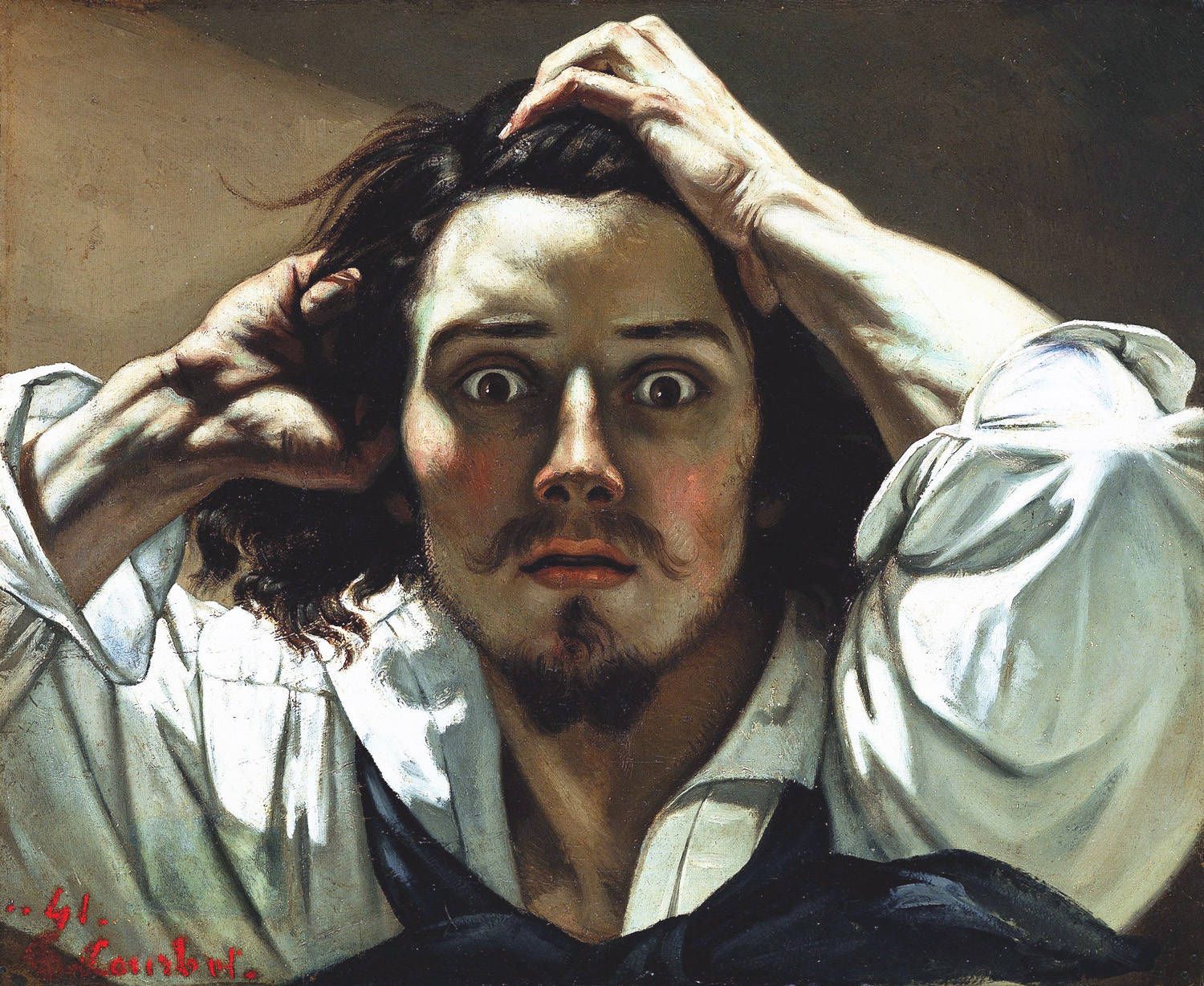
In the spring of 1873, alongside the Vienna World’s Fair, a small canvas titled Self-Portrait of the Artist hung in the rooms of the Austrian Art Society. Gustave Courbet had painted it in the mid-1840s and kept it ever since. He titled it Desperation only in the last year of his life.
Twenty faces of one man
In the early 1840s Courbet, a provincial from Ornans, was learning to paint in the Louvre by copying seventeenth-century Spaniards. His model was always at hand: his own face. Curators of the 2008 retrospective counted about twenty self-portraits, painted and drawn, from 1842 to 1855.
The one he showed the public was calm. Courbet with a Black Dog became, in 1844, the first of his works accepted by the Salon, listed as number 414 under the title Portrait of the Author. The date 1842 on the canvas, the Petit Palais believes, was added by Courbet later.
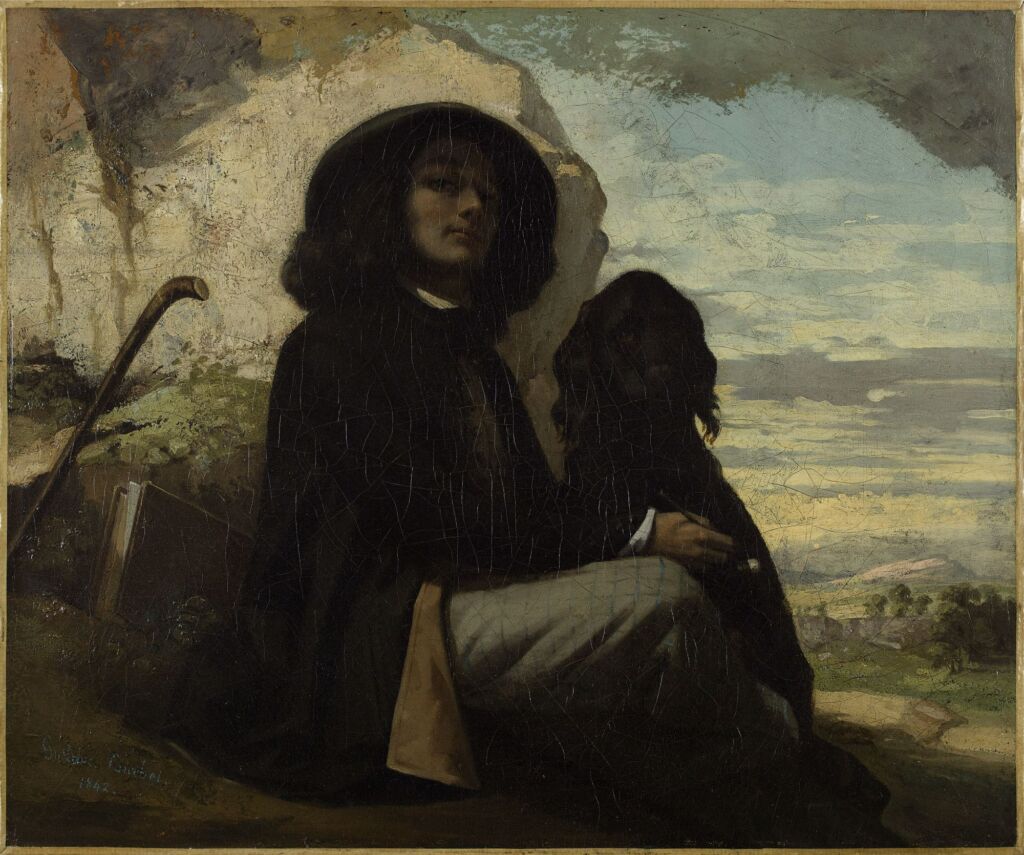
The two canvases are nearly the same size and shape. The Salon got the dapper young man with his dog, while the man clutching his hair stayed hidden for nearly thirty years.
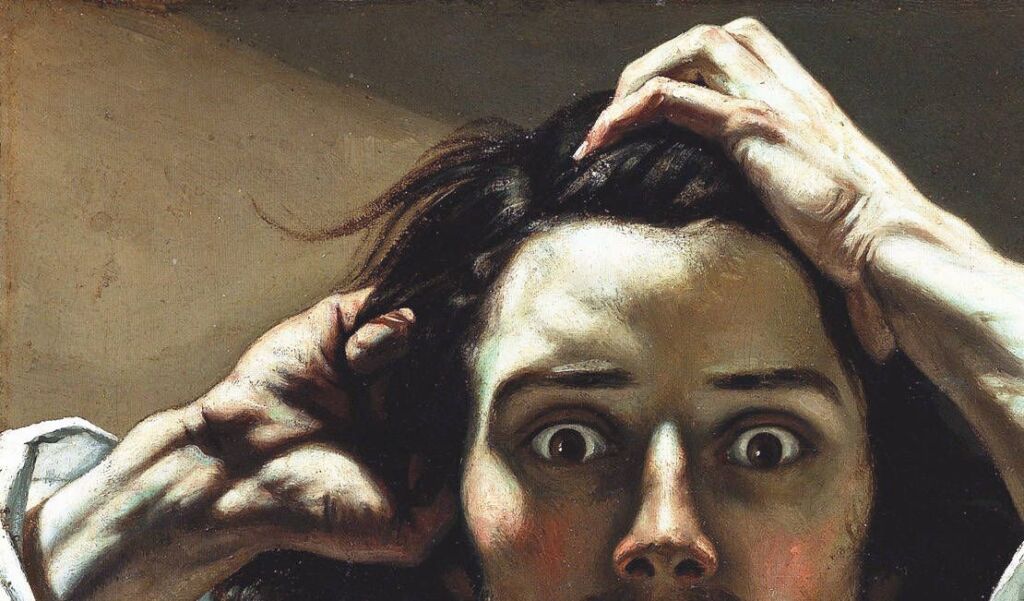
He stares straight at the viewer, pressed so close to the picture’s edge that he seems flattened against glass.
The Romantics loved faces like this; art historians also see the academy’s stock expressions of emotion, from Jacques-Louis David back to those Spaniards. Real despair or an exercise in depicting it? Courbet never said. Forty-five years later, Van Gogh would paint himself after a genuine breakdown, his ear bandaged.
A man on the brink
The same theme drives The Man Mad with Fear. Courbet places himself at the edge of a precipice, one hand at his head, the other reaching out into the void.
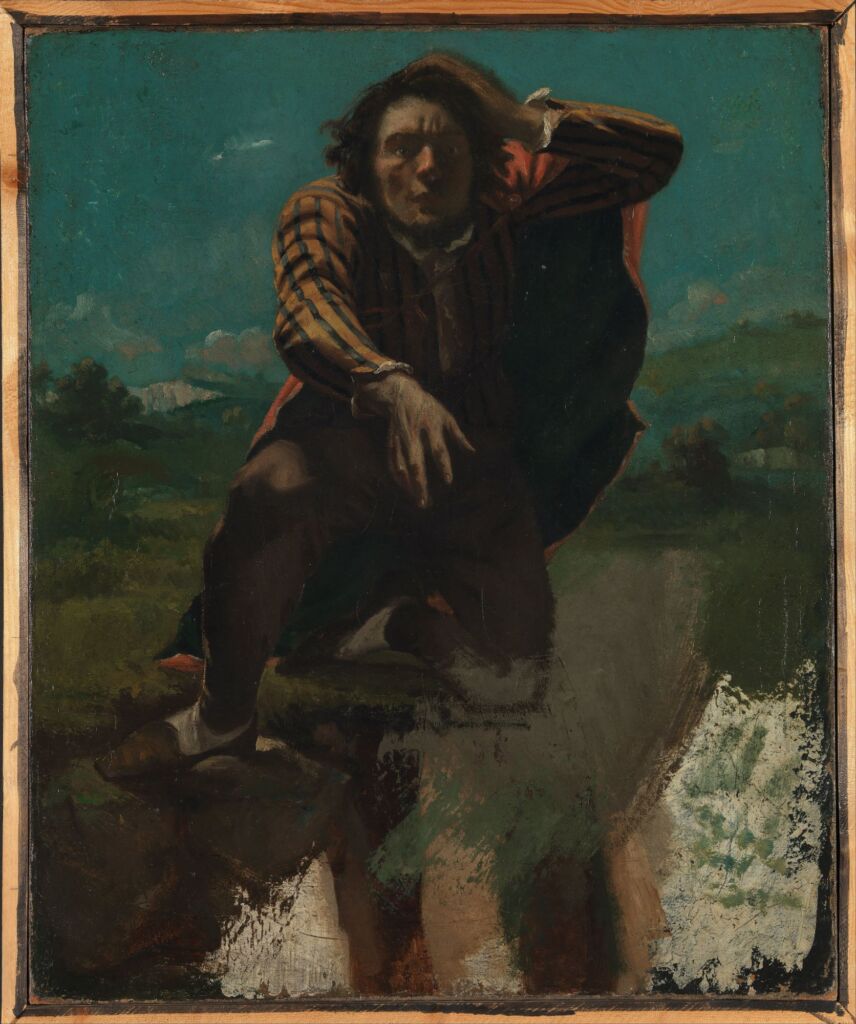
Later he supplied a key to the series himself. “I have done a good many self-portraits in my life, as my attitude gradually changed. One could say that I have written my autobiography,” he told the collector Alfred Bruyas in May 1854 (in French). If so, The Desperate Man is a diary page Courbet chose not to tear out.
He kept others, too. The Wounded Man, begun in 1844, was reworked a decade later: the woman leaning on his shoulder gave way to a sword, and a red stain appeared on his shirt over the heart. It too stayed with him and, as the Musée d’Orsay (in French) records, passed to his sister Juliette after his death.
In 1855 he would gather himself and his circle in his vast canvas The Painter’s Studio, no longer on the brink but squarely at the center of the composition.
Thirty years later
The despairing self-portrait left the studio only after the Paris Commune of 1871. In the spring of 1873 it was seen for the first time in Vienna, at a separate Courbet exhibition: the World’s Fair itself had refused to admit him. Probably around then he signed it in bright red and backdated it “41,” although it was painted around 1844–1845.
That summer Courbet, a Communard, left for Switzerland. In 1877 he showed the self-portrait in Geneva, now titled Desperation. He died on December 31 that year in La Tour-de-Peilz, the canvas still his.
It then passed through private collections. The public saw it at the 2007–2008 retrospective in Paris and New York. Only in October 2025 did it emerge that it belonged to Qatar Museums: Le Monde, as cited by The Art Newspaper, reported that the museums had bought it in 2014 for €50 million.
Qatar Museums lent the painting long-term to the Musée d’Orsay, where it will stay until the Art Mill Museum opens in Doha (not before 2030, says The Art Newspaper), then travel between the two cities. It hangs in Room 4, the first on the visitor route, beside Millet and Daumier.
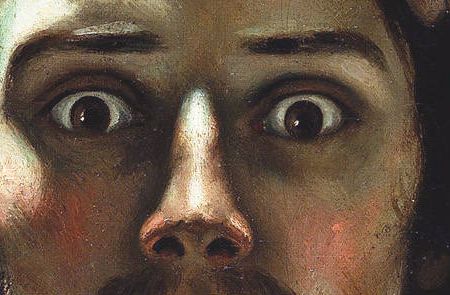
The man Courbet kept out of sight for almost thirty years is now the first to stare point-blank at visitors to the Orsay.
Comments
For Hroniki readers
Comments are open to readers with an account. Signing up is free and takes a few seconds.
No comments yet. Start the conversation.