Kandinsky’s Composition VII: how 30 studies buried the biblical Flood
More than thirty studies, then just four days on a canvas roughly 6½ by 10 feet. How Kandinsky painted Composition VII, and what is left of the Deluge in it.
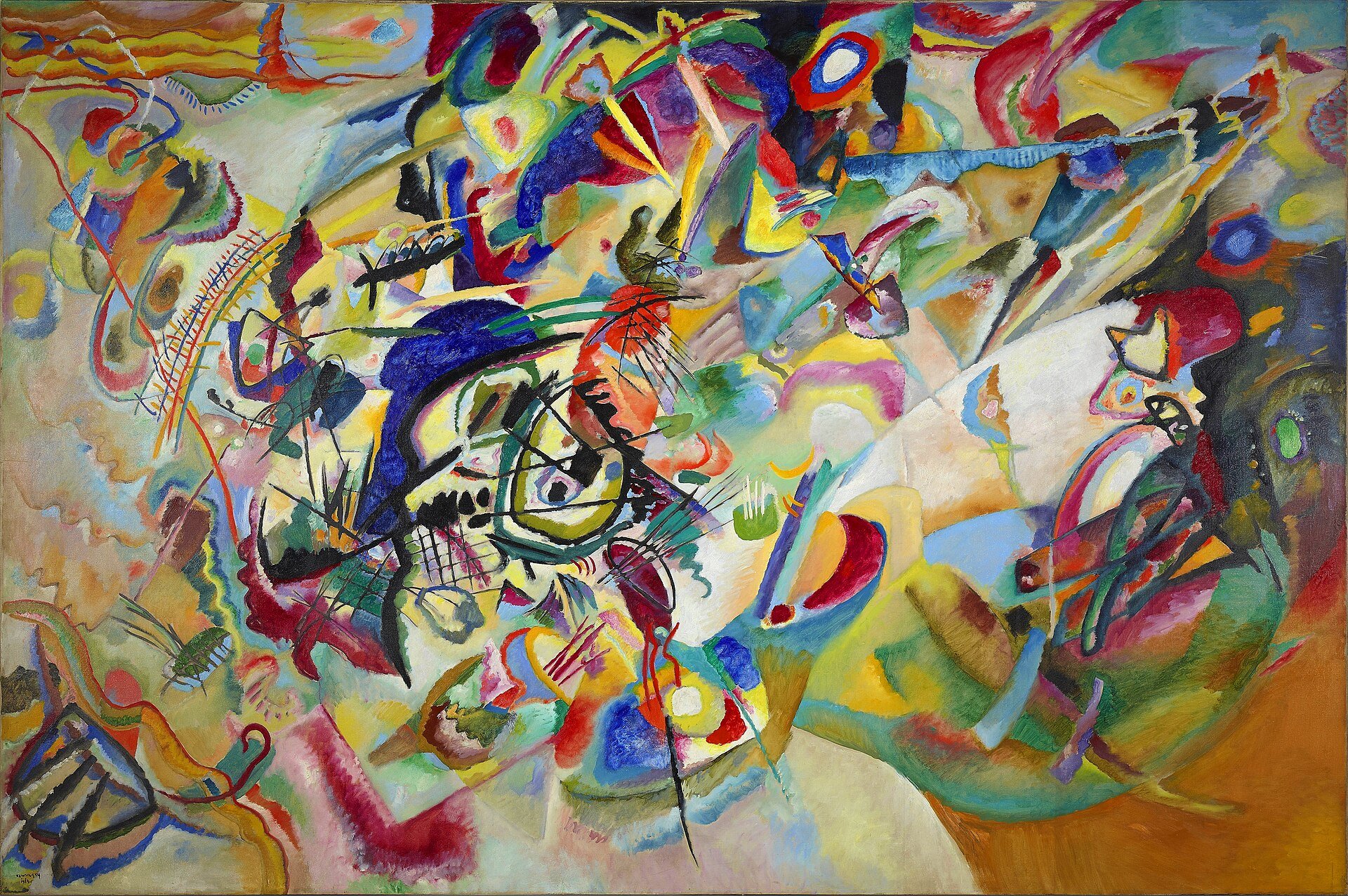
Wassily Kandinsky painted the canvas, about two by three meters (roughly 6½ by 10 feet), between November 25 and 28, 1913. Before it came more than thirty preparatory works: India ink drawings, watercolors, analytical diagrams, canvases over a meter long. Composition VII took up nearly the whole fall, and only the last four days went into the painting itself.
Kandinsky saw no contradiction in that arithmetic. In Concerning the Spiritual in Art (1911) he sorted his pictures into Impressions, Improvisations and Compositions. A Composition, in Michael Sadler’s translation, is “an expression of a slowly formed inner feeling, which comes to utterance only after long maturing.” Composition VII is that definition pushed to its limit.
Today the painting is in Moscow’s State Tretyakov Gallery, which sees it as the point where Kandinsky finally left the visible world behind. This is the story of one picture and one autumn.
Thirty approaches to one canvas
The studies cannot be lined up from first to last: several strands developed in parallel. Many are now in Munich, at the Städtische Galerie im Lenbachhaus.
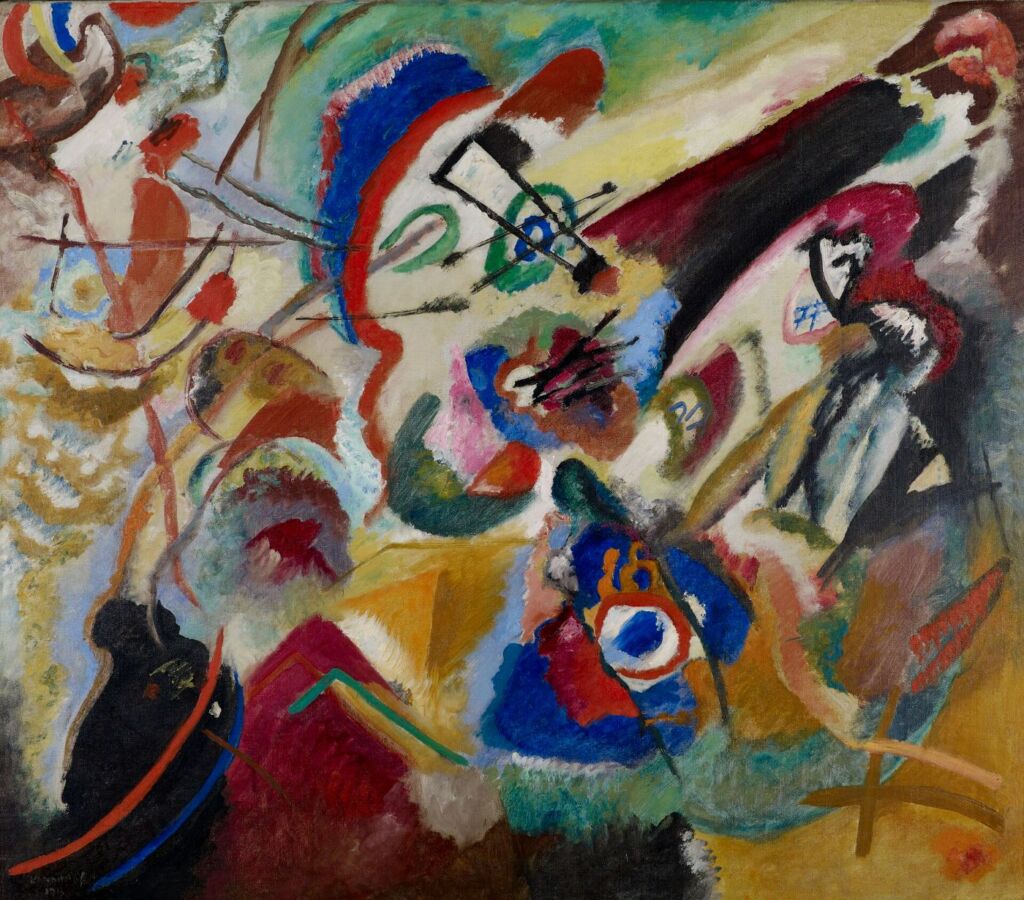
Side by side, the studies show the same figures migrating from sheet to sheet, shifting place, color and outline, harder to recognize at every step. Kandinsky seems to have been testing how much of the image he could erase and still keep the movement.
Six of the preparatory works are in oil. The first study is a nearly finished picture a third the size of the final canvas; the second is already half its size. Two more canvases work out sections separately. Fragment 1 (the center) is now in Milwaukee, Fragment 2 (the center and corners) in Buffalo, New York.
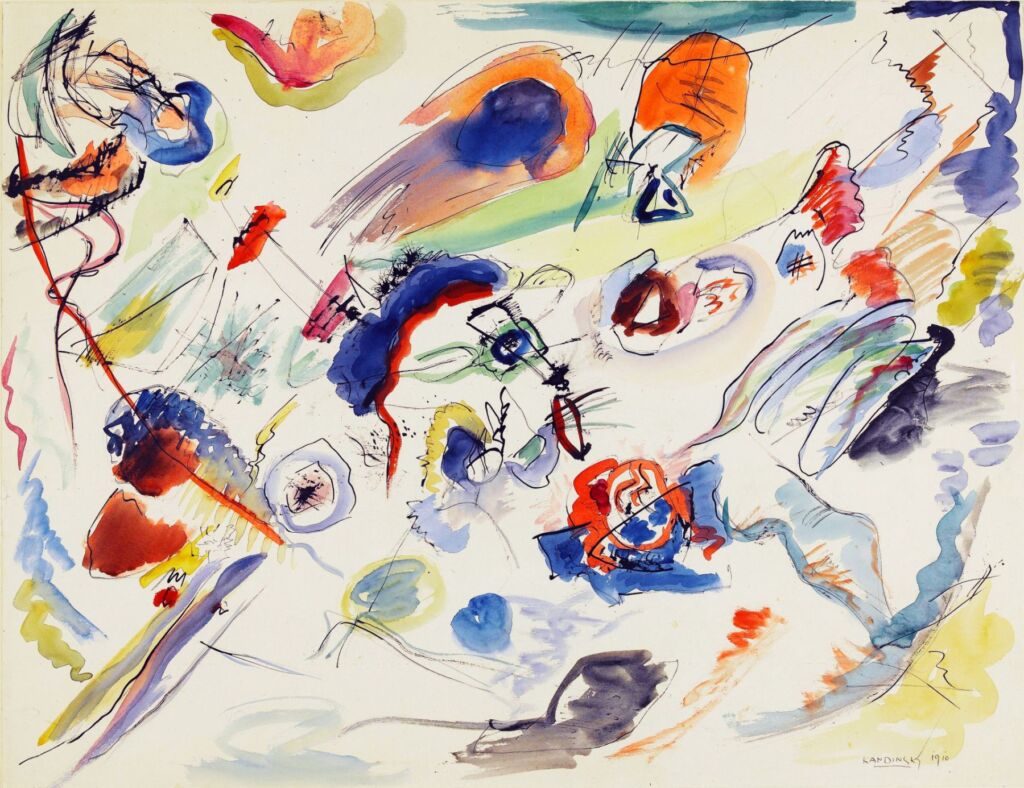
These studies lie behind the best-known muddle in Kandinsky’s biography. A watercolor at the Centre Pompidou in Paris bears a signature, the date 1910 and a note in French: abstraite, “abstract.” The museum calls the sheet Première abstraction, “First Abstraction.” But research in the 1950s suggested a later date, and it is now seen as one of the studies for Composition VII. The date remains disputed: the Pompidou gives 1913, though the sheet says 1910.
A painting begun from the center
Gabriele Münter, a painter and Kandinsky’s companion, photographed the canvas in progress at four stages. The painting took four days, and according to the catalog of Kandinsky: Compositions (Museum of Modern Art, New York, 1995), all four photographs were taken over three of those days.
They reveal the order of work. First Kandinsky drew the entire composition on the canvas. Then he painted the center and the far right edge, then the areas above and below the center. Next came the whole left half. The lower right corner was finished last.
At the heart of the picture is an oval outlined in green and black. The catalog’s author, Magdalena Dabrowski, noticed that in every study this focal point sat farther left. At the center of the second study is a small red oval ringed in blue, which in her view anchored the work from the very start.
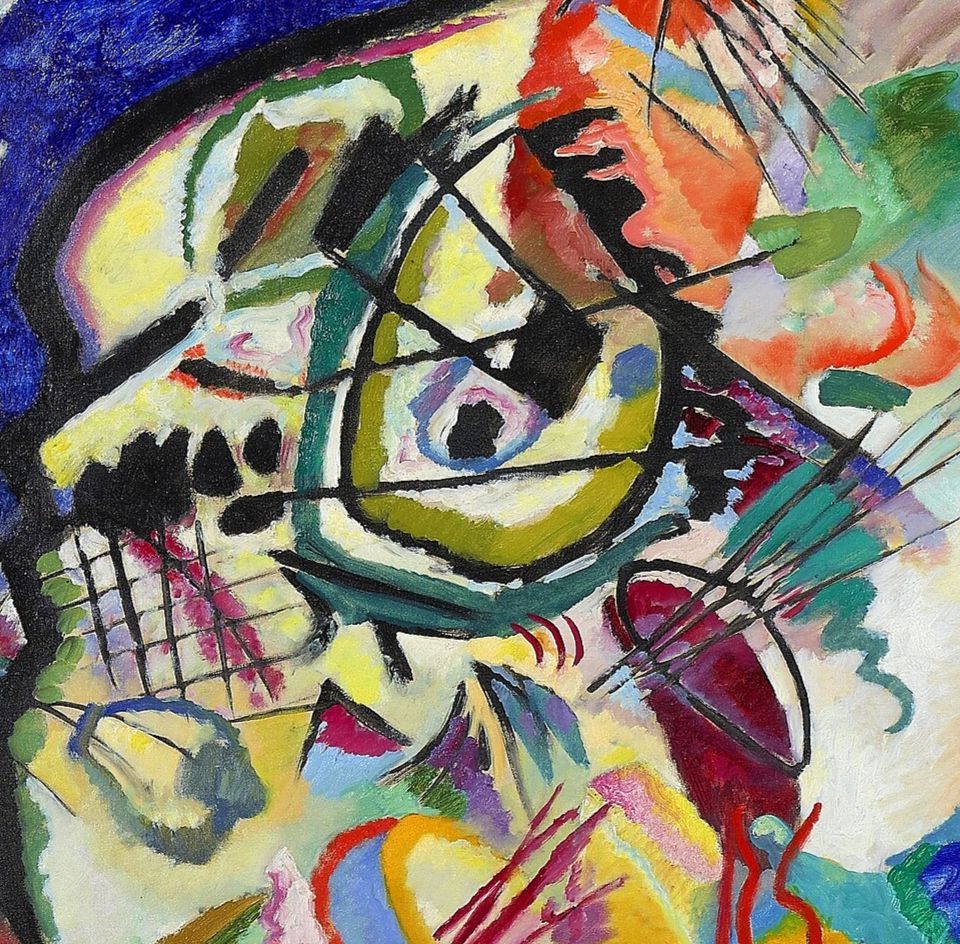
The sequence is telling. The canvas grew from the center outward, unlike the way a page is read. The left half, where the eye habitually lands first, came only at the third step.
A boat with three oars
Kandinsky never named a subject and insisted he had started from neither a story nor recognizable objects. Even so, the forms are believed to have grown out of his figurative series of 1911–12: Last Judgment, Resurrection, All Saints’ Day.
Scholars including Sixten Ringbom and Rose-Carol Washton Long read four themes in Composition VII at once: the Resurrection, the Last Judgment, the Deluge (Noah’s Flood) and the Garden of Love, the old European motif of lovers in a flowering garden. Washton Long studied that motif most closely; she also links the painting to the 1911 watercolor Sound of Trumpets (Large Resurrection).
At the lower left Dabrowski sees a boat with three oars outlined in black, a sign of the Deluge. A second boat, with a figure and two oars, is tucked in below the center.
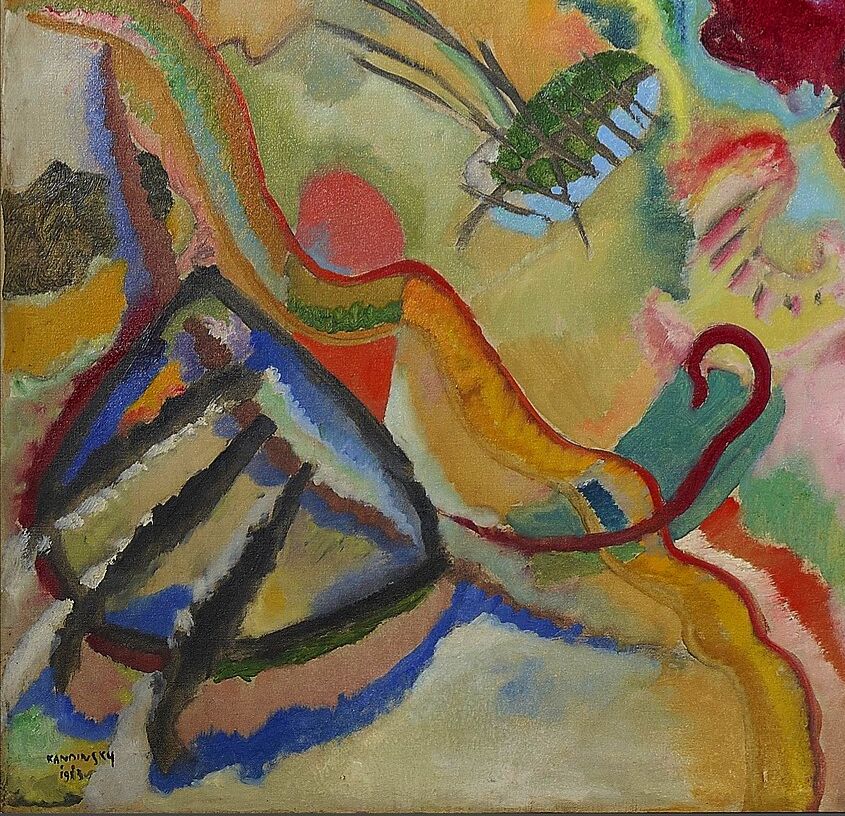
For Dabrowski, the elongated blue shapes at the upper right are the trumpets of the Last Judgment’s angels. A horse and rider, first placed on the right, have all but dissolved. At the lower right two ovals lie on a diagonal, as if intertwined: they are thought to be a reclining couple from the Garden of Love.
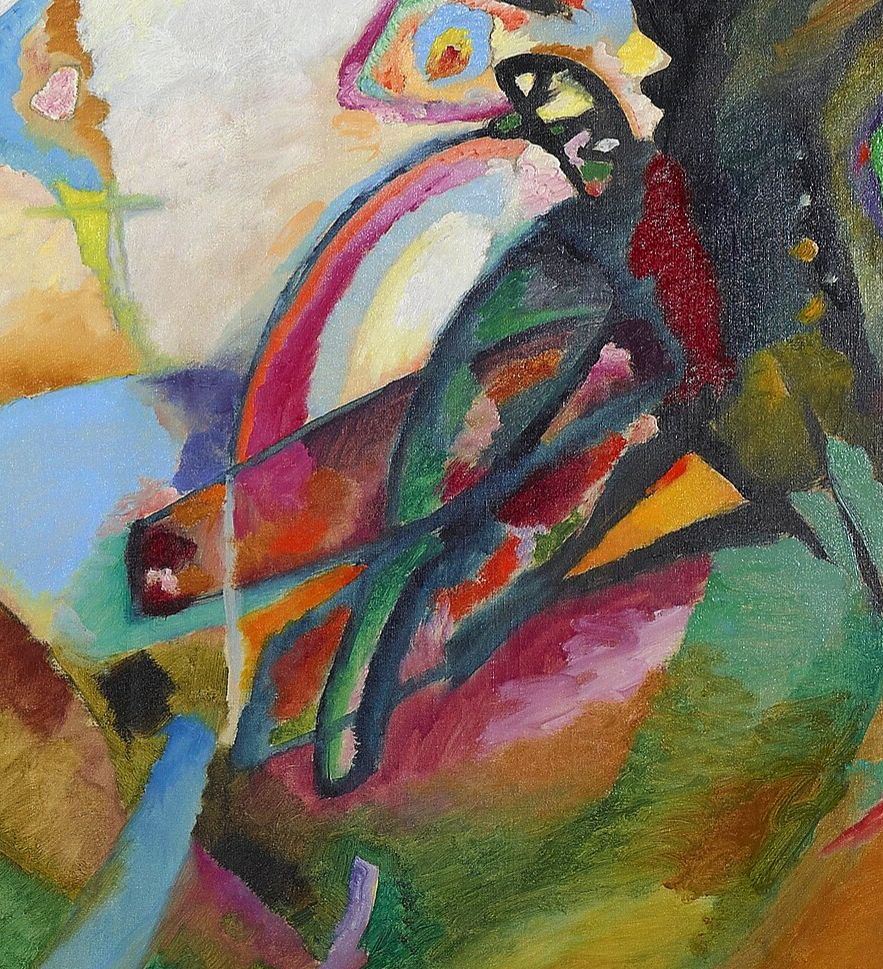
That corner was painted last. Two months later, in late January 1914, the painting was shown in Cologne, and in spring 1915 in Moscow, where Kandinsky had moved back by then.
Its contemporary, Composition VI, belongs to the State Hermitage Museum in St Petersburg. In 2016 the Tretyakov hung the two side by side in the exhibition Counterpoint, for the first time since the 1989 retrospectives in Moscow and Leningrad.
The canvas itself took four days. The thirty-odd works before it were spent making the rider all but vanish and shrinking the Deluge to a boat with three oars in the lower left.

Comments
For Hroniki readers
Comments are open to readers with an account. Signing up is free and takes a few seconds.
No comments yet. Start the conversation.