Levitan’s Vladimirka Road: a quiet highway that led convicts to Siberia
In the summer of 1892, Sofia Kuvshinnikova recalled, she and Isaac Levitan were walking home from a hunt when they came out onto a highway. Suddenly Levitan remembered its name: the Vladimirka, the road convicts walked in chains to Siberia.
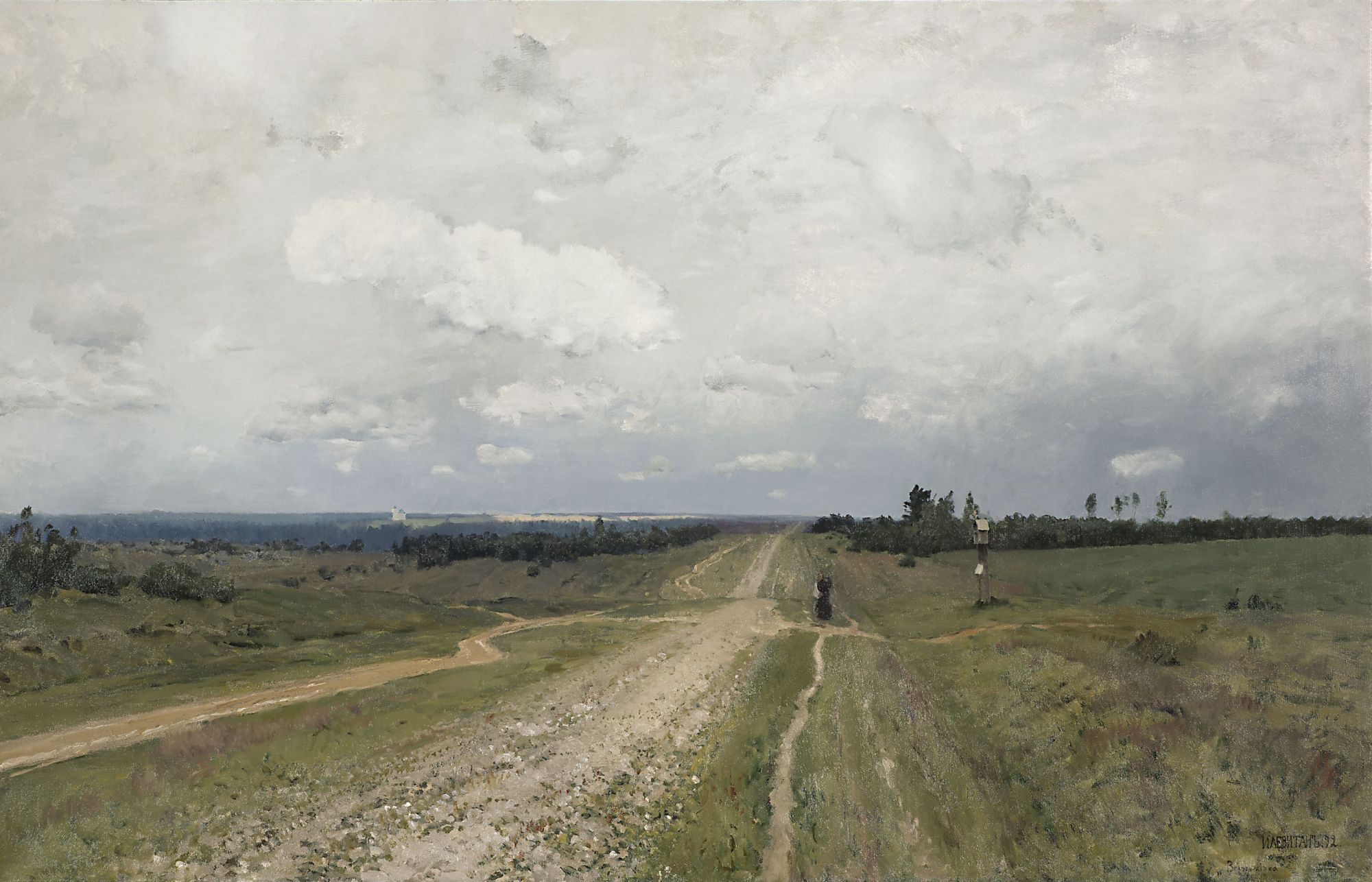
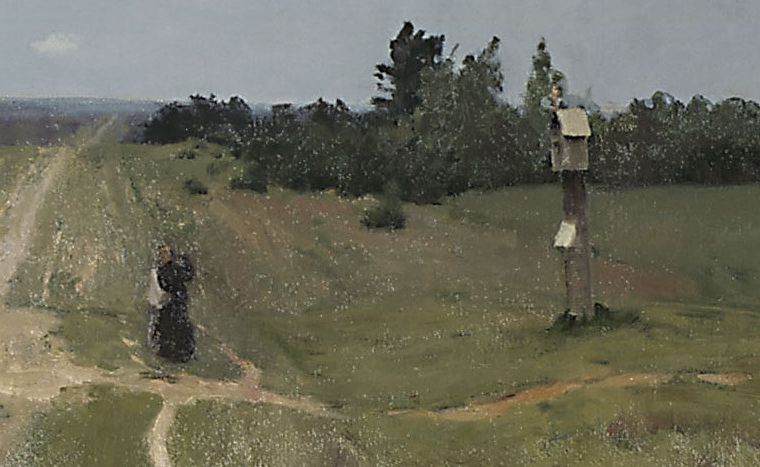
In the summer of 1892, the painter Sofia Kuvshinnikova recalled, she and Isaac Levitan, walking home from a hunt, came out onto a highway. The view was quiet, almost cozy: a pale road between copses and, by the roadside, an old golubets with an icon. A golubets is a wooden cross under a little gabled roof, put up along roads and over graves. Then, suddenly, Levitan remembered what the place was: the Vladimirka, the road convicts walked in chains to Siberia.
A convict road with no convicts left
They lived in the village of Gorodok, Vladimir Province, near Boldino station, the address Levitan gave in a letter to Pavel Tretyakov (reprinted in a 1956 collection of his letters; in Russian). Tretyakov was the Moscow merchant who founded the Tretyakov Gallery. The highway ran from Moscow to Vladimir and Nizhny Novgorod. For decades convicts walked it to penal labor, until trains took over.
The railroad from Moscow to Nizhny Novgorod opened in 1862 (in Russian), and the marching columns gradually disappeared from the highway. Thirty years on, it could pass for an ordinary country road.
Levitan kept going back to the road and, over several sessions, painted a study from life. Kuvshinnikova said he painted the canvas itself on the spot; scholars believe he finished it in his Moscow studio. The editors of his letters (1956) objected that surviving studies show the work took more than a few roadside sessions.
There are no convicts; by 1892 they were gone. The only person is a woman pilgrim on the footpath to the right of the road, the golubets beyond. From that quiet view Levitan kept the road, the sky and what everyone who had heard the word “Vladimirka” knew about it.
The wayside cross from the canvas has since returned to the landscape. In 2007, according to the Tretyakov Gallery’s own magazine, a new golubets, an Old Believer roofed cross, was put up and blessed on a surviving stretch of the old Vladimirka near the village of Peksha.
The autumn of 1892
In September 1892 the expulsion of Jews from Moscow and its surroundings reached Levitan. He had to leave the city, and he went back to the same countryside, to Boldino in Vladimir Province (in Russian). He stayed there, near Gorodok, from mid-September to mid-December.
It was not the first time. In May 1879, during an earlier expulsion, Levitan, then an 18-year-old student at the Moscow School of Painting, Sculpture and Architecture, had moved out to the village of Saltykovka outside the city. Now it happened again, except that he was past 30 and Tretyakov was buying his pictures.
So the painting of the road Russia used to march its exiles down was the work of a man pushed out of Moscow himself that same autumn. He was not sent far or for long, but he had no choice. When exactly he finished the canvas in his Moscow studio, before he left or after he returned, the sources do not say. By February it was ready.
Meanwhile, Moscow was gaining a museum. On August 31, Tretyakov wrote to the city council offering Moscow his collection and his late brother Sergei’s, along with part of his house on Lavrushinsky Lane. The council accepted the gift in September, just as Levitan was leaving for Boldino. A year later, in August 1893, the collection opened as the Pavel and Sergei Tretyakov Municipal Art Gallery.
Friends’ petitions got him back to Moscow in December, apparently only on a temporary permit. The right to live outside the Pale of Settlement, the zone where most Jews in the empire had to live, came at the very end of 1893 or the first days of 1894, shortly before The Vladimirka Road entered Tretyakov’s collection.
A painting nobody bought
In February 1893 the painting hung at the 21st exhibition of the Peredvizhniki, or Wanderers, a society of realist painters, first in St Petersburg, then in Moscow. “What could be more boring than Mr. Levitan’s Vladimirka. The High Road?” wrote the critic “L. Kh.” in the Peterburgskaya Gazeta on February 18 (translated by Hroniki). Moscow reviewers were kinder. No buyer appeared, though the show toured other cities for another year.
In March 1894, Tretyakov bought another large Levitan landscape, Above Eternal Peace. A few days later Levitan gave him The Vladimirka Road as well, this time as a gift to the gallery, which had just become a city museum. The canvas, 79 × 123 cm (31 × 48 in), is still there. Along with the canvas, he sent Tretyakov a short note with a request:
“Take it, and calm us both, me and it.”
Comments
For Hroniki readers
Comments are open to readers with an account. Signing up is free and takes a few seconds.
No comments yet. Start the conversation.