Giorgione’s The Tempest: who sat by the stream before the young man
Around 1530, Marcantonio Michiel described a Giorgione canvas in one line and named everyone in it. Who they really are is still debated, and a 1939 X-ray added one more figure.
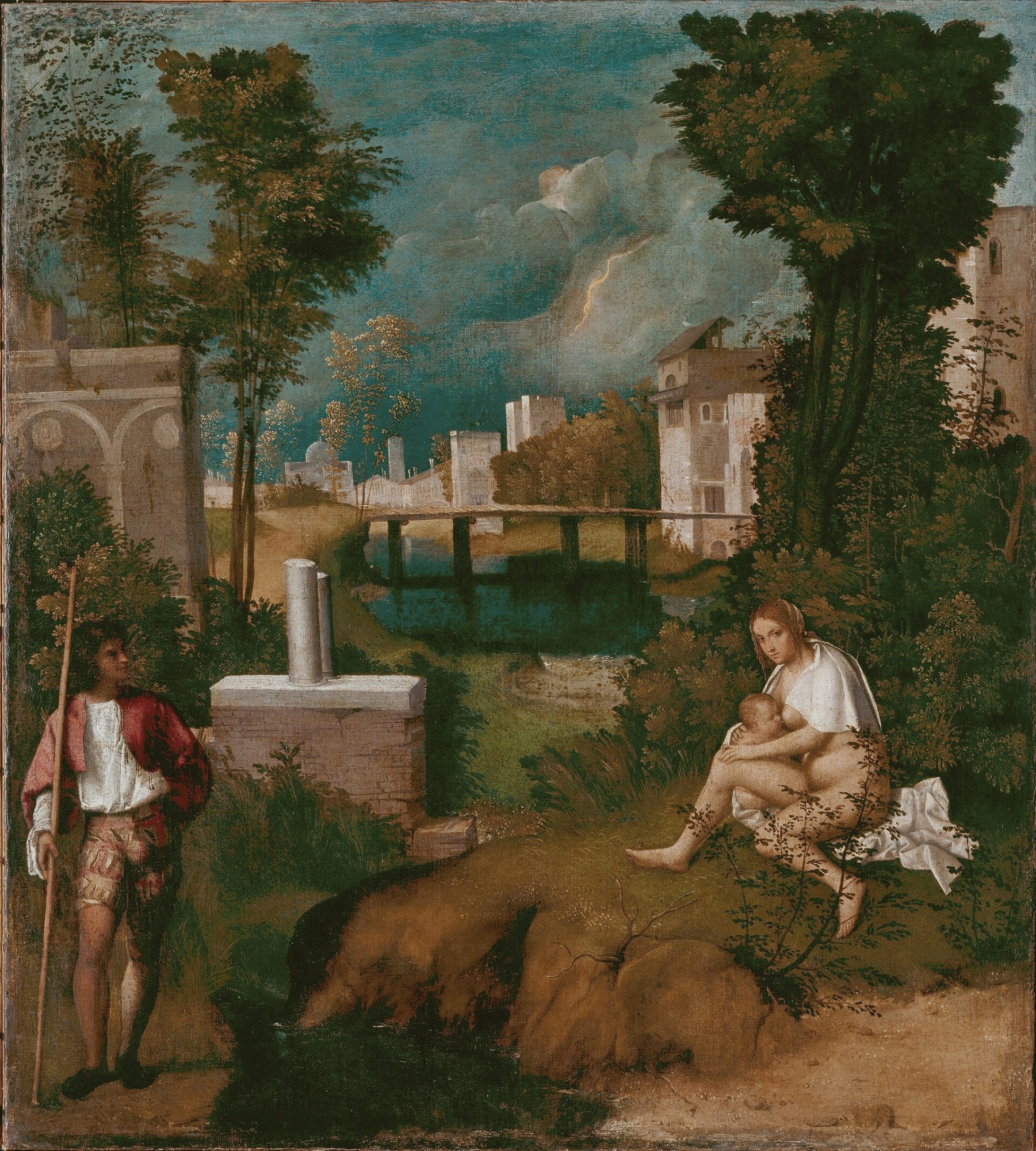
Around 1530 the Venetian Marcantonio Michiel toured the city’s private collections, noting what hung where. In the house of the patrician Gabriele Vendramin, he gave a small canvas one line: “The little landscape on canvas, representing stormy weather and a gipsy woman with a soldier, is by Giorgio di Castelfranco.”
Michiel actually wrote “Zorzi,” Venetian for Giorgio—that is, Giorgione. He named everyone in The Tempest but never said what was happening. More than a hundred explanations have followed, and in 1939 an X-ray added another figure to the puzzle.
Giorgione lived just over thirty years and died in the fall of 1510, probably of plague. He wrote nothing about The Tempest. Even its date is disputed; most put it around 1505.
A bather where the young man stands
When the painting was first X-rayed, another figure emerged under the young man with the staff: a nude woman seated by the water, bathing (in Italian). X-ray and infrared images turned up smaller changes too, mostly in the landscape.
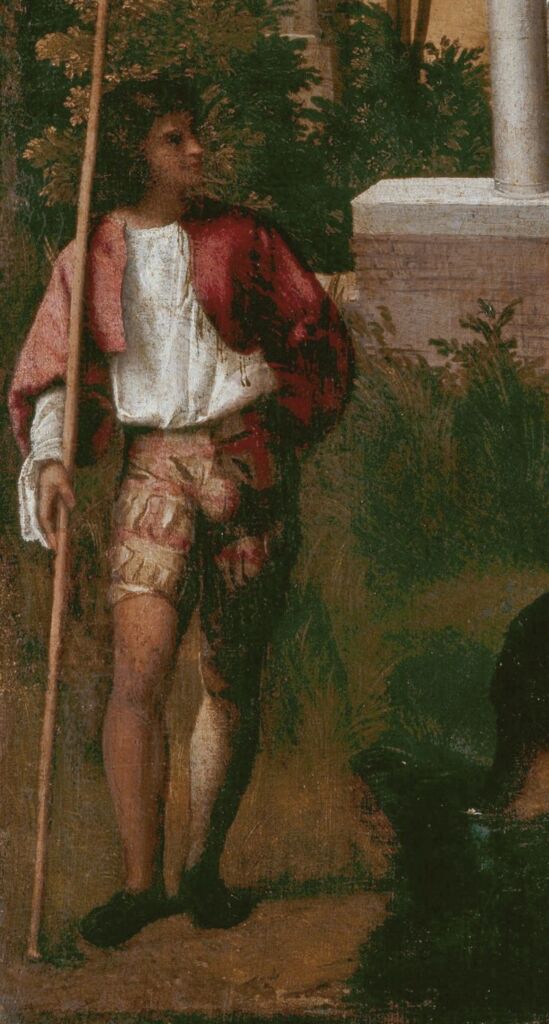
Giorgione painted her out and put a young man in a red jacket in her place. The picture kept its nude, but on the other bank and with a baby at her breast. This is Michiel’s “gipsy woman.”
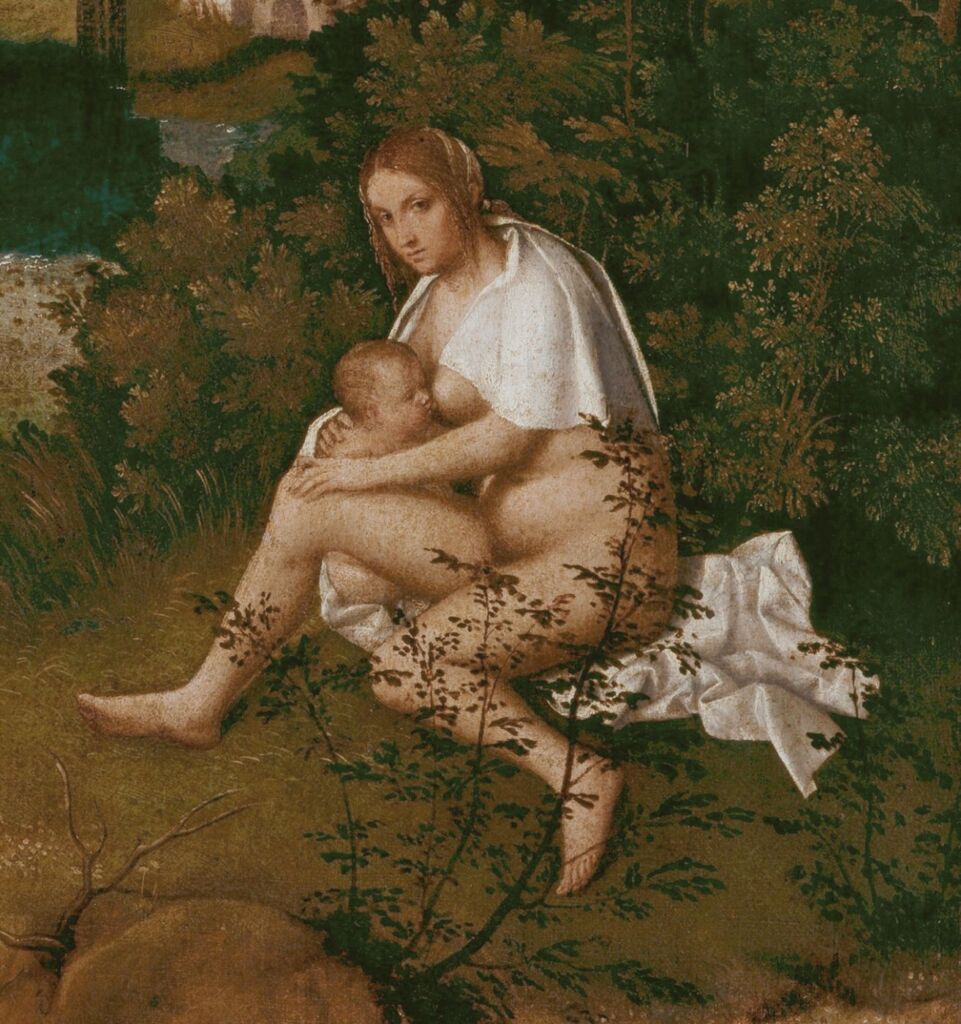
The young man looks at her. She looks at us.
The 1939 find is often cited as evidence for the simplest explanation: there is no coded subject, and the painter shifted figures as he worked, as a landscape painter moves trees. But the change proves only that the plan changed. The X-ray cannot say whether a hidden subject lay behind it, any more than the X-ray of Millet’s The Angelus could say whether a coffin lay under the basket.
There is a smaller find too. In 2019 the Italian researcher Sergio Alcamo pointed to a tiny angel on the bridge, painted, he says, over a traveler. It shows up clearly in a black-and-white X-ray. For Alcamo, it marks the border of Paradise.
A hundred answers to one line
In 1895 Franz Wickhoff saw an episode from Statius’s Thebaid. Edgar Wind read it as an allegory of the virtues and fortune: broken columns as Fortitude, the nursing mother as Charity, the storm as Fortune’s sudden turns.
In 1978 Salvatore Settis saw Adam and Eve after the expulsion from Paradise, with the infant Cain. Carlo Falciani tied it to verses praising the Vendramin family: the birth of Silvius, son of Aeneas. By the count of the art historian Enrico Maria Dal Pozzolo, new theories appear at least once a year.
Other readings do without a literary source: a political allegory of the Veneto in the War of the League of Cambrai, if it was painted after 1508, or simply poesia, a painted fantasy with no set subject.
Settis’s reading has drawn criticism, but he has kept to it. His book, in English since 1990 as Giorgione’s Tempest: Interpreting the Hidden Subject, came out in Russian in 2023, and in the preface to that edition he stands by his reading (in Russian).
From Vendramin to the Accademia
From Vendramin’s house the painting passed to the merchant Cristoforo Orsetti, in the late 18th century to the collector Girolamo Manfrin, and in 1875 to the Giovanelli princes. In 1932 it was bought for the Gallerie dell’Accademia in Venice, where it still hangs.
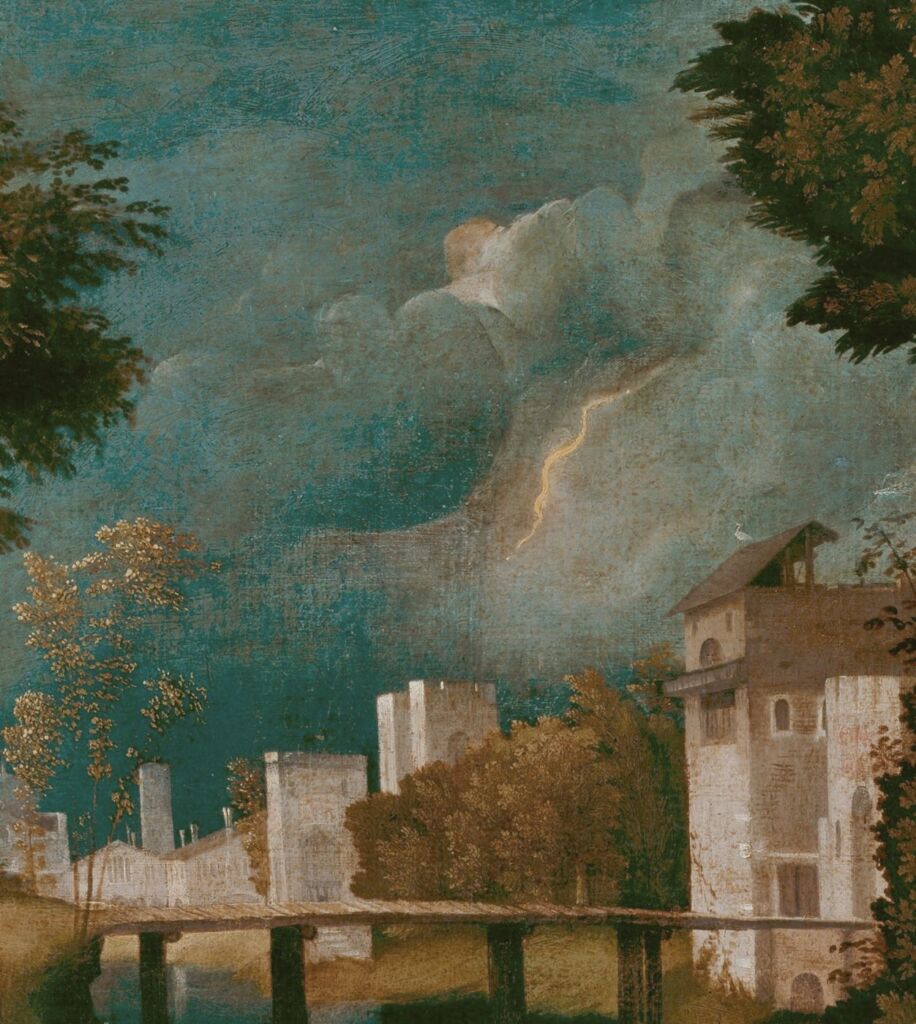
In five centuries the young man and the mother have had more names than the painting has had owners: she has been Eve, Charity and Lavinia; he, Adam and a shepherd. Michiel listed the storm before the people, and his word for it, la tempesta, became the one title nobody disputes.

Comments
For Hroniki readers
Comments are open to readers with an account. Signing up is free and takes a few seconds.
No comments yet. Start the conversation.