Goya’s Naked Maja: the Inquisition’s four questions of 1815
In 1815 the Inquisition ordered Goya to say whether he had painted the two Majas, why, and for whom. The summons survives; what he answered, and whether he came at all, is unknown.
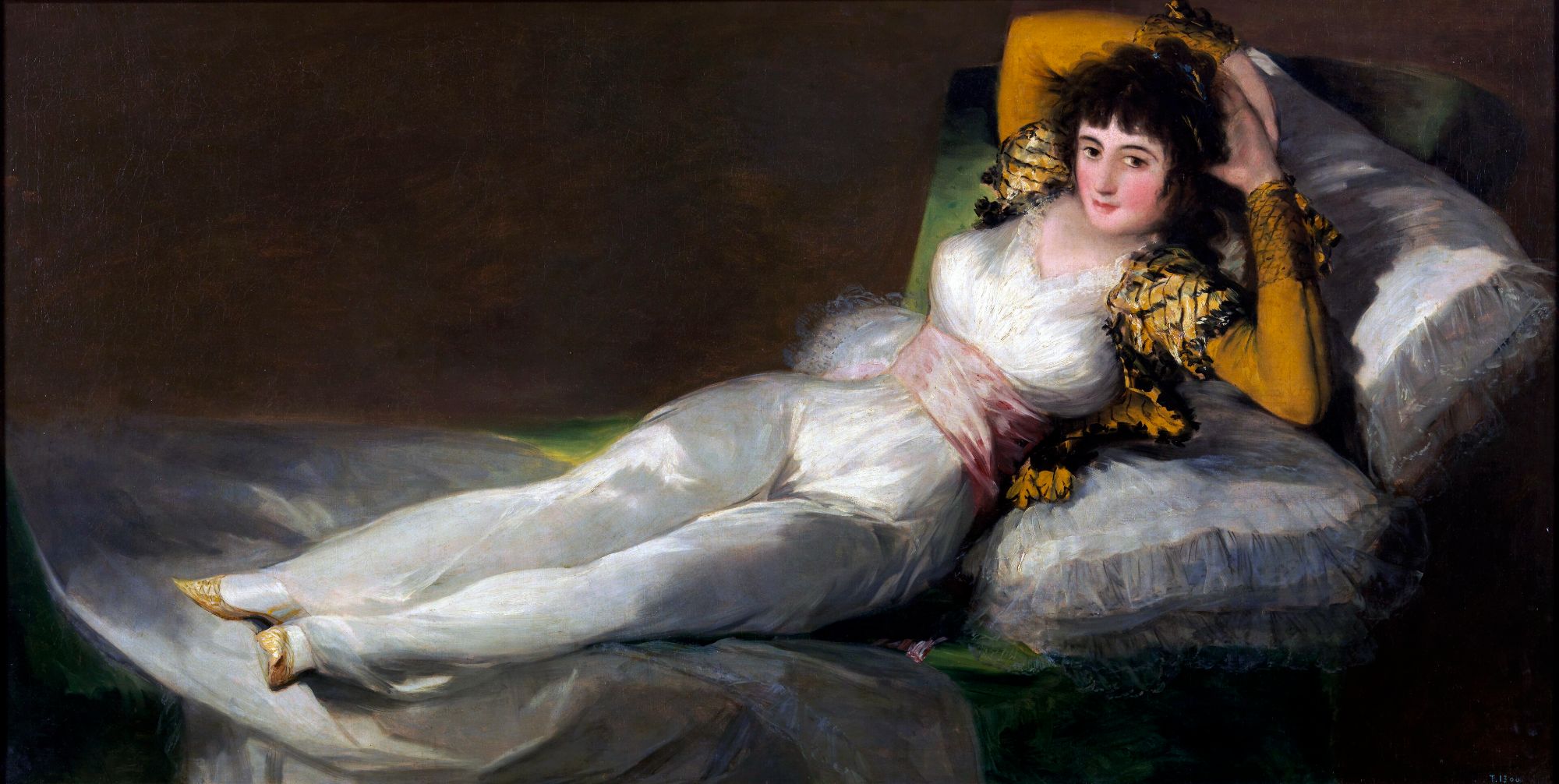
Francisco Goya, the Spanish court painter, was to appear before the Inquisition, identify two paintings and declare “whether they are his work, for what reason he made them, by commission for whom, and what ends were intended.” The Secret Chamber of the Inquisition of Madrid signed the order on March 16, 1815.
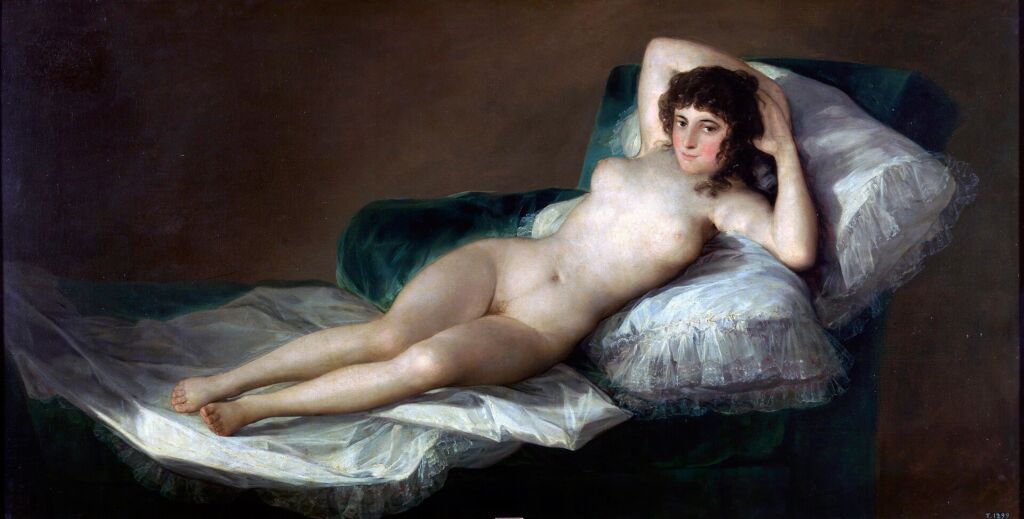
The paintings were The Nude Maja, also known as The Naked Maja, and The Clothed Maja. In late 18th-century Madrid, majas were lower-class young women known for showy dress and brazen manners. What Goya answered, or whether he came at all, is unknown: the order survives, his testimony does not. Two centuries of guesswork about the Duchess of Alba and a painting that hid another have filled the gap.
Above a door in the favorite’s palace
Both belonged to Manuel Godoy, Queen Maria Luisa’s favorite and the most powerful man at Charles IV’s court. The nude is first recorded in 1800, hanging above a door in his palace. The clothed one first appears in an 1808 inventory, drawn up after his fall.
Godoy collected nudes seriously. When the Duchess of Alba died in 1802, her heirs, on the king’s orders, sold him Velázquez’s Rokeby Venus. He hung it beside both Majas in a private room a contemporary called the “gavinete interior,” the inner cabinet. It now hangs in the National Gallery, London.
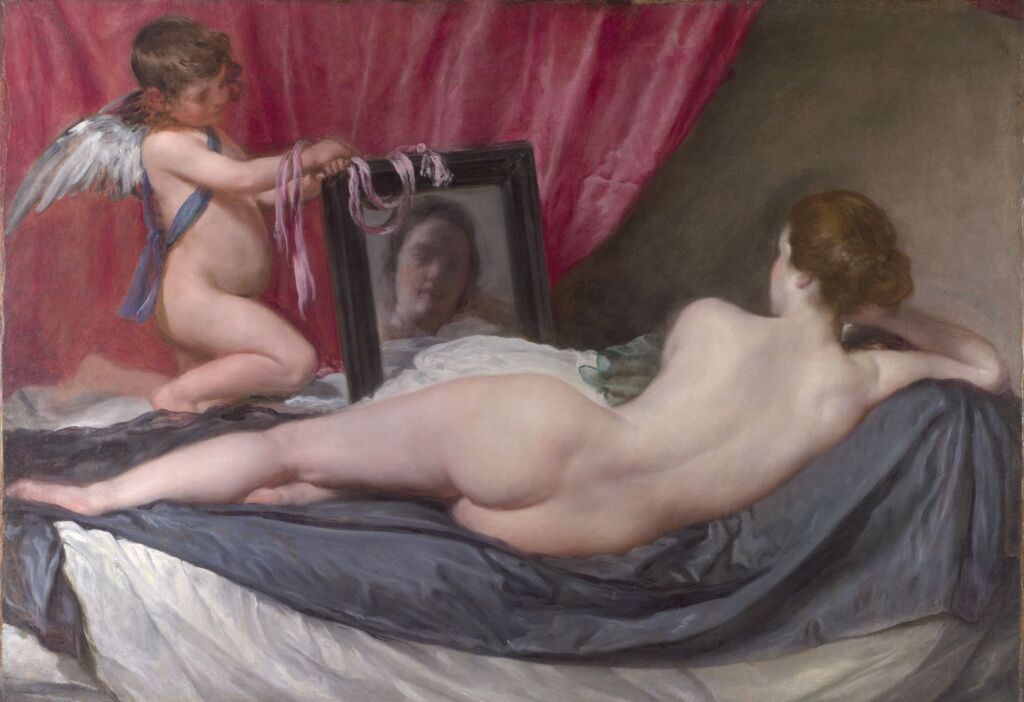
This was daring: Spanish painters then rarely attempted the female nude. If Goya looked to precedents, they included Velázquez’s Venus and Titian’s Venus of Urbino. But his woman is no goddess, and she looks straight at the viewer.
The cabinet also produced the most persistent story of how the Majas hung. In La duquesa de Alba y Goya (The Duchess of Alba and Goya, 1959), the Spanish writer Joaquín Ezquerra del Bayo proposed that an ingenioso mecanismo, a clever device, let the clothed Maja cover the nude: one picture for guests, the other for the host. He cited the matching poses and canvases a few centimeters apart in size.
No document describes such a device. In Smithsonian magazine in 2002, Stanley Meisler went only this far: “Goya also painted a clothed version, which the minister may have hung over the nude in order to conceal it.” And the records of 1800 mention only the nude.
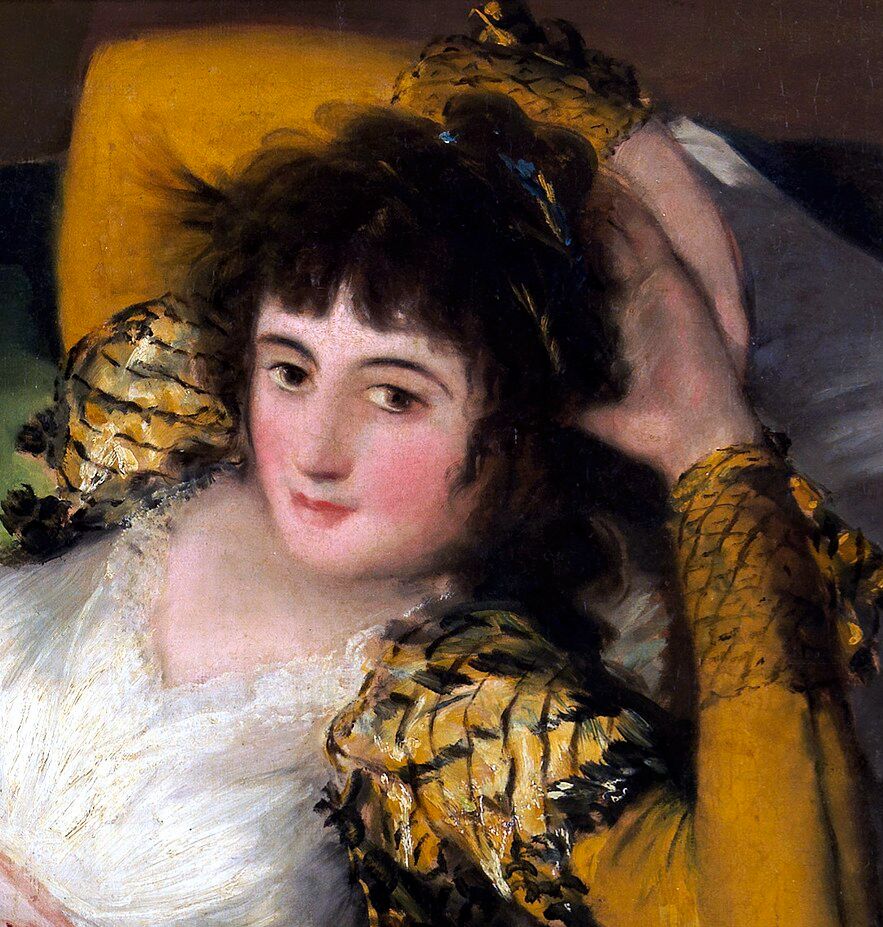
The two are not even painted alike. The nude is carefully, academically finished; on the clothed Maja’s jacket and dress the paint lies thicker and looser. Some scholars believe Goya painted the clothed version several years later.
Two Gypsies under arrest
In March 1808, after the Mutiny of Aranjuez, Godoy fell, and Ferdinand VII ordered his property seized. An agent of Joseph Bonaparte inventoried the collection, and, as the Prado notes, it was there that the two Majas were first listed together. The 1813 inventory of confiscated goods calls them “Gypsies”: the clerk apparently took them for nameless genre figures.
Joseph Bonaparte abolished the Inquisition in 1808. Ferdinand VII, restored to the throne, revived it in 1814, and that year the paintings came into its hands. The summons followed a year later. The case was most likely dropped: there is no record of Goya ever appearing before the tribunal.
They never returned to Godoy. In 1836, with the Inquisition gone, they passed to the Royal Academy of Fine Arts of San Fernando, and in 1901 to the Prado. A few years after the summons Goya bought a country house, covered its walls with the Black Paintings, and never exhibited them.
A duchess out of a novel
Legend, as the Prado cautiously puts it, would have it that the model was the Duchess of Alba. Fiction cemented it in the 20th century: in Lion Feuchtwanger’s novel This Is the Hour (1951), the duchess poses for The Nude Maja. The 1958 film The Naked Maja, starring Ava Gardner, rests on the same assumption.
The portraits, though, are real. Goya painted the duchess in white in 1795 and, two years later, in mourning for her husband, who had died in 1796. The second he kept for himself. Readers can set the maja’s face beside hers, but no document links Alba to the Majas.
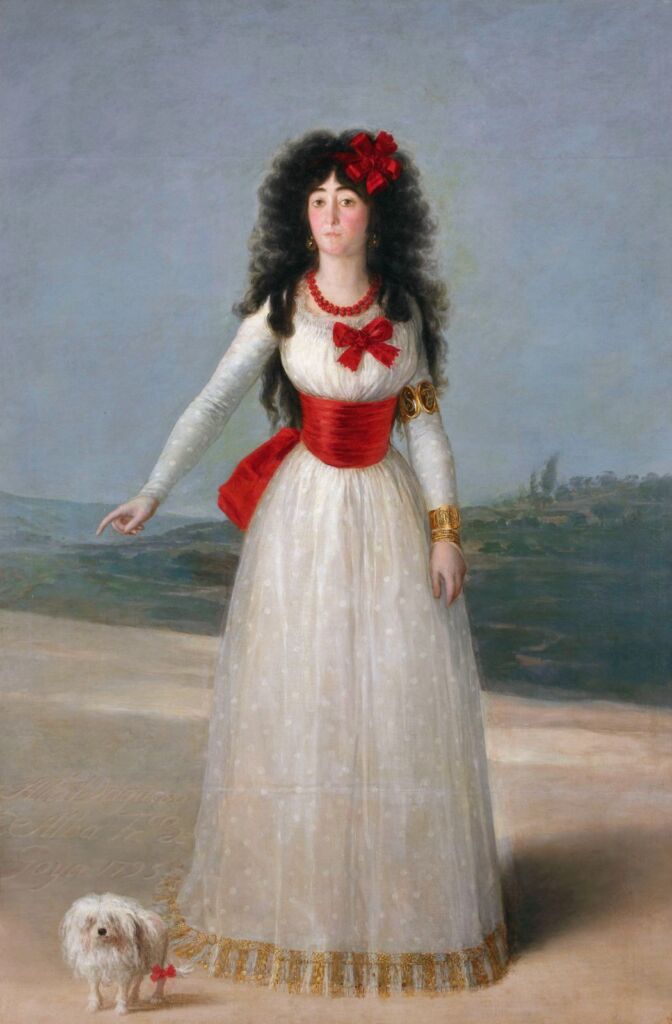
Even a love affair between painter and duchess is doubtful. There is little evidence of Goya’s affairs, and most modern scholars dismiss them as conjecture. In a 2007 book, the Prado’s Goya specialist Manuela Mena rejected the idea: “It was an inequality he tried to overcome, but as an artist, not a lover.”
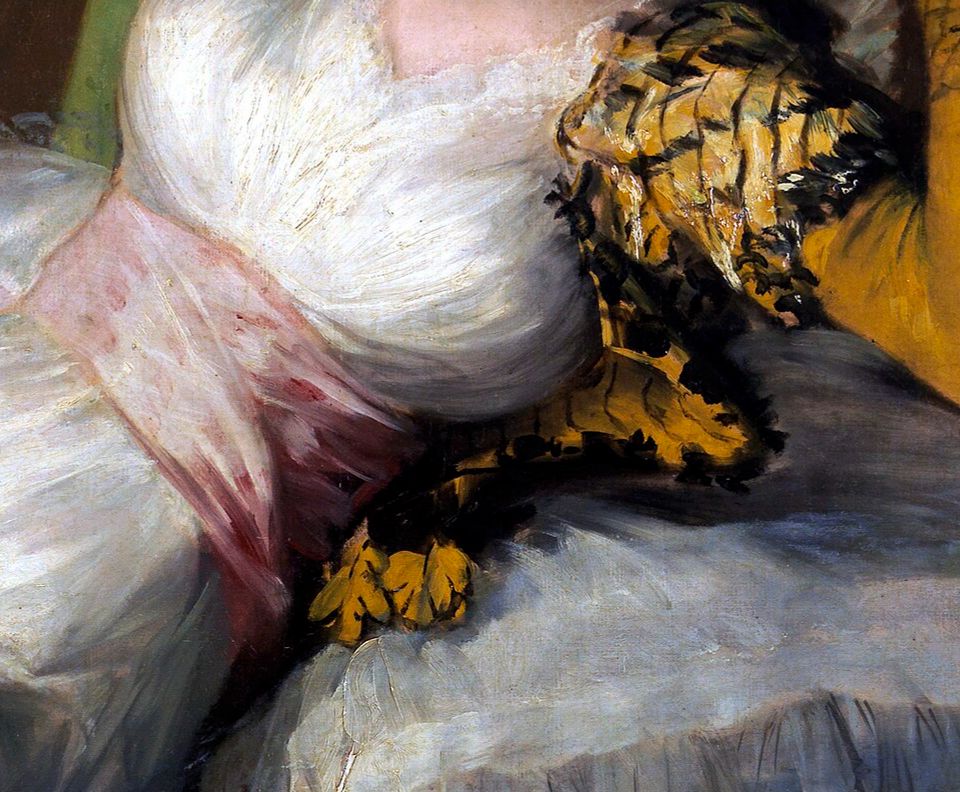
The museum names another candidate: Pepita Tudó, Godoy’s mistress from 1797 on. That, too, is a theory: no inventory names the model. Even the reddish object under the clothed maja’s hip is disputed: the Fundación Goya en Aragón catalog notes that some see a dagger hilt, others a folded fan.
Of the Inquisition’s four questions, the first has an answer: the paintings are his. To the third, “by commission for whom,” historians cautiously reply: probably Godoy. The other two, “for what reason” and “what ends were intended,” only Goya could answer.
Comments
For Hroniki readers
Comments are open to readers with an account. Signing up is free and takes a few seconds.
No comments yet. Start the conversation.