Goya’s Saturn: what the mural lost when it left the wall
Goya painted Saturn straight onto the wall of his house and never showed it. Half a century later the mural was peeled off the plaster, and how it once looked we now judge from an old photograph.
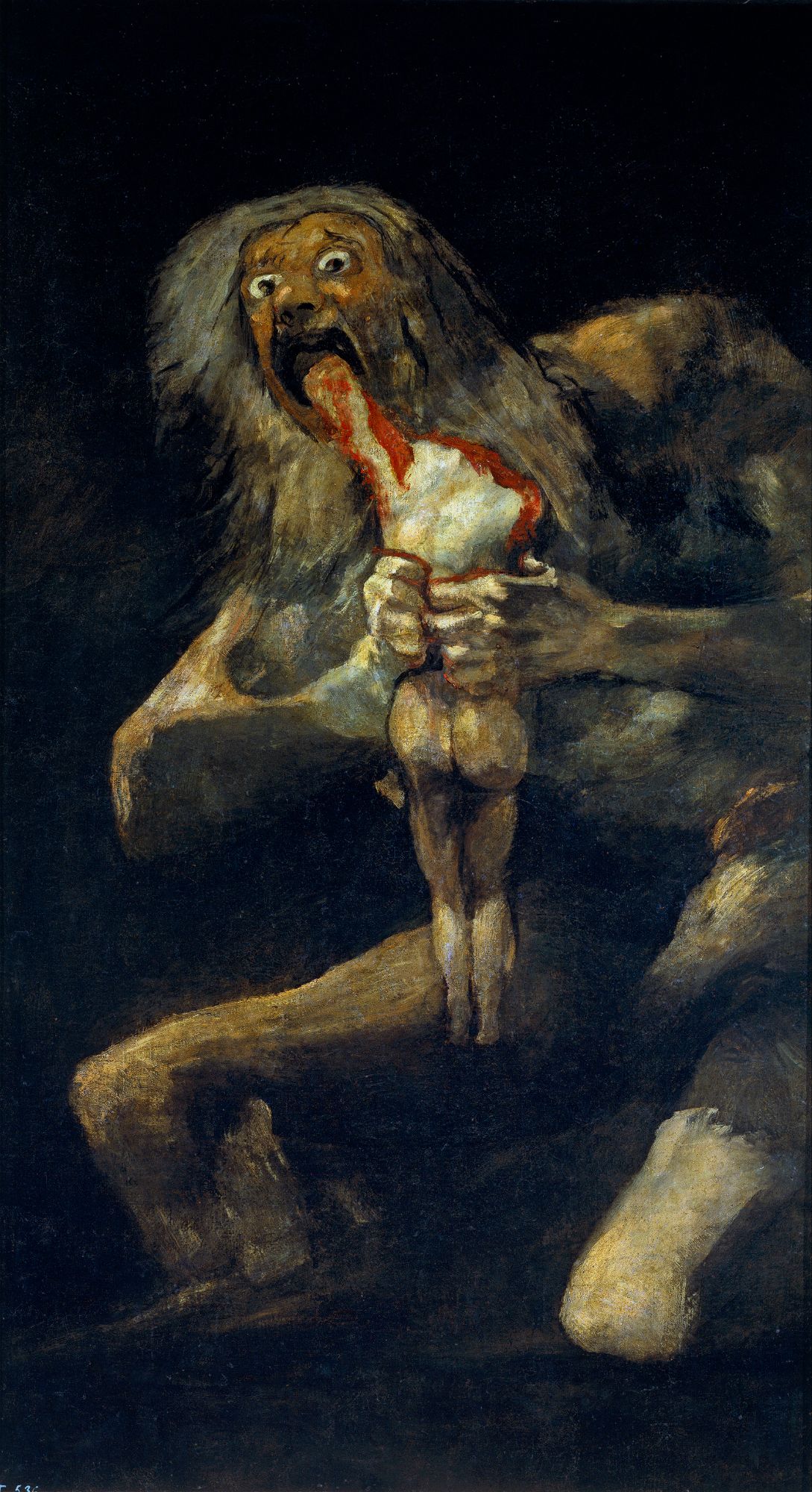
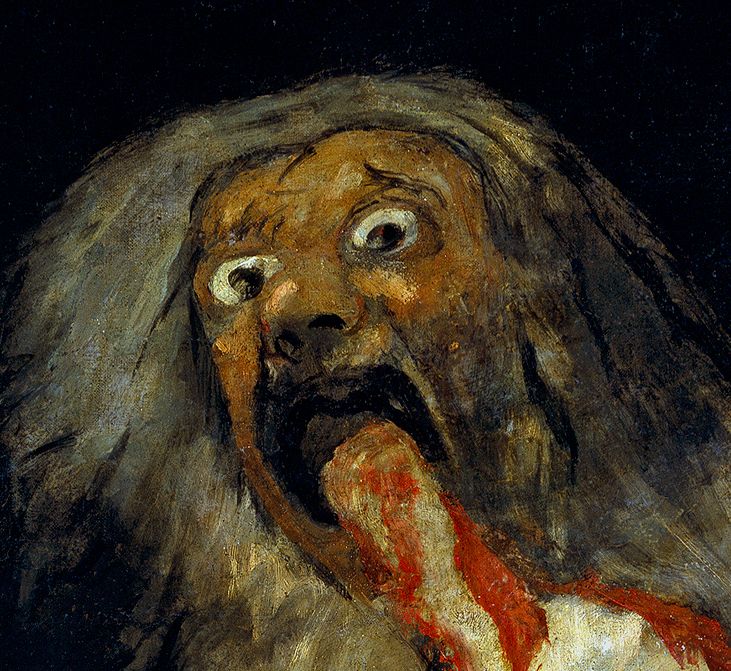
Goya painted Saturn on the plaster of his own house and never exhibited it. He gave it and its neighbors no titles or explanations: the Prado still lists it as plain Saturn, though in English it usually goes by Saturn Devouring His Son. Half a century later it was taken off the wall, and what hangs in the museum is not quite what Goya saw.
In 1819, at 72, he bought a country house outside Madrid, later nicknamed the Quinta del Sordo, the “Deaf Man’s Villa.” He went on to paint two of its rooms, downstairs and upstairs; Saturn went downstairs. These murals became known as the Black Paintings. In 1823 Goya left the house to his grandson and moved to France.
Canvas instead of plaster
Today Saturn hangs in the Prado with the other Quinta murals, but its canvas is not original: Goya painted on the wall.
The mural is not as large as reproductions suggest, about 144 × 81 cm (57 × 32 in), and there is another layer beneath it. X-rays taken at the Prado in the early 1980s, paint samples and a 1984 study by Carmen Garrido showed earlier murals beneath his, mostly landscapes and decorative motifs, most likely already on the walls when he bought the house.
Goya did not start from bare plaster. He covered the old decoration of the house he had bought with his own subjects, and Saturn, too, sits on top of an earlier mural. The only one with nothing underneath is Witches’ Sabbath, from the same room.
After Goya, the house changed hands several times. In 1873 the Paris banker Baron Frédéric Émile d’Erlanger bought it. The walls were crumbling, so he hired the Prado restorer Salvador Martínez Cubells to move the murals to canvas.
Work began in 1874 by strappo (Italian for “tear”): cloth was glued to the wall and pulled away with the paint layer. The murals “suffered enormously” and lost a great deal of paint. The canvases were then trimmed and the gaps painted in.
In 1878 Erlanger showed the murals at the Exposition Universelle in Paris. He reportedly hoped to sell them, but they made no impression. Three years later he gave them to the Spanish state, and by royal decree they went to the Prado, arriving in January 1882.
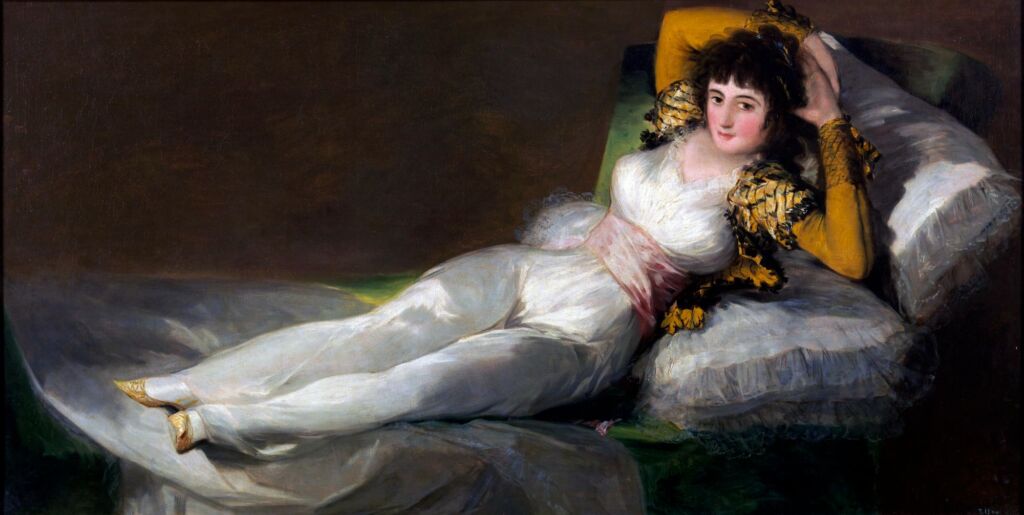
Photographs from before the transfer
Before the murals came down, the photographer Jean Laurent recorded them on the walls. The pictures are usually dated 1874, though the British scholar Nigel Glendinning placed them in the mid-1860s. The glass negatives survive in Madrid, in the photo library of the Cultural Heritage Institute of Spain (the Ruiz Vernacci Archive).
The photographs also help work out where Saturn hung. The Frenchman Charles Yriarte saw it in 1867 on the ground floor, in the room usually taken to be the dining room, on the far wall facing the entrance next to Judith and Holofernes, but he did not say on which side. He gave it a longer title than the museum does: Saturn Devouring His Children, in the plural. That is closer to the myth, in which Saturn, the Roman counterpart of the Greek Kronos, swallowed his children one after another because he had been told that one of them would overthrow him.
Glendinning noticed that in Laurent’s photograph the light falls on the molding around Saturn from the right, and connected it with a window: in his view the mural hung on the right-hand side of the room. Others object that Laurent may have used artificial light, in which case the highlight proves nothing. The question is still open.
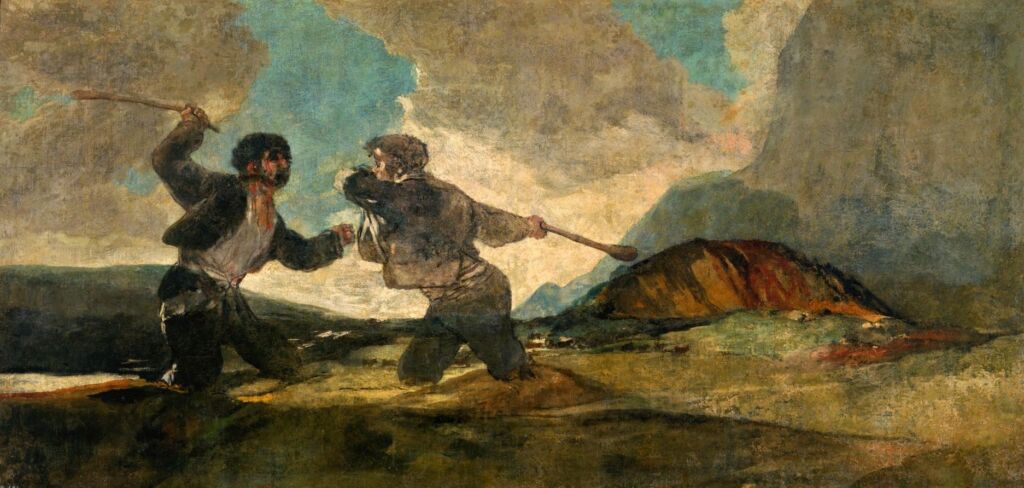
Photographs and X-rays show how much changed. Today the two men in Duel with Cudgels stand knee-deep in earth, yet Yriarte, who saw the mural on the wall in 1867, described them in a grassy meadow.
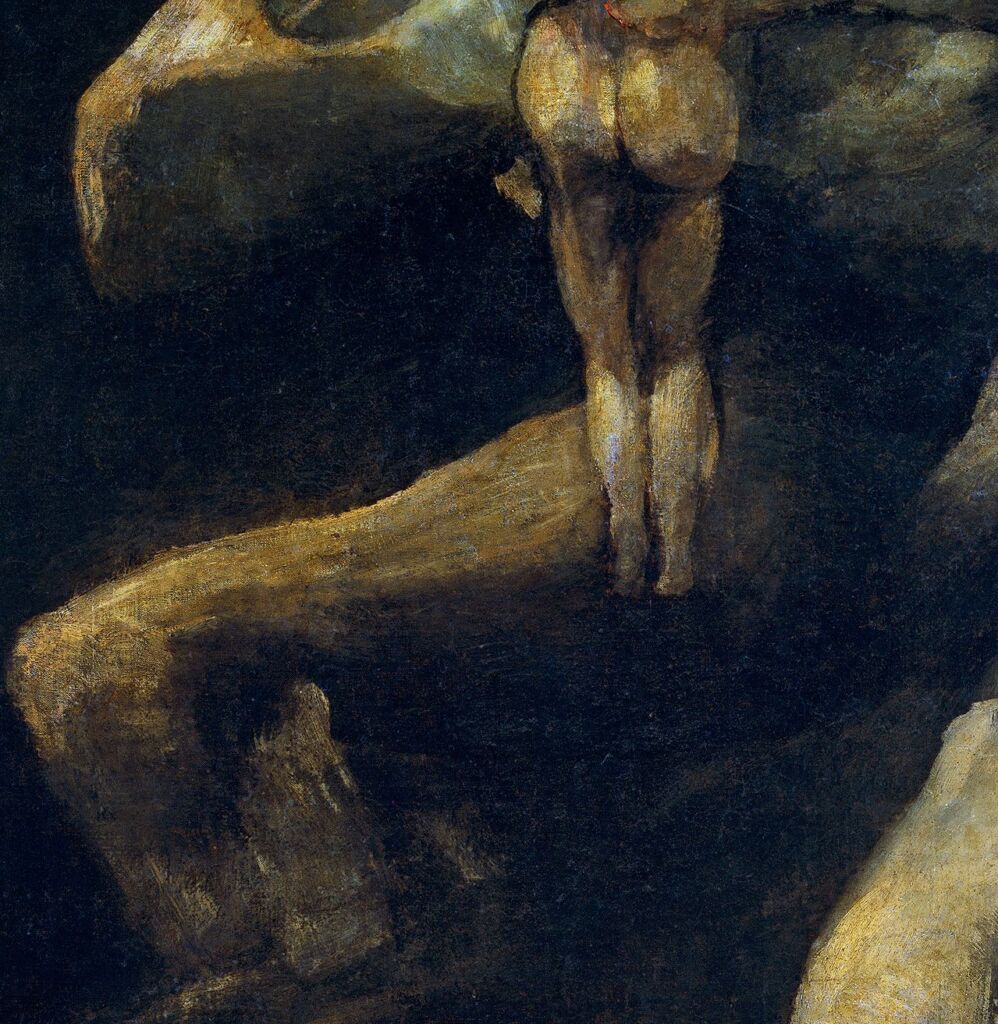
With Saturn the story is more explicit. Some scholars see an enormous phallus on the giant in Laurent’s photograph; in their view, it was painted over during the transfer.
The eyes that make the painting unforgettable suffered too. According to the catalog of the Fundación Goya en Aragón, they were among the worst-damaged areas and were repainted in the first restoration. The Spanish scholar Juan José Barragán writes that the giant’s gaze was almost entirely left behind on the wall.
In 2010 Carlos Foradada, a painter and art historian at the University of Zaragoza, digitized and enlarged Laurent’s glass negatives and compared them with the canvas as it is now. Before him, as the Spanish press reported, even Glendinning had worked from poorly printed copies of these photographs. On the wall, Foradada argues, Saturn looked straight at the viewer, astonished but piercing; after restoration his gaze became “uncertain and hesitant” (translated by Hroniki). He believes the restorer turned the giant into a simple predator, and that this reading still shapes how the painting is seen. The negatives also bore out the story of Duel with Cudgels: Goya stood the men in a meadow, and the restorer removed the grass and painted crude earth in its place.
The argument over the upper floor
In 2003 the art historian Juan José Junquera of the Complutense University of Madrid questioned whether Goya painted the Black Paintings at all. By his account, the upper floor was added after the artist left, so Goya could not have painted walls that did not yet exist.
In fact, Junquera doubted the whole series, even the downstairs Saturn, and named Goya’s son Javier as a possible author. The inventory of the house’s paintings, linked to the painter Antonio Brugada, he argued, was much later: it uses words like vargueño (a Spanish writing cabinet) that in his view were not yet current in Goya’s day.
The Prado said it respected his views but still considered the murals Goya’s. Glendinning pushed back (in Spanish): an 1859 property register calls the house “the original house of the famous painter Goya,” and no signed painting by Javier is known. Junquera replied again; the museum held its position.
The walls that carried Saturn no longer exist: the Quinta was demolished in 1909. The room Yriarte saw survives only in Laurent’s photographs and in reconstructions. In summer 2022 the Prado screened a 40-minute film by the French artist Philippe Parreno, La Quinta del Sordo, made in collaboration with the Fondation Beyeler: an attempt to give the murals back their vanished house, at least on screen.
Goya never explained Saturn. Today we judge how the giant looked on the wall from Laurent’s photograph and the X-rays, and from what a restorer chose to leave us a century and a half ago.
Comments
For Hroniki readers
Comments are open to readers with an account. Signing up is free and takes a few seconds.
No comments yet. Start the conversation.