Judith and Holofernes: from an unwanted bronze to Klimt’s gold
One biblical story of a widow and a general traveled from Donatello's bronze, removed from the doors of Florence's town hall, to Klimt's Judith, whom viewers mistook for Salome.
In June 1504 Florence swapped the statue outside the doors of the Palazzo della Signoria. Donatello’s bronze Judith, there for ten years, was removed, and Michelangelo’s newly finished David took its place.
The decision came on January 25, when some thirty citizens, Leonardo da Vinci and Sandro Botticelli among them, met to choose a spot for the David. The Signoria’s herald, Francesco Filarete, proposed the palace doors; the Judith, he felt, should go.
Yet the subject Florence wanted out of sight kept its hold on artists for four more centuries. The same widow with a sword became civic virtue, a courtly beauty, a killer at work, a painter’s mistress and, finally, a Viennese femme fatale.
Two blows and a bag of meat
The story comes from the Book of Judith, which the King James Bible prints among the Apocrypha. Holofernes, Nebuchadnezzar’s Assyrian general, besieged the town of Bethulia. Judith, a beautiful widow, dressed in her finest and went with her maid into the enemy camp. “In the fourth day Holofernes made a feast,” drank heavily and fell asleep in his tent.
Here the text becomes spare and precise. Judith took his sword from the bedpost, seized him by the hair, “and she smote twice upon his neck with all her might.” She handed the head to her maid, who “put it in her bag of meat,” that is, of provisions. The women left the camp as if going to their usual prayers, and in Bethulia Judith showed the head to the people: “the Lord hath smitten him by the hand of a woman.”
These few verses hold all that artists loved: beauty and piety, a feast and a night, a sword, a severed head, a maid as witness. In the fifteenth century, the Uffizi notes, Judith was read two ways: as a model of marital fidelity, since she rejected the enemy’s advances, and of lawful resistance to a tyrant.
Each age chose its own second of the biblical story: the homecoming, the trophy, the blow or the gaze.
The bronze that was asked to leave
Donatello cast his Judith for the Medici between 1457 and 1464. The group, 236 centimeters (7 feet 9 inches) tall, stood in their palace garden on the Via Larga as a fountain, water spouting from the corners of the cushion and from reliefs on the base. Donatello assembled it from eleven castings and signed the cushion beneath Holofernes: OPVS DONATELLI FLO, “the work of the Florentine Donatello.”
A pedestal inscription, now lost but recorded in early sources, spelled out the meaning: “Kingdoms fall through luxury, cities rise through virtues; behold the neck of pride severed by the hand of humility.” A lesson in humility, set in the garden of the family that effectively ruled the city.
In 1494 the Medici were driven out and the republic took the statue. In 1495 it was installed at the entrance to the Palazzo della Signoria, its new inscription declaring it placed by the citizens as an example of public well-being. A story of a tyrant and his killer now pointed at its former owners.
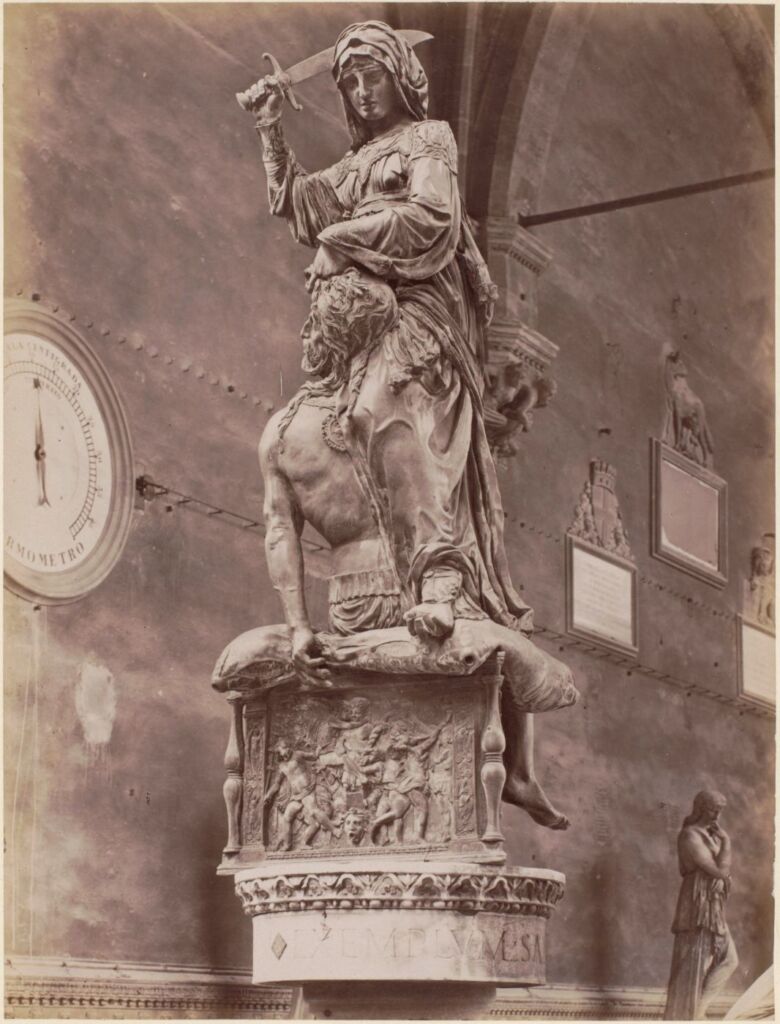
At the 1504 meeting Filarete spoke bluntly. The minutes, as quoted in English by the art historian Richard Stemp, have him say: “The Judith is a deadly symbol, and unfitting for us whose emblems are the cross and the lily.” Nor was it proper, he added, for a woman to kill a man. There was also the omen: the statue had gone up as Florence was losing Pisa.
Displaced by the David, the Judith spent nearly five centuries moving around the square, to the Loggia dei Lanzi and back to the palace doors, until a copy replaced it in the 1980s. The original stands in the Palazzo Vecchio’s Hall of Lilies: indoors, away from the street where it was once called a bad omen.
A homecoming without blood
Botticelli, who helped settle the David‘s fate in 1504, had painted Judith some thirty years earlier, more than a decade before The Birth of Venus, on two small panels about 31 by 24 centimeters. In one, the Assyrians find the headless body in the tent; in the other, Judith and her maid return to Bethulia. Both are in the Uffizi Galleries; they once belonged to Bianca Cappello, Grand Duchess of Tuscany.
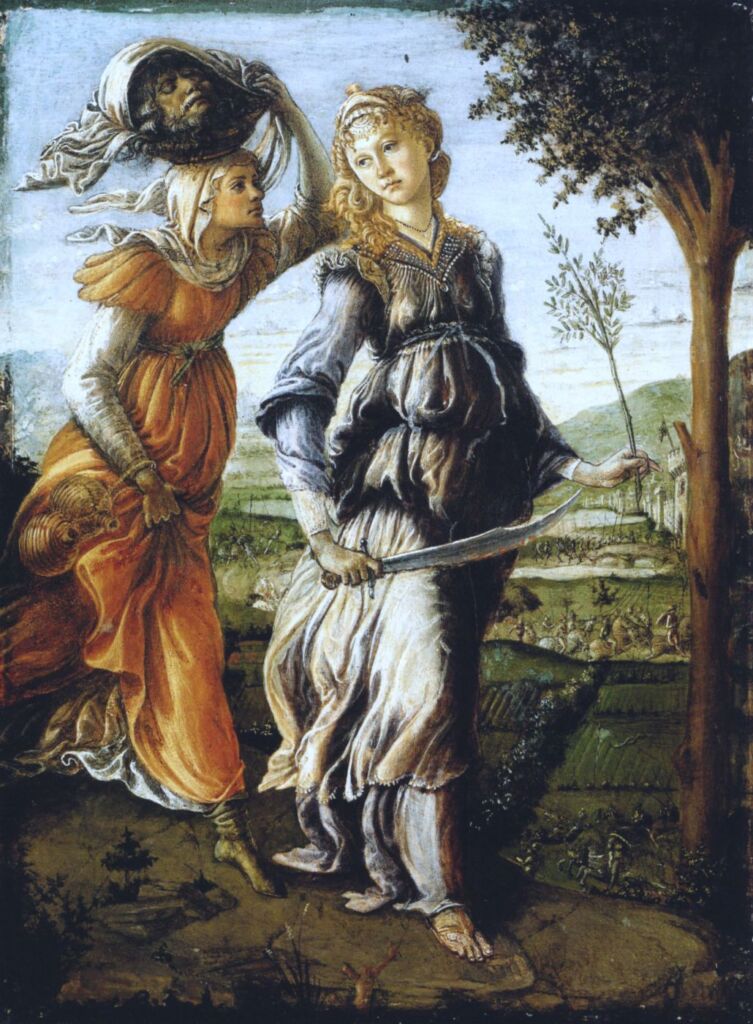
Botticelli turned the aftermath into a walk home. The women stride through the hills, wind tugging at their clothes, the terrible load wrapped and riding on the maid’s head. The Warburg Institute notes how easily the pair carry sword and burden.
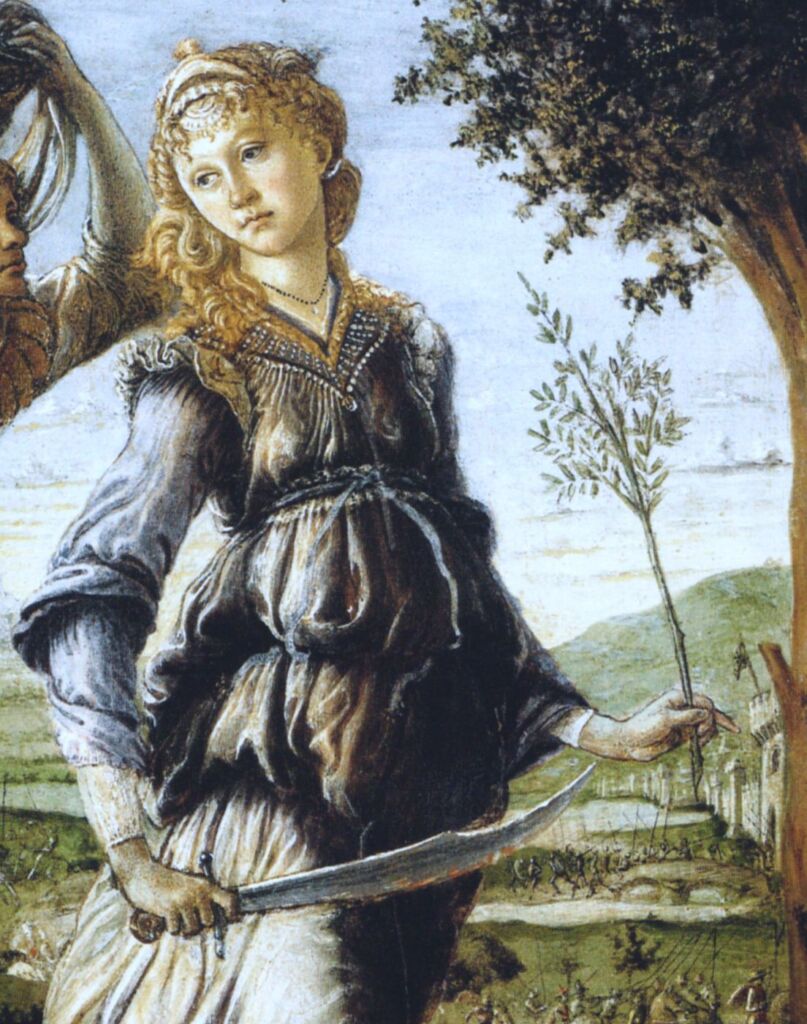
She carries the sword as lightly as the branch. There is almost no violence, only a city saved and a woman coming home. This is the Judith of the Medici garden and the Signoria’s doors: civic virtue.
A beauty with it all behind her
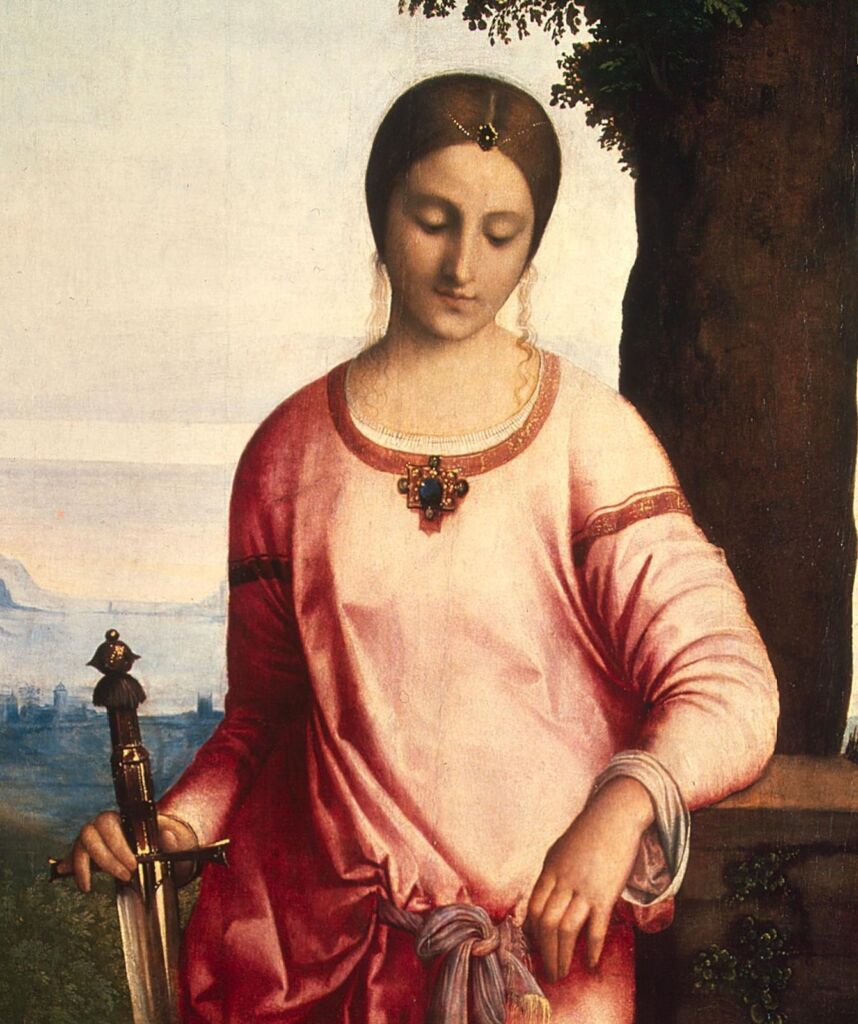
Around 1504, while Florence argued over the David, the Venetian Giorgione painted a Judith to whom nothing is happening anymore. The killing happened somewhere beyond the frame; what remains is stillness. The tall, narrow panel, 144 by 66.5 centimeters, may have been a cupboard door, suggests the art historian Jaynie Anderson, who spotted a painted-over keyhole.
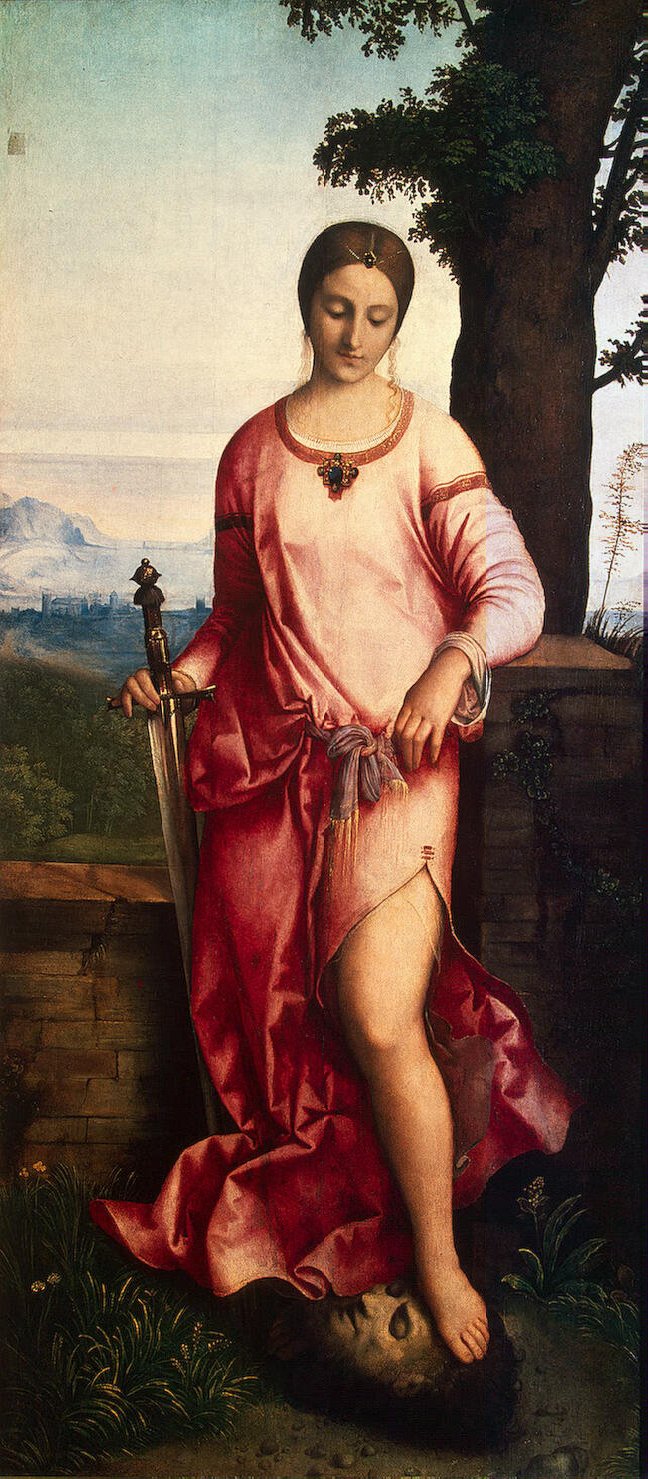
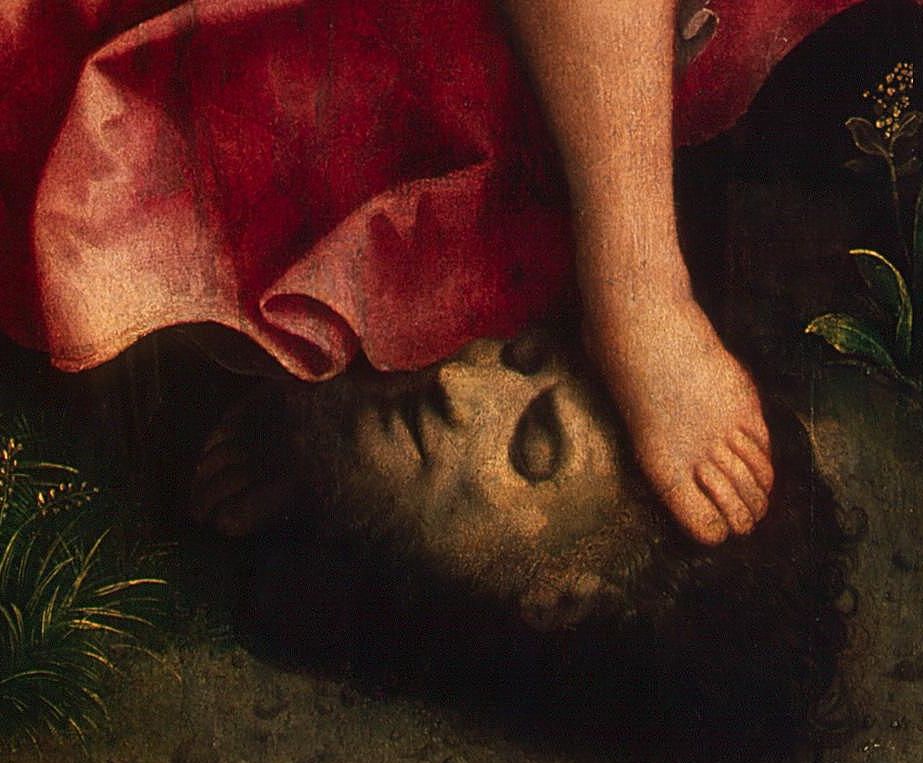
Judith rests her bare foot on Holofernes’s head almost absent-mindedly. The head is still there; it has simply become one more detail among the grass and stones.
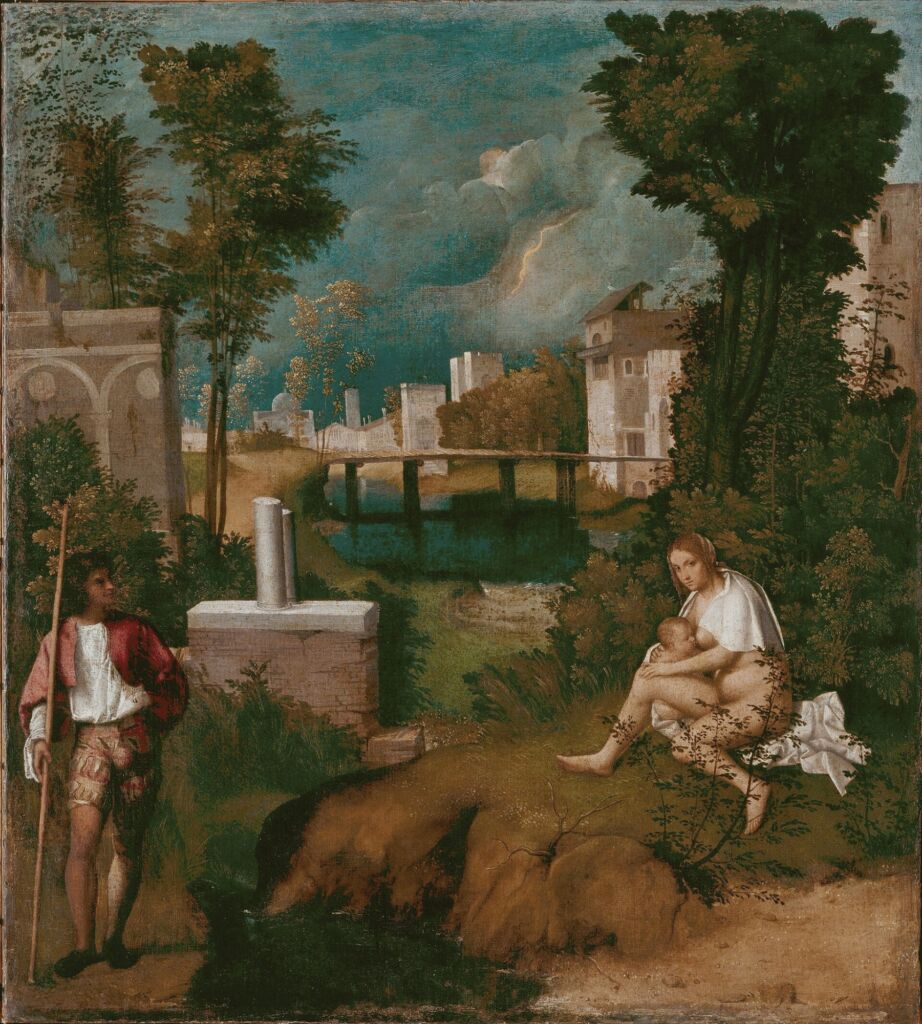
It reached the Hermitage in 1772 with the Crozat collection from Paris, bought for Catherine the Great, and long passed for a Raphael. Giorgione signed nothing; the attribution rests on style, and this is the only painting in Russia that scholars unanimously accept as his. His most famous picture, The Tempest, is in Venice; we have written about what X-rays found beneath it.
The Judith was not always so calm and luminous. Over time the paint had disappeared under yellowed varnish and retouching. Preparations for cleaning began in 1967, and the work lasted until 1971, under a microscope, a few square centimeters a day. With the varnish gone, a tower and hills emerged in the distance, and the color grew brighter and deeper.
Judith in court dress
North of the Alps, Judith dressed in the latest fashion. Lucas Cranach the Elder and his workshop painted her more than twelve times in different media. In the version of around 1530 at the Metropolitan Museum of Art, she wears what the museum calls an “elaborate contemporary costume that would have appealed to Cranach’s courtly patrons.”
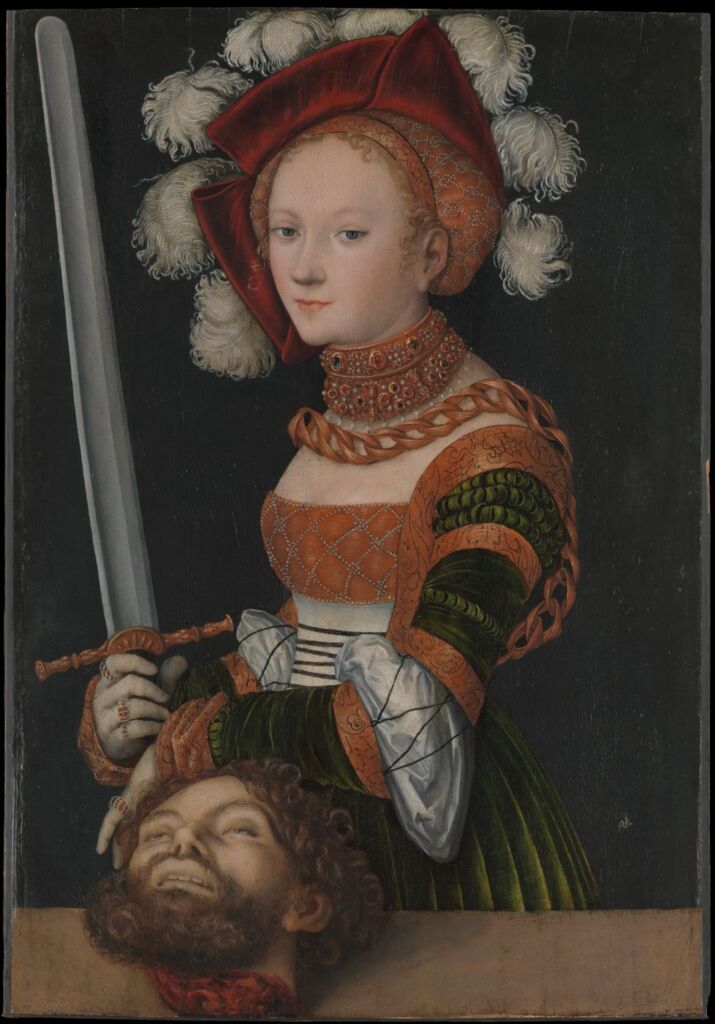
The workshop repeated the successful composition several times. At lower right is Cranach’s mark, a crowned winged serpent with a ring in its mouth. Of the biblical story, all that remains is a composed beauty and the evidence at her side.
The moment of the blow
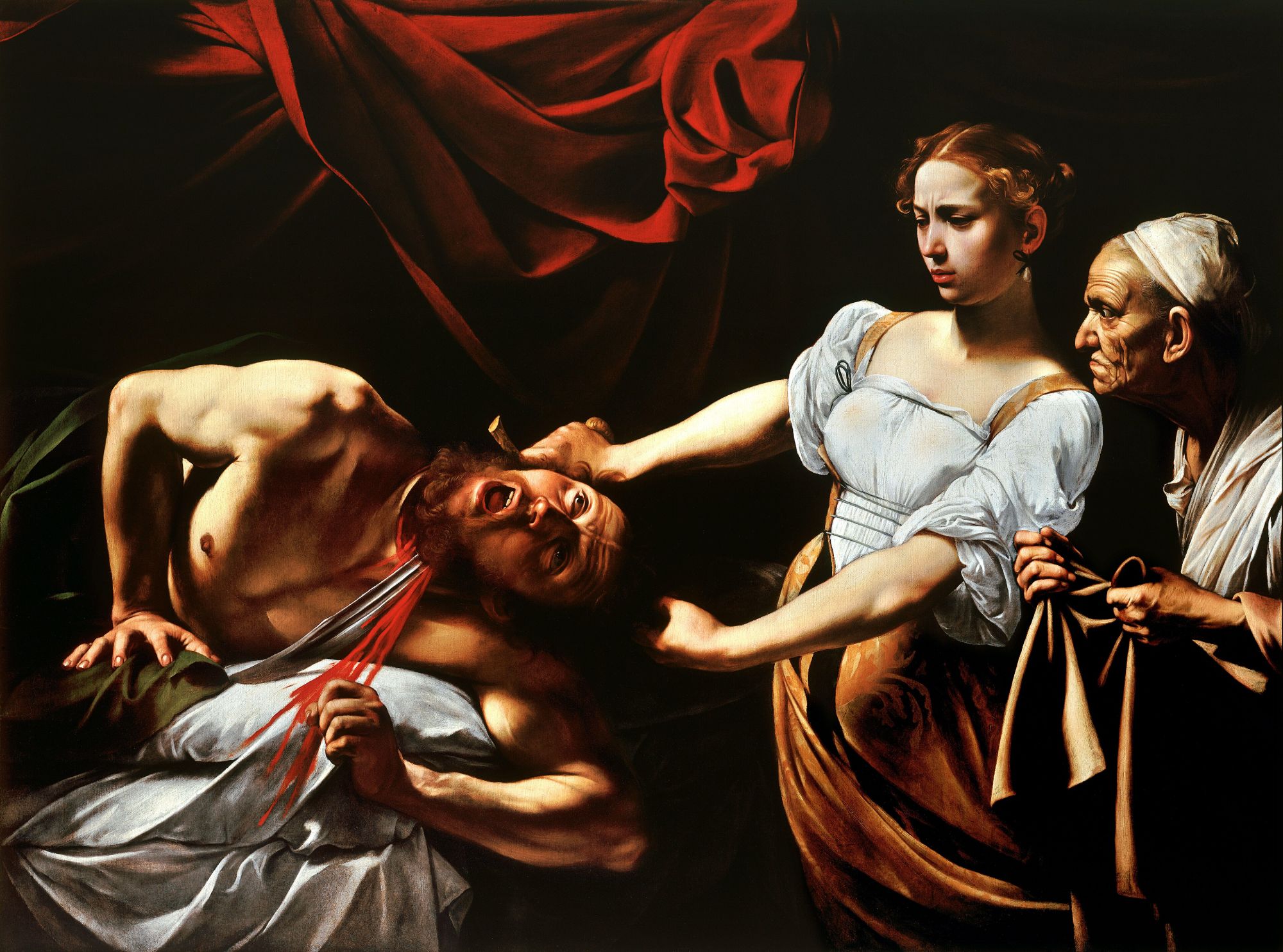
Around 1599 in Rome, Caravaggio painted neither homecoming nor trophy but the blow itself: the picture at the top of this article. The Ligurian banker Ottavio Costa, who commissioned the 145-by-195-centimeter canvas, prized it so much that he forbade selling or even copying it.
The ban worked too well. In the mid-nineteenth century the picture passed to the Coppi family and was all but forgotten. It now hangs in the Palazzo Barberini in Rome, state property since 1971.
In 1951 the restorer Pico Cellini recalled a Judith he had seen as a boy in a Roman palazzo, attributed to Orazio Gentileschi. He found it with Vincenzo Coppi, photographed it and showed the photograph to Roberto Longhi, then holding a big Caravaggio exhibition in Milan. Longhi had the show extended to include the find.
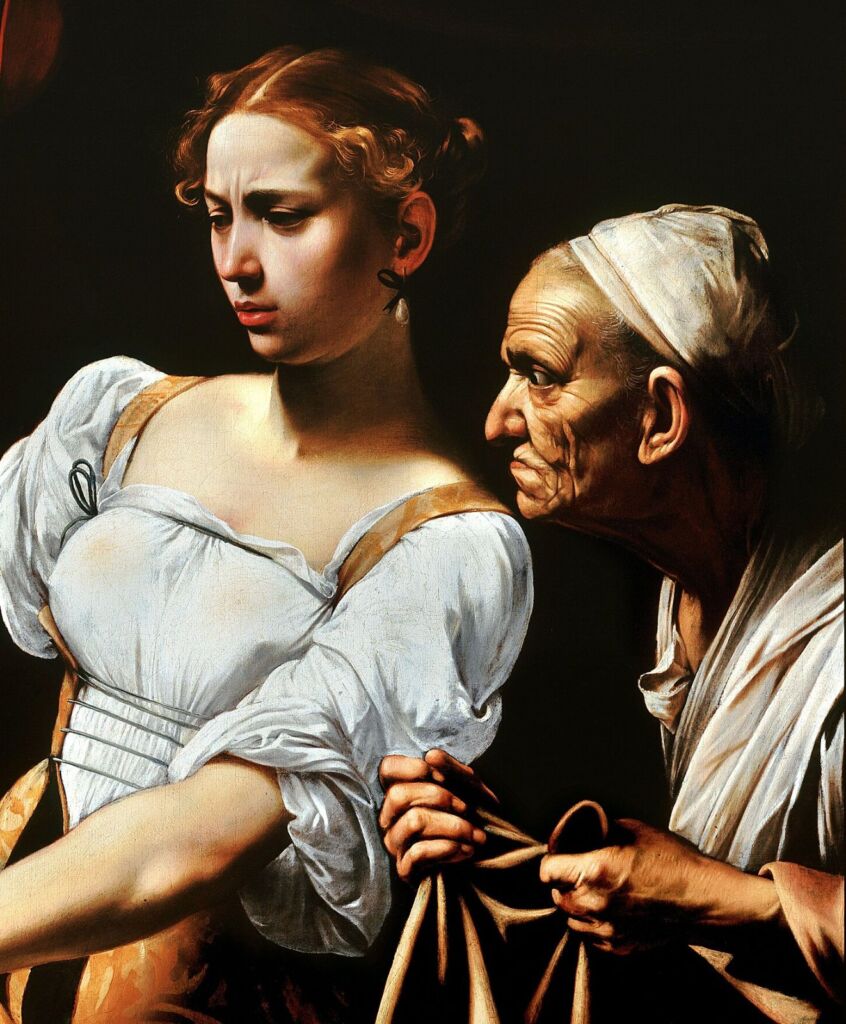
Caravaggio’s Judith pulls back from her own deed, frowning as if at an unpleasant chore. Beside her an old woman watches wide-eyed. The Bible never says the maid was old; that was the painter’s choice. Young face and lined face meet in one hard beam of light aimed out of the darkness.
By the hand of a woman
About a decade later Artemisia Gentileschi, daughter of the Caravaggist Orazio, took up the subject. Her first Judith, from around 1612–1613, is in the Museo di Capodimonte in Naples. Here the maid pins Holofernes down with all her weight, and the killing becomes a job for two.
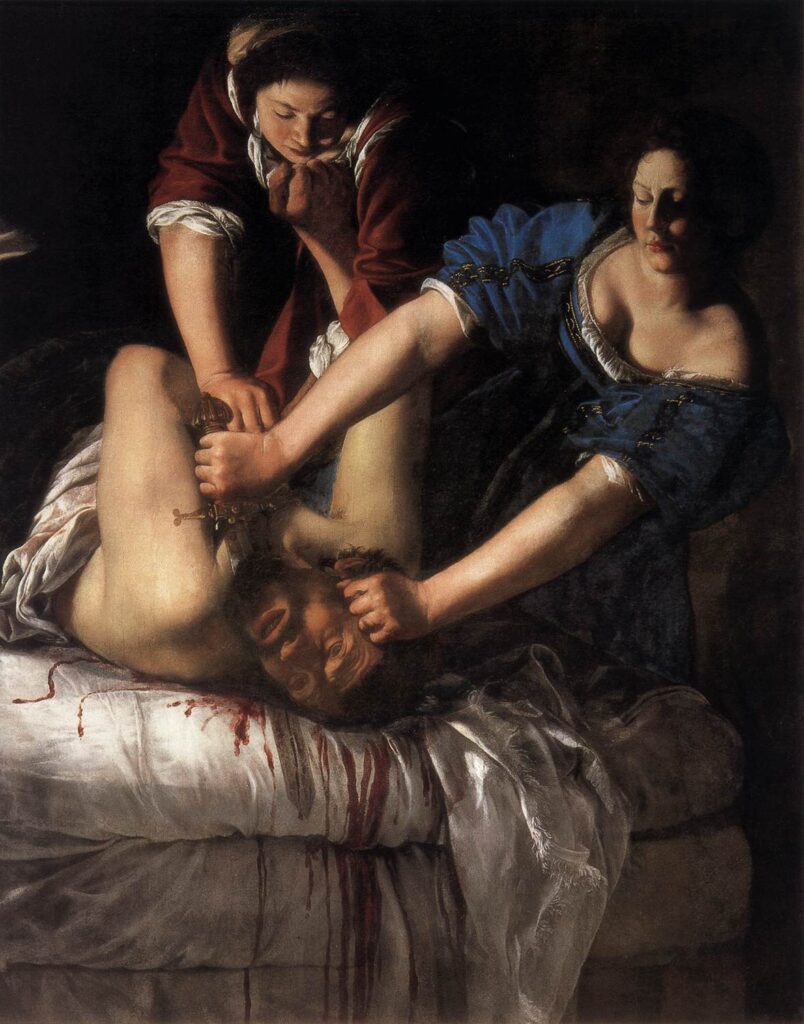
In 1612 Rome tried the painter Agostino Tassi, who had raped Artemisia. Her Judiths are often read as revenge on canvas, but that is interpretation, not documentation: as far as is known, she never linked them to the trial.
Around 1620, in Florence, she painted it again. The fee was agreed with Grand Duke Cosimo II, but, as the Uffizi explains, he died in 1621, soon after the canvas was finished. Payment was late, and a friend helped her collect it: Galileo Galilei.
The painting, the museum says, was “denied the honor of being exhibited in the Gallery”; its naturalism shook Florence. It now hangs in the Uffizi’s Caravaggio and Artemisia room.
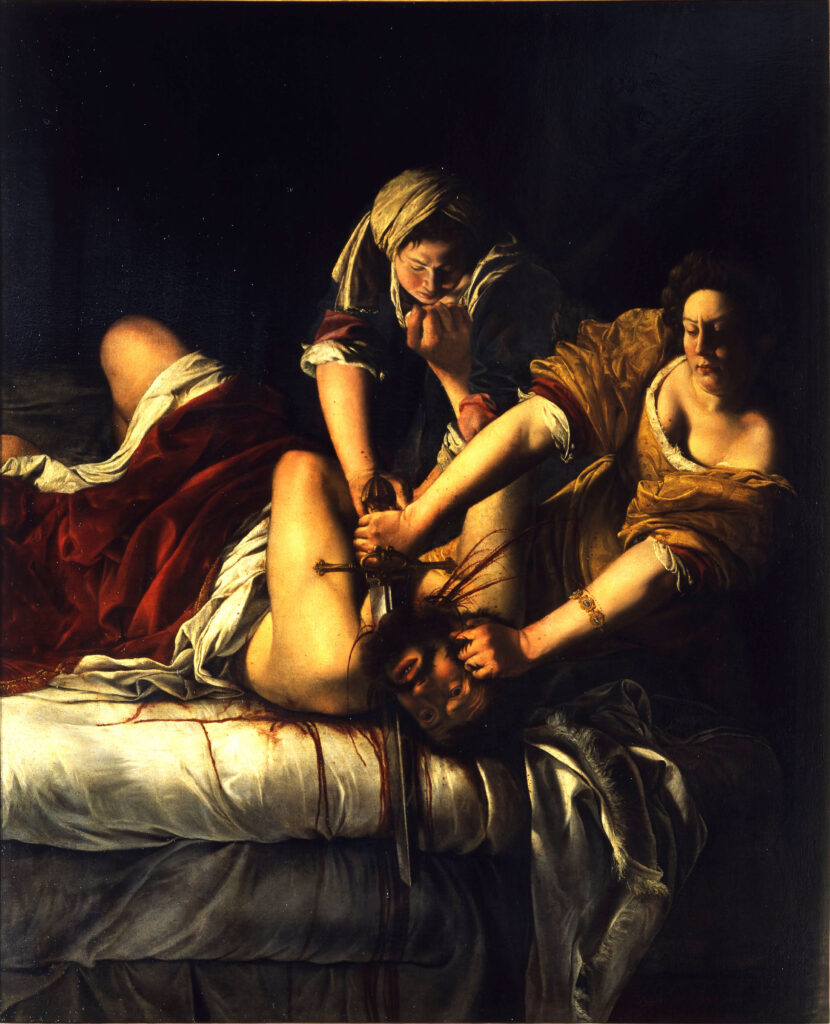
Her Judith does not flinch like Caravaggio’s. Here blood spurts in arcing jets and falls in drops on her arms and dress. Scholars allow that Artemisia may have known Galileo’s work on parabolic trajectories.
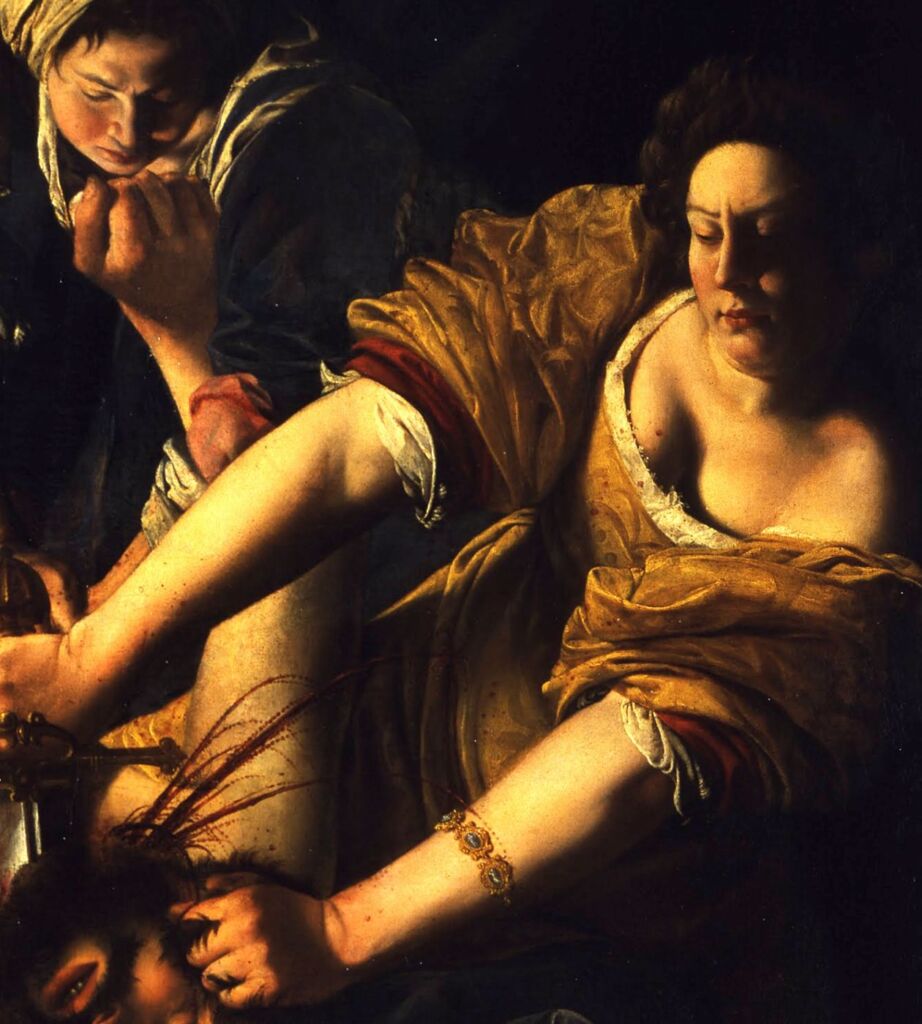
On the arm gripping the head is a bracelet of cameos, one of which appears to show Artemis, goddess of the hunt and of chastity. The painter’s namesake attends the execution.
A self-portrait as a trophy
The Florentine Cristofano Allori made the subject personal. His Judith with the Head of Holofernes, in the Palatine Gallery of the Palazzo Pitti, is his best-known and much-copied painting. The museum dates it 1610–1612; Britain’s Royal Collection says 1620. In the museum’s view, Allori learned Caravaggio’s lesson through Artemisia, who painted her Judiths for Cosimo II.
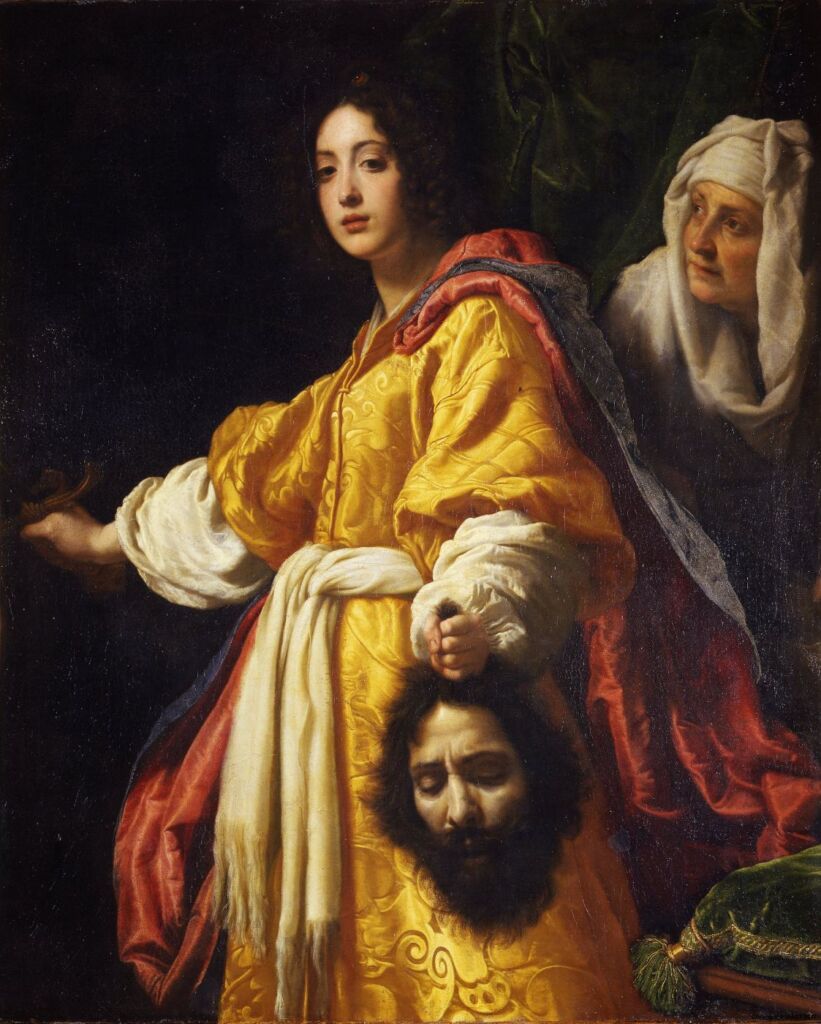
By Florentine tradition, Judith was modeled on the artist’s mistress, known as La Mazzafirra, and the head of Holofernes is a self-portrait. The story was recorded by Filippo Baldinucci, biographer of Florentine artists. In his account, cited by the Royal Collection Trust, the picture is partly autobiographical, and the old maid is Mazzafirra’s mother.
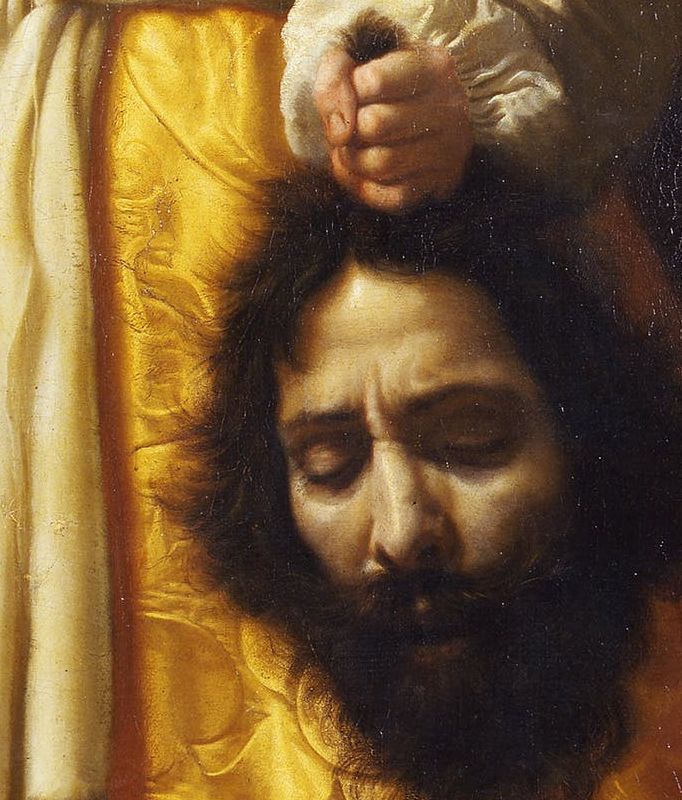
The British version is signed and dated 1613. Its Latin inscription reads: “By this work of Cristofano Allori Bronzino, nature, until now unconquered, is almost conquered” (translated here by Hroniki). If the legend is true, the painter gave his lover the sword and cast himself as the trophy. Holofernes has gone from enemy of Israel to a man who literally lost his head over a woman.
A name on the frame
In 1901 in Vienna, Gustav Klimt painted his Judith, often called Judith I, in oil and gold leaf on an 84-by-42-centimeter canvas now in the Belvedere. The picture’s edge cuts Holofernes’s head roughly in half, and the Klimt Foundation’s database reduces it to “a mere attribute.” Everything else belongs to the heroine.
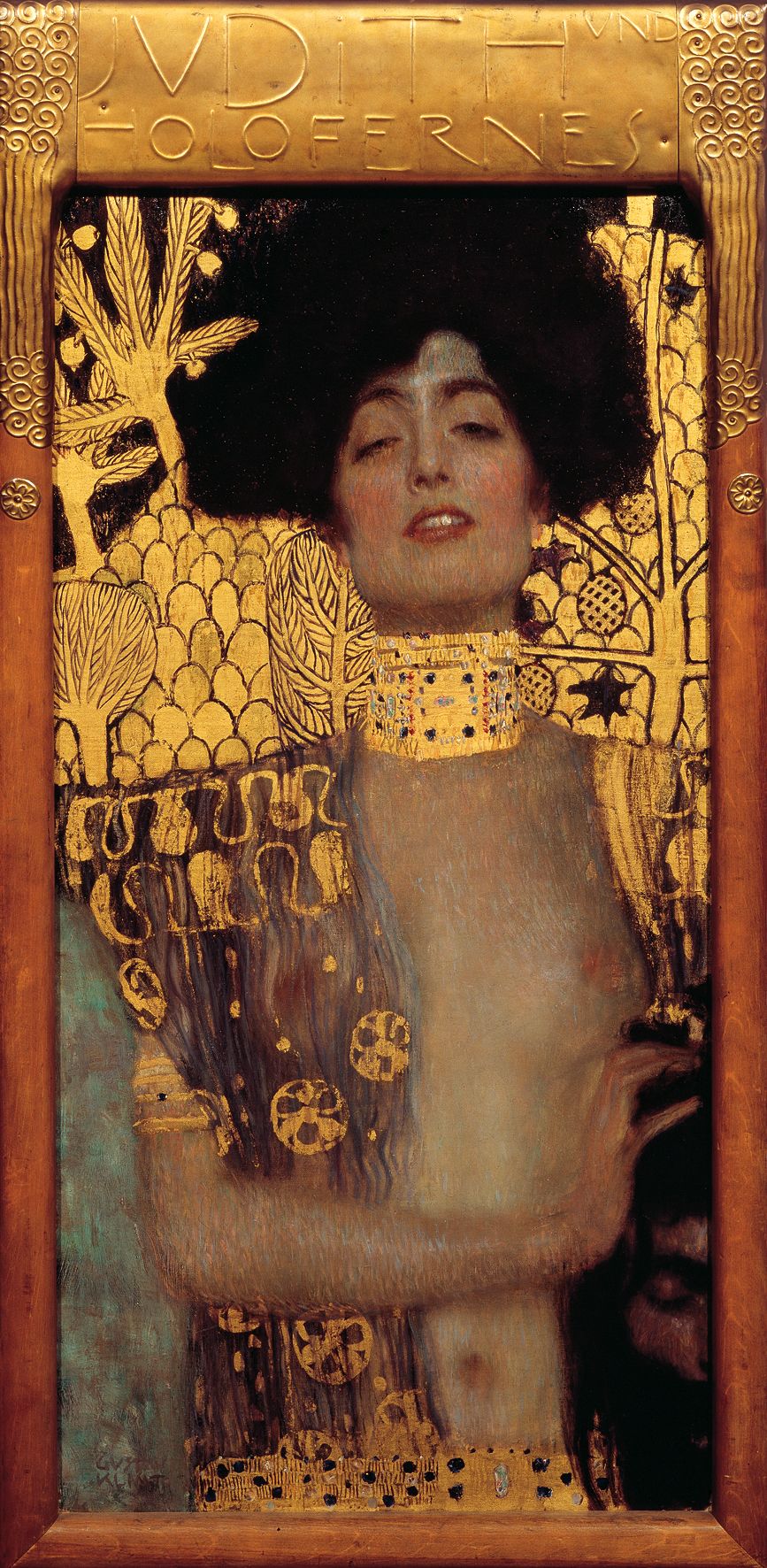
Klimt designed the frame, and his brother Georg, a metal sculptor, made it. It reads JUDITH UND HOLOFERNES, yet viewers saw Salome in her, the temptress who demanded the head of John the Baptist. The critic Fritz von Ostini wrote in 1901: “For the splendid biblical figure of the slayer of Holofernes, this face is much too lustful and much too perverse.”
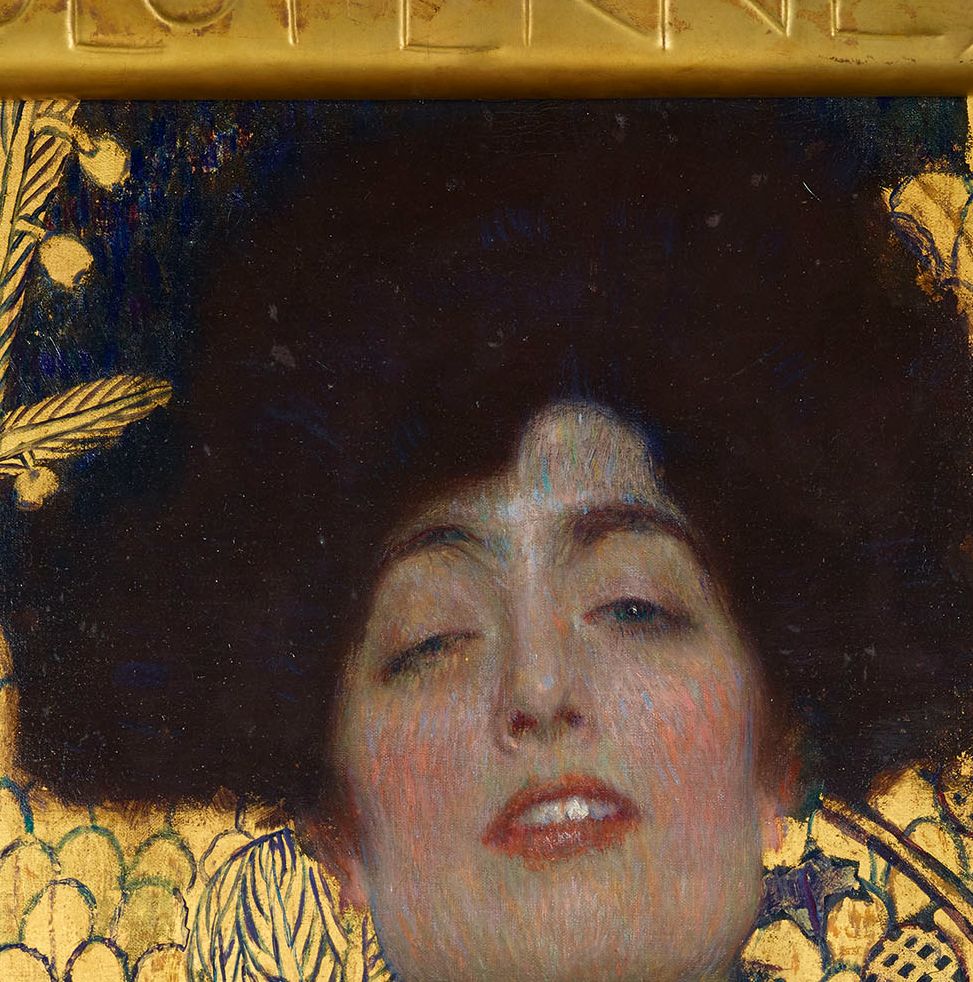
The Eastern motifs of the gold ground come from Assyrian reliefs, the art of Holofernes’s own people. Klimt returned to the subject in 1909 with a second Judith, now in Venice. We looked at what Klimt’s gold is made of in our article on The Kiss.
In 1504 a Florentine herald held that a woman should not kill a man. Nearly four hundred years later Judith’s name was on the frame itself, and people still saw Salome. Holofernes’s head, meanwhile, traveled the other way: from the chief proof of victory, carried through a whole city, to a detail cropped by the edge of the canvas.
Comments
For Hroniki readers
Comments are open to readers with an account. Signing up is free and takes a few seconds.
No comments yet. Start the conversation.