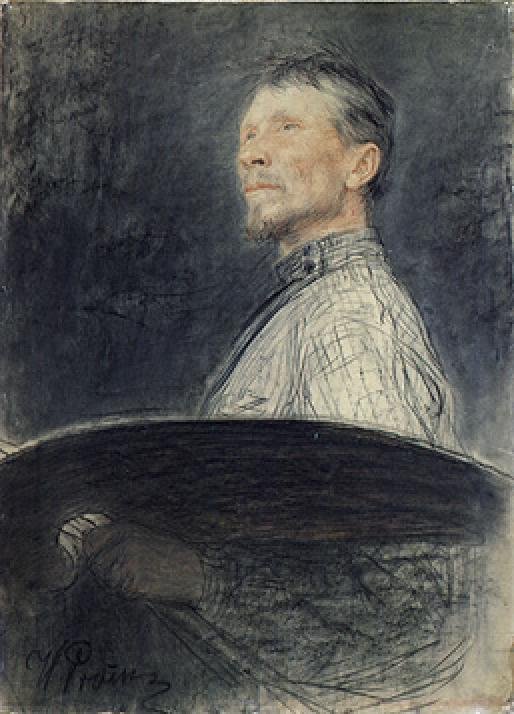
Abram Arkhipov
Abram Yefimovich Arkhipov · 1862, Yegorovo — 1930, Moscow
Biography
Abram Pyrkov came to Moscow from a village in Ryazan Governorate at the age of fifteen. He entered the Moscow School of Painting, Sculpture and Architecture in 1877, but it was as Arkhipov that he made his name. Even the surname he was born with appears in two forms in the sources: Pyrkov or Pyrikov. The peasant’s son became one of the leading painters of Russian village life at the turn of the century, and an artist who passed from the Peredvizhniki into the Soviet era with his reputation intact.
He was born on August 27, 1862 (August 15, Old Style), in the village of Yegorovo in Ryazan Governorate, to a poor peasant family. In Moscow he studied under Vasily Perov, Vasily Polenov, Alexei Savrasov, Illarion Pryanishnikov and Vladimir Makovsky. His studies were interrupted by two years at the Academy of Arts in St Petersburg (1884–1886, according to a German encyclopedia), but the academic system could not hold him. Back in Moscow, he completed his course at the school in 1886–1888.
His early works of the 1880s are still close to the accusatory genre painting of his teachers, above all Perov. The turning point came with On the Oka River (c. 1889–1890), in which a story of injustice gave way to light and air. For Arkhipov, painting outdoors became the subject itself rather than a backdrop. He traveled in Europe in 1886 and again in 1912, visiting France, Germany and Italy. He joined the Association of Traveling Art Exhibitions, better known as the Peredvizhniki, in 1891, and in 1903 he was among the founders of the Union of Russian Artists.
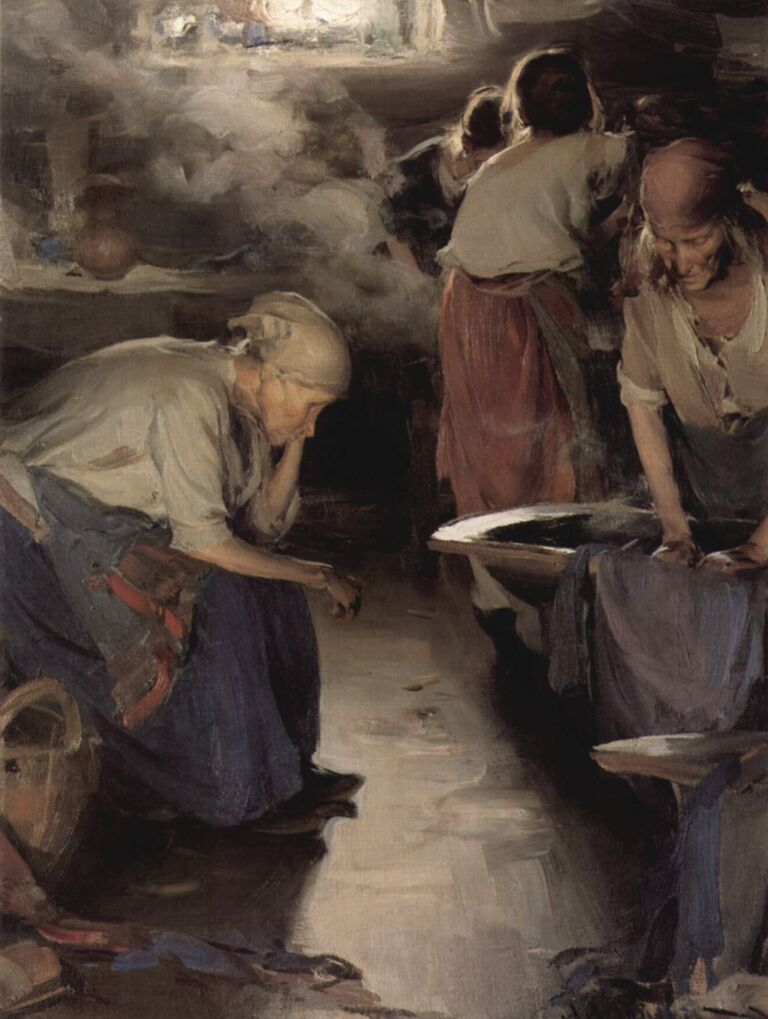
His best-known theme is the heavy labor of women. Washerwomen exists in several versions: one, from 1899, is in the State Russian Museum, and another, from the late 1890s, is in the State Tretyakov Gallery. Beside them stands The Return Journey (1896), one of his most recognizable works. A Northern Village (1903) anticipated an interest that became lasting from 1912 onward, when Arkhipov began traveling often to the Russian North. Those trips gave rise to his late series of peasant portraits, which includes Visitors (1914) and A Girl with a Jug (1927).
Arkhipov combined the subject matter of the Peredvizhniki with the freedom of the oil sketch. He taught landscape for many years and looked at a genre scene through a landscape painter’s eyes: the story in his pictures often dissolves into weather and space. In his late portraits of peasant women, color takes over, and the sitter is no longer a victim of circumstance but a heroine.
Recognition came through official channels. He became an academician in 1898 and a full member of the Academy of Arts in 1916. From 1894 Arkhipov ran the landscape class at his old school, and in 1922–1924 he taught at Vkhutemas, the Higher Art and Technical Studios. Thirty years of teaching turned the pupil of Perov and Savrasov into a mentor to several generations of Moscow painters. In the 1920s he joined the Association of Artists of Revolutionary Russia (AKhRR), and in 1927, in his sixties, he was named People’s Artist of the Republic.
Abram Arkhipov died in Moscow on September 25, 1930. Most of his work is in the State Tretyakov Gallery, and individual pieces are in the National Art Museum of Belarus in Minsk. His career, from Perov’s classroom to AKhRR, is a rare case of one subject, peasant life, carried through three artistic eras.
Major works
Click a painting to see the details.
-
 01
Washerwomen
Late 1890s · State Tretyakov Gallery, Moscow
Related artists
 Vasily Perov
1877–1882 · teacher
 Vasily Polenov
1880s · teacher
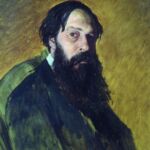 Alexei Savrasov
1877–1882 · teacher