Caspar David Friedrich: from a brother lost under ice to the Wanderer
A boy who watched his brother vanish under the ice grew up to be a leading painter of German Romanticism and a favorite of the Russian court, then was forgotten for 66 years after his death. Friedrich's life, told through his key paintings.
In the winter of 1787, when Caspar David Friedrich was thirteen, his younger brother Johann Christoffer fell through the ice in Greifswald. Thirty-seven years later Friedrich would finish The Sea of Ice, where the ice rears up and crushes a ship. Friedrich never linked the two winters; his biographers do. But death and ice stayed with him for life.
His Wanderer above the Sea of Fog is now among the most recognizable paintings of the 19th century, yet by 1890 Friedrich was barely remembered, even in Germany. His life can be told through seven paintings, each a turning point.
Ice in Greifswald
Friedrich was born on September 5, 1774, in Greifswald, a Baltic port that then belonged to Sweden. His father, a soap boiler and candle maker, had a workshop adjoining the family house near the cathedral. The Friedrichs owned it for more than two hundred years; today it is the Caspar David Friedrich Centre.
Johann Christoffer was a year younger. Accounts place the accident on the town moat or on a frozen lake. One version, repeated by many biographers but hard to prove, has him dying while pulling Caspar out of the water.
What is certain is that Friedrich kept returning to death and burial. Graves and cemeteries appear in more than twenty of his works.
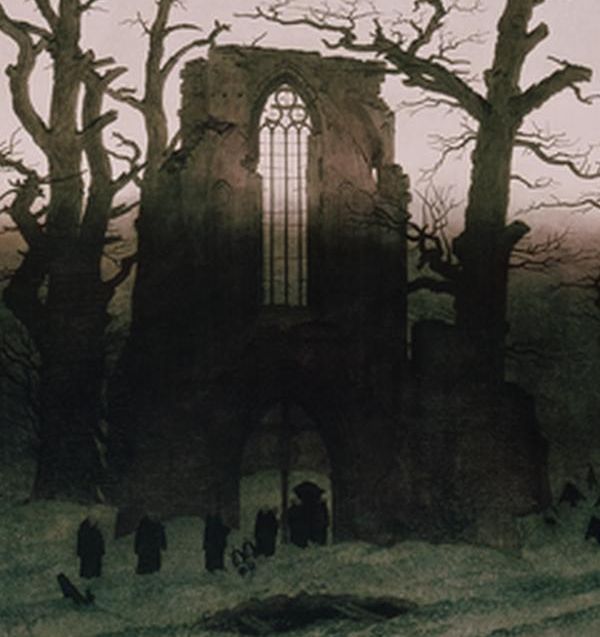
The ruin in this painting is based on studies of Eldena Abbey outside Greifswald. He drew it from his teens and, almost twenty years later, moved it into Abbey among the Oaks.
He began his training in 1790 with Johann Gottfried Quistorp, the university’s drawing master, who demanded exact copying and correct proportions. In 1794 it was probably Quistorp who advised him to go on to Copenhagen, whose academy charged no tuition.
He spent 1794–98 at the academy there. Painting was not taught as a separate subject; his teachers were Christian August Lorentzen and Jens Juel. In the fall of 1798 he moved to Dresden, where he stayed for the rest of his life.
Recognition first came in 1805, when two of his sepia drawings (sepia is a brown ink made from cuttlefish) won a half share of the Weimar art prize run by Goethe.

A landscape on the altar
At Christmas 1808 Friedrich invited the Dresden public to his studio to see one painting, Cross in the Mountains, set on a table draped in black, the light dimmed so the room felt like a chapel. He designed the carved, gilded frame with its religious symbols; the sculptor Christian Gottlob Kühn carved it.
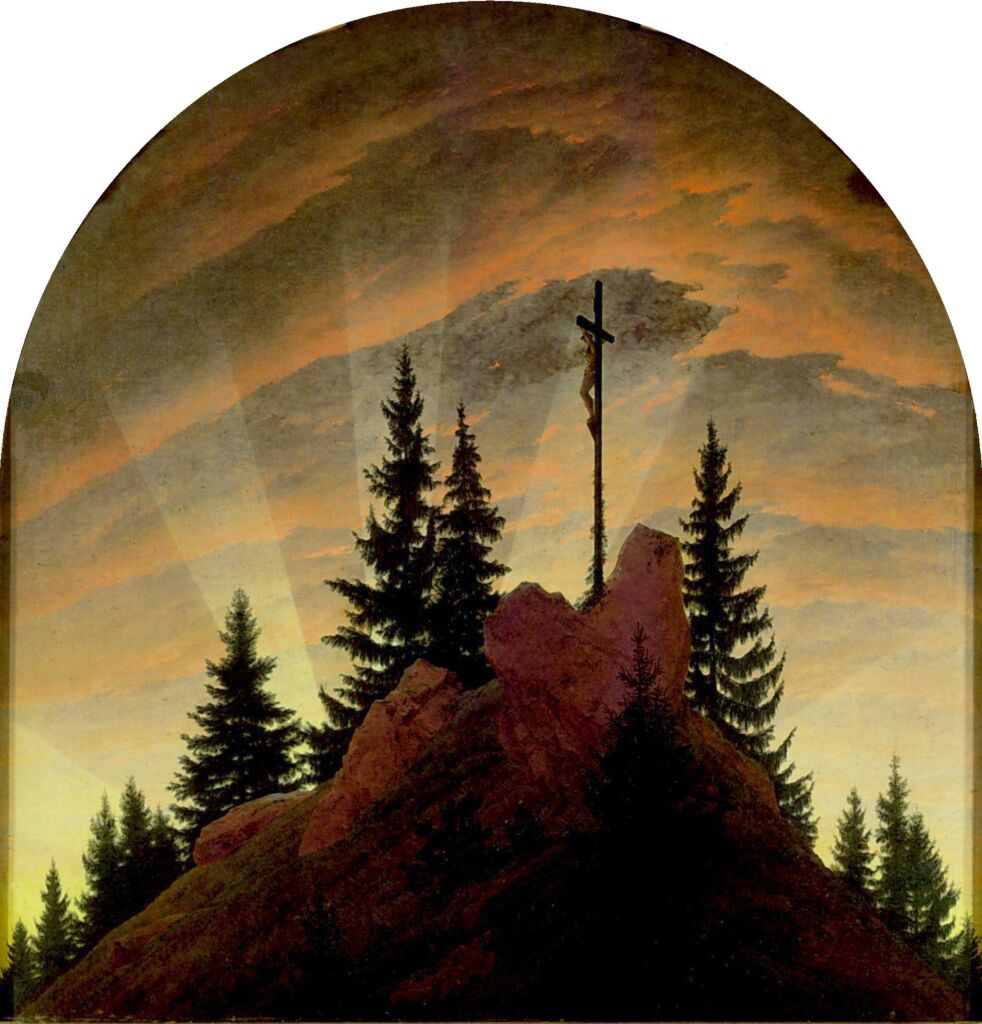
Countess Theresia von Thun-Hohenstein was long thought to have commissioned the altarpiece for the private chapel of Tetschen Castle (today Děčín, Czech Republic). Research in the 1970s showed that the painting was conceived earlier: Friedrich meant to dedicate it to the king of Sweden, a Protestant monarch at war with Napoleon. In 1809 the Thun-Hohensteins bought it for their castle anyway, hence its second name.
The altarpiece now hangs in the Galerie Neue Meister in Dresden.
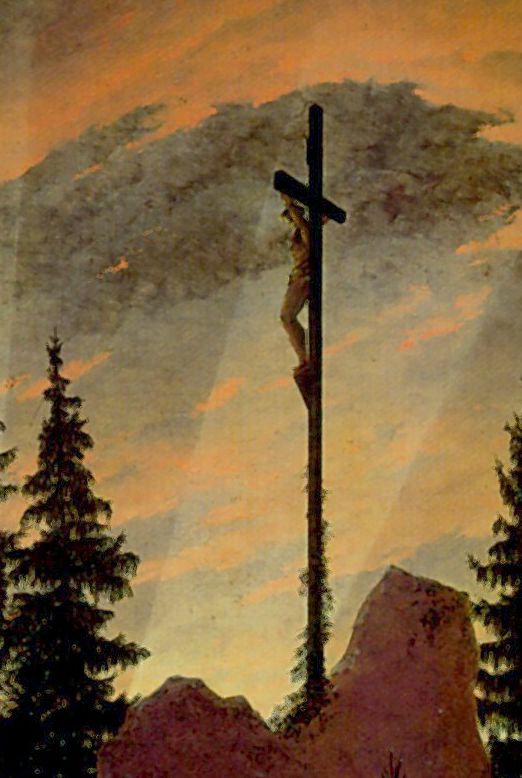
The cross is tiny; the mountain and the sunset take over. That is what outraged the critic Basilius von Ramdohr: a landscape had usurped the altar image. In 1809 he published a long, scathing article in the Zeitung für die elegante Welt (Journal for the Elegant World). Its most famous line: “It is true presumption when landscape painting wants to slink into the church and creep onto the altars.”
The quarrel ran in print until 1810. In reply Friedrich, for perhaps the only time, explained a painting in public. His explanation opens with Christ nailed to the cross and turned toward the setting sun.
A monk, a king and an empty sea
In October 1810 Friedrich showed a pair of paintings at the Berlin Academy exhibition: Monk by the Sea and Abbey among the Oaks. The theologian Friedrich Schleiermacher suggested showing them. Friedrich asked for the Monk to hang above the Abbey, and it did.
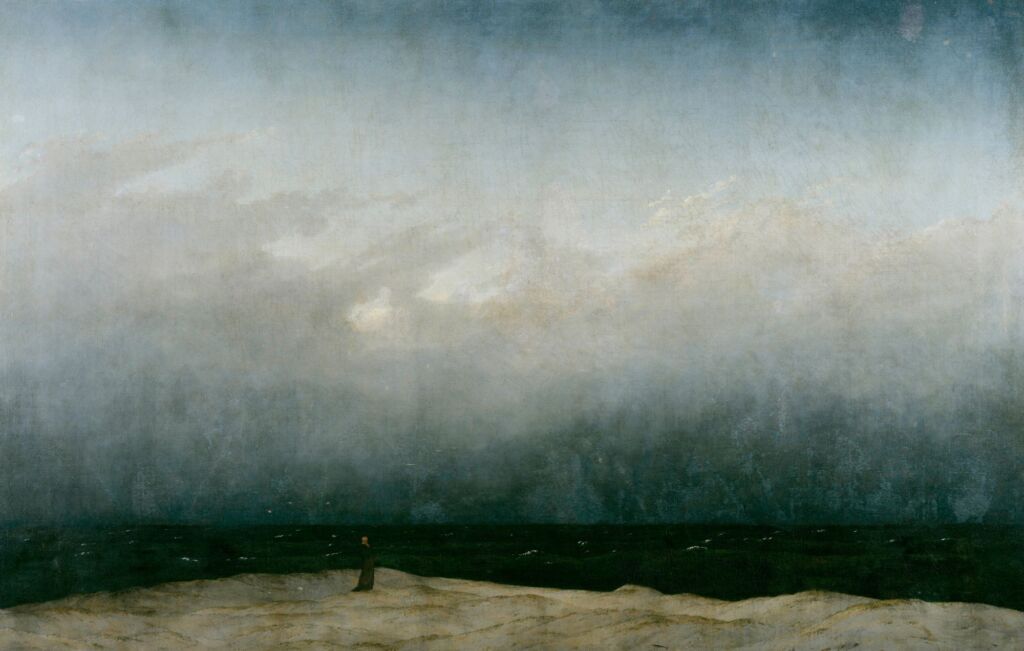
Friedrich called it simply “Seestük,” a seascape. It puzzled and divided the public. Clemens Brentano sent a note about it to the Berliner Abendblätter, the newspaper Heinrich von Kleist was editing.
Kleist rewrote the skeptical text so heavily that it came out sympathetic, and that is the source of a line still quoted: before this painting, he wrote in 1810, one feels “as if one’s eyelids had been cut away.”
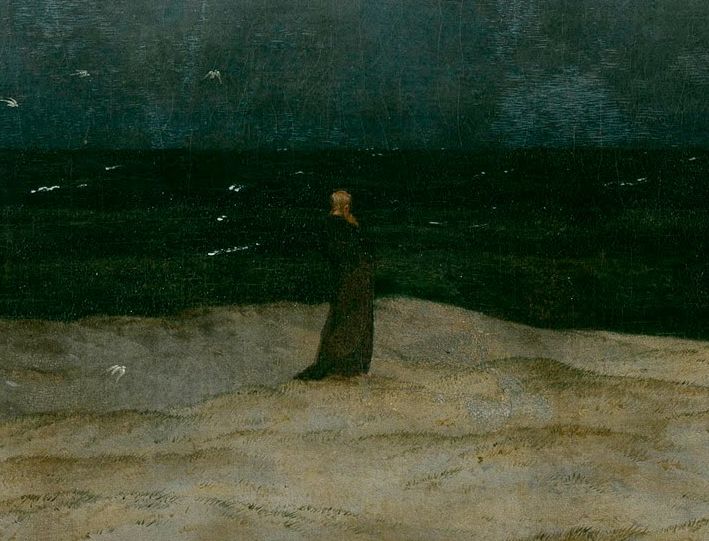
The emptiness was not there from the start. Studies of the paint layer revealed sailing ships on the horizon, later painted out. What remained was one man at the edge of the land.
The Prussian court then bought both, though sources differ on who exactly: either King Frederick William III himself, on his son’s advice, or, as the Alte Nationalgalerie’s catalog entry records, the fifteen-year-old crown prince, the future King Frederick William IV. It was Friedrich’s breakthrough: that year he was elected to the Berlin Academy.
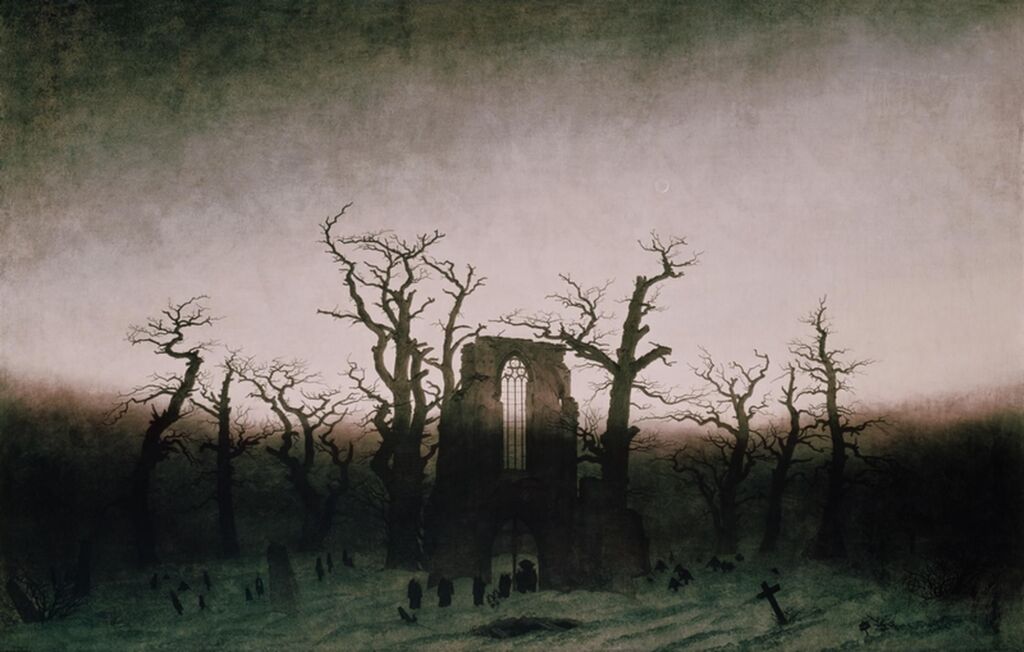
Both still hang together in Berlin, though side by side, not one above the other as he wanted. Around 1900 they were in catastrophic condition, and restorers returned to them many times, not always successfully. The latest major restoration was finished in January 2016 and celebrated with an aptly named exhibition: Der Mönch ist zurück (The Monk Is Back).
A man on the summit
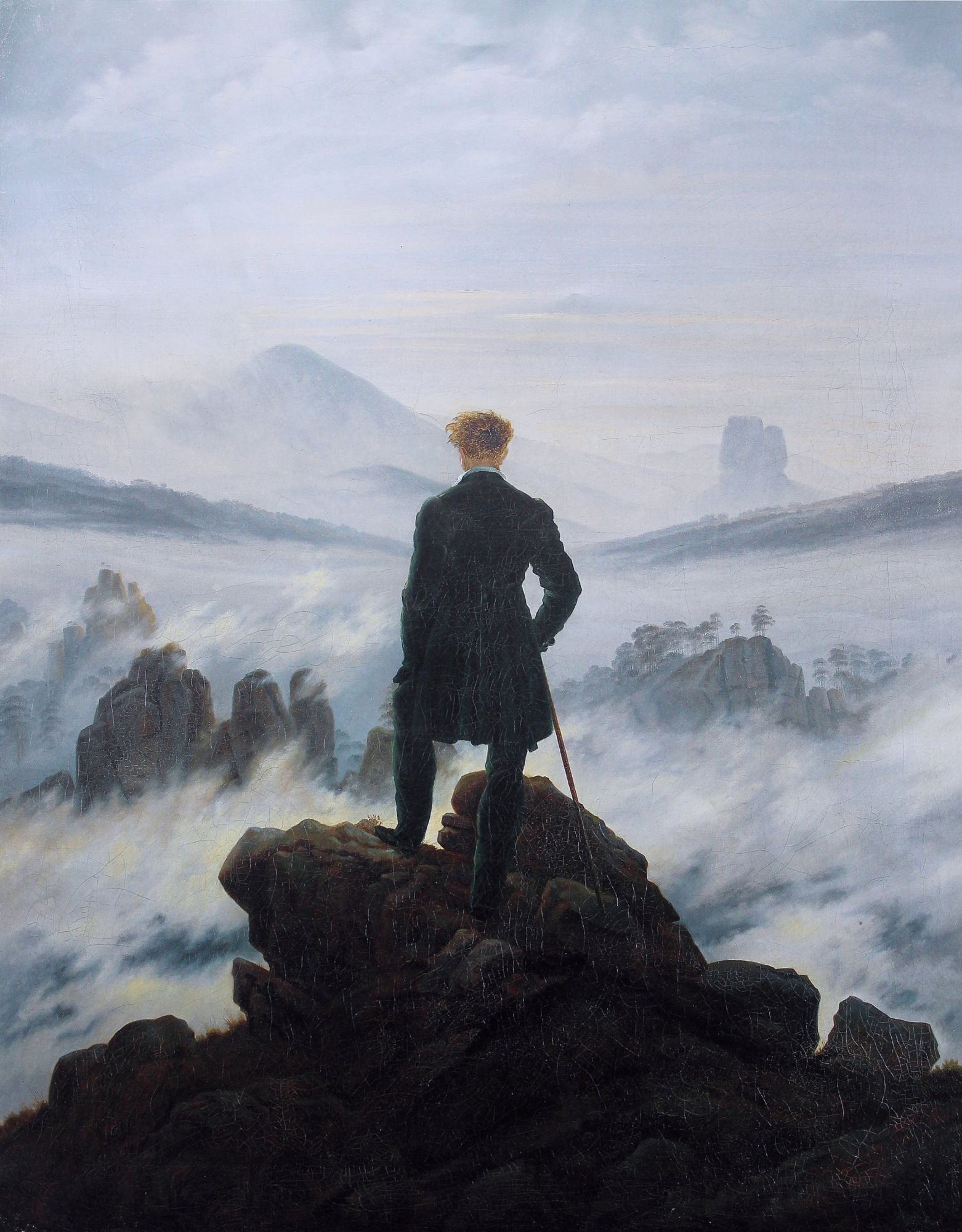
Friedrich’s most famous painting has almost no history in his biography: no one knows where Wanderer above the Sea of Fog was during the artist’s lifetime. The Hamburger Kunsthalle, its home today, dates it to around 1817; some literature gives 1818.
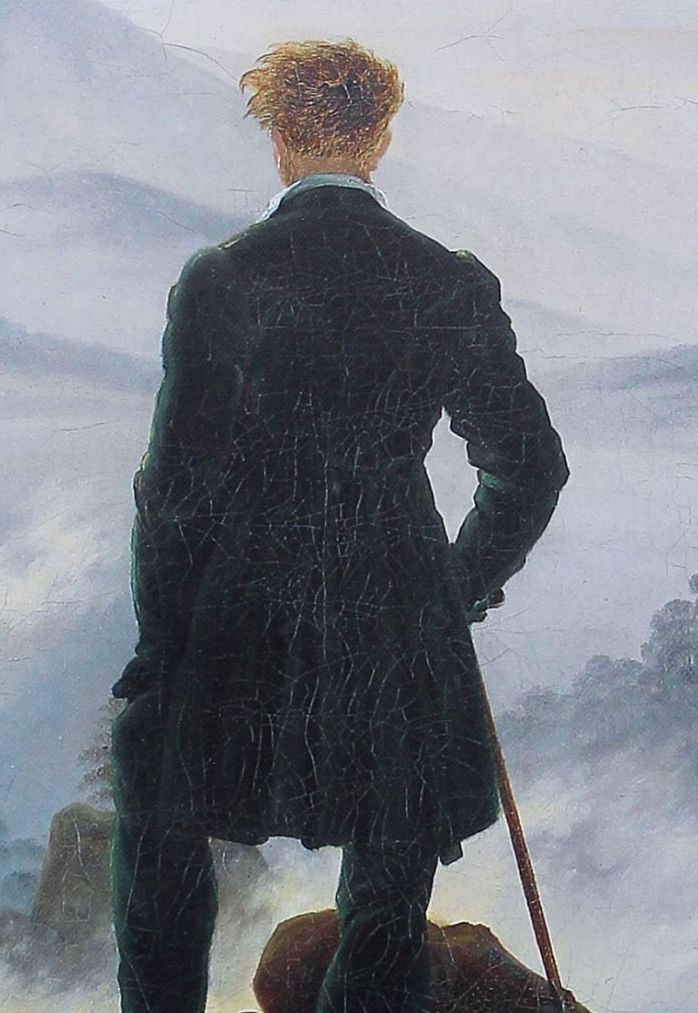
Who stands on the rock is another mystery. Some see a self-portrait: Friedrich, too, had reddish hair. Others look at the clothes. Joseph Koerner and Norbert Wolf identify them as the “Old German” dress worn by patriots after the Napoleonic Wars, a political statement. Still others recognize the uniform of a jäger, a volunteer rifleman. Friedrich left no answer.
The landscape is assembled, not seen from one spot. The rocks under the wanderer’s feet are a group on the Kaiserkrone in Saxon Switzerland, the sandstone mountains along the Elbe near Dresden; the mountain on the right is the Zirkelstein. He drew them from life, then rearranged them in the studio like stage sets.

The mountain on the left, beyond the fog, is either the Rosenberg or the Kaltenberg; scholars disagree. Both stand in Bohemia, on the far side of today’s border between Saxony and the Czech Republic. What looks like the view from one summit is stitched together from two countries.
Backs to the viewer
Friedrich did not marry until he was forty-three. On January 21, 1818, he wed Caroline Bommer, the daughter of a Dresden dyer and almost twenty years his junior.
That summer the newlyweds visited family in Neubrandenburg and Greifswald, and went on from there, with his brother Christian, to the island of Rügen. The trip produced Chalk Cliffs on Rügen, one of his brightest paintings.
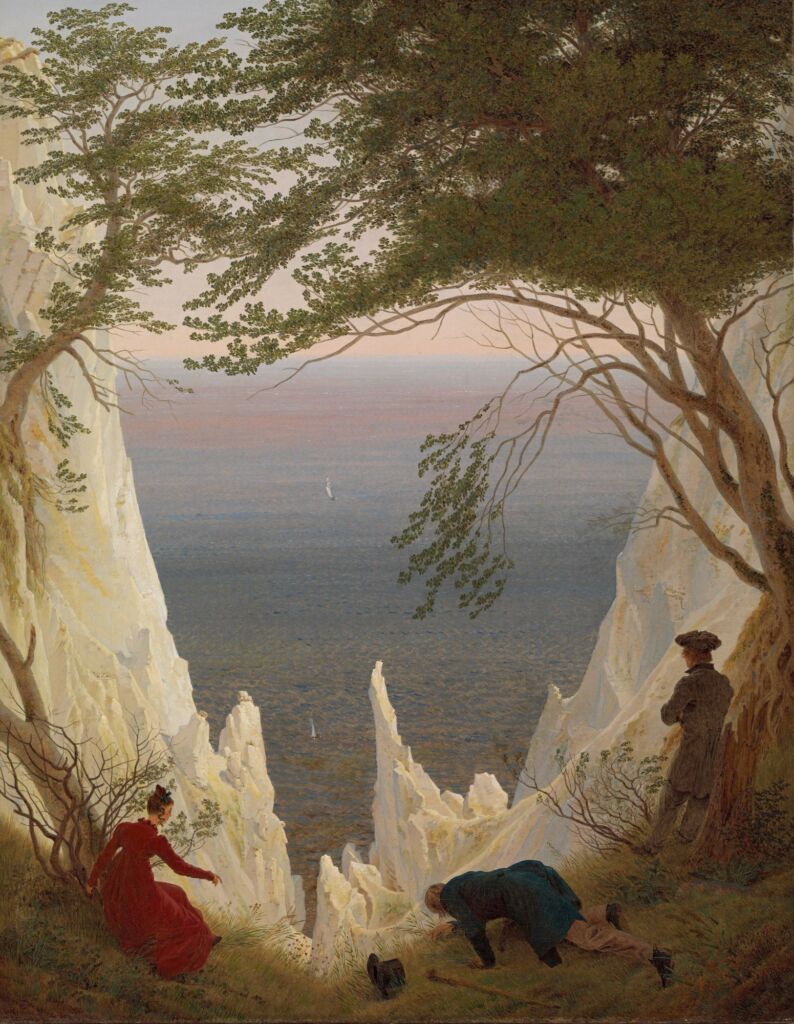
The woman in red is usually taken to be Caroline, and the man creeping on his knees toward the edge, Friedrich. The third figure, by the tree on the right, is sometimes identified as his brother Christian, but there is no consensus. It is often read as a wedding picture, about trust and the future. Yet none of the three looks at us.
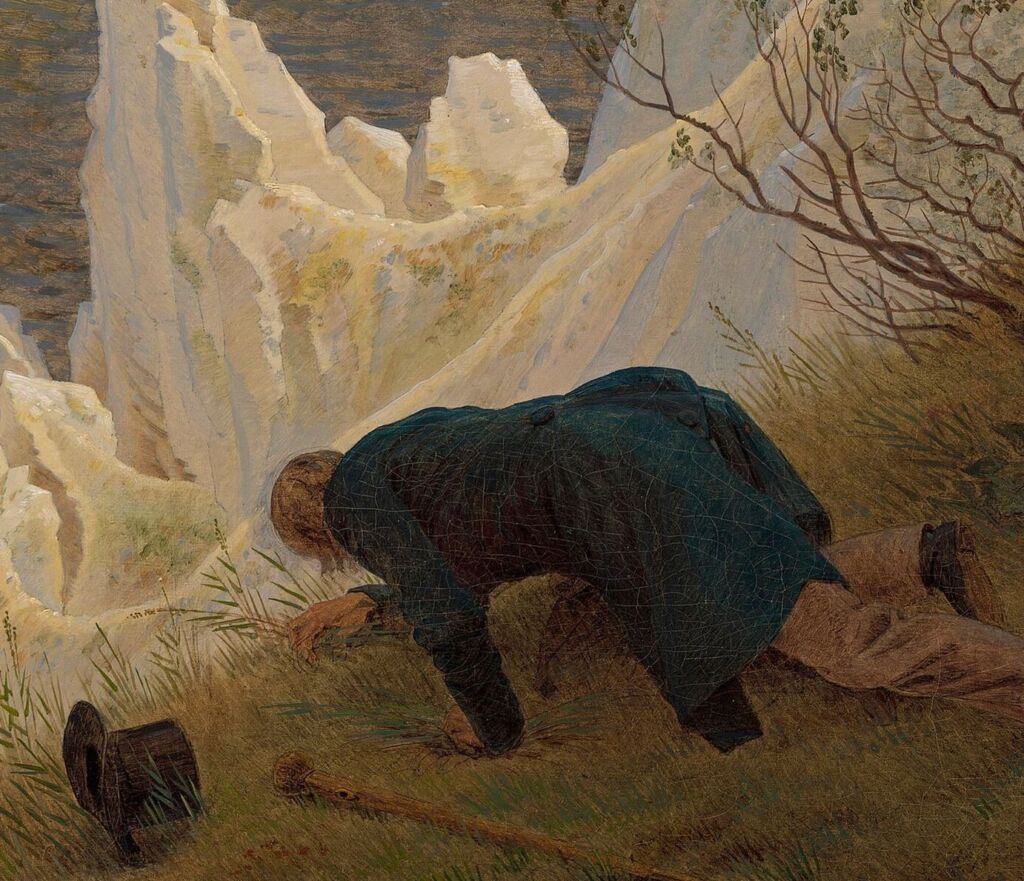
German art history has a word for figures seen from behind: Rückenfigur. In Friedrich’s work they became a signature. People stand or sit motionless in the landscape and look where we look. Almost a century later the Danish painter Vilhelm Hammershøi would make a similar device his own.
Friedrich rarely shows faces. He shows where a person is looking, and leaves that place to us.
Ice floes from the Elbe
In the winter of 1820–21 Friedrich made oil sketches of ice floes on the Elbe near Dresden. They most likely became the basis for The Sea of Ice. William Parry’s Arctic expedition in search of the Northwest Passage is sometimes named as the trigger, but that is a theory, not a document.
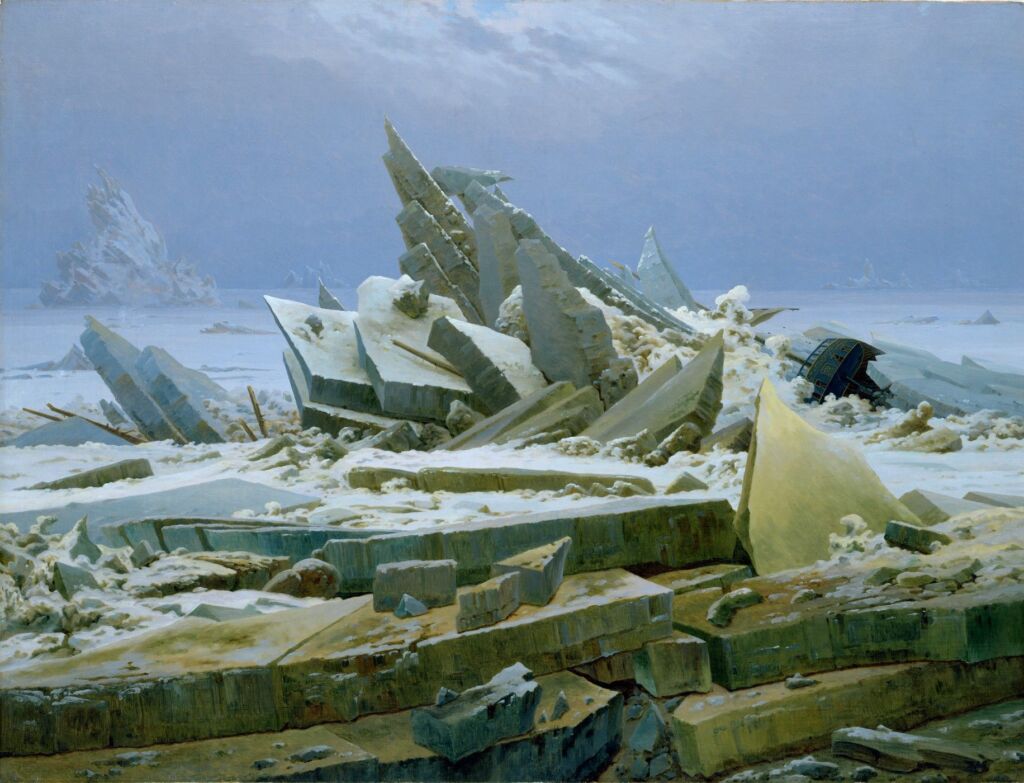
First shown at the Prague Academy exhibition in 1824, it was poorly received and stayed unsold until the artist’s death. It was long confused with a lost painting of 1822, a wrecked ship off the coast of Greenland. That work’s title, The Wreck of Hope, still sometimes gets attached to the Hamburg canvas.

The ship is easy to miss: only the stern is left, and the ice has nearly closed over it.
Also in 1824 Friedrich became a professor at the Dresden Academy but never got the landscape class he had hoped for. His moment in Germany was passing.
Buyers at the other end of Europe
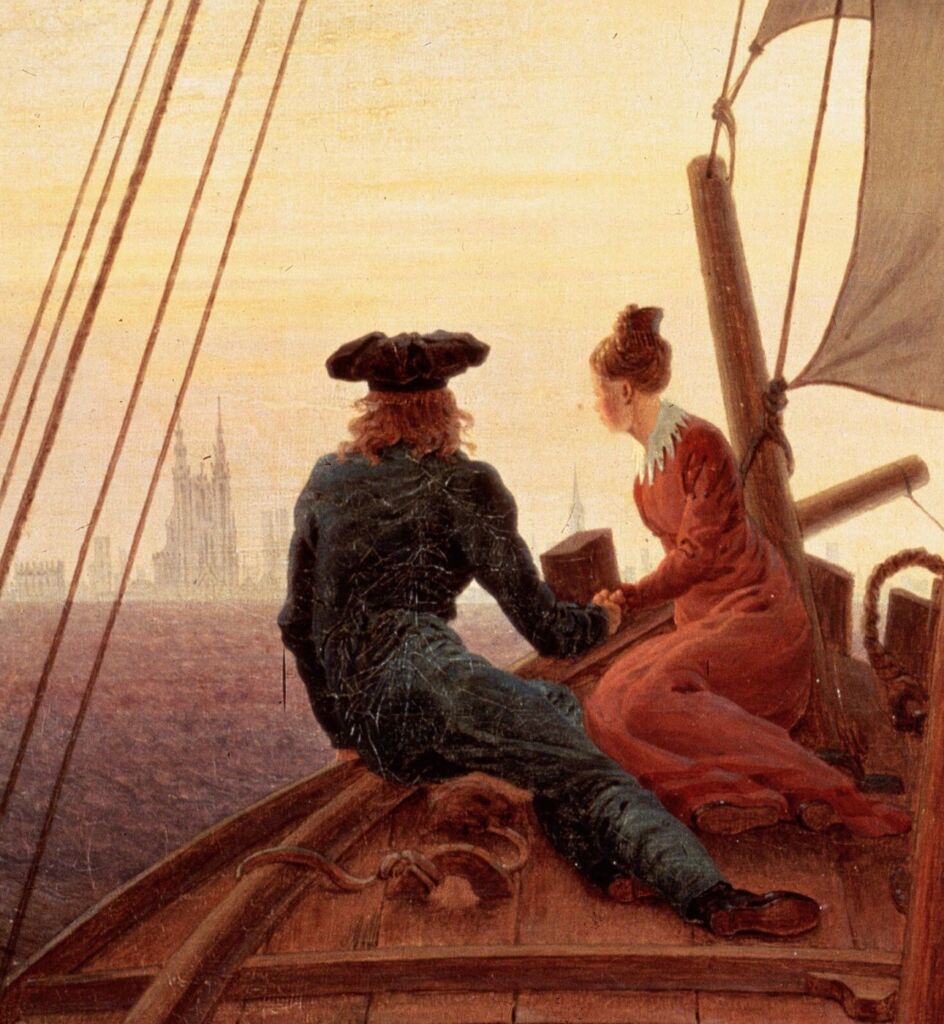
Grand Duke Nicholas, the future Tsar Nicholas I, visited Friedrich’s Dresden studio as early as 1820, at the urging of his wife, Alexandra Feodorovna, born Princess Charlotte of Prussia and a daughter of that same Frederick William III, and bought his first painting then. For twenty years after that, the Russian court kept buying Friedrich.
The key go-between was the poet Vasily Zhukovsky, Alexandra’s Russian tutor and later tutor to the heir, the future Alexander II. He met Friedrich in 1821.
Zhukovsky was often in Dresden and sent descriptions of new paintings and advice on what to buy. Friedrich’s works also hung in his apartment at court, where, according to Hermitage curators, Pushkin, Gogol, the fabulist Krylov and the composer Glinka were visitors.
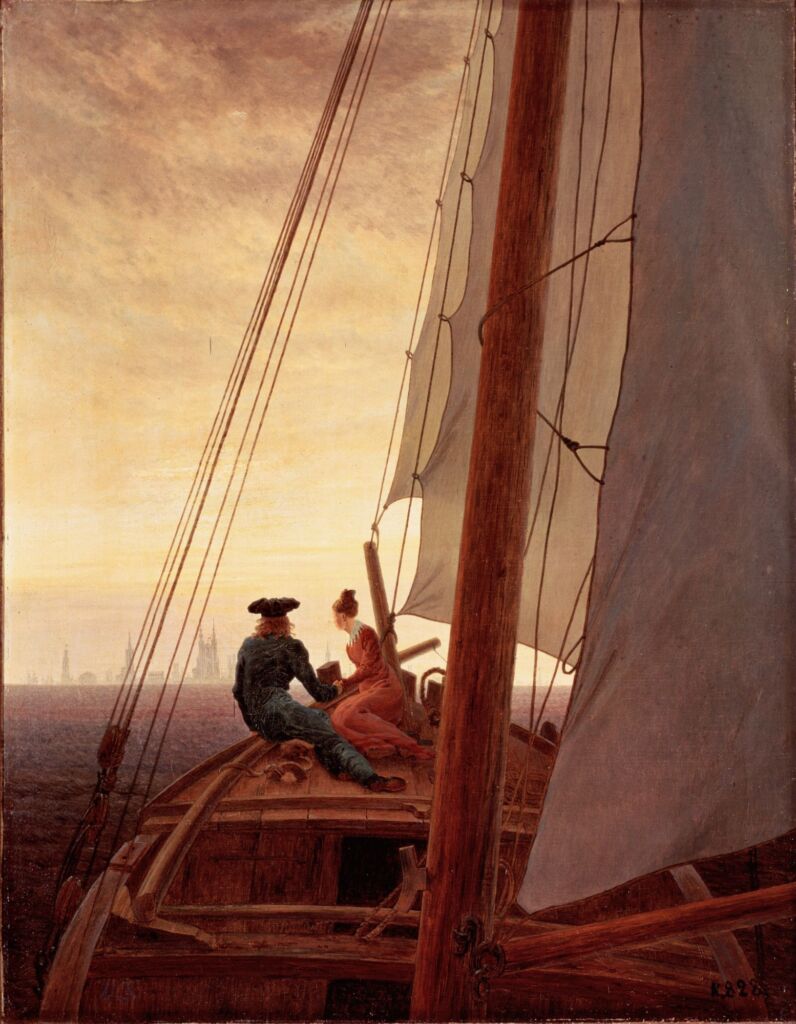
The couple at the bow are usually taken for Friedrich and Caroline: it was painted soon after the wedding. According to the curators, Nicholas gave it to his wife. The court’s purchases went to country residences outside St Petersburg: the Cottage Palace at Peterhof, Znamenka and Ropsha. On a Sailing Ship is now in the Hermitage.
In June 1835 Friedrich had a stroke. Unable to paint in oils, he worked only in sepia. Russian money paid for a cure at the spa of Teplitz, and Zhukovsky reminded the heir of Nicholas’s promise not to abandon the artist in hard times. The court bought a series of sepias for 1,000 silver rubles.
Zhukovsky last saw him in 1840, two months before his death. The court made its last purchase from his widow, in 1841.
Russian museums now hold the largest Friedrich collection outside Germany. But Russia forgot him too: the Hermitage inventories of 1859–61 list nine of his paintings, six of them already without the artist’s name.
Ninety-three works in Berlin
His fame died before he did. “Friedrich had outlived himself,” Zhukovsky wrote of their last meeting (translated here by Hroniki); in 2024 the curator Mikhail Dedinkin recalled those words (in Russian). Friedrich died in Dresden on May 7, 1840, at 65. Caroline outlived him by seven years and died in poverty.
One exhibition brought him back. In 1906 the Nationalgalerie in Berlin staged the German Centenary Exhibition, prepared by the gallery’s director, Hugo von Tschudi, and the director of the Hamburger Kunsthalle, Alfred Lichtwark. Friedrich was shown in depth: 36 paintings and 57 drawings, 93 works in all.
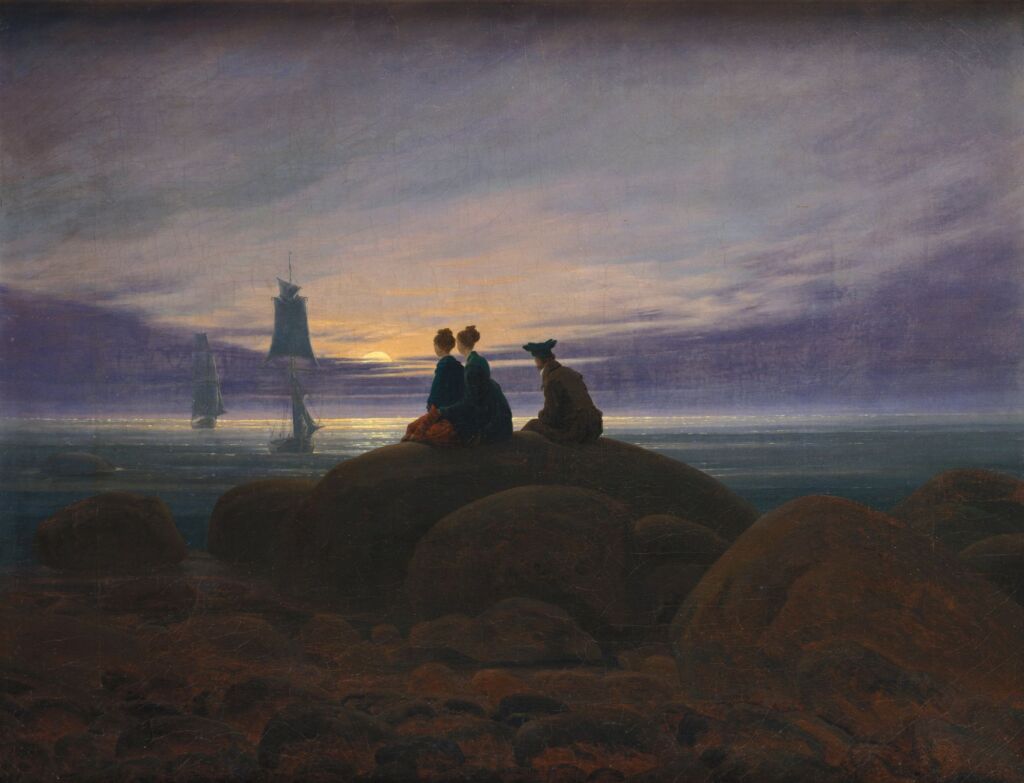
Tschudi was careful at the time: “One certainly cannot say that Friedrich is an altogether unknown artist.” The Nationalgalerie itself owned only three of his paintings, one bought shortly before the show. Moonrise over the Sea, from 1822, still hangs in the gallery that gave Friedrich back to the public.
For his 250th birthday in 2024, several cities showed him at once. The Hamburg exhibition Art for a New Age, in the winter of 2023–24, drew 335,000 visitors, the most in the Kunsthalle’s history (in German). Berlin gathered more than sixty paintings, and Greifswald stretched the anniversary over a whole year.
In December 2024 the Hermitage opened its own exhibition, Landscape of the Soul: Caspar David Friedrich and Russia, with 11 paintings and 16 drawings from Russian collections. At the opening, the director, Mikhail Piotrovsky, noted that Friedrich had been “the favorite artist not only of Nicholas I but also of Hitler.” Arnold Böcklin’s Isle of the Dead, one version of which Hitler owned, carries a similar burden.
Hamburg’s posters featured the wanderer, back to the viewer, face to the fog. There was a time when even Germany had forgotten Friedrich; now people recognize him by a single silhouette.
Comments
For Hroniki readers
Comments are open to readers with an account. Signing up is free and takes a few seconds.
No comments yet. Start the conversation.