The Ghent Altarpiece Theft: The Secret a Dying Stockbroker Took to His Grave
On the night of April 10–11, 1934, a thief took The Just Judges from the Ghent Altarpiece. The extortionist sent a dozen or more letters and returned half the board, and the man who claimed to know the hiding place died before he could say where.
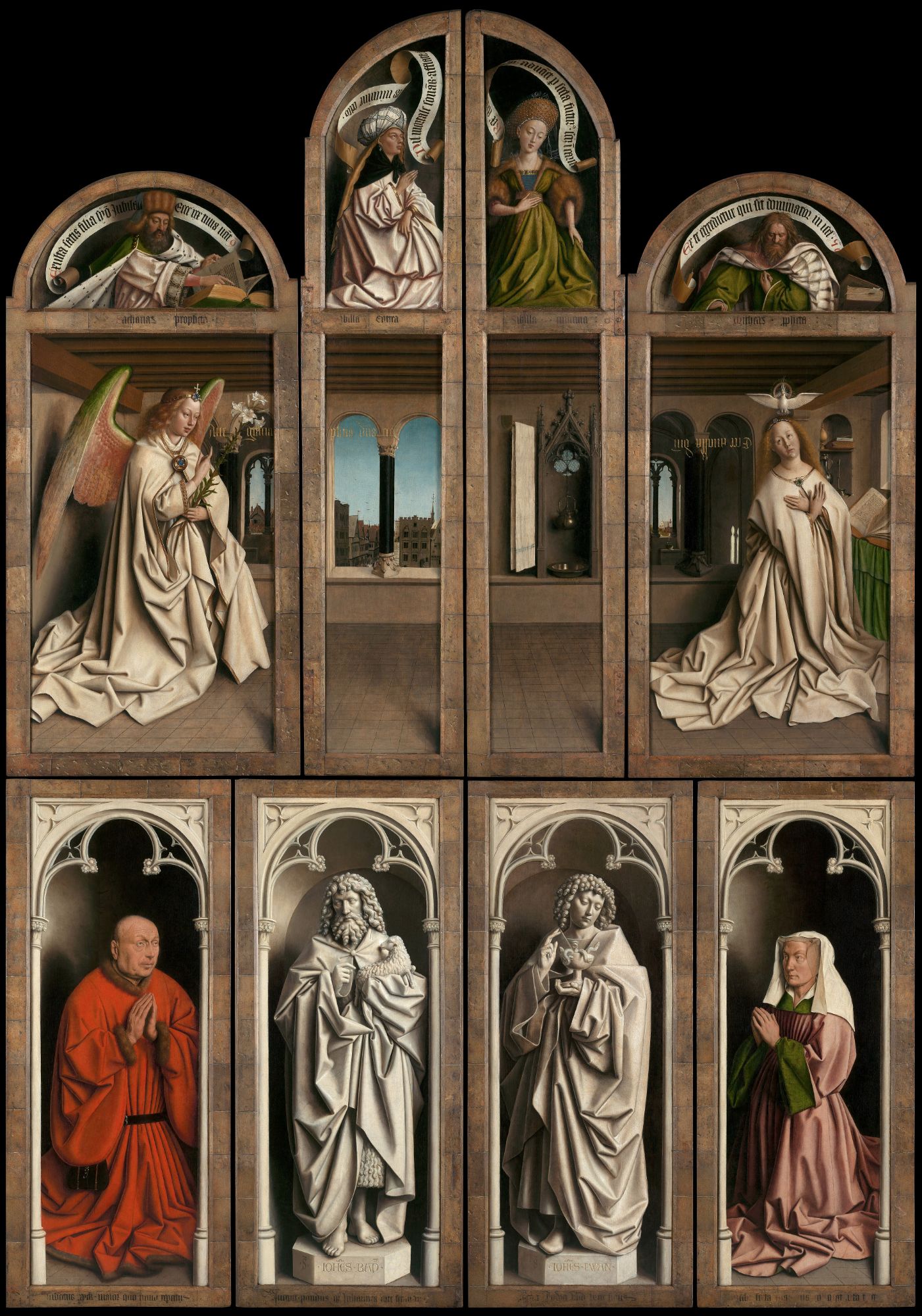
“Taken from Germany by the Treaty of Versailles.” That was the note found on the morning of April 11, 1934, on the frame of the Ghent Altarpiece, Hubert and Jan van Eyck’s 1432 polyptych in St Bavo’s Cathedral, Ghent. The sexton had found the chapel door forced and two panels missing.
Gone were The Just Judges and John the Baptist, once the two faces of a single board. In 1894, in Berlin, it had been sawn in half lengthwise so both sides could be shown at once, which made each half easy to carry off.
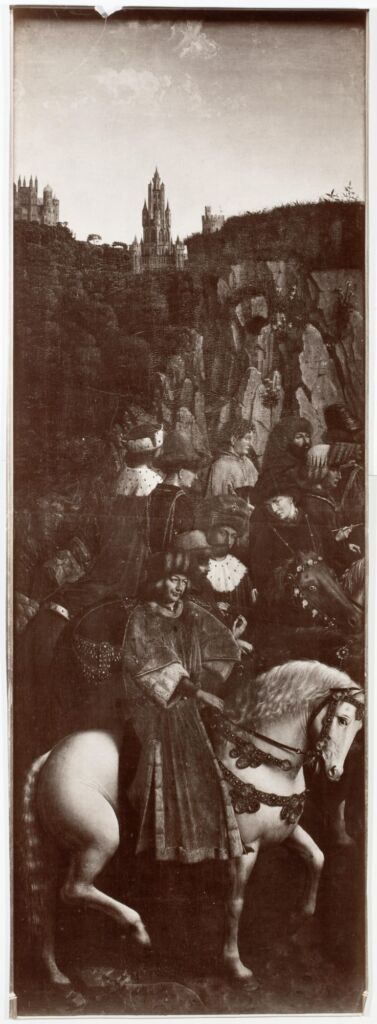
The note hinted at revenge for the war. Six of the wings had belonged to Berlin for nearly a century and returned to Ghent only in 1920, as reparations under the Treaty of Versailles. But the thief was not after justice.
Letters signed D.U.A.
On April 30, Honoré-Joseph Coppieters, the Bishop of Ghent, received a letter written in French. The writer demanded one million Belgian francs and threatened to destroy both panels. It was signed with three letters: D.U.A.
The bishop was willing to pay, but the prosecutor and the justice minister, Paul-Émile Janson, refused. The correspondence went on anyway, and the Brussels paper La Dernière Heure printed the bishop’s replies. To prove he was not bluffing, the extortionist mailed a baggage-check ticket. On May 29 it was redeemed at the Brussels-North station checkroom for a large parcel. Inside was John the Baptist.
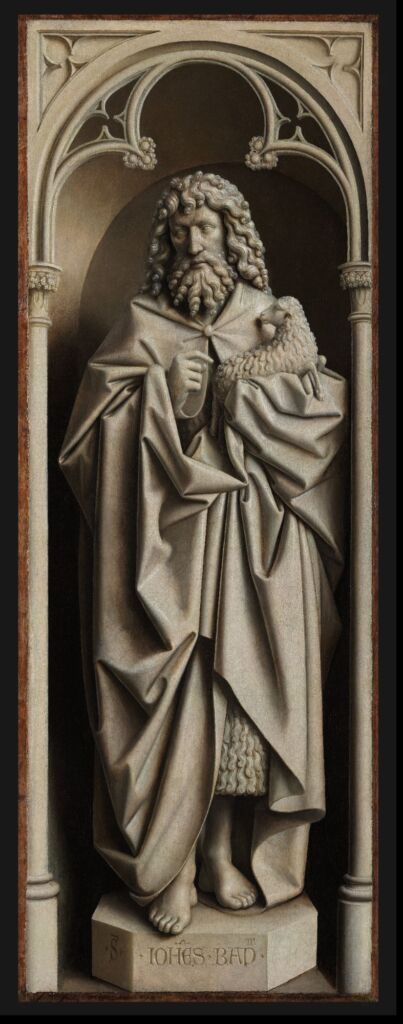
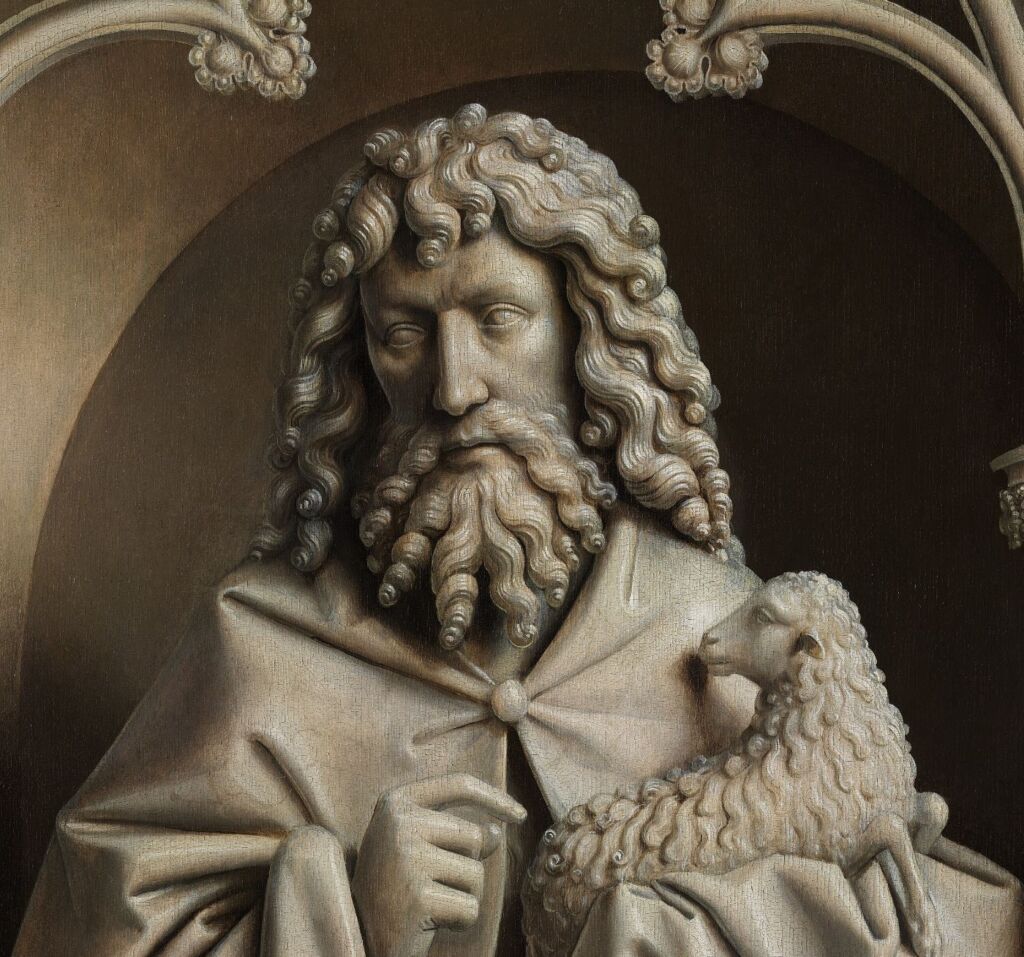
The returned half is a grisaille, painted in grays to pass for a stone statue in a niche. The Baptist points to a lamb; open the altarpiece, and the righteous, mounted judges among them, ride toward the Lamb in the central scene. The thief gave this half back for nothing; apparently the colored side was what he meant to bargain with.
Henri Meulepas, dean of St Lawrence’s Church in Antwerp, became the go-between. The police gave him a package holding 25,000 francs, not a million, and on June 14 a taxi driver collected it. The last letter arrived on October 1, and then D.U.A. fell silent.
The city of Ghent counts thirteen letters; The Art Newspaper counts twelve sent and a thirteenth that never went out.
“Desk, key, closet…”
On November 25, 1934, Arsène Goedertier, a 57-year-old stockbroker, collapsed at a political meeting in Dendermonde. He ran a small bank in Wetteren, near Ghent, had once been a sexton, and was well connected in the Diocese of Ghent.
On his deathbed he told his lawyer, Georges de Vos, that he alone knew where The Just Judges was hidden. His last words, as Visit Gent renders them, were “desk, key, closet, health service folder.” The word he used was mutualité, Belgian for a mutual health-insurance fund.
Inside the folder were copies of the D.U.A. letters to the bishop, but no panel. There was also an unsent letter: the judges, it said, were in a place from which neither he nor anyone else could remove them without attracting public attention.
That line has fed treasure hunters ever since. It suggests a place in plain sight: a church, a square, the paving underfoot. Investigators decided Goedertier was the extortionist, and the duplicate letters are serious evidence. Whether he was the thief or only knew him is unknown, and the case against him still has doubters.
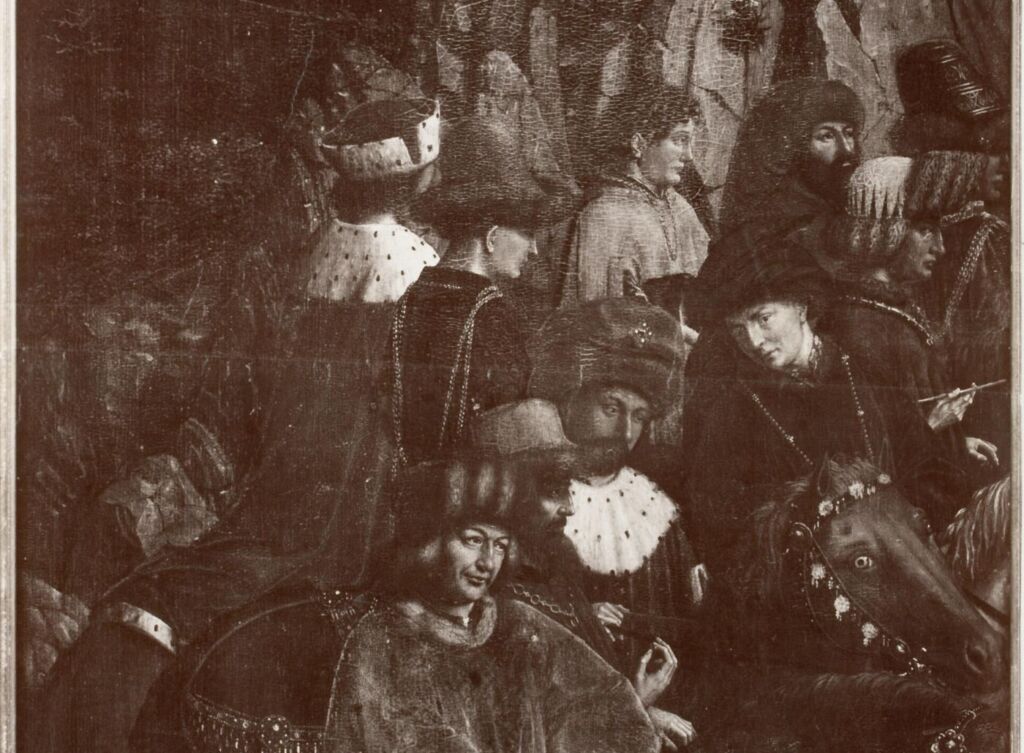
These faces survive only in old black-and-white photographs. The colors must be imagined from copies.
Judges by Jef Van der Veken
One copy stands in the altarpiece today. In 1936 the restorer Jef Van der Veken offered to paint a replacement, and in 1939 he began work at the Royal Museums of Fine Arts of Belgium in Brussels. His model was the copy Michiel Coxcie had made in the mid-16th century for Philip II of Spain.
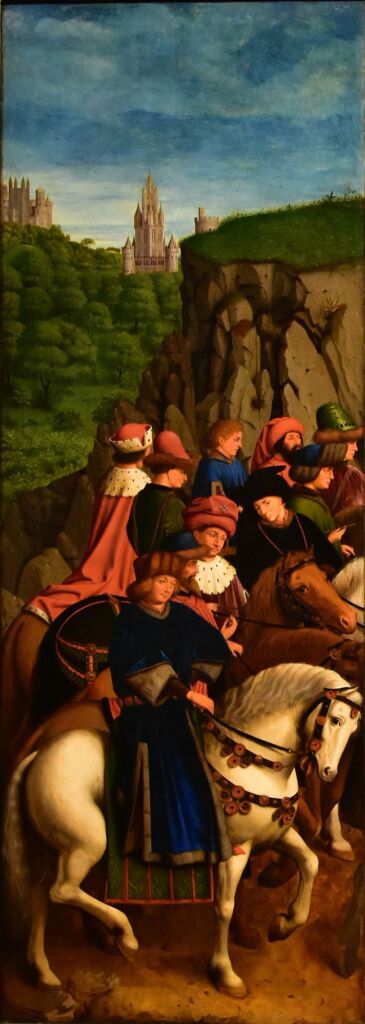
The war interrupted him; he returned to it in 1945. On the back he painted a rhyming inscription in Dutch, dated October 1945 and now illegible: “Uit liefde – als plicht – verricht – en om te wreken – voor streken – niet geweken.”
Belgium’s Royal Institute for Cultural Heritage, KIK-IRPA (in French), renders it as “done out of love and as a duty, and to avenge the petty schemes that did not make me bend” (translated here by Hroniki). The institute links the lines to the copy’s long misadventures. Later he waxed the panel for a patina that would not clash with its neighbors; the price was settled only in 1957.
Van der Veken signed the copy with his own name, an almost Eyckian gesture: Jan van Eyck himself once wrote “Jan van Eyck was here” above the mirror in The Arnolfini Portrait. At first glance, the substitution goes unnoticed.
Nor was he merely a copyist. Restoring early Netherlandish paintings, he repainted whole passages, and it later emerged that he had painted several forgeries. In 2010, when the paint on the copy began to flake, KIK-IRPA decided to study his technique so it could recognize the restorer’s hand in other works.
The search for the original, meanwhile, went on. During the war the Germans joined it: Oberleutnant Heinrich Köhn of the Kunstschutz, the Wehrmacht’s art-protection unit, concluded in 1942 that Goedertier was not the thief and suspected the Ghent clergy.
In 2008 a floor was lifted in a house on Sint-Jansvest in Ghent. In 2019, prompted by a book by the children’s author Marc de Bel, searchers dug up Kalandeberg square by the cathedral and found only an old iron ladder. In January 2025 East Flanders prosecutors announced new searches of a villa on a fresh tip. Again, nothing turned up.
The theft of the Mona Lisa from the Louvre in 1911 had an ending: more than two years later, the painting came home. Ghent’s has none. The one man who claimed to know where the judges are took the answer with him in 1934, leaving only a hint: a place from which no one could remove them unnoticed.
The case remains open. “As long as there is no body, there is no death,” said the host of Mysteriejagers, a documentary series on Belgian public broadcaster VRT, in January 2026. The judges, if they survive, are still riding toward the Lamb.

Comments
For Hroniki readers
Comments are open to readers with an account. Signing up is free and takes a few seconds.
No comments yet. Start the conversation.