The king who vanished from Bruegel’s second Tower of Babel
Two of Bruegel's Tower of Babel paintings survive: the large panel in Vienna, with King Nimrod, and the smaller one in Rotterdam, with no king and red brick at the top. What changed between them, and what the Roman Colosseum has to do with it.
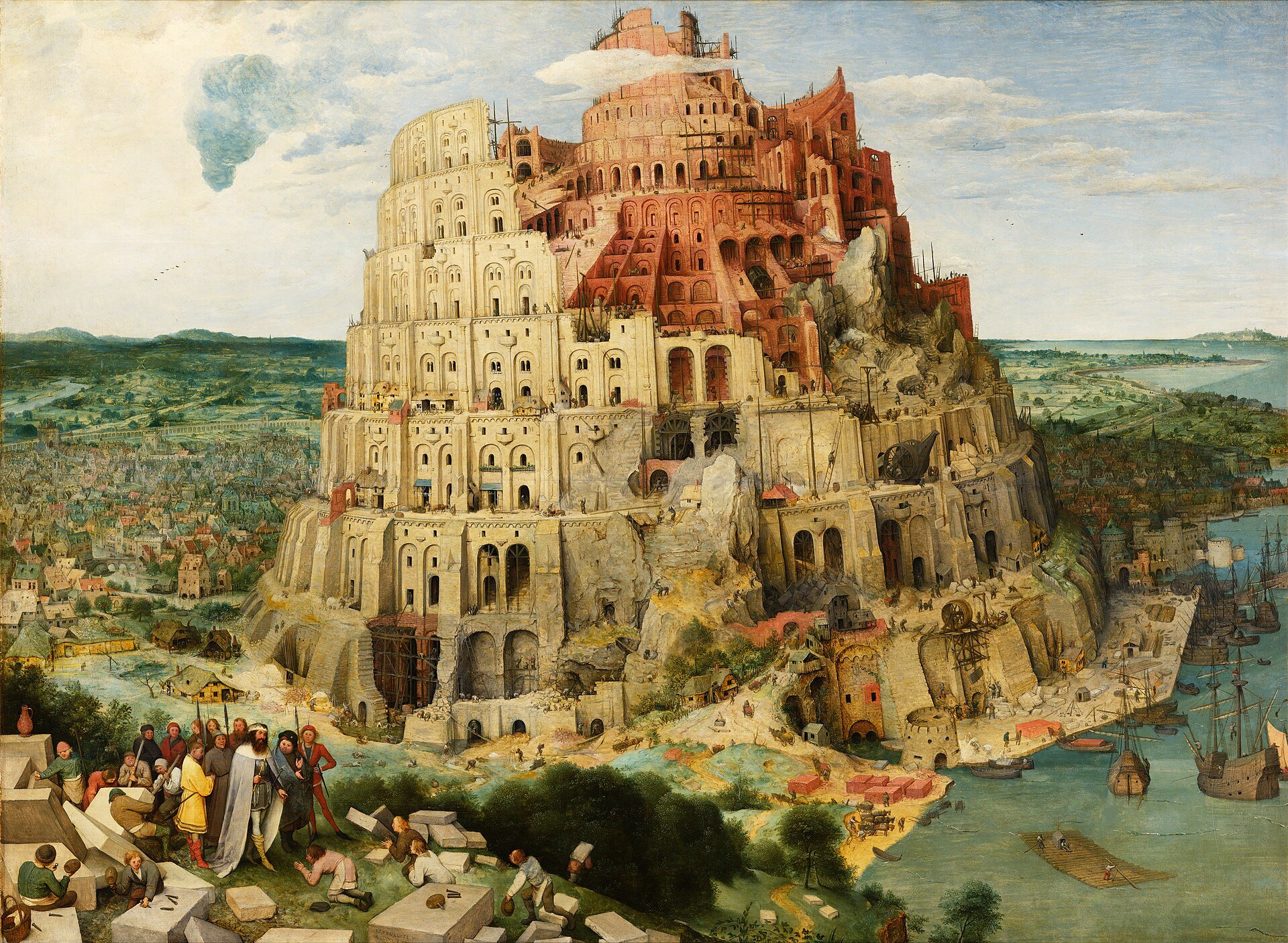
When the Roman miniaturist Giulio Clovio died, the inventory of his estate listed paintings and drawings by Pieter Bruegel the Elder, who had worked with him in Rome. The same inventory is widely believed to have included a small Tower of Babel Bruegel painted on ivory. That miniature is lost. Two other towers survive, and the telling difference between them is that one has lost its king.
The Vienna tower and the king at its foot
The large tower is signed and dated on a block of stone: 1563. The Latin signature reads BRVEGEL. FE., for fecit, “Bruegel made it.” The oil on oak panel, about 114 by 155 cm, hangs in the Kunsthistorisches Museum in Vienna.
The main figures in the foreground, King Nimrod and his retinue, do not appear in the biblical story of the tower. Genesis introduces him earlier, among Noah’s descendants, as “a mighty hunter before the LORD,” adding that “the beginning of his kingdom was Babel.” Cäcilia Bischoff’s 2010 guide to the Vienna gallery notes that the tower narrative never mentions him.
Later tradition made him the builder. As early as the first century, Josephus cast Nimrod in Antiquities of the Jews as the instigator, urging people to build above the waters of the Flood.
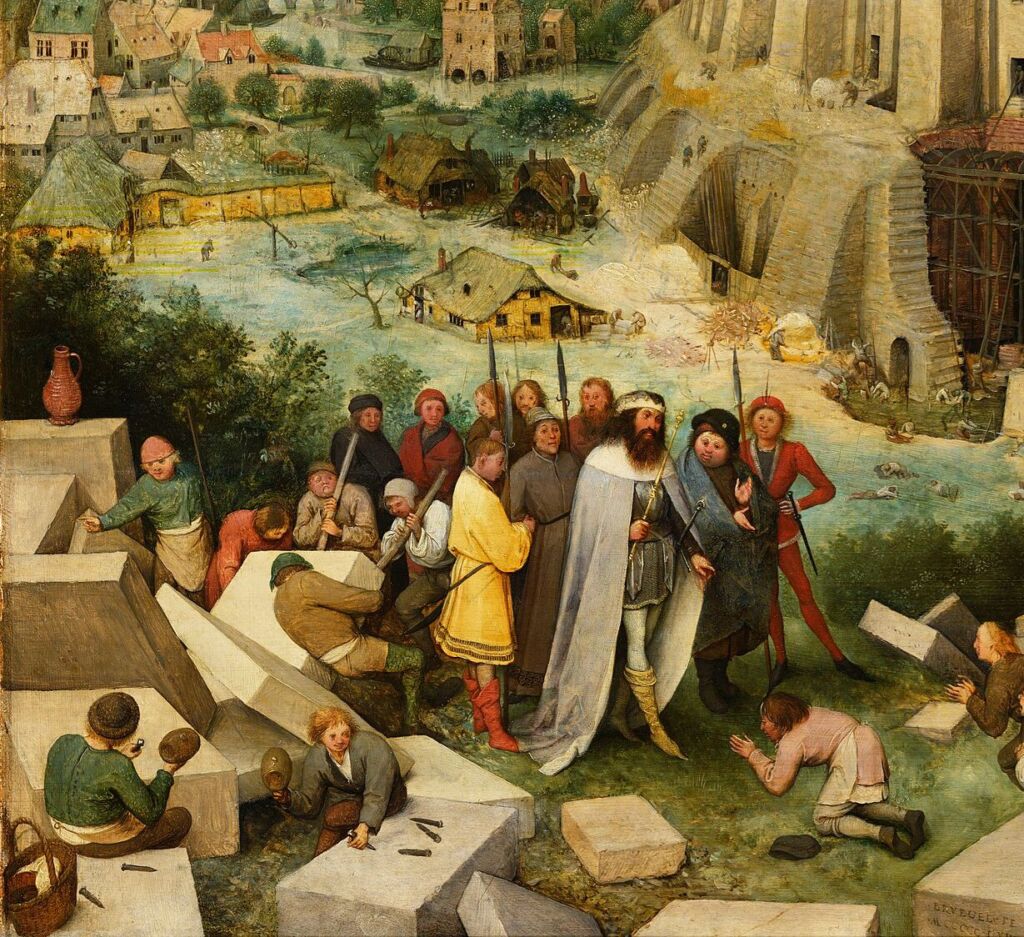
Bruegel places the king in the lower left corner, where the eye enters the picture. His power shows in how others bow to him, not in his size: Nimrod is tiny beside what he has set in motion.
What the museum calls a “seemingly Flemish port” sets the scale: beside it, the tower looks like a mountain. The building site depends on the harbor, and Bruegel records the crafts and machinery of his day with encyclopedic precision. Cargo moves up from the docks; cranes and scaffolding cling to the unfinished masonry.
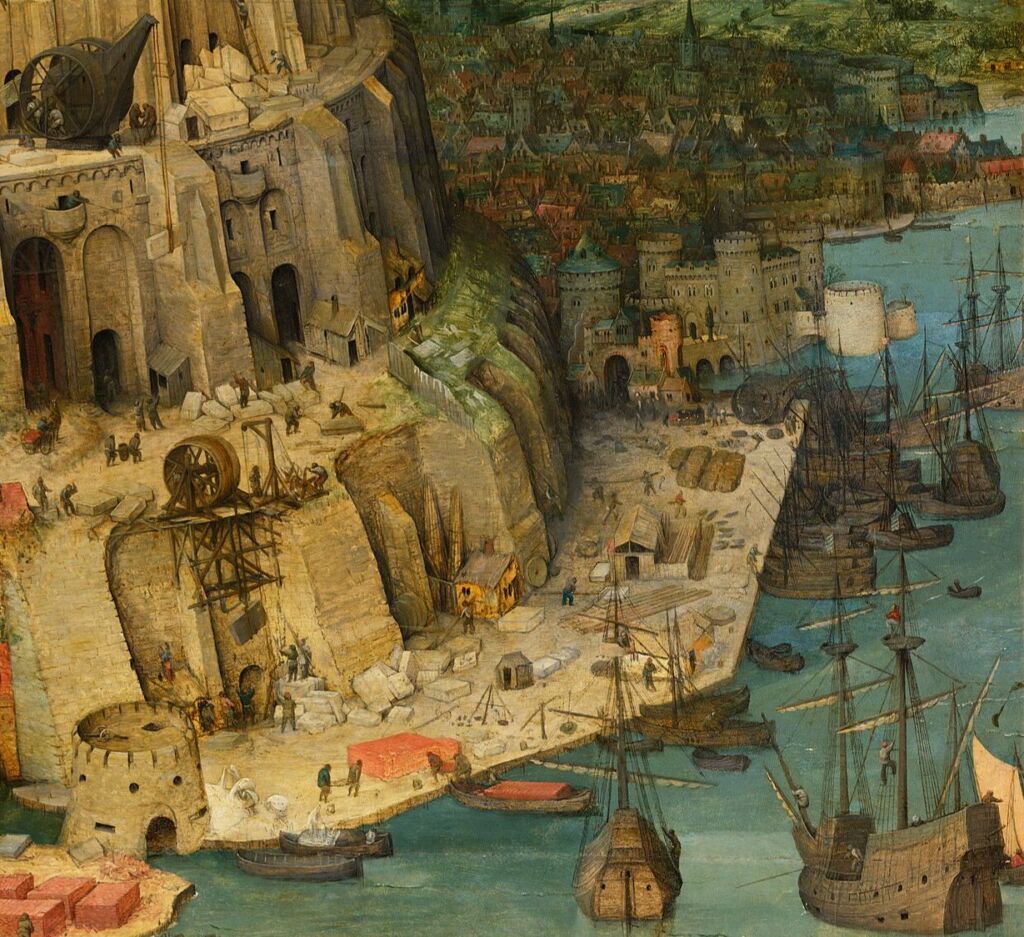
The city is never named, but Antwerp suggests itself: Bruegel lived there for many years. By 1566 the painting belonged to the Antwerp collector Nicolaas Jongelinck. According to an often-repeated account, that same year his Bruegels were pledged to the city as surety for another man’s debt.
A Roman arena in the middle of Flanders
Bruegel builds Babylon on a Roman model. The Museum Boijmans Van Beuningen in Rotterdam says it outright: the tower’s architecture comes from the Colosseum. The circling tiers of arches do recall the Roman amphitheater, only set on a rock and wound upward into a spiral.
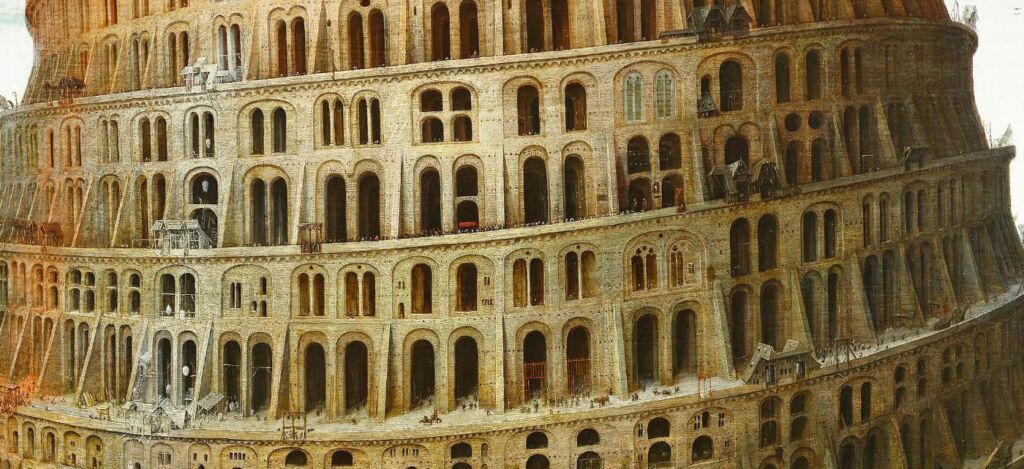
The outer stone shell mixes antique and Romanesque forms. The tower grows out of a rocky slope, which, Bischoff writes, makes it look stable: a building doomed to collapse appears perfectly sound.
A building doomed to collapse looks perfectly sound.
Bruegel knew Rome firsthand: according to Britannica, he was living there in 1553. Joanne Morra read his towers as allegories of ruin in “Utopia Lost” (Art History, 2007). To a 16th-century eye, the Colosseum was just such a ruin: a monument to pagan grandeur that had not endured.
The king leaves, the building goes on
The Rotterdam panel is about half the size of the Vienna one in each dimension, roughly a quarter of its area: about 60 by 75 cm. It is undated. The museum places it around 1568, partly by comparison with The Magpie on the Gallows in Darmstadt; earlier dates have also been proposed.
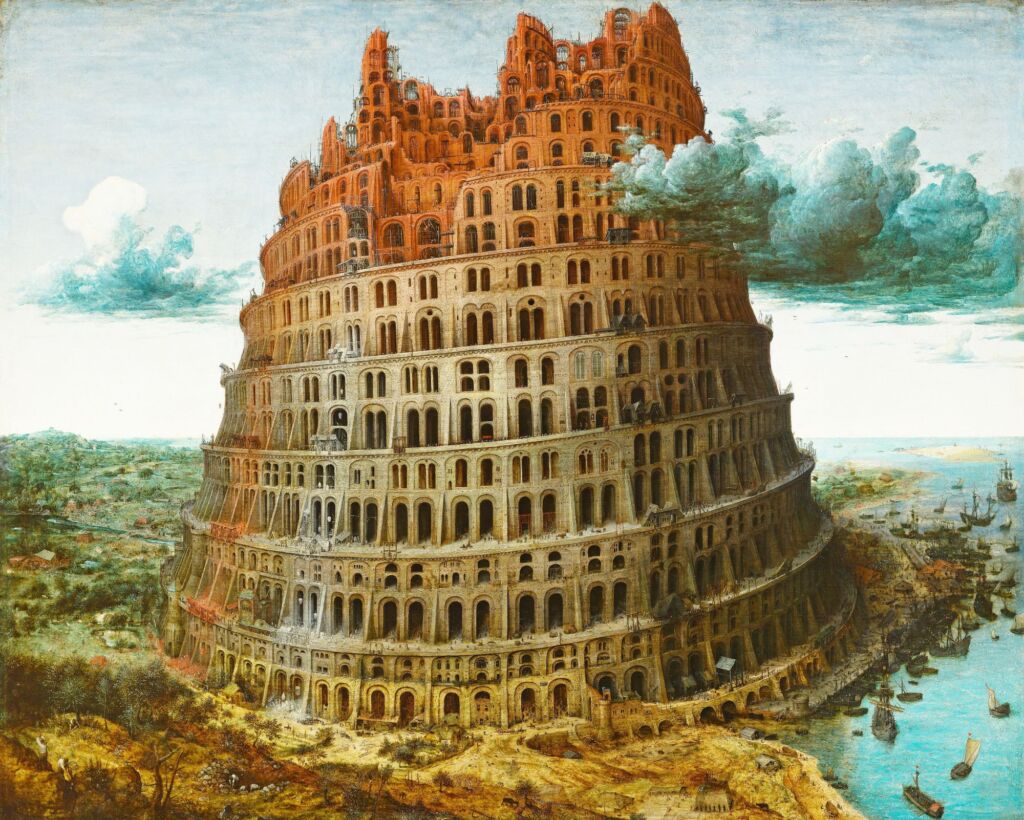
The Rotterdam panel has no Nimrod, no retinue, no bowing craftsmen. In Vienna we stand on the hill beside the king and see the site through his eyes. In Rotterdam there is no one to stand beside: the tower fills almost the whole panel, and the city shrinks to a strip along the bottom. By the museum’s count, more than a thousand people crowd the scene, nearly all at work.
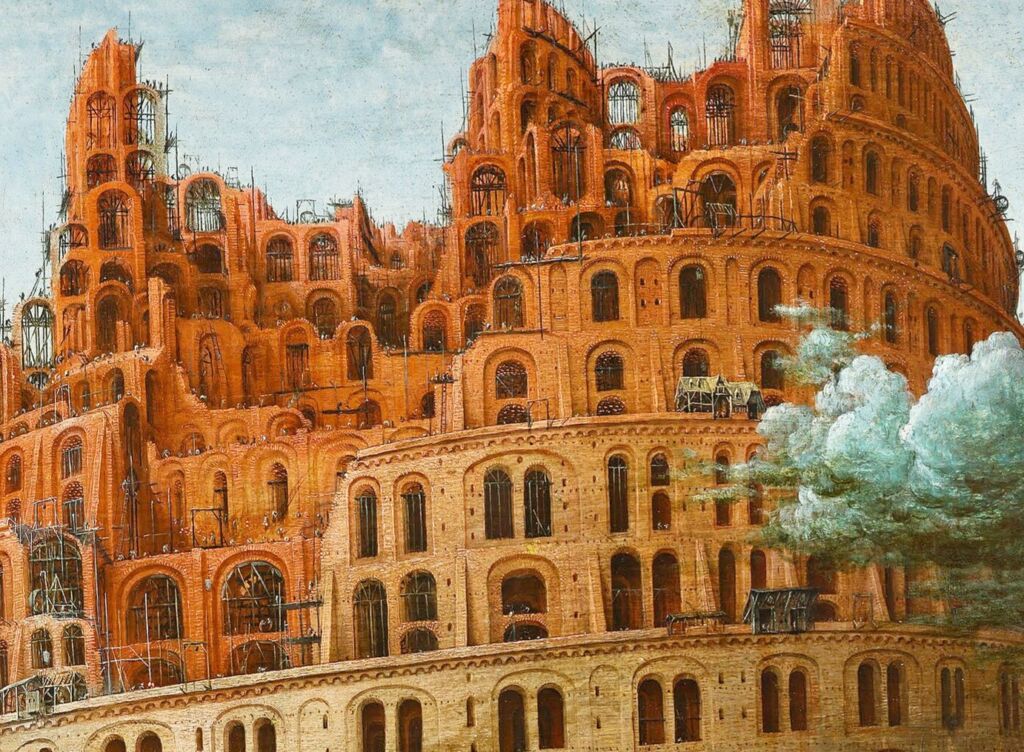
The top is redder than the base, and the museum explains why: the lower brick has weathered, the upper is still fresh. A red vertical stripe marks new brick going up, a white one limestone coming in. The tower is still rising and already growing old.
Who commissioned the smaller tower is unknown. Citing Karel van Mander, the first biographer of Netherlandish painters, the Rotterdam museum places its panel with Emperor Rudolf II in the early 17th century; the Kunsthistorisches Museum records the Vienna picture there too. The Vienna panel then passed to Archduke Leopold Wilhelm, stayed with the Habsburgs and now hangs in Room X. The Rotterdam panel passed through the collections of Elisabeth Farnese and the Infante Don Luis de Bourbon and entered the museum in 1958 with D. G. van Beuningen’s collection. With the main building closed for renovation, the painting is currently in storage.
In Vienna, Bruegel paints the pride of a king who has come to inspect his building site. In Rotterdam the king is gone: people carry on building, and the summit reaches into the clouds. The third tower, apparently painted in Rome on a small ivory plaque, survives only as a line in an inventory.
Comments
For Hroniki readers
Comments are open to readers with an account. Signing up is free and takes a few seconds.
No comments yet. Start the conversation.