Vrubel’s Swan Princess: what came from his wife, and what he made up
Mikhail Vrubel sold The Swan Princess for 300 rubles six months before Rimsky-Korsakov's opera opened. What the painting owes to his wife, the singer Nadezhda Zabela, and what Vrubel made up.
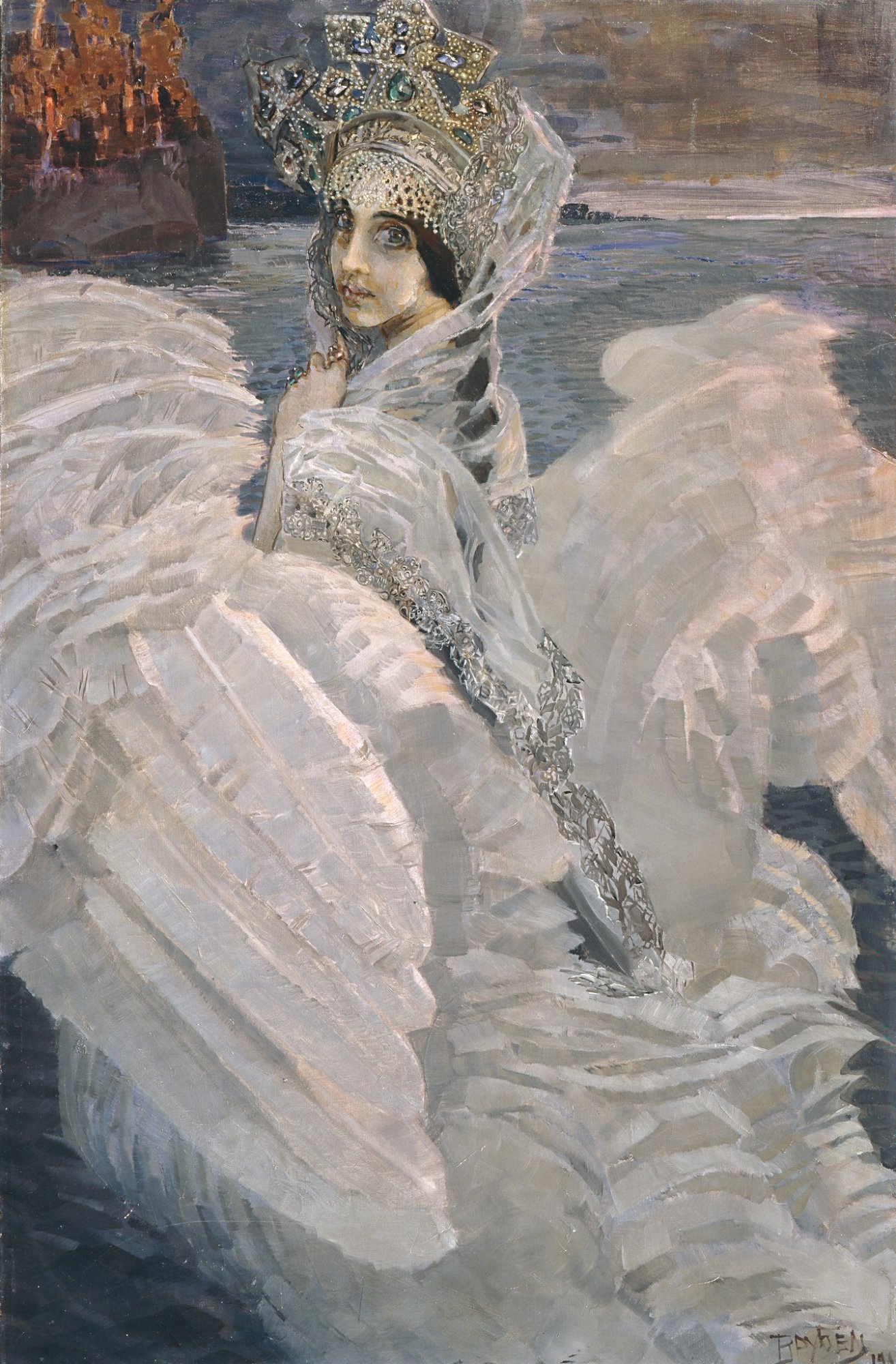
On April 19, 1900, the singer Nadezhda Zabela-Vrubel wrote to her sister: “Misha has already sold the Swan Princess and, sure enough, very cheaply — for 300 rubles, to Morozov.” The opera was still six months away. Zabela had yet to sing the role, but the picture already belonged to the collector Mikhail Morozov.
Mikhail Vrubel’s The Swan Princess, now in the State Tretyakov Gallery, Moscow, is often called a portrait of his wife in stage costume. The documents complicate that: the painting ran ahead of both opera and role.
A composer waiting on two Vrubels
Nikolai Rimsky-Korsakov was writing The Tale of Tsar Saltan, source of the “Flight of the Bumblebee,” after Pushkin’s verse tale: Prince Gvidon rescues a swan who is an enchanted princess.
Following the work of both Vrubels, the singer and the painter, he gave Zabela the first fragment of the Swan’s part on November 23, 1899, and on April 8, 1900, wrote to her: “I am interested to see how Mikhail Alexandrovich’s [Vrubel’s] Swan will come out.”
Zabela had already sung his sea princess Volkhova in Sadko, and in 1898 Vrubel portrayed her in the role. Now the composer awaited a second princess, this one winged.
The opera premiered on October 21, 1900 (November 3 by the Western calendar), at Moscow’s Solodovnikov Theater, given by the Private Opera, which the railway magnate Savva Mamontov had founded but no longer ran after his arrest. Reviewers praised Vrubel’s sets and costumes above all, though one grumbled: “Mr Vrubel’s sea is somewhat gloomy and overly ominous looking all the time.”
The image came before the opera, and not on canvas. In March 1899, for the 1900 Paris World’s Fair, Vrubel painted a balalaika for Princess Maria Tenisheva, a patron of Russian crafts. The instrument is now in the Smolensk State Museum-Reserve, its design at the Abramtsevo Museum-Reserve.
Abramtsevo was Mamontov’s estate, where Valentin Serov painted Girl with Peaches. From 1890 Vrubel worked in its pottery workshop, which later moved to Moscow; in all he made some 150 majolica models and designs.
His wife’s gesture, an invented face
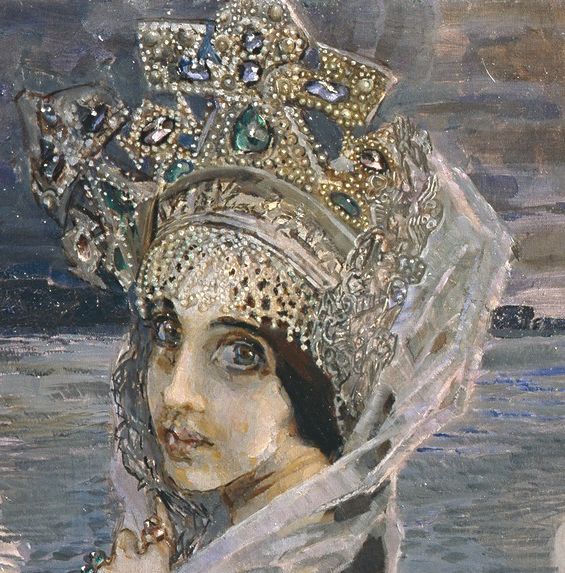
Did Zabela pose? The Tretyakov Gallery researcher Vera Bodunova concludes the face and figure are “a composite image,” not a portrait of the singer.
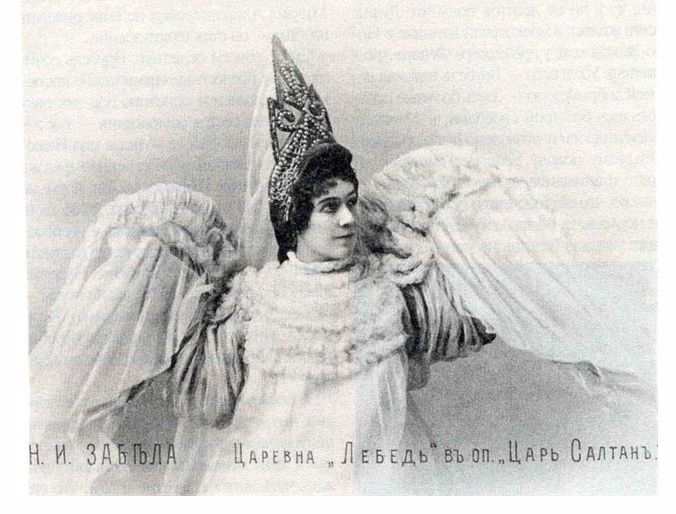
The turn of the figure and the hand holding the veil are another matter: Vrubel “most likely” caught them in his wife as she learned the part, Bodunova argues. The gesture reappears in a photograph of Zabela as the Swan.
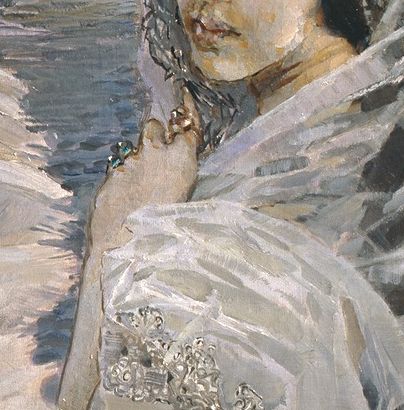
The face had other claimants. The art historian Nikolai Prakhov saw “a considerable likeness” to his sister Yelena. Zabela’s sister Ekaterina Ge compared Vrubel with her father-in-law, the painter Nikolai Ge: “Ge painted everything from nature, whereas Vrubel did not.” In his portraits, she said, Vrubel “invented my sister’s beauty.”
Vrubel, Bodunova writes, needed “at least one element of the material world faithfully copied from its natural prototype.” Here that seems to be the fabric and stones of the kokoshnik, the tall Russian headdress.
The city over her shoulder seems to come from the tale too. In Pushkin the Swan gives Gvidon an island city, and for the production Vrubel designed a similar one, Ledenets.
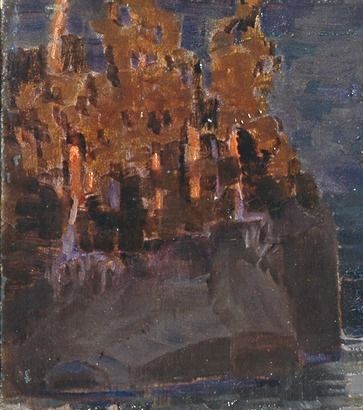
In Vrubel’s oil sketches the features are barely there; the wings already dominate. Of two small studies on wood in the State Russian Museum, St Petersburg, one had belonged to Zabela; the artist’s sister Anna gave it to the museum in 1918.
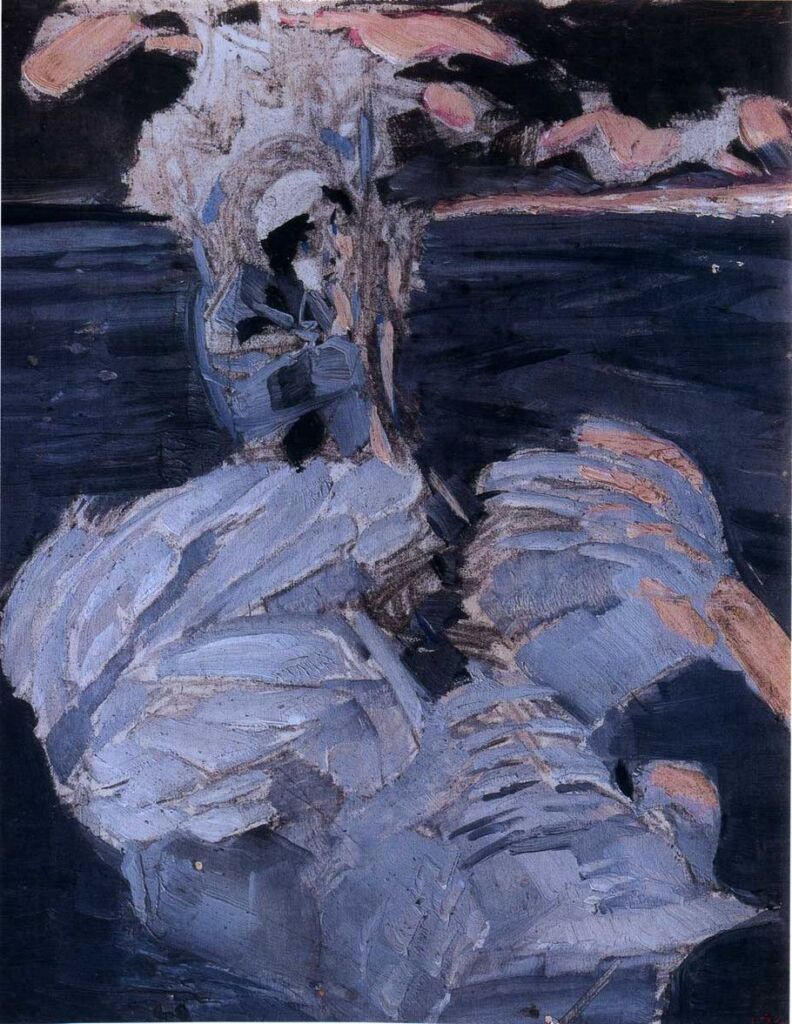
That summer, at the Ge family farm in Pliski, in present-day Ukraine, Vrubel painted a second version for the collector Vladimir von Meck. But the Moscow canvas, already in Morozov’s house, came first.
A collector owned The Swan Princess first. The singer took the role six months later.
A bird for the Symbolists
Morozov, heir to a textile fortune, died in 1903; his collection, The Swan Princess included, was later given to the Tretyakov Gallery.
The Symbolist poets claimed Vrubel as their own, which may be why one story took hold so easily: that Alexander Blok kept a reproduction of the painting at Shakhmatovo, his family estate. Encyclopedias and newspapers repeat it, but we found no letter, diary or inventory confirming it. For now it is a good story, not a fact.
Blok’s documented words came in his 1910 speech “In Memory of Vrubel”: Vrubel came “with an insane but blissful face.” Valery Bryusov’s poem “To M. A. Vrubel” opened the first issue of The Golden Fleece in 1906. Sitting for the ailing artist, Bryusov recalled, he watched the man in Vrubel fall apart while the master kept working.
For Zabela the Swan became a farewell, if only a stage one. Anna Vrubel recalled her saying, as the audience applauded: “this Swan Princess is to be my swansong.”
On the canvas, the singer survives only in the turn of the figure and the hand at the throat. Long before, Vrubel had searched for a face of his own for his Demon Seated, and the princess looks more like his heroes than his models.
Comments
For Hroniki readers
Comments are open to readers with an account. Signing up is free and takes a few seconds.
No comments yet. Start the conversation.