Trompe l’oeil: from Zeuxis’s grapes to Harnett’s Paris envelope
Trompe l'oeil is a picture that wants to pass for the real thing. The trick is over two thousand years old, the word just over two hundred: from the grapes Zeuxis painted for the birds to Harnett's envelope from Paris.
Pliny the Elder tells of two rival Greek painters. Zeuxis painted grapes so convincing that “birds flew up to the stage-buildings.” Proud of the birds’ verdict, Zeuxis asked Parrhasius to draw back his picture’s curtain. The curtain was painted. Zeuxis yielded, “saying that whereas he had deceived birds Parrhasius had deceived him, an artist” (trans. H. Rackham).
This is trompe l’oeil, French for “fool the eye”: an image that wants to pass for the thing itself. It hides the brushstroke that impasto flaunts. The device is ancient, the word young. According to the Metropolitan Museum of Art, it was coined in 1800 by the French painter Louis-Léopold Boilly, whose optical illusions drew crowds. At that year’s Salon he showed a painting so titled.
A canvas turned to the wall
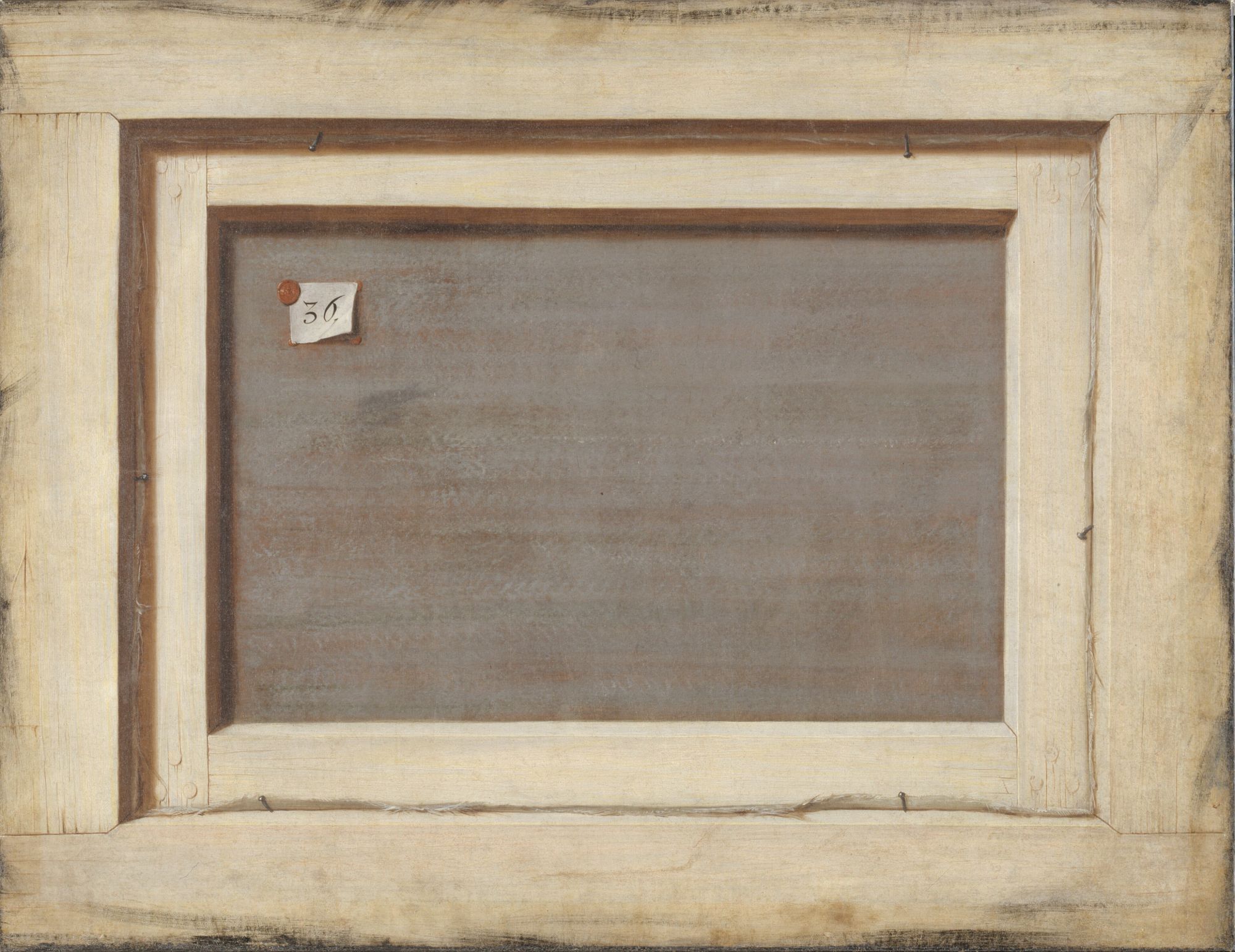
From 1668 to 1672 the Flemish painter Cornelis Norbertus Gijsbrechts served the Danish kings Frederick III and Christian V as court painter. For the “perspective room,” a chamber of illusions in the royal Kunstkammer in Copenhagen, he painted at least fifteen trompe l’oeil pictures and vanitas still lifes.
The boldest shows the back of a painting: stretcher, nails, a slip numbered 36, nothing else. Scholars note it closely matches the canvas’s real back and suggest it hung unframed.
More often he hung objects on a painted wall: around 1672 it was a violin, sheet music and a recorder, a subject revived in America two centuries later.
Samuel van Hoogstraten went further: the Dutch painter, a pupil of Rembrandt, fooled an emperor. According to the biographer Arnold Houbraken, Ferdinand III took one of his still lifes for the real thing and gave him a gold medal with the imperial portrait.
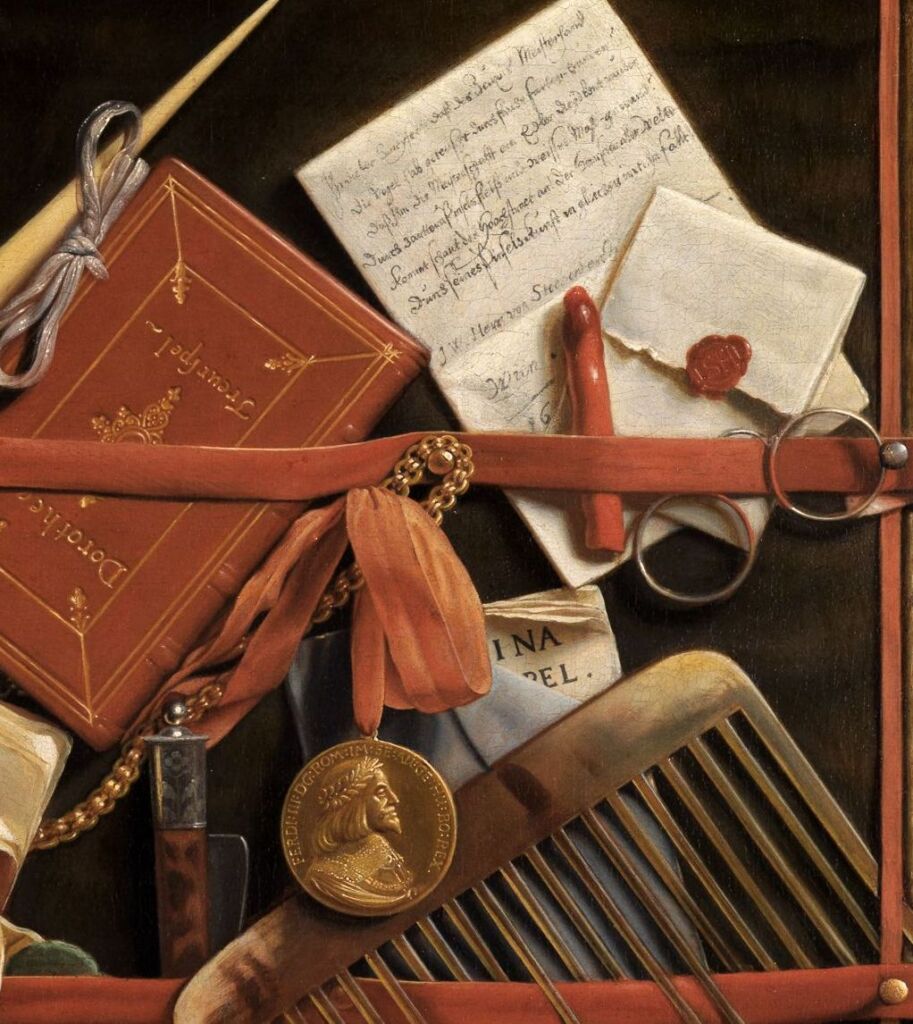
The medal hangs on its chain among twenty-one objects on his Karlsruhe letter board, beside spectacles and a written note praising his skill at deceiving the eye. The note compares him to Zeuxis: the painter wrote himself into Pliny’s story.
An envelope from Paris
William Michael Harnett painted The Old Violin in 1886. At the Cincinnati Industrial Exhibition it “sold as soon as it was unpacked, and at his own price,” the Cincinnati Commercial Gazette reported. Instead of a signature, Harnett’s name is on a painted envelope, with his New York address and a Paris postmark from April ’86.
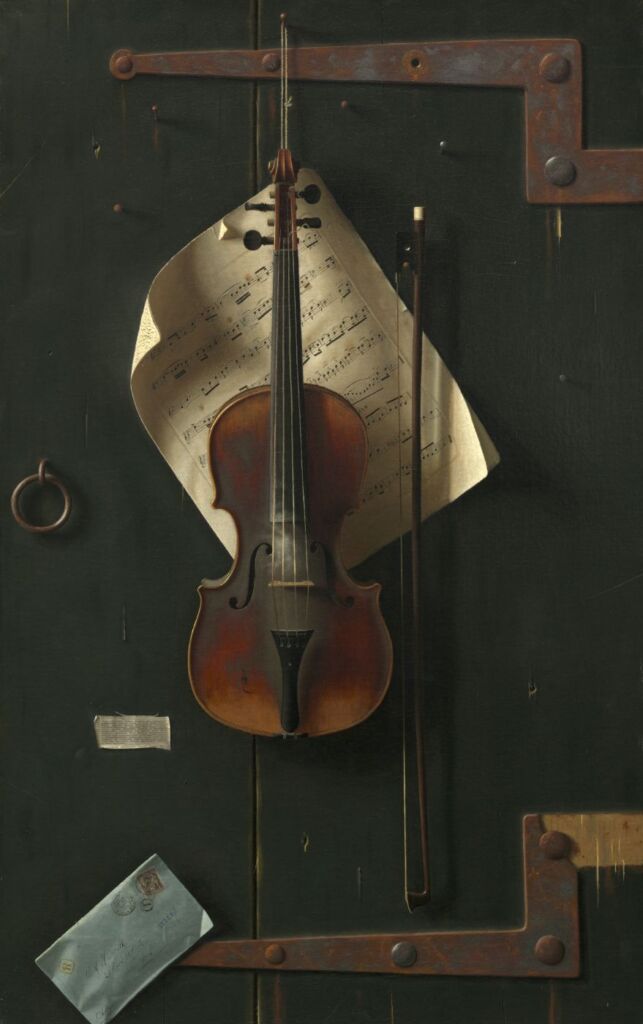
John Frederick Peto, born in Philadelphia, moved in 1889 to Island Heights on the New Jersey shore, where he painted his own Old Violin around 1890 and lived out his life in obscurity. For a time his pictures were sold as Harnett’s, with forged signatures. The art historian Alfred Frankenstein untangled the two in After the Hunt.
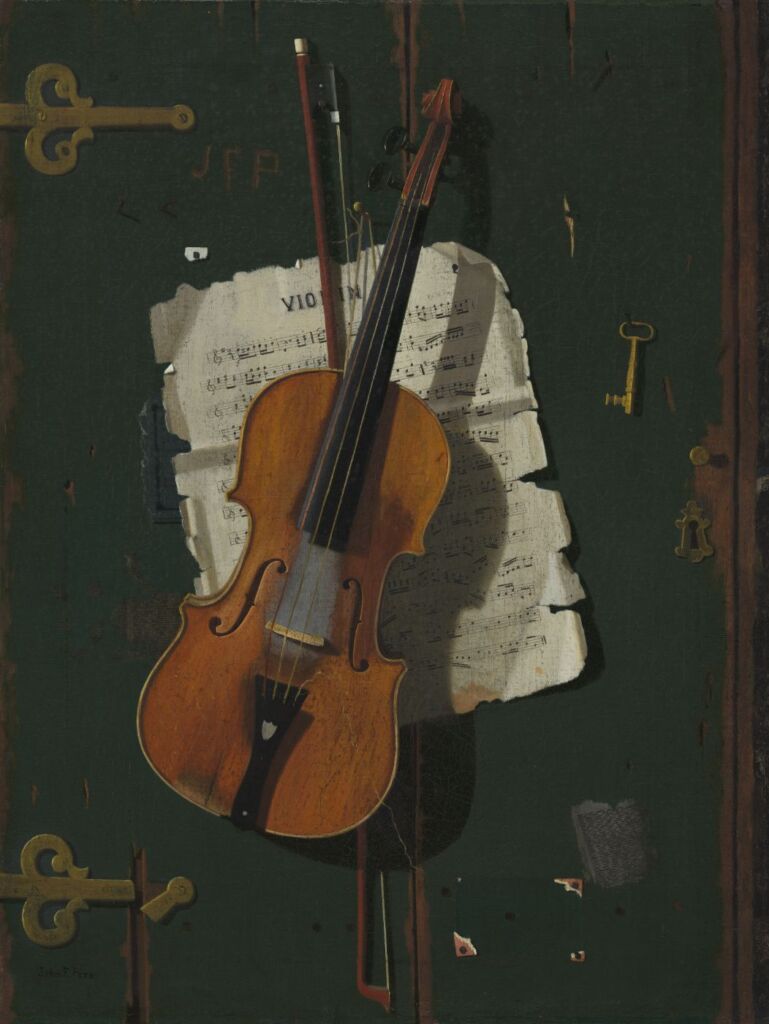
On this door Peto seems to have cut his initials with a knife: JFP, upper left. He cut them, of course, with a brush.
For my own amusement
In Russia, Grigory Teplov, later a statesman and confidant of Catherine the Great, was painting trompe l’oeil by 1737. In his still life with a parrot (Kuskovo Estate, Moscow), a rolled sheet of music bears a Latin signature with that date. He did not count himself a painter: in 1765 he wrote (in Russian) to Ivan Betskoy that he had learned to paint “for my own amusement alone” (this and the next quotation translated here by Hroniki).
Count Fyodor Tolstoy, a medalist and later vice president of the Imperial Academy of Arts, said much the same: he made his still lifes “in time free from serious occupations.” He kept them carefully in an album, whose sheets the collector Pavel Tretyakov bought from his daughter in 1895.
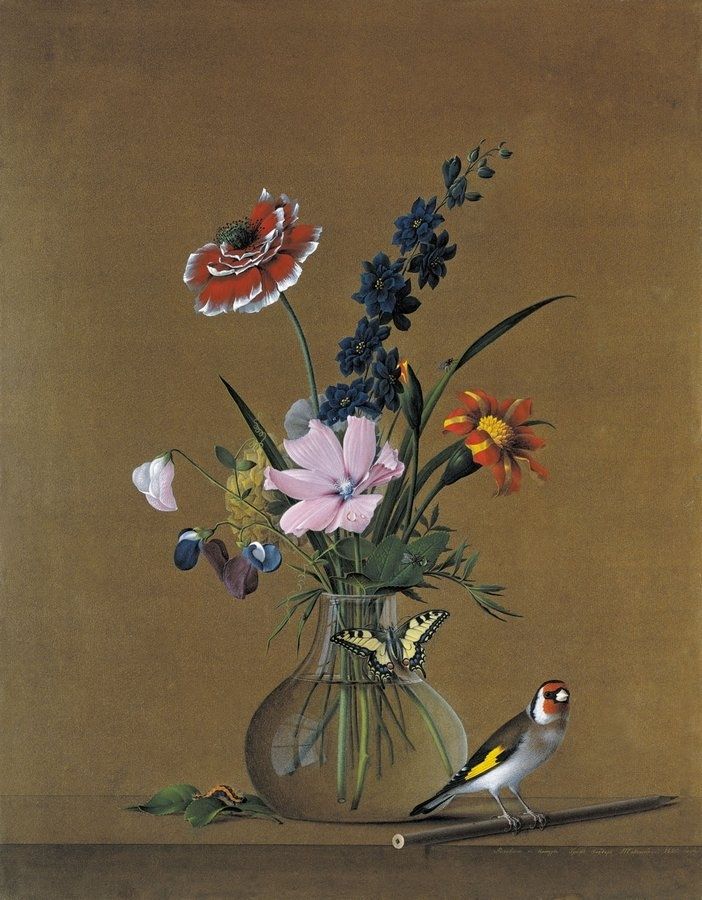
In Bouquet of Flowers, a Butterfly and a Bird (1820), a fly sits on a narrow leaf and dew dots the petals. As the Tretyakov Gallery (in Russian) notes, these living details make everything else convincing. And Tolstoy’s fly sits where Parrhasius’s curtain hung: on the edge a viewer itches to test by touch.
Comments
For Hroniki readers
Comments are open to readers with an account. Signing up is free and takes a few seconds.
No comments yet. Start the conversation.