A lady with a monkey: what Seurat was hinting at in La Grande Jatte
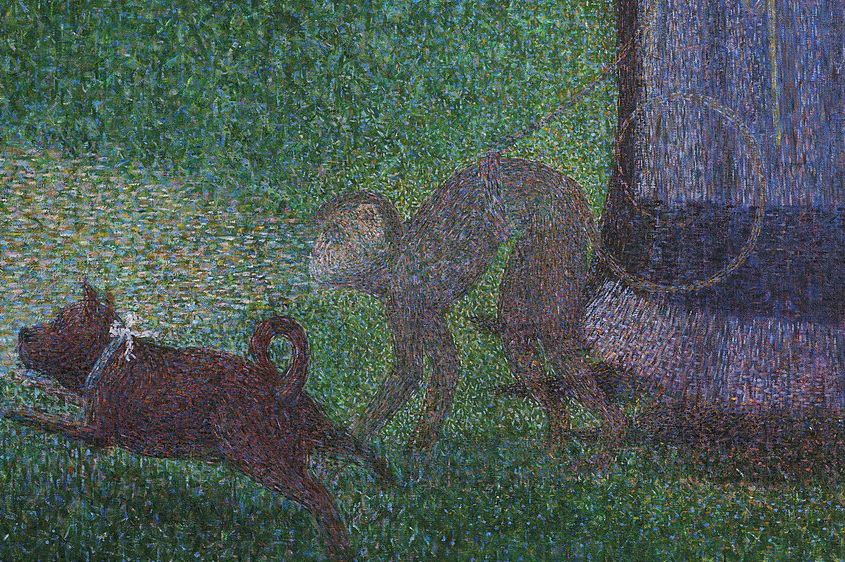
Seurat painted the monkey on a leash into La Grande Jatte two years after he started the canvas. The museum sees a finishing touch to the composition; others, a slang reference to prostitution.
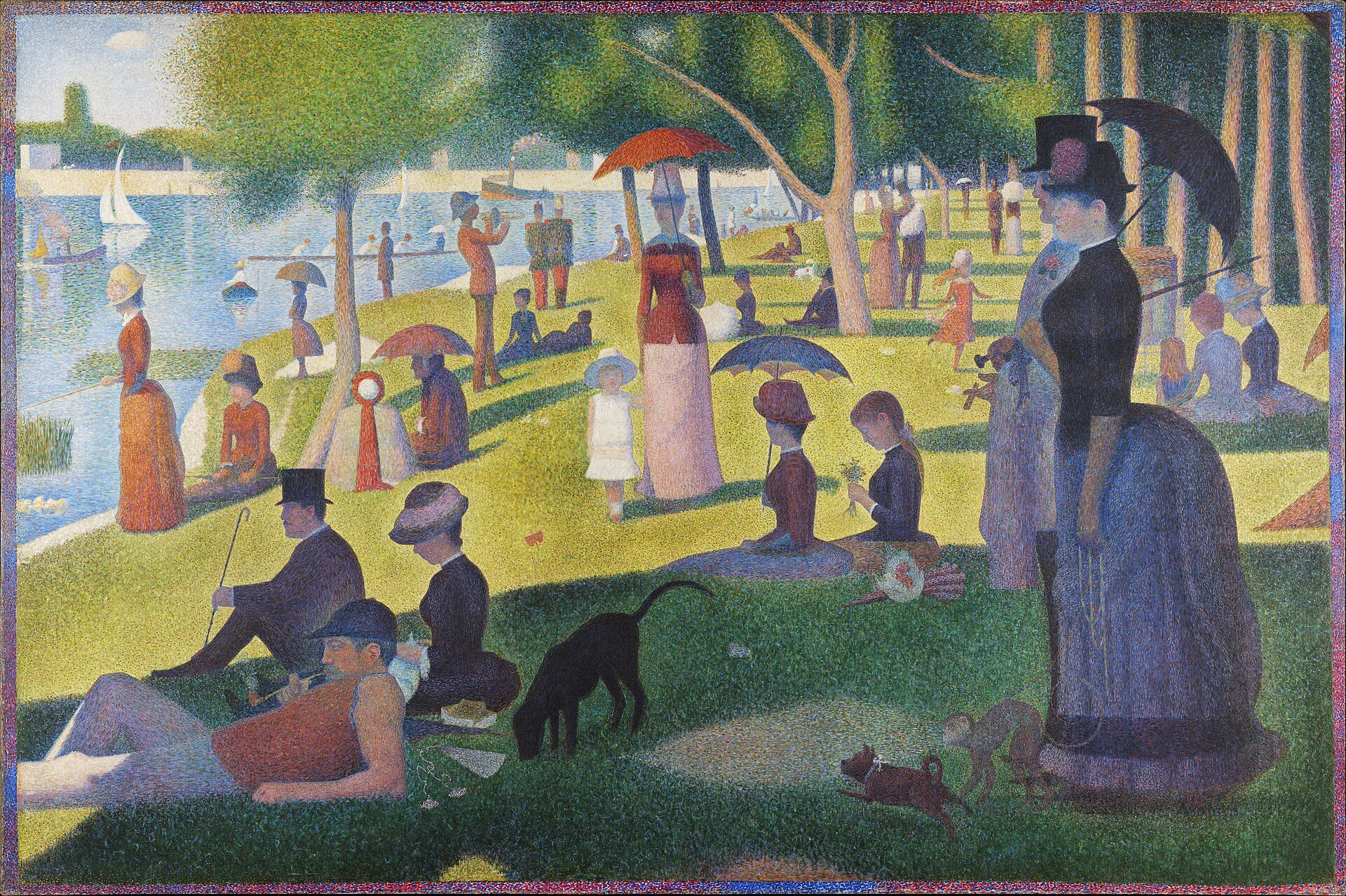
Georges Seurat began A Sunday on La Grande Jatte in 1884 and returned to it in 1885, reworking the figures already there and adding new ones. The Art Institute of Chicago, its home today, lists the leashed monkey among the additions. It fits the composition so well, the museum notes, that it is hard to picture as an afterthought. In 1888–89 he added a border of colored dots.
Seurat worked out the monkey before he painted it in. The Metropolitan Museum owns his 1884 drawing Monkey, drawn in conté crayon (a dense black drawing crayon) in strict profile against a blank sheet. The sheet is small, 31.1 × 23.9 cm (12¼ × 9⅜ in), a 1967 bequest from the collector Adelaide Milton de Groot. Light and shade, not outline, hold the form. From the same year comes Woman with a Monkey, an oil study on wood at Smith College, Massachusetts.
The monkey was a small part of the preparation. The catalogue of the Art Institute’s 2004 exhibition Seurat and the Making of La Grande Jatte, by Robert L. Herbert and colleagues, counts 28 drawings, 28 oil studies, and three large canvases directly tied to the painting. Britannica is more generous, with more than 70 sketches and drawings; it depends on what you count. One of those canvases, 81 × 65 cm, shows the strolling couple and is squared up in conté crayon, the grid used to transfer a composition to a bigger surface.
The lady with the monkey and her reputation
Seurat left no explanation, and the readings divide. Encyclopaedia Britannica treats the monkey as a symbol of lust and the lady holding it as a woman of loose morals. The Fitzwilliam Museum in Cambridge, which shows a large study of the couple owned by King’s College, cites a word from Parisian slang of the time, singesse, “she-monkey,” said to mean a prostitute hanging on her client’s arm.
The Trésor de la langue française (TLFi), the major dictionary of modern French, has no such sense: there singesse is a female monkey, and an example from 1901 uses it for the boss’s wife. The Fitzwilliam also offers a calmer reading: Seurat may simply have been poking fun at the couple’s stiff, English-style primness and at the fashionable airs of the Sunday crowd.
Chicago reads it in a similar spirit. Material from the 2004 exhibition calls the foreground couple “somewhat comically puffed-up fashion plates.” On that reading, the monkey belongs to the same fashion rather than to a secret code.
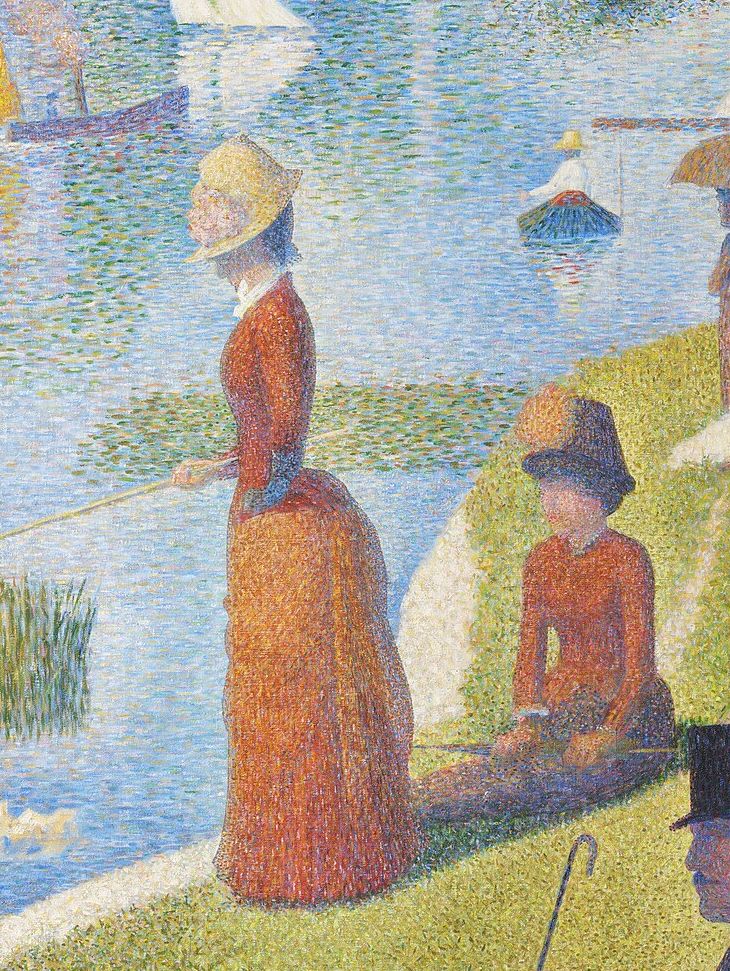
The woman fishing at the other edge of the picture falls under suspicion too. Popular write-ups point out that the island was known for prostitutes and read the rod as a wish to “hook” a man. English-language retellings add a pun: in French pêcher means “to fish” and pécher “to sin.” Museums do not mention it.
The second campaign of 1885
The Salon des Indépendants planned for March 1885 was canceled, and Seurat set the canvas aside for a while. The Art Institute dates his return to it to October 1885. He repainted over earlier layers in small, separate strokes of nearly unmixed color and reshaped the figures with scalloped, curving outlines.
In May 1886 the painting appeared at the eighth Impressionist exhibition, which turned out to be the last. The Art Institute calls it the most talked-about canvas in that show, and Britannica notes it was not widely liked at first. The border of blue, orange, and red dots did not yet exist; according to Britannica, Seurat later restretched the canvas to make room for it.
One of his paints let him down. Seurat used zinc yellow freely for passages including the sunlit grass, and over time it changed: yellow strokes drifted toward ocher, yellow-greens toward olive, oranges toward reddish brown. Visitors in 1886 saw a noticeably brighter picture than today’s.
In a 2010 study, a team led by Francesca Casadio, a conservation scientist at the Art Institute, artificially aged zinc yellow under light, humidity, and sulfur dioxide. The changes turned up only in the top few microns of paint, which is why earlier tests missed them. A sample from the painting itself showed the same altered chromium compounds in the browned strokes. The reaction is reversible: in laboratory tests, strongly alkaline gases can turn the darkened pigment yellow again.
Earlier, for the 2004 exhibition, Roy Berns of the Rochester Institute of Technology, with Art Institute scientists, measured the spectra of darkened passages and of fresh samples of the same paints, then rebuilt the original colors on a computer, dot by dot, without touching the canvas.
Seurat died in 1891, at 31. Chicago sees the monkey as a deft compositional touch; others, a hint at prostitution. The leash runs from the animal to the lady’s hem; who leads whom, the viewer decides.
Comments
For Hroniki readers
Comments are open to readers with an account. Signing up is free and takes a few seconds.
No comments yet. Start the conversation.