Why Dürer put a magic square in Melencolia I
In <em>Melencolia I</em>, Dürer engraved a square of sixteen numbers in which every row, column and both diagonals add up to 34, with the year 1514 in the bottom row. Why a print about melancholy needs it, and where Jupiter comes in.
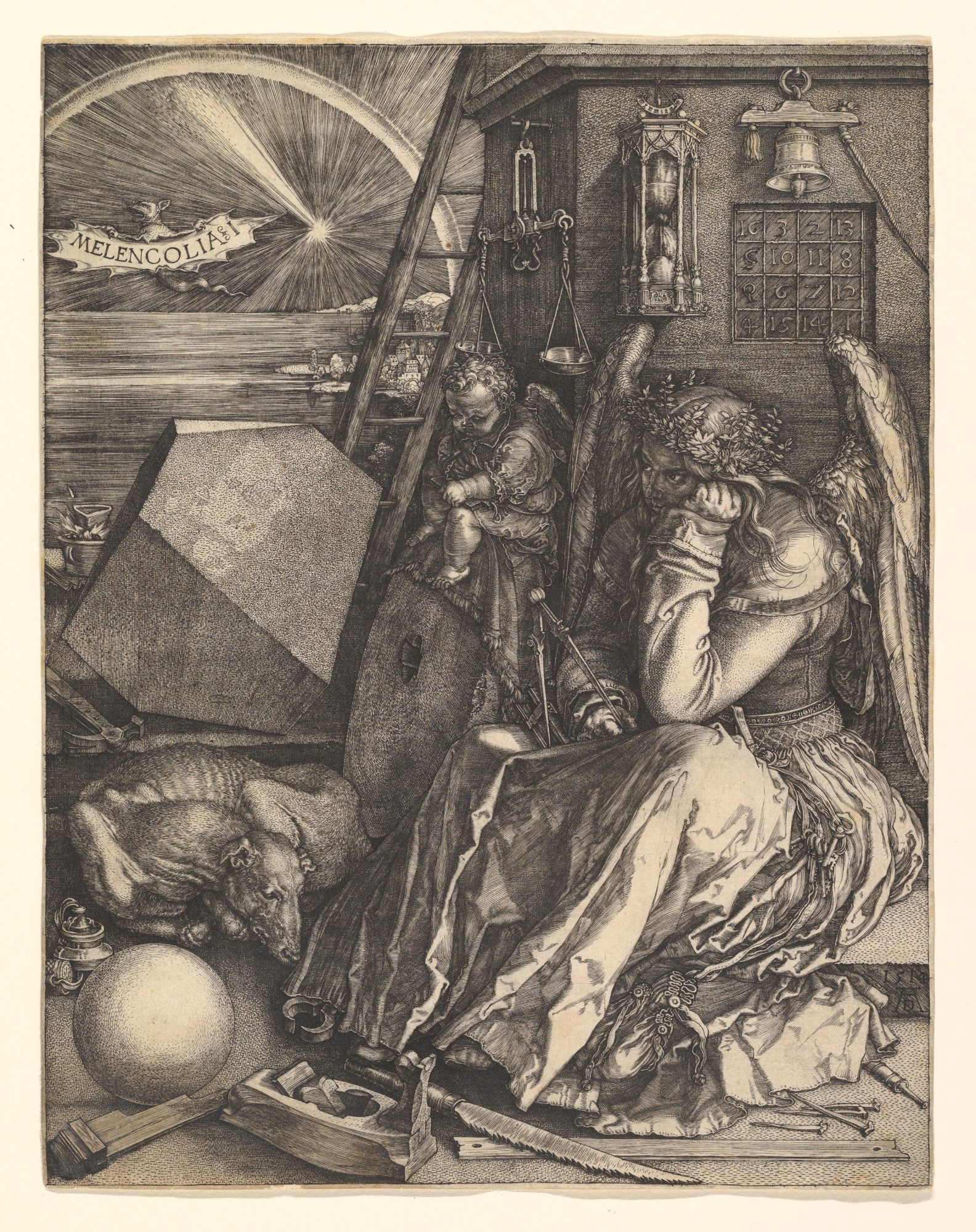
Add up any row, column or diagonal of the square in Melencolia I and you get 34. Albrecht Dürer cut these sixteen numbers below a bell, beside an hourglass. The square is often called the first magic square printed in Europe.
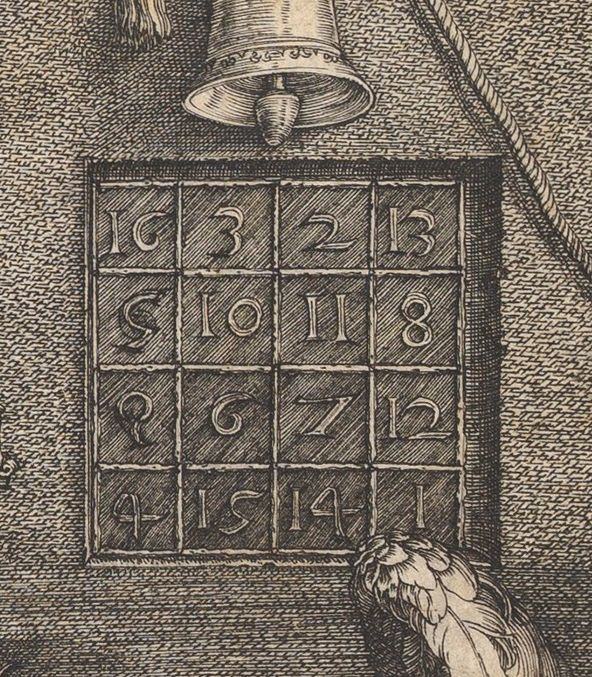
The total holds even where nobody promised it. The four corners make 34; so do the four central cells and each two-by-two corner block. Any two cells symmetrical about the center make 17.
In the middle of the bottom row sit 15 and 14: 1514, the year of the engraving. The date appears again at the lower right of the sheet, above Dürer’s monogram. So it is there twice, as a signature and inside the arithmetic.
Sixteen numbers in order
Dürer left no note on how he built his square, but you can get there from the dullest table imaginable. Write out 1 to 16 in four rows: 1, 2, 3, 4 at the top, 13, 14, 15, 16 at the bottom.
The rows add up to 10, 26, 42 and 58. Yet both diagonals already make 34, and that is the clue. Replace every number on the diagonals with its partner to 17: 1 becomes 16, 6 becomes 11, 4 becomes 13. Eight numbers trade places; the other eight stay put.
Now every row and column comes to 34, and the diagonals keep their total. The result is a true magic square, but its bottom row reads 4, 14, 15, 1. One move remains: exchange the two middle columns.
No sum breaks. The bottom row now reads 4, 15, 14, 1 and the top 16, 3, 2, 13: exactly the square in the engraving. Whether Dürer took this route is unknown. But the year came free of charge: no sum had to be sacrificed for it.
Another property cannot be seen on the print at all. Square the eight numbers in the top two rows and add them up: 748. The bottom two rows give the same, and so do the eight cells on the diagonals and the eight off them.
A nine cut backward
Melencolia I is one of three large engravings of 1513–14 known as the Meisterstiche, or master engravings. Many impressions survive: the Metropolitan Museum of Art in New York has several, and the National Gallery of Art in Washington has one too.
The plate itself did not stay the same. The engraving exists in two states, versions of the plate before and after the artist reworked it. In the first, the 9 opening the square’s third row printed backward. Dürer later corrected it.
The likeliest explanation lies in the technique. An engraver works in mirror image: whatever reads left to right on paper is cut in reverse in the copper, so sixteen numbers, the date and the monogram all had to be flipped in the head. The date and monogram in the corner came out right, but one digit inside the square went onto the plate unflipped.
Very few impressions of the first state are known. One is in the British Museum, where Campbell Dodgson, Keeper of Prints and Drawings, recognized it as the first known impression of the first state; the London collection has no other. The backward 9 is what marks an early impression.
The usual sheet is a second-state impression. Moscow has one, at the Pushkin State Museum of Fine Arts: it came there in 1924 from the Rumyantsev Museum, after passing through the private collections of Füssli and Basnin. The museum’s catalogue describes it in just those terms: second state, the 9 corrected. The square meant to come out even needed a correction of its own.
Jupiter against Saturn
Why would a print about melancholy need a table of numbers? Melancholy then meant more than gloom: it was one of the four temperaments, ruled in astrology by Saturn. Magical tradition gave the four-by-four square to Jupiter, thought to counterbalance Saturn. Hence the best-known reading, from Saturn and Melancholy (1964) by Raymond Klibansky, Erwin Panofsky and Fritz Saxl: the square is a protective charm, Jupiter against Saturn.
A square of Jupiter also appears in De occulta philosophia by the German scholar and occultist Cornelius Agrippa, with its sixteen numbers in a different order but the same sum, 34. Engraved on a silver plate, Agrippa writes, such a table draws riches, love, peace and concord. Of melancholy, not a word.
Agrippa gives seven tables, one per planet of the old astronomy, arranged by size. Saturn comes first, with a three-by-three square whose lines add up to 15, then Jupiter with four by four and 34. Mars, the Sun, Venus and Mercury follow, and the Moon closes the series with nine by nine. The smallest table went to Saturn, the next to the planet meant to balance it.
The dates are a second snag: the treatise was printed in full only in 1533, nineteen years after the engraving. According to the Met, Dürer almost certainly knew the text, and it explains the I in the title. Panofsky allowed that the artist may have seen it in manuscript. That assumption is disputed, and there is no firm answer.
The manuscript itself did exist. Agrippa finished an early version of the treatise in 1510 and sent it to the abbot Johannes Trithemius; the dedication copy survives in Würzburg. The text circulated in manuscript while Agrippa revised it for two more decades. Whether that draft contained the square of Jupiter, and whether a copy reached Nuremberg, is unknown.
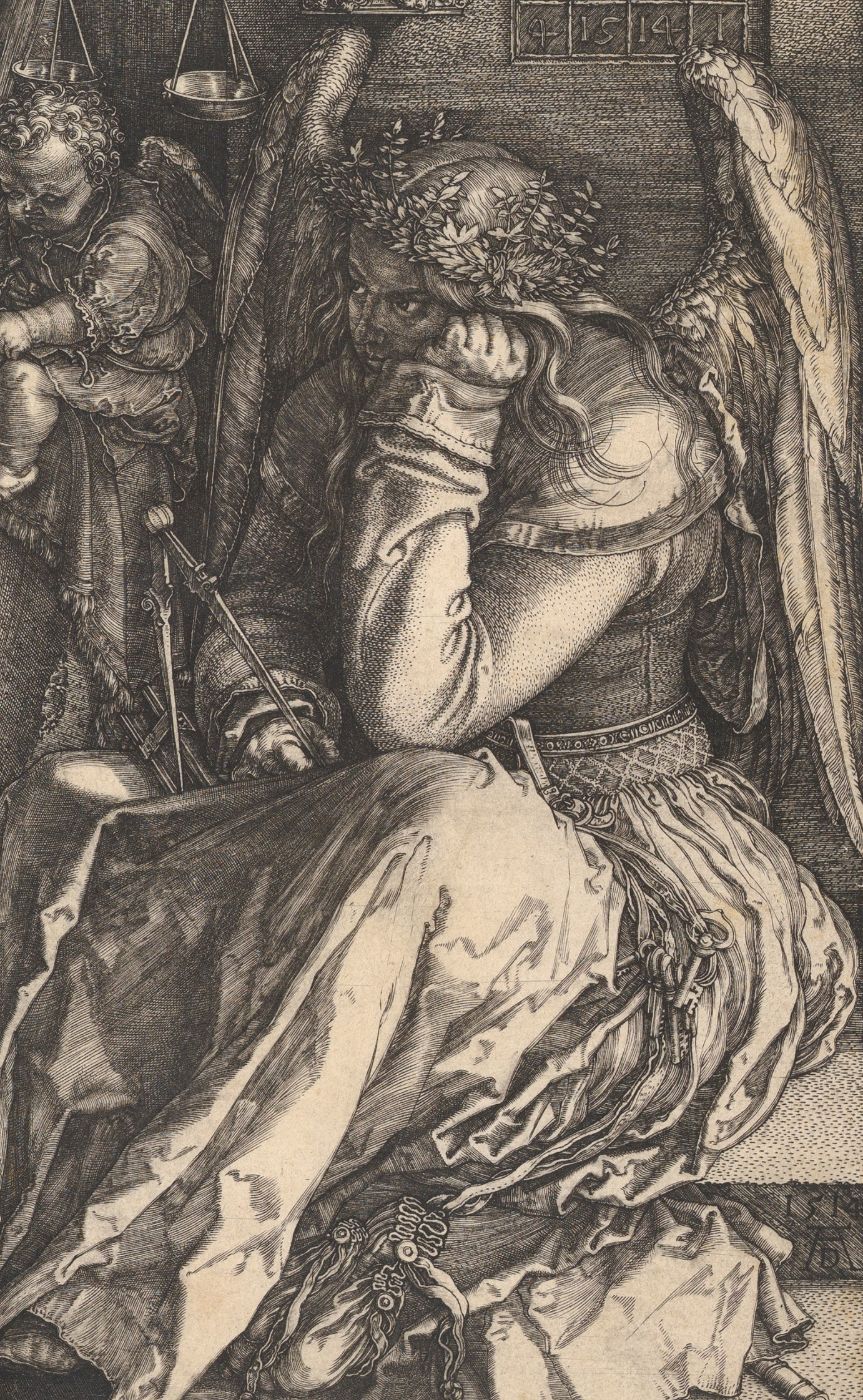
Whatever the source, the scene stays the same. The winged figure sits idle among abandoned tools, a compass in hand. On the wall above her hangs the only thing on the sheet where everything comes out even.

Comments
For Hroniki readers
Comments are open to readers with an account. Signing up is free and takes a few seconds.
No comments yet. Start the conversation.