Manet’s Olympia: why the nude needed guards
At the Salon of 1865, Manet's Olympia needed guards, and then it was hung above a door in the last gallery. What so offended Paris, when everyone recognized the pose at first glance?
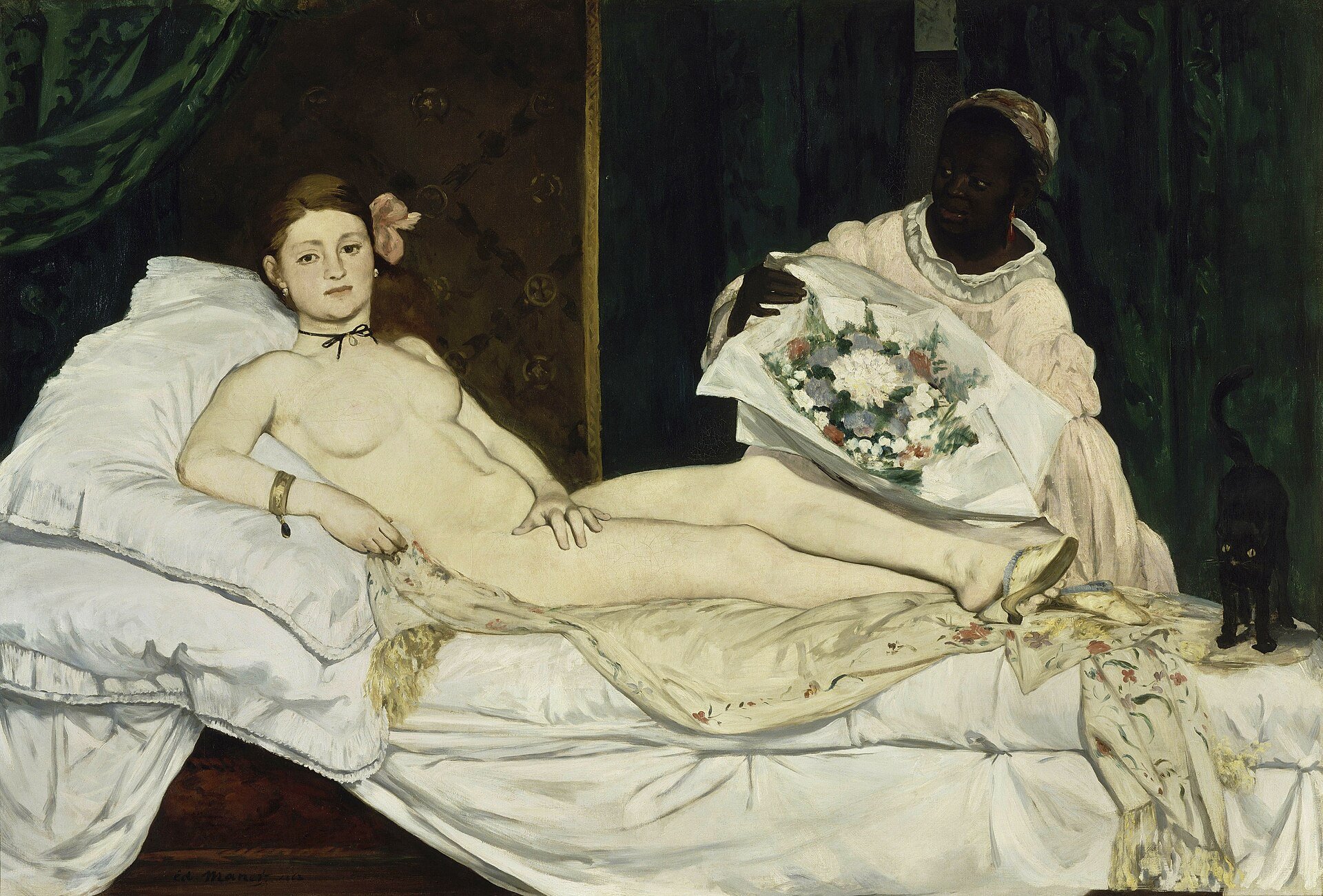
More than thirty years after the Salon of 1865, Manet’s friend Antonin Proust recalled that if the canvas of Olympia had not been slashed and punctured, it was only thanks to the precautions taken by the administration. The organizers had to post guards beside the painting, then move it where it could barely be seen.
Édouard Manet painted Olympia in 1863. The canvas, 130.5 by 191 centimeters (about 51 by 75 inches), now hangs in the Musée d’Orsay, in Room 14 on the ground floor. Why it once needed protecting comes down to whom Manet laid on that bed and what he placed beside her.
Number 1428
The date on the canvas suggests Manet meant it for the Salon of 1864, but he held it back a year, until the uproar over Luncheon on the Grass was behind him. In 1865 the jury accepted Olympia. The Salon opened on May 1 at the Palais des Champs-Élysées, and the catalog listed the picture as number 1428.
Beside it ran verses by Manet’s friend, the critic and poet Zacharie Astruc: Olympia waking, spring entering on the arm of a “gentle black messenger,” an “august young girl” (translated here by Hroniki). The painting probably took its name from the poem. The lofty tone only underlined what everyone could see: the woman on the bed was no goddess.
Manet also sent a very different picture, Jesus Mocked by the Soldiers. Françoise Cachin, who wrote the Olympia entry for the 1983 Manet retrospective, calls this pairing of a Gospel scene with a Parisian courtesan provocative. Both canvases were attacked, but Olympia took the brunt.
First, guards were stationed in front of it; then it was rehung in the last gallery, above a door and very high up. That, at least, is how the historians Theodore Reff and John Richardson tell it. How many guards, and when it was moved, nobody knows. What survives is one critic’s quip: from down below, “you scarcely knew whether you were looking at a parcel of nude flesh or a bundle of laundry.”
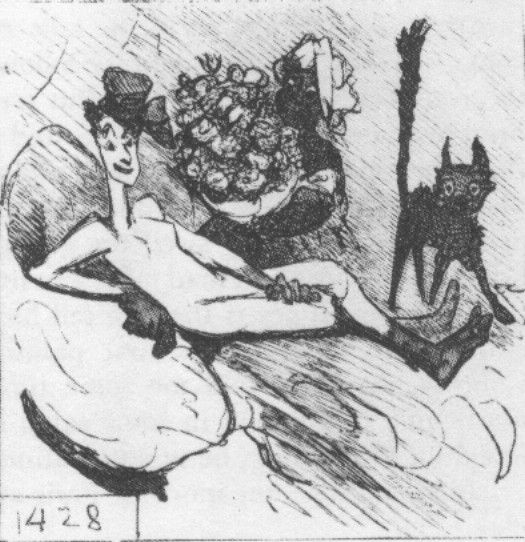
“As at the morgue”
Cartoonists mocked Olympia; critics were harsher. In the magazine L’Artiste, Jules Claretie asked: “What’s this yellow-bellied Odalisque, this vile model picked up who knows where?”
Paul de Saint-Victor wrote that “the crowd, as at the morgue, presses together in front of the gamy Olympia.” To Félix Deriège, “white, black, red, green set up a frightful din on the canvas.” Théophile Gautier found the model “wretched” and the flesh tones “dirty”; Ernest Chesneau saw “an almost childish ignorance of the first elements of drawing.”
Manet had not expected such a storm. Right after the opening he wrote to Charles Baudelaire in Brussels that insults were raining down on him like hail and that someone was clearly wrong. The poet’s reply of May 11 was blunt and affectionate at once. Others had been greeted this way before, he said: “You are only the first in the decrepitude of your art.”
What Baudelaire meant is still debated; the journal Romantisme devoted an entire article (in French) to that one phrase. A champion appeared a year later. In 1866 the young Émile Zola defended Manet in his Salon reviews, and in an 1867 pamphlet he called Olympia the artist’s masterpiece.
Even fellow painters balked. According to the critic Albert Wolff, Gustave Courbet compared Olympia to the queen of spades from a deck of cards, “fresh from her bath”: “It’s all flat, no modeling.” Courbet meant it as an insult. Cachin sees the picture’s novelty in exactly this flat, hard manner, and some scholars trace it to Japanese prints.
Venus without the mythology
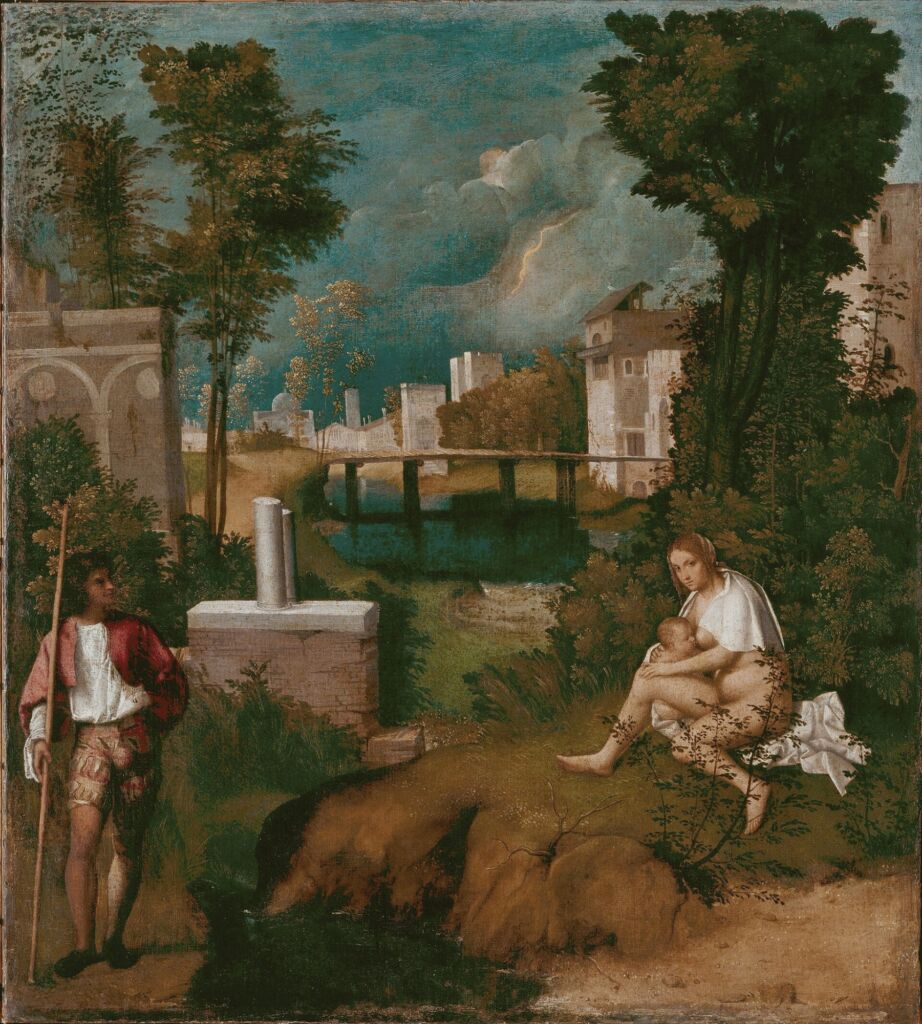
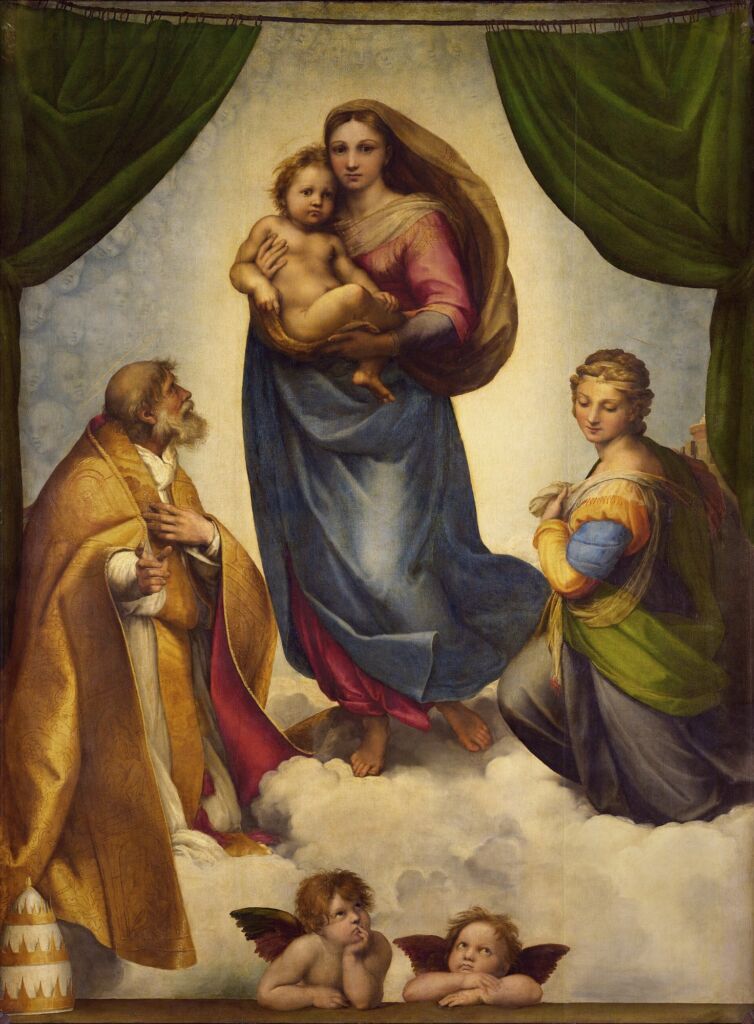
Manet made no secret of his source: Titian’s Venus of Urbino of 1538, which he had copied as a young man at the Uffizi in Florence, where it still hangs. The pose is nearly the same: body on a diagonal, elbow on pillows, left hand on the thigh.
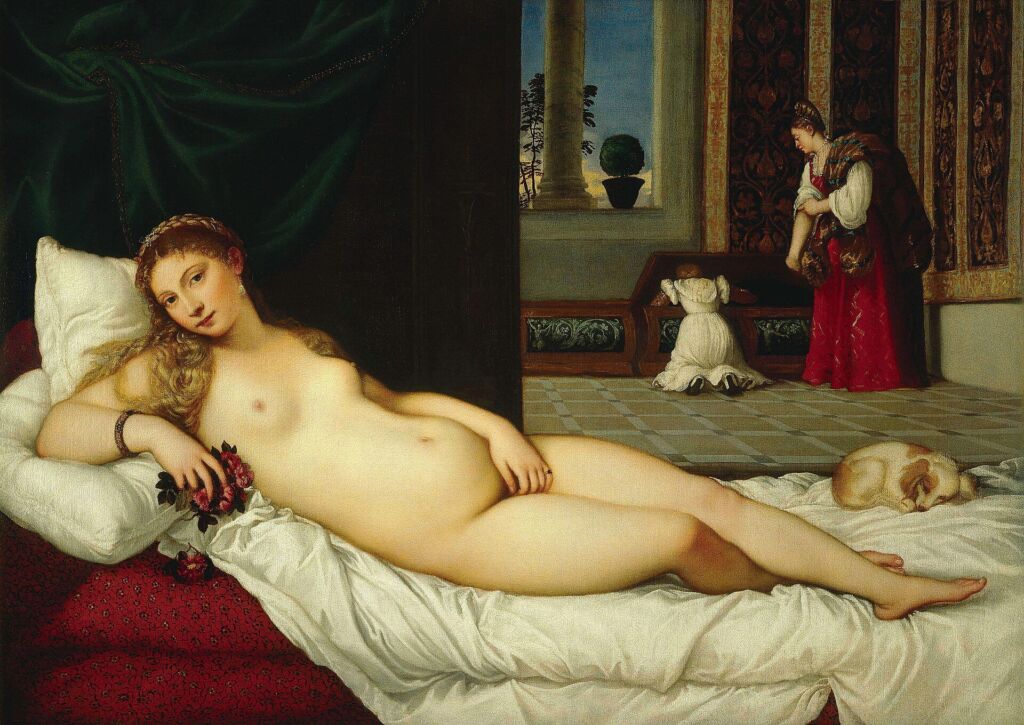
Guidobaldo II della Rovere, heir to the dukes of Urbino, bought it from Titian himself. The Uffizi’s commentary reads it as a marriage picture: two maids take a dress out of a chest, and at Venus’s feet a little dog sleeps, an emblem of marital fidelity.
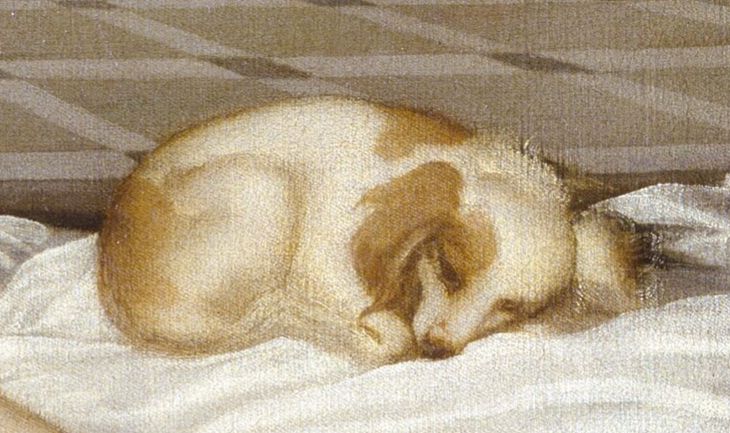
In Manet’s version, that spot belongs to a black cat, and it is wide awake.
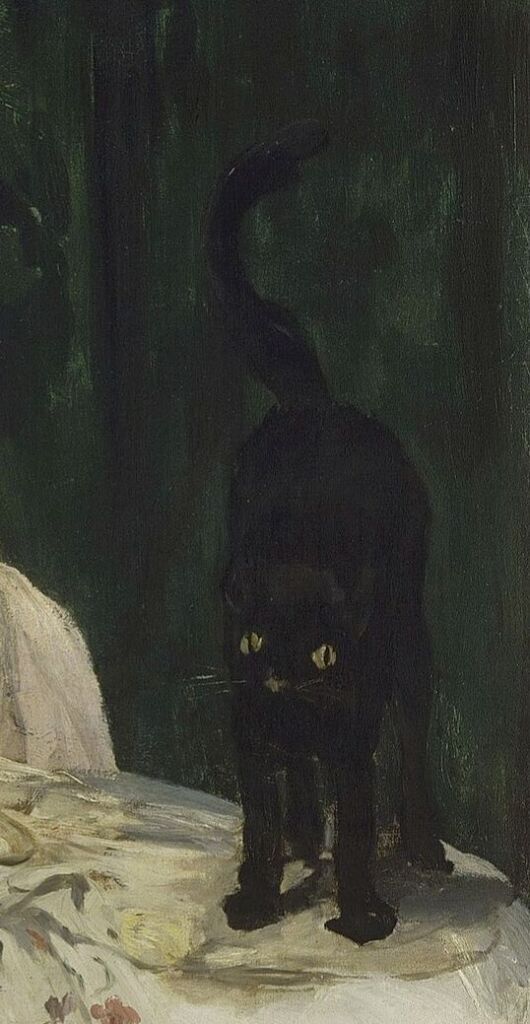
The 1983 catalog calls it a “familiar of witches, beast of ill omen, and manifest erotic allusion.” In 1867 Zola recalled “that famous cat” that had so amused the public.
Today the cat is hard to make out against the dark background, but as early as 1876 the cartoonist and critic Bertall noted that the picture’s tones had dulled and that maid and cat had become “opaque black masses.” In 1865 the contrasts were much sharper: Salon visitors saw at once the cat we now hunt for.
The hand is another matter. Titian’s rests softly, in the age-old gesture of the Venus pudica. Manet’s presses down firmly, fingers spread, and the eye goes straight to what it covers.
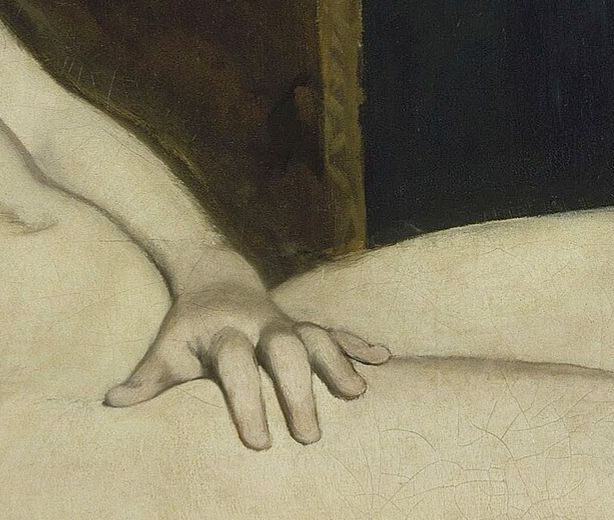
In Titian, too, the edge of a screen or curtain runs down to the hand. Manet quotes almost verbatim here, so everything he changed stands out. Parisians were used to nude Venuses drawn from myth. This one came with no myth at all.
Yet not one reviewer mentioned Titian. The 1983 catalog suggests the borrowing was too obvious and parodying the great Venetian looked close to sacrilege. Besides, in Manet’s day Titian too was believed to have painted a famous courtesan. He had simply called her Venus.
The pose was easy to recognize. What was hard to forgive was that she did not pretend to be a goddess.
The girl with the velvet ribbon
The face that so outraged Claretie belonged to Victorine Meurent. She had sat for Manet since 1862: for The Street Singer, in a bullfighter’s costume for Mademoiselle V. in the Costume of an Espada, and nude in Luncheon on the Grass. Zola called her a girl of sixteen, though by the time Manet painted Olympia she was about nineteen.
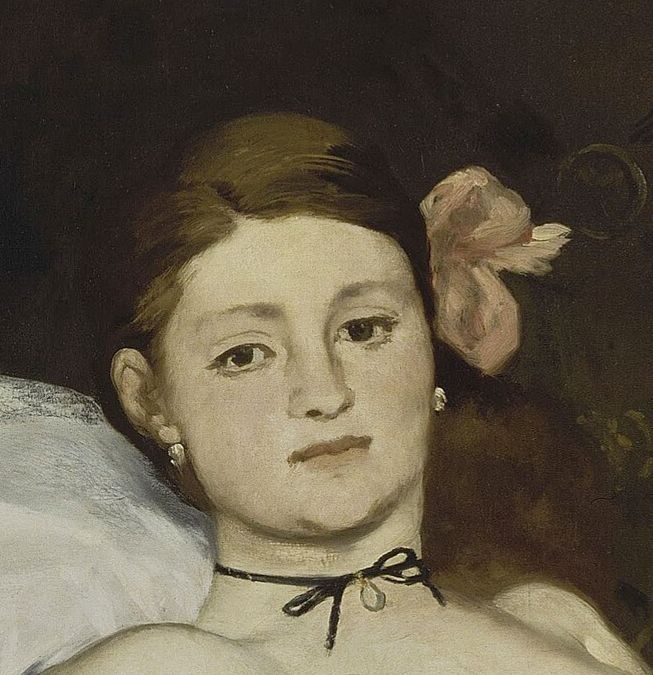
Manet did nothing to flatter her, which Cachin counts among the causes of the scandal. The legs are a little short, the chest narrow, the chin sharp, the gaze cool and direct. None of the shyness or coquetry the genre demanded. The poet Paul Valéry later wrote: “Her head is empty, a black velvet string isolates it from the essence of her being.”
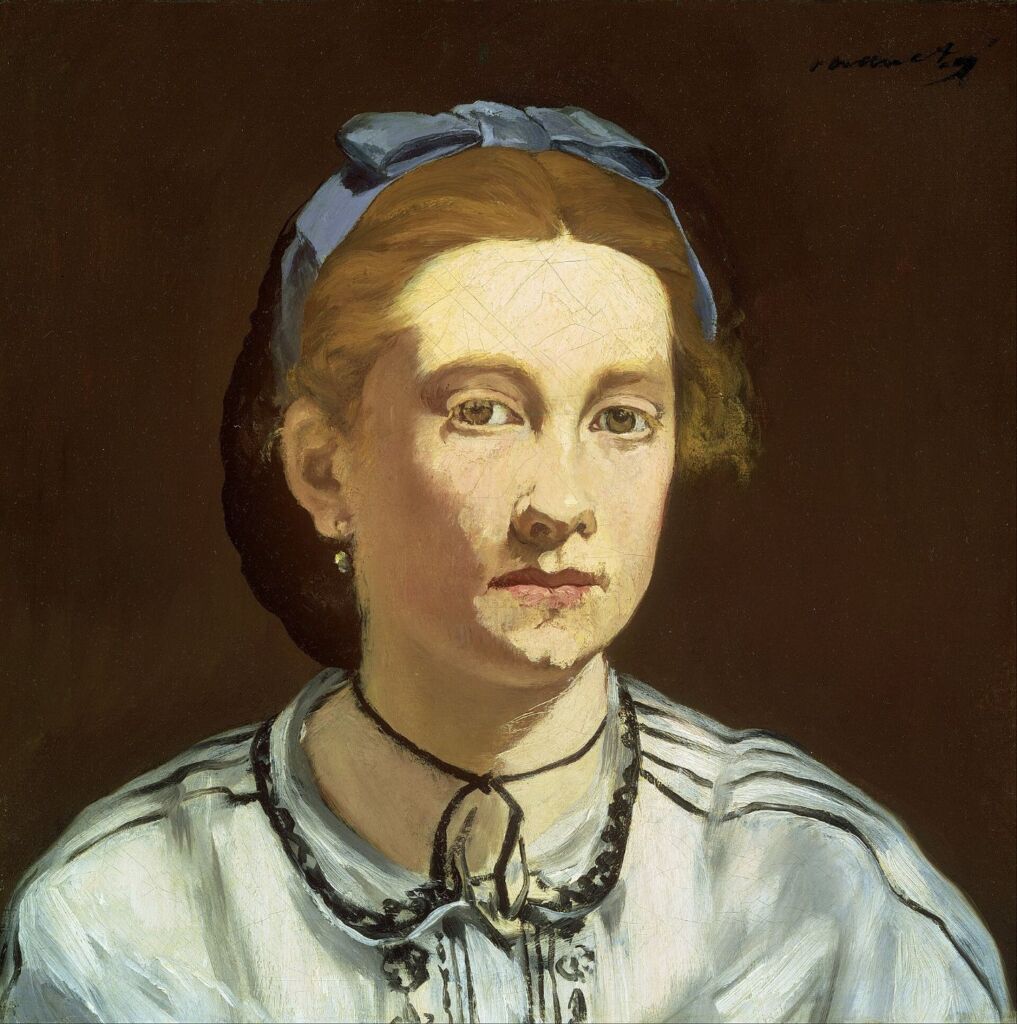
Meurent, born in 1844, later became a painter herself. According to the Museum of Fine Arts, Boston, she exhibited at the Salon from 1876, the very Salon where she had once been laughed at. Her own work was long overshadowed by Manet’s images of her, as Berthe Morisot’s was by his portraits of her. In May 2026 The Burlington Magazine published an article on two photographs of her connected with Luncheon on the Grass and Olympia; her life is still being pieced together.
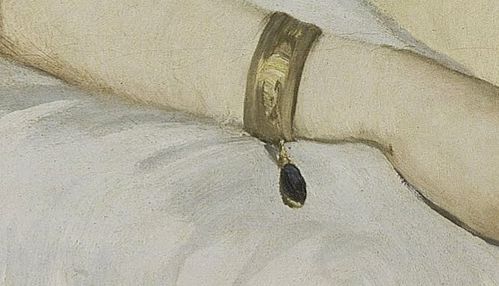
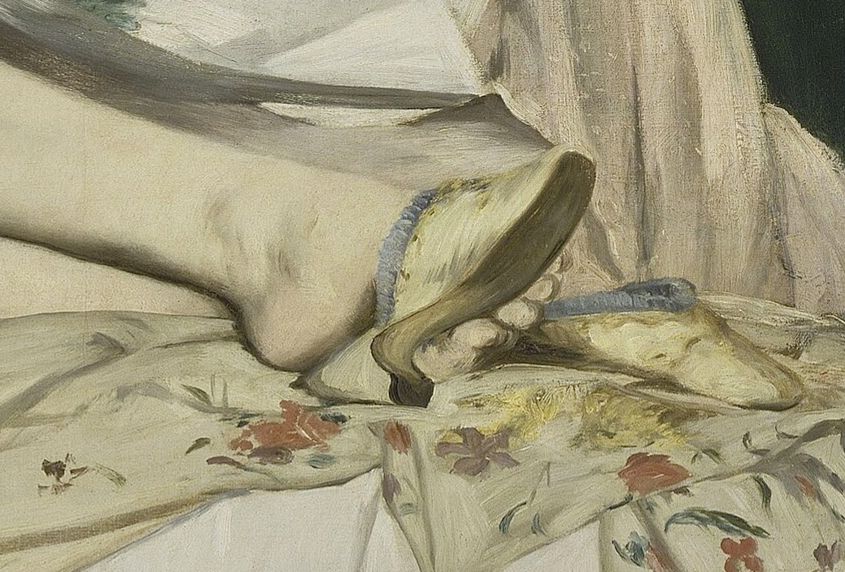
Olympia wears nothing but earrings, a bracelet and the ribbon. The 1983 catalog links this spare jewelry to Baudelaire’s The Flowers of Evil and “Les Bijoux,” in which the beloved is naked but for her “bijoux sonores,” her ringing jewels. Baudelaire even has a line for the slippers: in “Afternoon Song” the poet lays his great joy beneath his mistress’s satin shoes.
Laure of the rue de Vintimille
Nothing was known about the second model until researchers found her in Manet’s notebook of 1860–62, now at the Morgan Library & Museum in New York. On one page Manet wrote down her first name, Laure, and an address: 11 rue de Vintimille. No surname, and no other document about her, has been found.
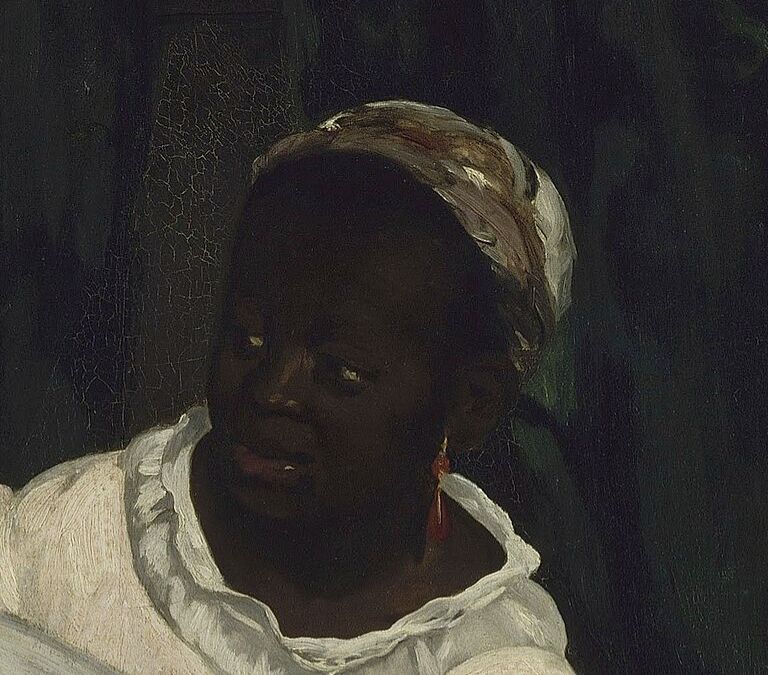
The building stood just south of the Place de Clichy. She is linked to two more works by Manet: she probably posed for the nursemaid in Children in the Tuileries Gardens, and her unfinished portrait is now in Turin, at the Pinacoteca Agnelli.
The critics of 1865 mentioned the maid in passing, as part of the furnishings. That changed only in this century. In 2019 Olympia was a centerpiece of the Musée d’Orsay exhibition “Black Models: From Géricault to Matisse.” This time the spotlight fell not on Victorine but on Laure.
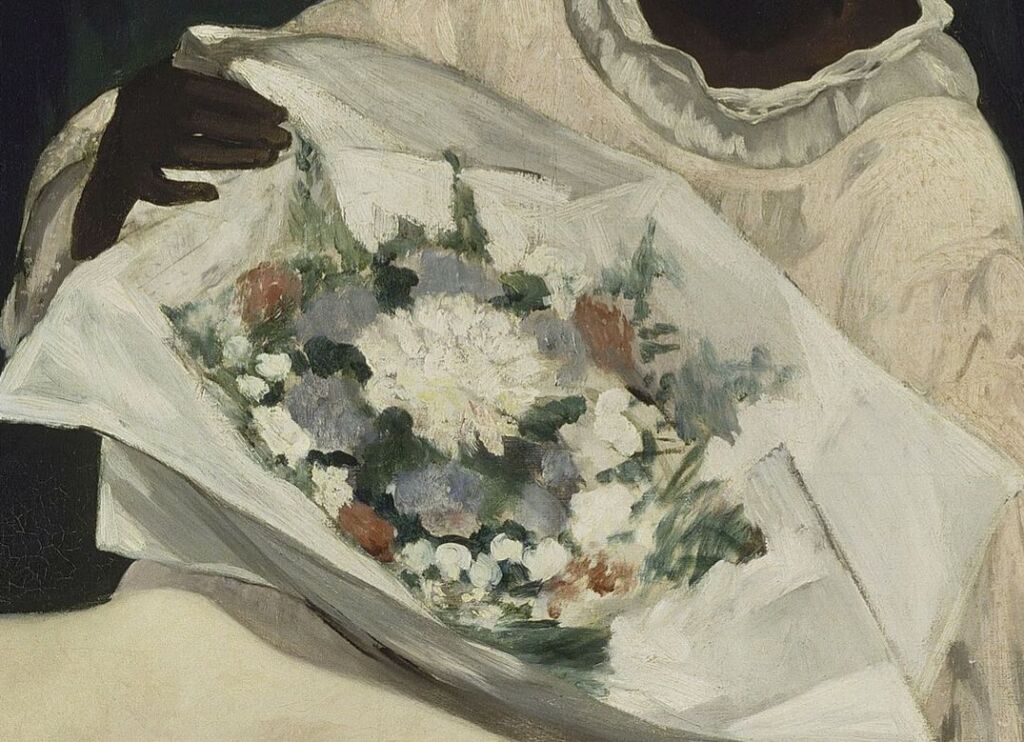
The bouquet, perhaps the loveliest passage in the painting, explains the story. The flowers are wrapped the way a florist wraps them; someone has sent them. The catalog says it outright: they are a gift from a client, and Laure is both maid and go-between.
Beside her slender dark hand on the white paper, her mistress’s hand looks like a “short, taloned paw.” Cachin compared it to the hands in Ingres’s Portrait of Monsieur Bertin, symbols of power and authority.
A subscription instead of a buyer
Manet never gave up on the picture. In 1867, during the Exposition Universelle, he hung it in a pavilion of his own. In 1872 he valued it at 20,000 francs, but no buyer came forward in his lifetime.
In February 1884, months after his death, his widow, Suzanne Manet, put Olympia up at auction as lot 1 with a reserve of 10,000 francs. Nearly everything else sold; Olympia did not. The turn came in 1889, when Manet’s work, Olympia included, was suddenly a hit at the Centennial Exhibition of French Art.
By the late 1880s Suzanne needed money. A letter from the American painter John Singer Sargent to Claude Monet reveals that an American collector wanted to take Olympia across the Atlantic. So Monet and Sargent launched a subscription to buy the painting for the French state.
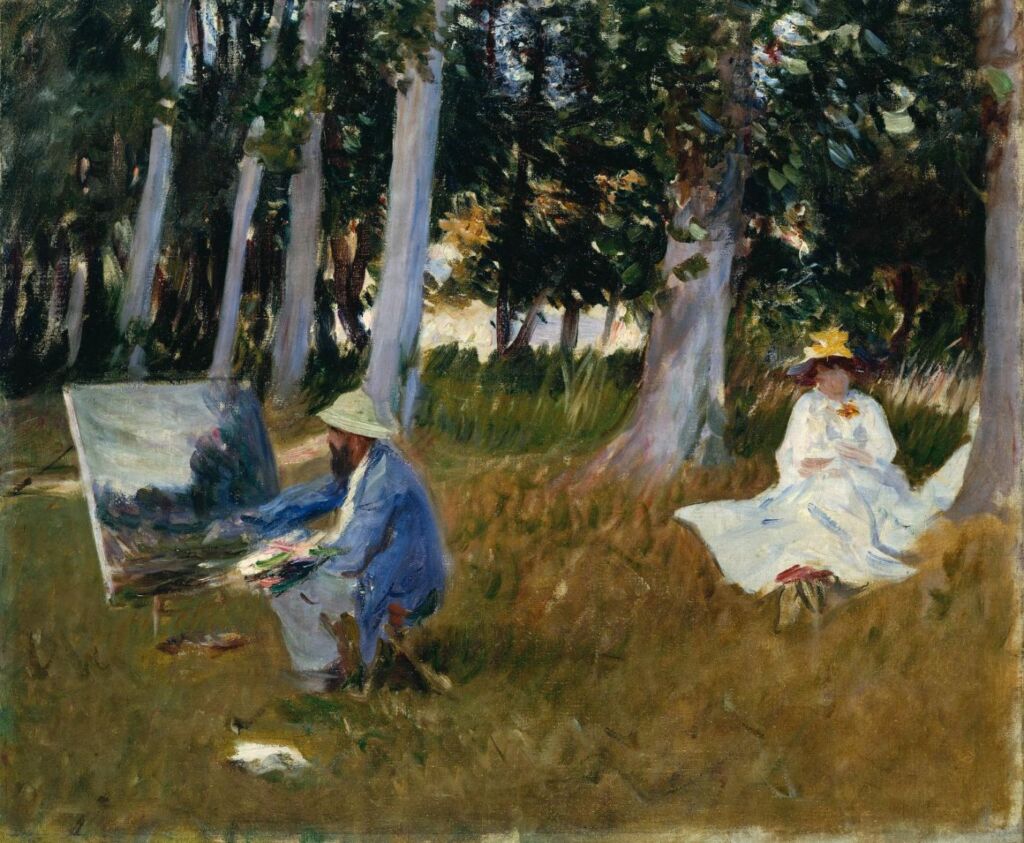
About a hundred people contributed, Pissarro, Renoir and Mallarmé among them. Monet, Sargent and Caillebotte each gave 1,000 francs; Winnaretta Singer, heiress to the sewing-machine fortune, gave 2,000. The subscribers raised about 20,000 francs, and in March 1890 the widow received 19,415.
One name was missing: Zola, the painting’s first defender. He told Monet he did not buy pictures, on principle. Manet would enter the Louvre, but “by himself, with full national recognition,” not by way of a gift “which smells of the coterie.”
On February 7, 1890, Monet wrote (in French) to Armand Fallières, minister of public instruction and fine arts, offering the state Manet’s Olympia on behalf of a group of subscribers.
The gift was accepted by decree on November 17, 1890, but for the Musée du Luxembourg, the museum for living artists, not the Louvre. A few years later the Impressionists from Caillebotte’s bequest were hung beside it, the very painters who took their name from Monet’s Impression, Sunrise.
Olympia moved to the Louvre only in 1907. Monet went to his friend Georges Clemenceau, then prime minister, and, as Monet recalled, two days later it was there. It hung in the Salle des États, opposite Ingres’s Grande Odalisque.
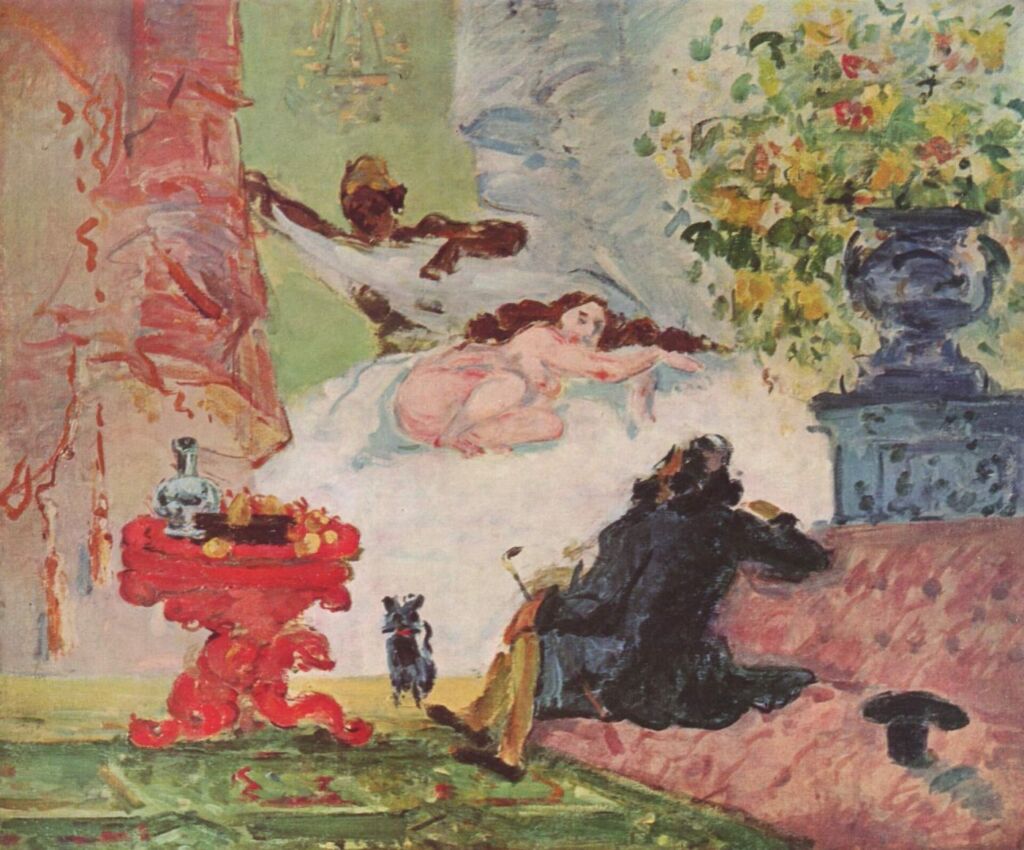
Artists answered Olympia in paint. While Manet was still alive, Paul Cézanne painted his own A Modern Olympia, in which the visitor himself has entered the room, and in 1891 Paul Gauguin made a copy of Manet’s original.
From 1947 Olympia hung in the Jeu de Paume, and since 1986 it has been at the Musée d’Orsay. Framed, it weighs 120 kilograms (about 265 pounds) and rarely travels. It was shown in Venice in 2013, at the Pushkin Museum of Fine Arts in Moscow and the Hermitage in St Petersburg in 2016, and at the Metropolitan Museum of Art in New York in 2023.
Fifteen years after the scandal, Proust recalled, Manet was still answering critics who told him the picture had harsh passages. They were there, he agreed: “I saw them. I did what I saw.”

Comments
For Hroniki readers
Comments are open to readers with an account. Signing up is free and takes a few seconds.
No comments yet. Start the conversation.