Vereshchagin’s skull pyramid: why he called it a satire on himself
Vereshchagin first meant his pyramid of skulls for Tamerlane alone. Then the frame acquired a dedication to all great conquerors, and the artist called the picture a wicked satire, not least on himself.
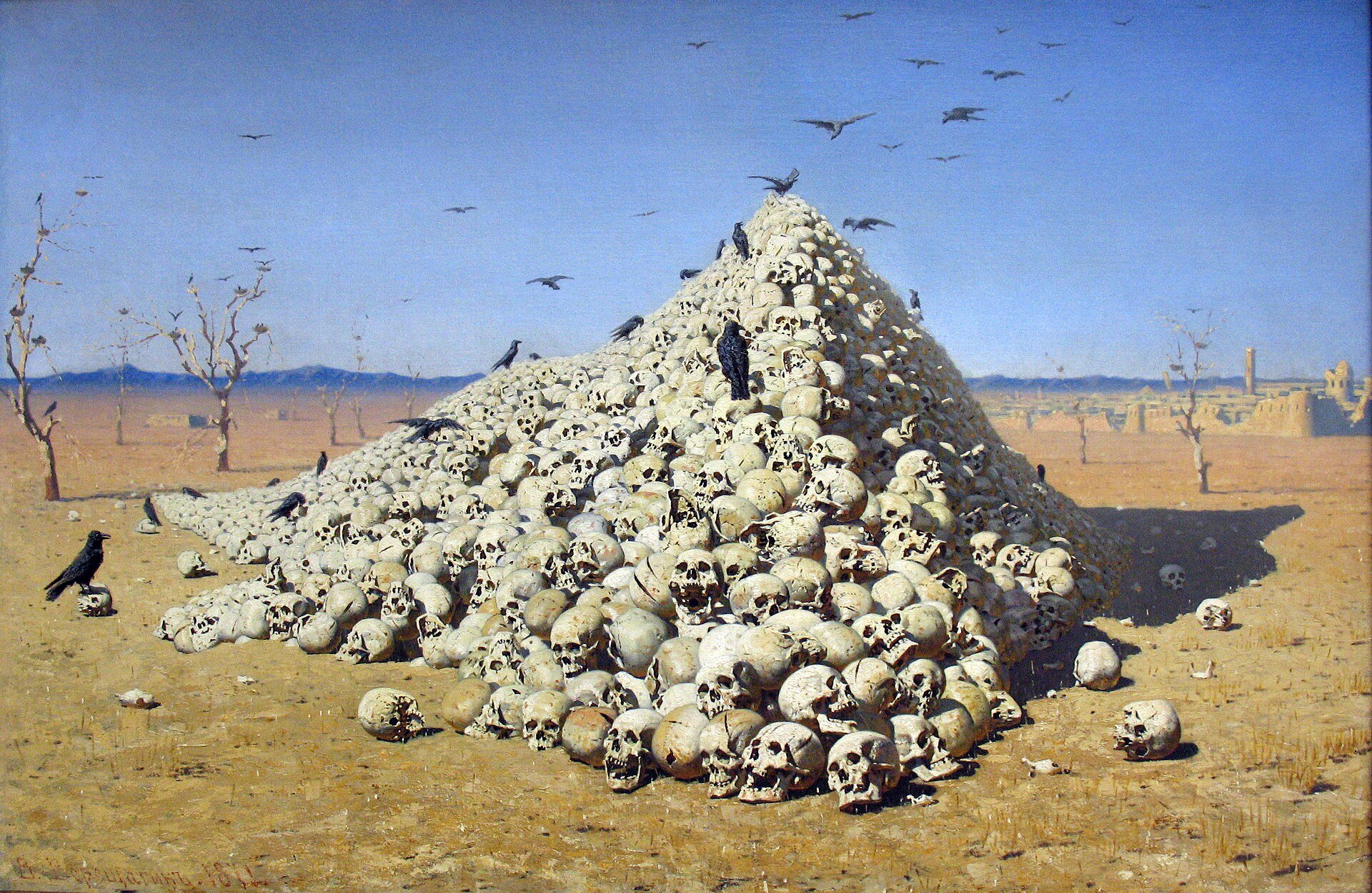
Along the bottom of this painting’s frame runs a line: “Dedicated to all great conquerors, past, present and to come.” Above it is the title, in the artist’s own archaic spelling: Apoteoza voiny. Vasily Vereshchagin finished the canvas in Munich in 1871; both inscriptions came later, once the idea outgrew one conqueror.
The pyramid first belonged to Tamerlane
According to the State Tretyakov Gallery (in Russian), Vereshchagin meant to call the picture The Apotheosis of Tamerlane and devote it to the cruelty of the 14th-century conqueror. Some writers give it as The Triumph of Tamerlane.
In the catalog of his 1876 Moscow exhibition, he insisted on historical accuracy: Tamerlane, or Timur, raised such pyramids of skulls in conquered lands. There was a recent example: in 1857 the German explorer Adolf Schlagintweit was executed in Kashgar, and his head, the museum notes, went into the base of one such pyramid.
Crows circle the summit. The museum calls them heralds of the Apocalypse.
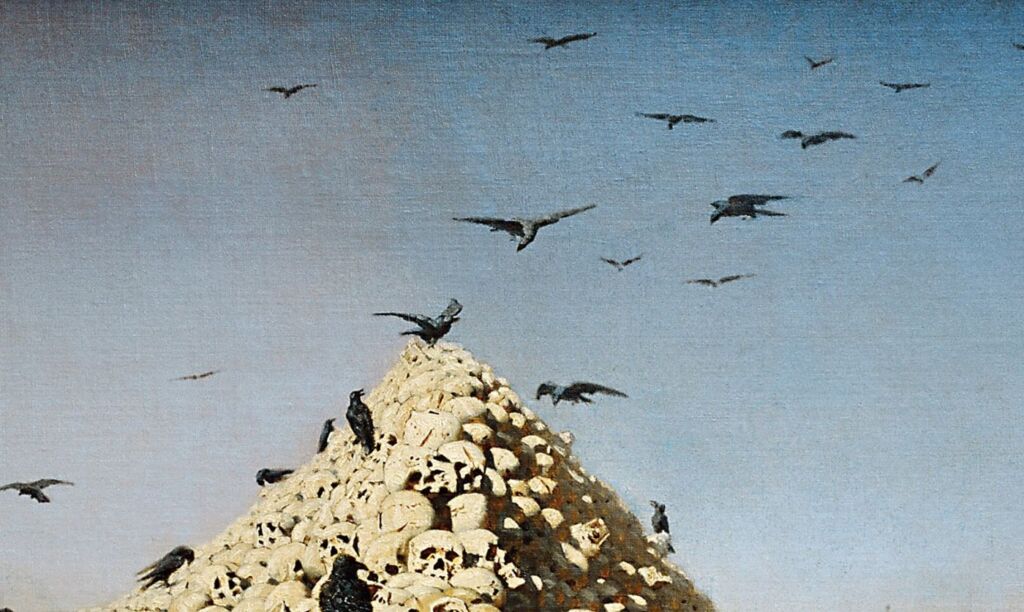
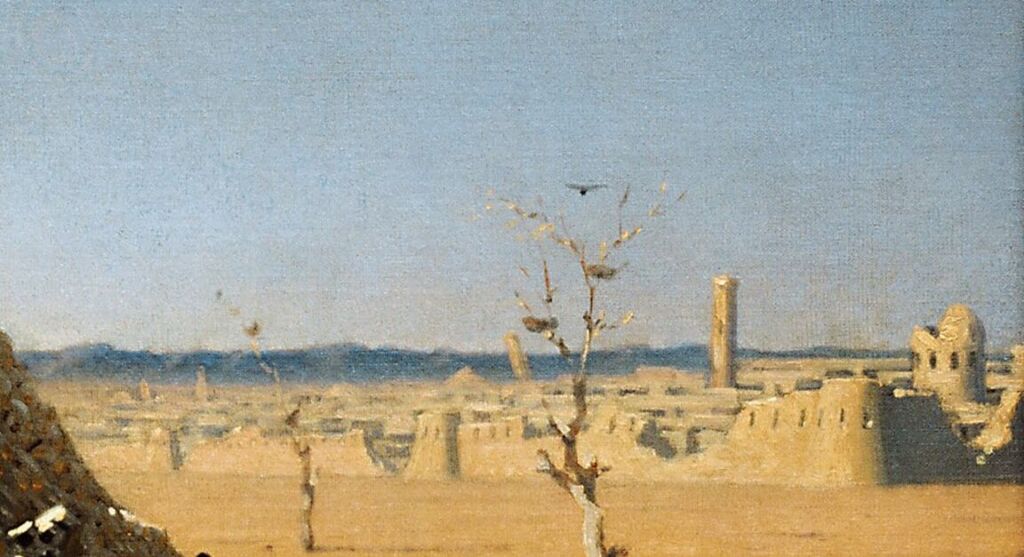
Vereshchagin knew Turkestan firsthand. In 1867 he went there as an ensign attached to the governor-general, Konstantin von Kaufman, and in the summer of 1868 helped defend the besieged citadel of Samarkand. The painting followed his second journey, in 1869–1870, and joined his Turkestan Series. The museum reads the ruined fortress in the background as a sign of how fragile human works are.
Then one conqueror’s story became a formula: Tamerlane vanished from the title; war remained.
A satire, not least on himself
In mid-March 1874, as the critic Vladimir Stasov prepared an article on Vereshchagin’s St Petersburg exhibition, the artist sent him a letter of pointers. Of this canvas he wrote that it was “as much a historical painting as a satire, a wicked and unsparing satire.” (Quotations are translated here by Hroniki.)
And right there, in parentheses: a satire “even on myself as a soldier.” “I myself shot people, literally like partridges,” he admits in the same letter (in Russian). The horrors he painted were not invented or secondhand, he said: he had seen them.
The Apotheosis of War is the epilogue to The Barbarians, a cycle within the Turkestan Series. The cycle, in his words, “might rather be called an epic poem in which paintings take the place of chapters.” Its plot is the destruction of a Russian detachment by Bukharan troops.
Vereshchagin was fond of frame inscriptions. On neighboring canvases the victors thank God; both sides, he told Stasov, pray to the same God, and the inscriptions give a tragicomic effect, as true of Europe as of Asia.
In 1874 the writer Vsevolod Krestovsky, reviewing the show for Semeinye vechera (in Russian), saw suffering, horror, bewilderment and even a sardonic smile on these skulls. “The impression is heavy, unpleasant,” he wrote.
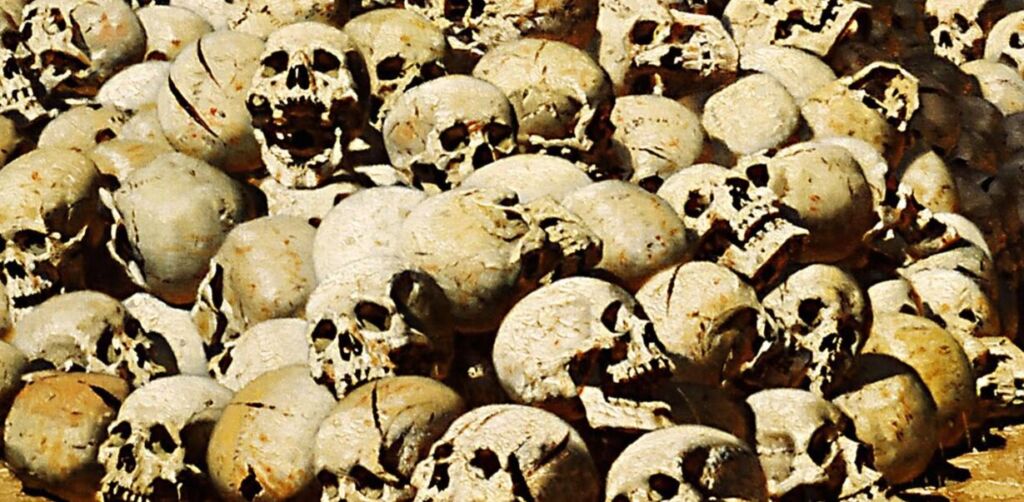
Still, he granted that the painting conveys “with astonishing fidelity this terrible reality of Central Asian life, manners and ancient custom.” He saw a truth about Asia. Not yet about war.
Generals, three burned canvases and Tretyakov
London saw the series first, at the Crystal Palace in April 1873. A year later it opened in St Petersburg, free of charge, at the Ministry of Internal Affairs. It sold thirty thousand catalogs, a figure unheard of at the time.
Kaufman and Pyotr Stremoukhov, head of the Foreign Ministry’s Asiatic Department, saw slander on the Russian army. Kaufman insisted his troops always carried off their own. Stremoukhov toured the show with the French ambassador, General Le Flô, and, by the early biographer Fyodor Bulgakov’s account, picked up a comparison with the battle painter Horace Vernet: Vernet had glorified the French army; Vereshchagin had “humiliated and slandered” the Russian one.
Three paintings—Forgotten, Surrounded, Pursued and At the Fortress Wall: They Have Entered—were removed from the show (in Russian). His first biographers say he burned them. The Apotheosis of War stayed in the series.
Vereshchagin refused to sell it piecemeal. In 1874 Pavel Tretyakov, the merchant behind the gallery that bears his name, bought it whole for 92,000 silver rubles.
Vereshchagin spoke against war for the rest of his life; in 1901 he was to be nominated for the first Nobel Peace Prize. The list on the frame stayed open. Its last words are “to come.”
Comments
For Hroniki readers
Comments are open to readers with an account. Signing up is free and takes a few seconds.
No comments yet. Start the conversation.