Dürer’s Rhinoceros: how an animal from Lisbon got its armor and a horn on its shoulders
In 1515 the first live rhinoceros since ancient Rome arrived in Lisbon. Dürer never saw it, yet for two centuries his woodcut showed Europe what this animal looked like.
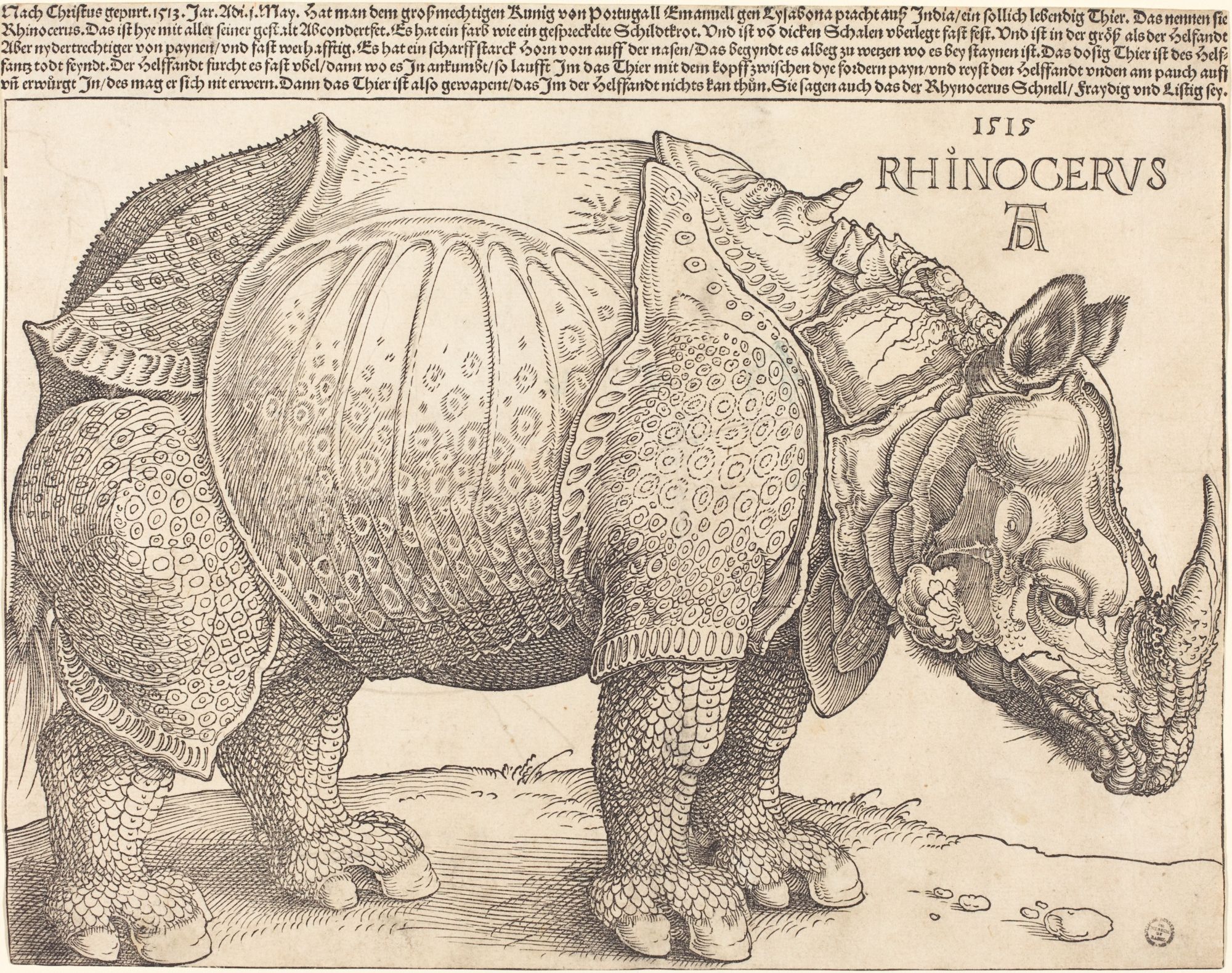
On May 20, 1515, a ship from India reached Lisbon with a gift for King Manuel I. On deck stood a rhinoceros, the first live one in Europe since ancient Rome. In Nuremberg, 2,000 kilometers (1,200 miles) away, Albrecht Dürer soon made its portrait for a woodcut.
Dürer never saw the animal. Yet for over two centuries his woodcut was Europe’s answer to what a rhinoceros looks like, armor, rivets and all, plus an extra horn on the shoulders that no real rhinoceros has.
A gift, a fight with an elephant and a shipwreck
The animal was a diplomatic gift: Sultan Muzaffar Shah II of Gujarat gave it to Afonso de Albuquerque, the Portuguese governor of India, who sent it on to the king. The literature calls it Ganda, the local name as Europeans recorded it.
Manuel decided to test Pliny the Elder, who wrote of an eternal feud between rhinoceros and elephant. On June 3, 1515, a fight was staged at court, but nothing came of it: the young elephant panicked and fled.
In December the king sent Ganda on as a gift to Pope Leo X. In January 1516 the ship anchored at islands off Marseille, and Francis I of France came to see the marvel. Then, off Liguria near La Spezia, the ship met a storm. Chained to the deck, the rhinoceros drowned.
Sources disagree about the carcass. In one version it was recovered and stuffed in Italy; in another the hide went back to Lisbon.
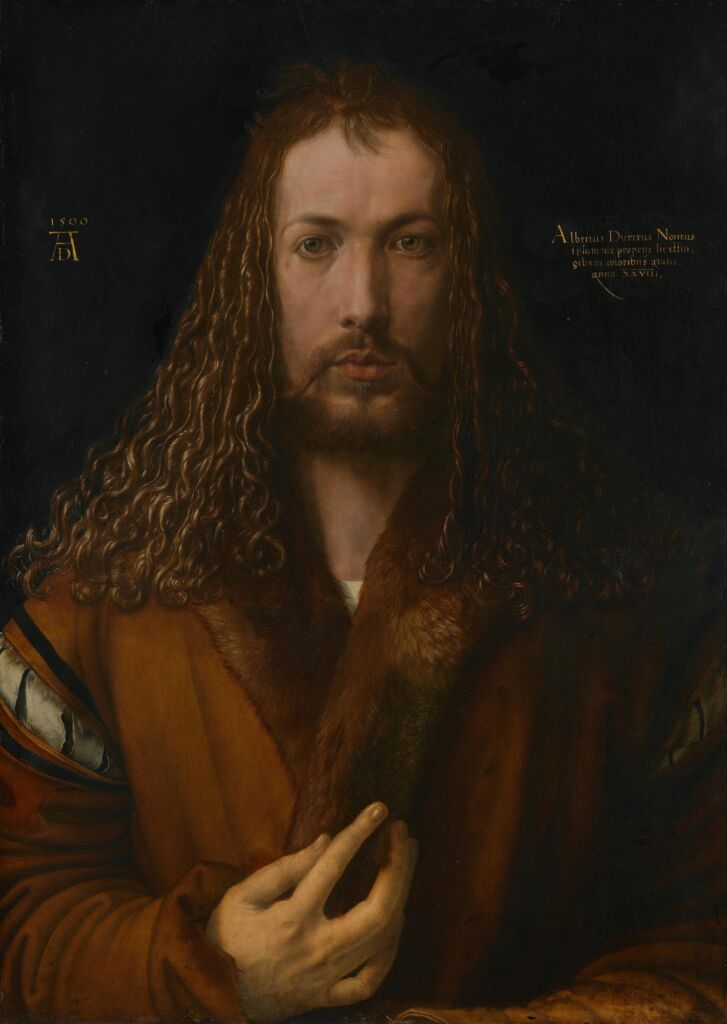
A sketch, a letter and a horn on the shoulders
Nuremberg received a letter from Valentim Fernandes, a Moravian printer in Lisbon, and apparently a sketch from life. The German original of the letter is lost, but an Italian copy survives in Florence; the sketch has vanished.
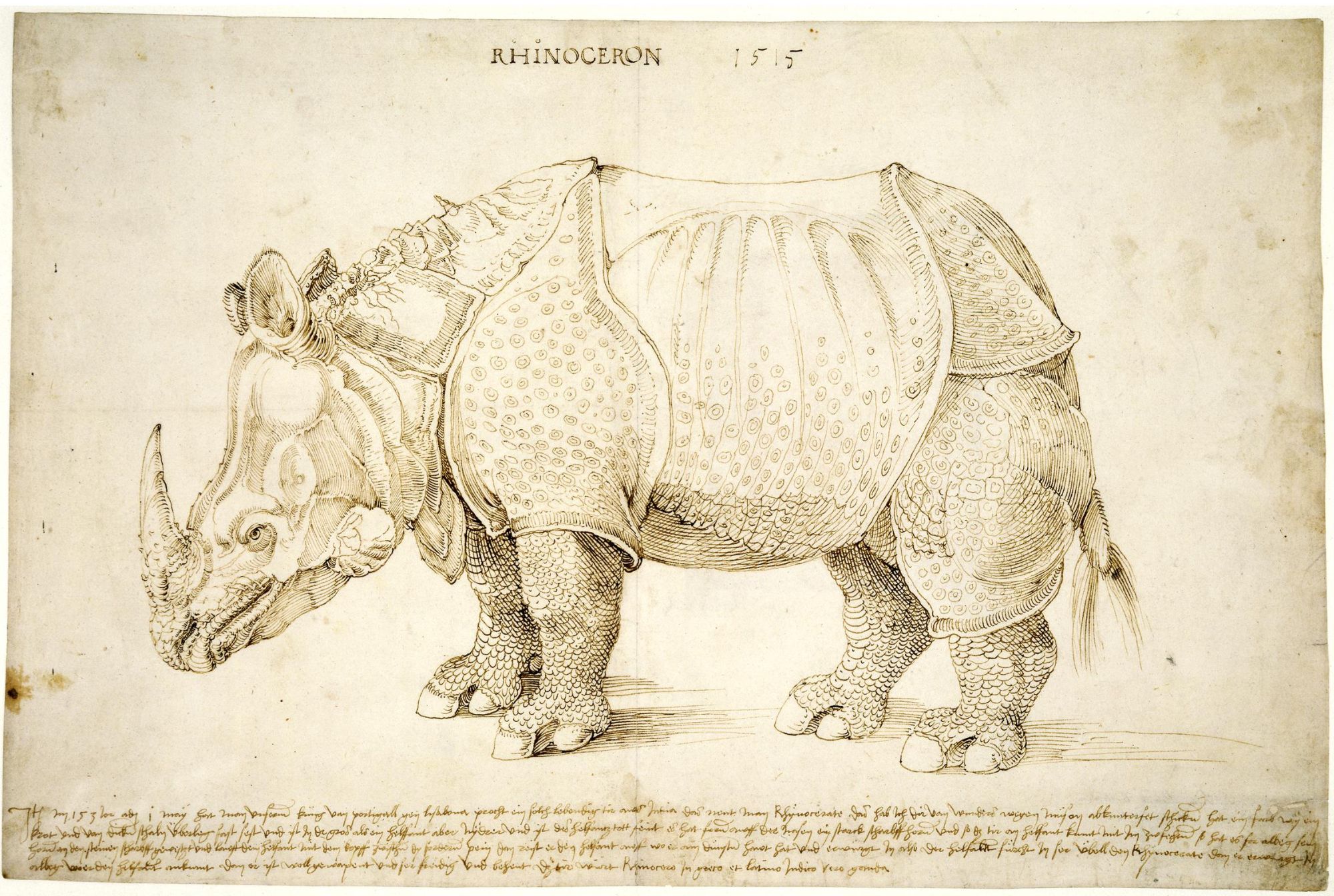
Dürer’s own drawing does survive, in pen and brown ink on a sheet of 27 by 42 centimeters, in the British Museum. The watermark points to Nuremberg: the paper was Dürer’s.
Above the animal there is only “RHINOCERON 1515”; below it is an inscription in the tone of a private letter: “Because it is such a wonder, I had to send you its likeness” (translated here by Hroniki). It also records the Indian name, “gomda.”
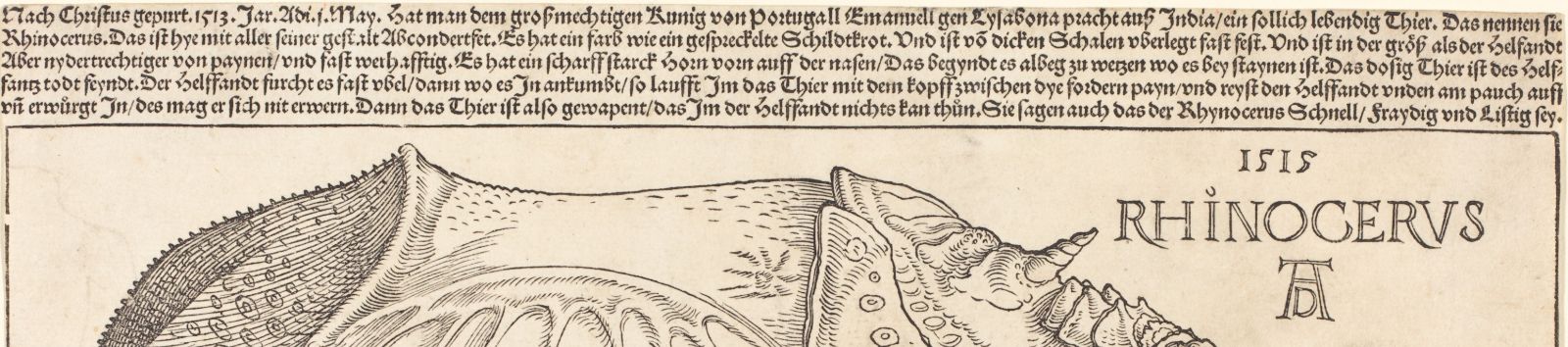
On the woodcut the text became advertising: the beast is “the color of a speckled tortoise,” “the mortal enemy of the elephant” and “so well-armed that the elephant cannot harm it.” The arrival date is given wrongly, as May 1, 1513.
The source of the armor is unknown. The folds of rhinoceros hide do look like plates, and the artist’s imagination may have done the rest. Another theory holds that Ganda wore protection for the elephant fight, an attractive idea but unproven.
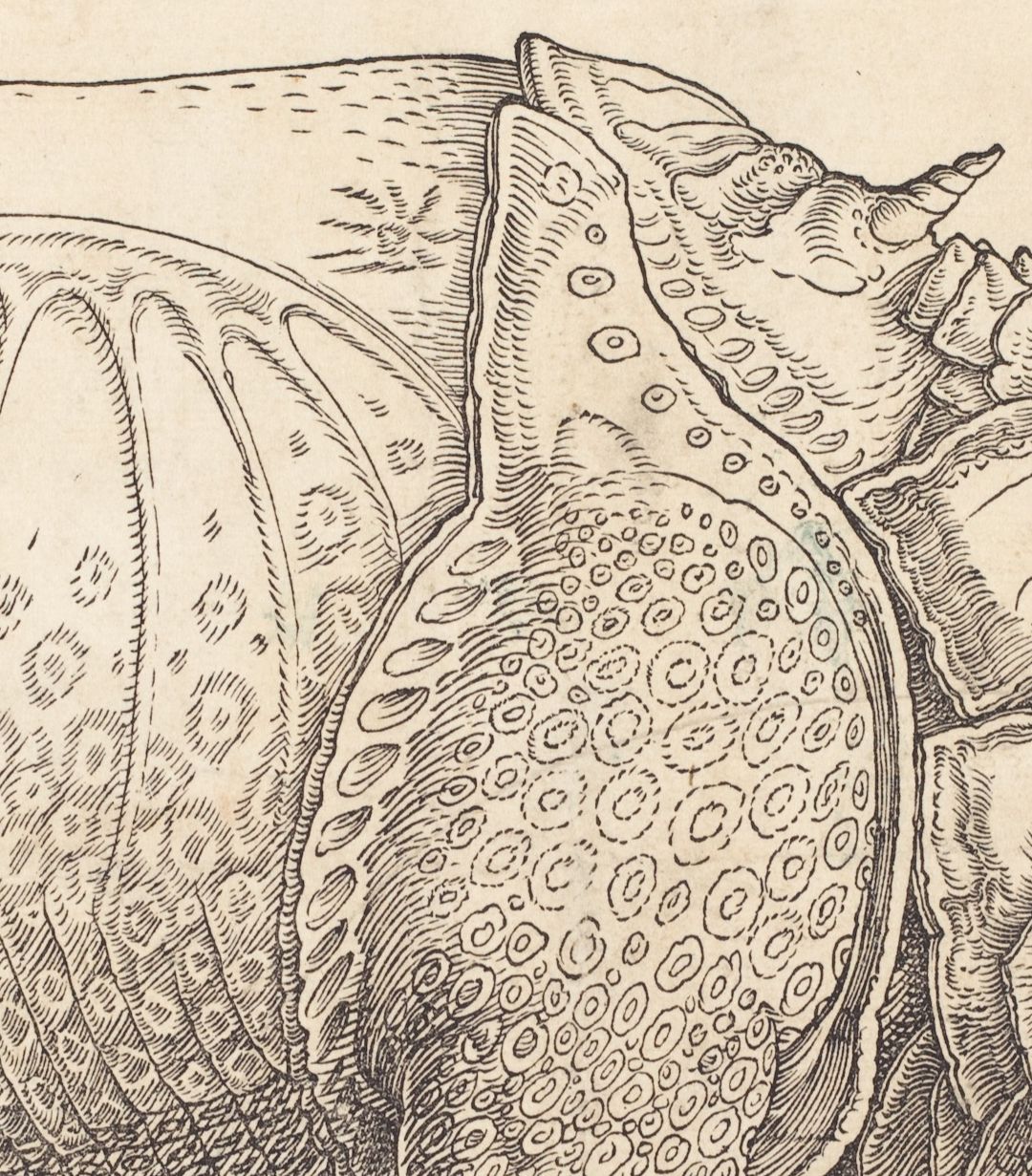
The small twisted horn on the shoulders Dürer apparently invented. The zoologist Heini Hediger suggested that a horny growth on the skin lay behind it. In a 2025 paper the biologist Xavier Bellés agrees: the Lisbon sketch probably showed a prominent growth, which the artist read as another horn.
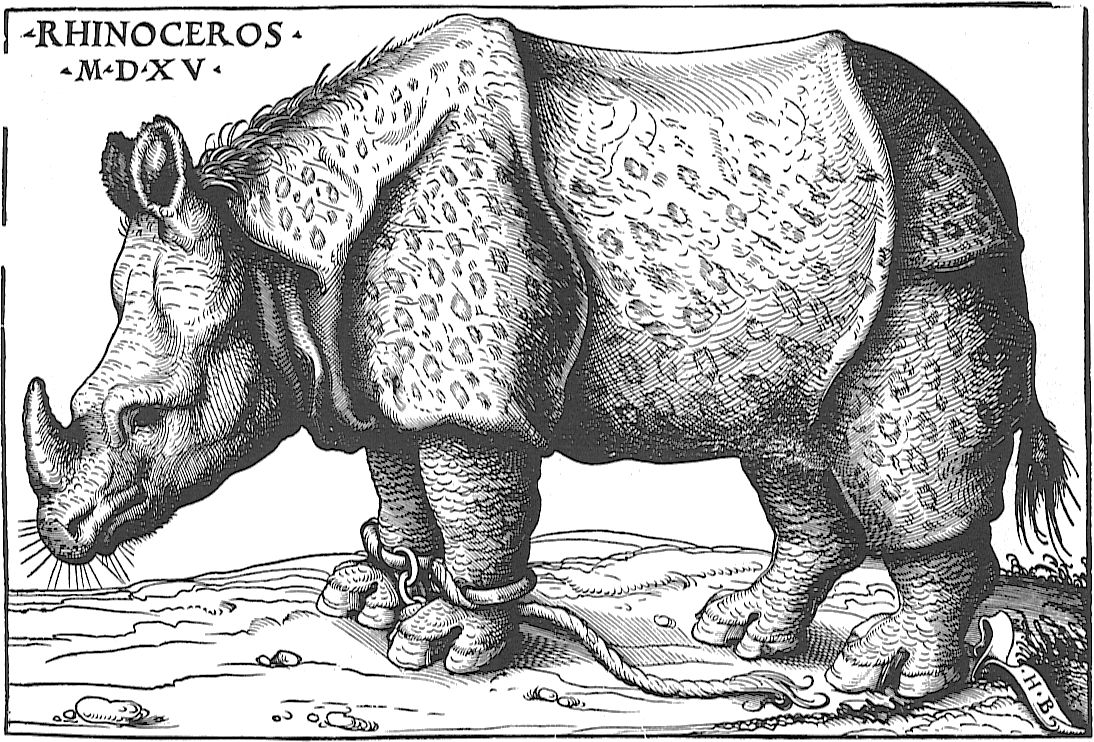
That same year, 1515, Hans Burgkmair made his own woodcut in Augsburg. His animal has no armor and no little horn, and a rope binds its front legs. This print is usually thought more accurate, though the smooth skin and small mane are invented too. Its only surviving impression is in the Albertina in Vienna, so the print seems to have barely circulated.
Two hundred years without a model
Dürer’s woodcut worked like a broadsheet, close to a poster or a newspaper notice. People bought it for the news, and no buyer could compare it with the real animal.
Dürer won on circulation. A professional block cutter carved the block from his drawing, and over a century and more it went through eight editions, many after Dürer’s death in 1528. One sheet offered all that print buyers prized: the name of a famous master who had issued Melencolia I the year before, news and a scientific curiosity.
Conrad Gessner copied Dürer’s rhinoceros in his Historiae animalium of 1551, and other natural histories followed. Europe almost never saw a live rhinoceros, so there was nothing to check against.
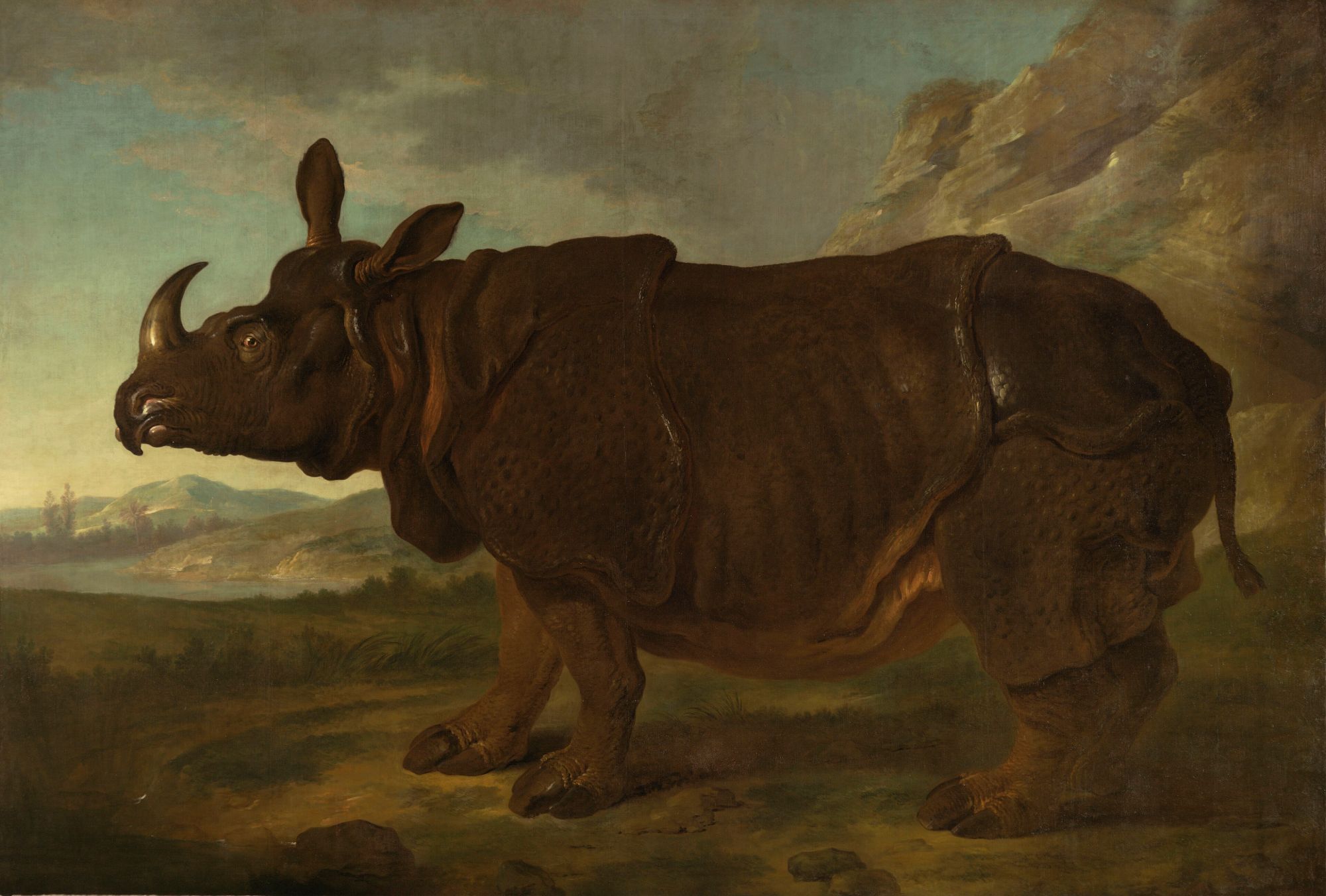
The turning point came with another visitor. In 1741 the Dutch captain Douwe Mout van der Meer brought a female Indian rhinoceros, Clara, to Rotterdam and toured her around Europe for 17 years. Clara had been caught as a calf in Assam, and for the tour the captain had a special wagon built, pulled by eight horses.
Clara was not the first rhinoceros in Europe after Ganda. The Portuguese court kept one called Abada from 1577, and another was shown in London in 1684–86. But kings and scholars flocked to Clara, and artists could finally draw a rhinoceros from life in detail.
In 1749 Jean-Baptiste Oudry painted Clara life-size and showed the canvas at the Paris Salon a year later. His drawing became a plate in Buffon’s Histoire naturelle, which at last pushed Dürer’s rhinoceros out of books on nature.
Ganda lived less than a year in Europe and drowned before reaching Rome. Yet his portrait, made from hearsay by a man who never saw him, lasted in books for more than four centuries. As late as 1938 the art historian Friedrich Winkler observed that German school textbooks had only just dropped the image.
Comments
For Hroniki readers
Comments are open to readers with an account. Signing up is free and takes a few seconds.
No comments yet. Start the conversation.