Vermeer and the camera obscura: a head twice as wide, and no lens in the inventory
Blurred points of light, a room where the projection on the wall matched the canvas, and an inventor who painted a "Vermeer" in 130 days. The clues are many, yet the inventory of the painter's estate lists not a single lens.
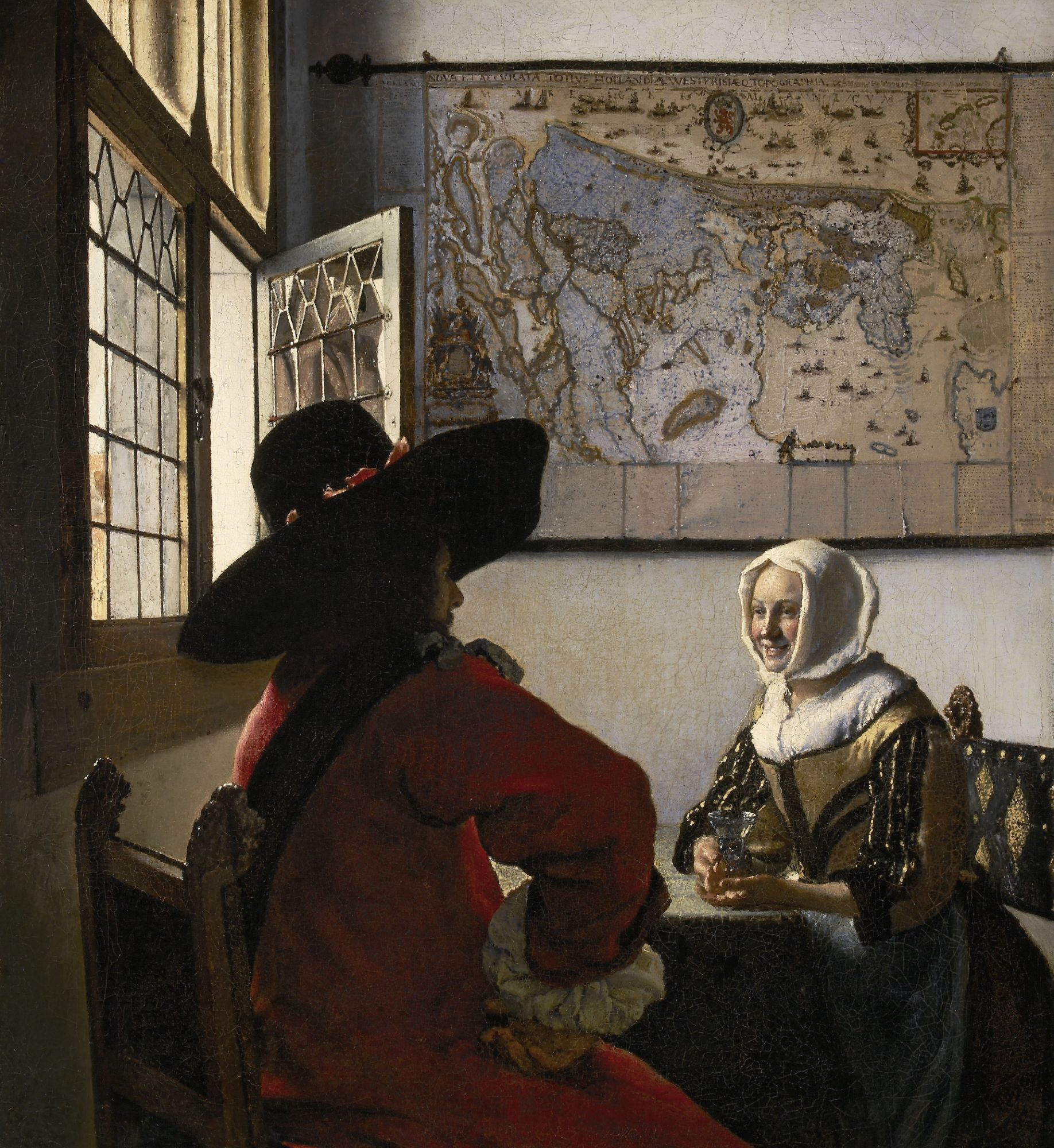
In Vermeer’s Officer and Laughing Girl at the Frick Collection in New York, the soldier sits with his back to us, his dark bulk blocking nearly a third of the room. In 1891 the American engraver Joseph Pennell noted the picture’s “photographic perspective”: the officer looks disproportionately large beside the girl, though both sit at one small table.
By the reckoning of the Essential Vermeer website, his head is almost twice as wide as hers. Pennell first suggested that an optical device gave Vermeer this leap in scale.
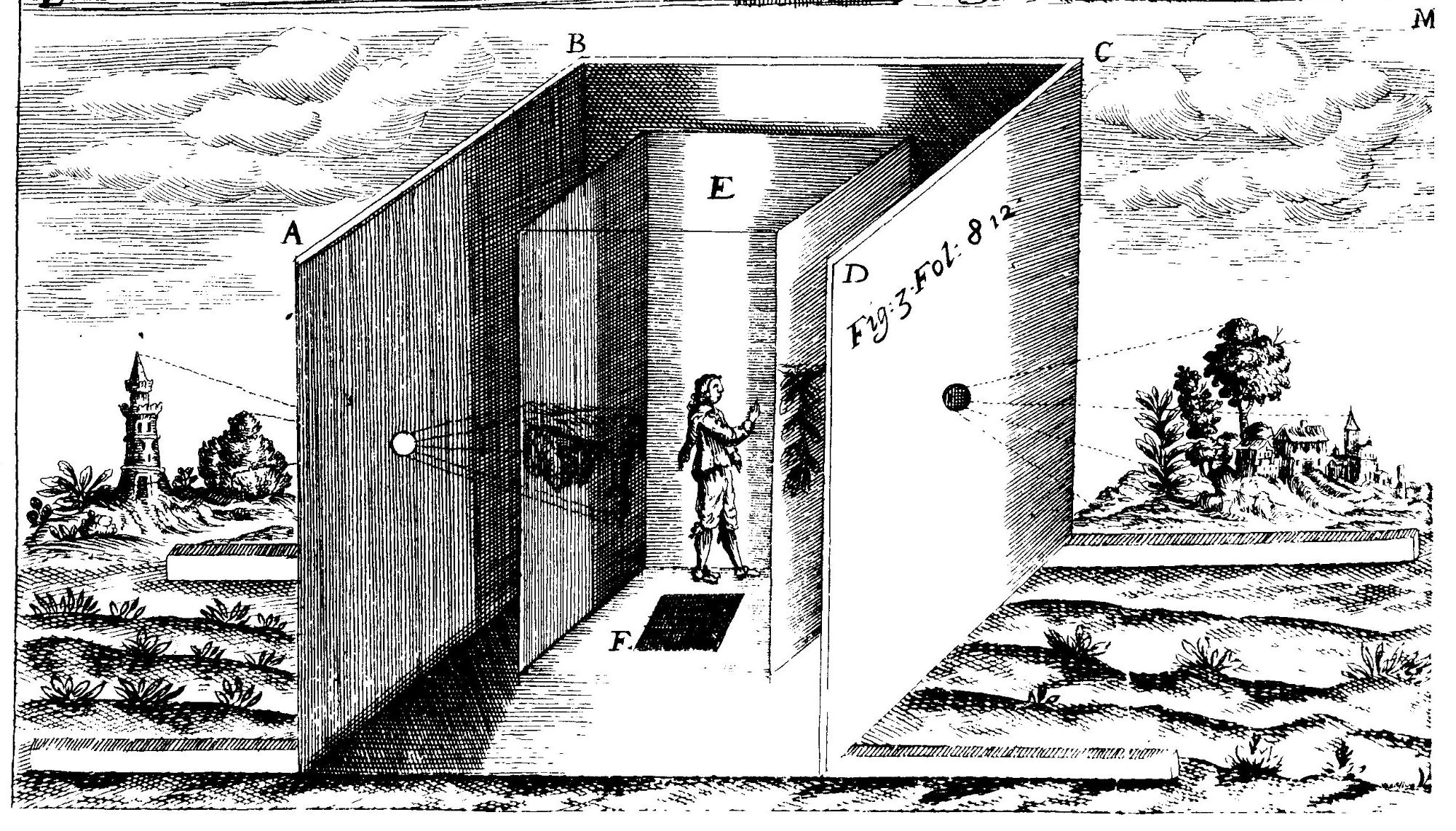
A camera obscura is a dark room or box where light enters through a small hole or lens and casts an upside-down image of the outside onto the opposite wall. Whether Vermeer looked into one has been argued for over a century. His life is covered in our Vermeer biography; here, only the evidence and the objections.
Highlights the eye cannot see
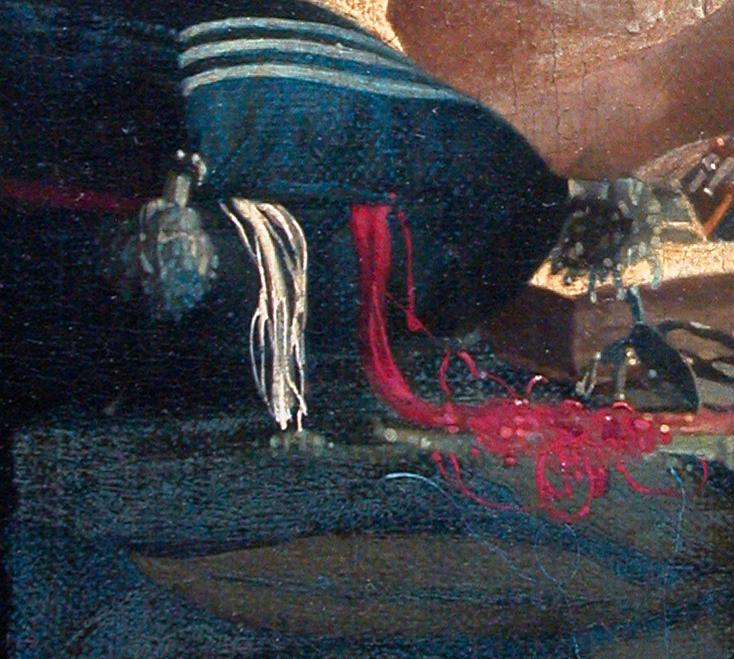
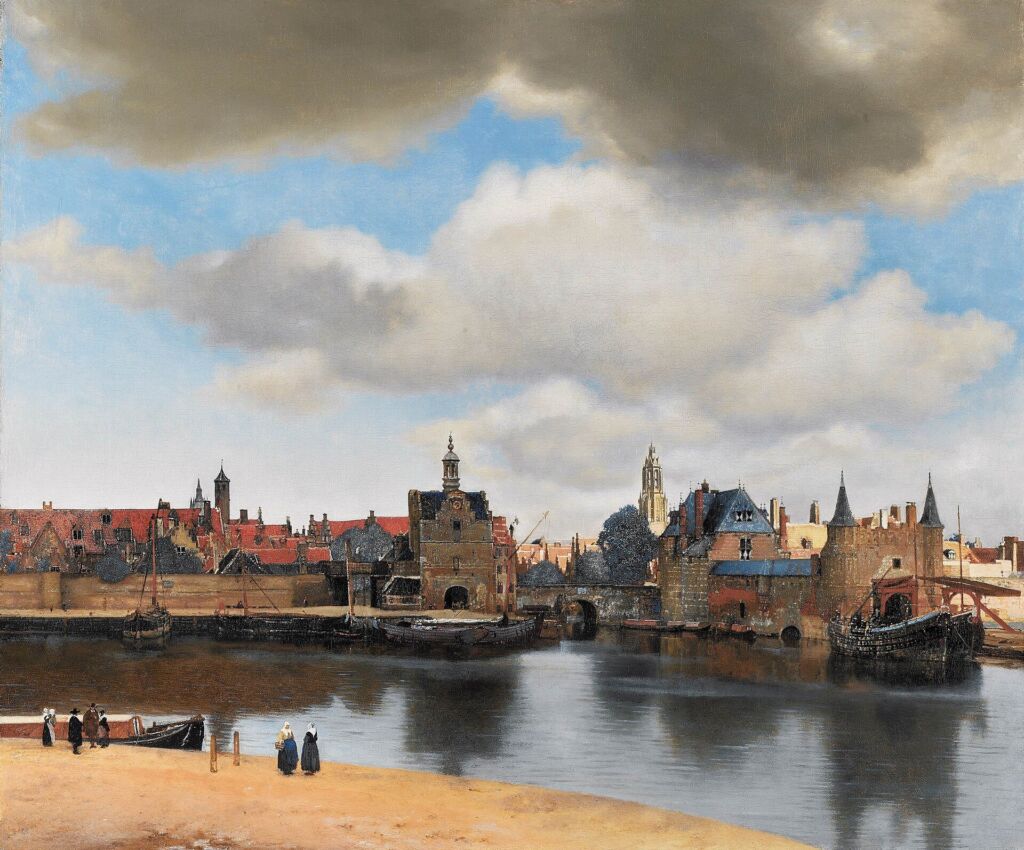
Charles Seymour first tested the idea in practice: in 1964 he pointed an old camera at Vermeer-style props. At issue was pointillé, the round beads of pale paint Vermeer scattered over metal, bread and wet wood. An unfocused lens makes the same halos, spreading a highlight into a disk. The naked eye cannot see them.
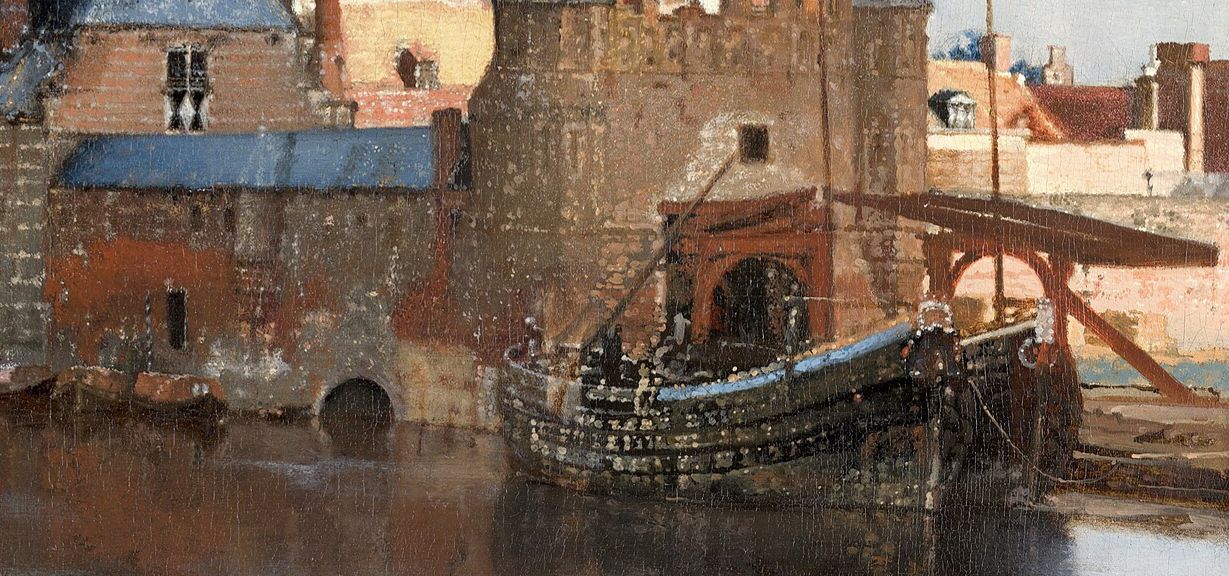
The dots appear in about half of Vermeer’s paintings. The best-known case is the boats at the quay in View of Delft. In The Lacemaker, threads spilling from the sewing cushion turn into red and white foam. The historian Lawrence Gowing wrote of “an enticing and baffling bluntness of focus.”
Skeptics reply that similar bright touches occur in Frans Hals, as Walter Liedtke, a curator at the Metropolitan Museum of Art, pointed out. And in late works such as The Allegory of Faith, the dots become a device in their own right.
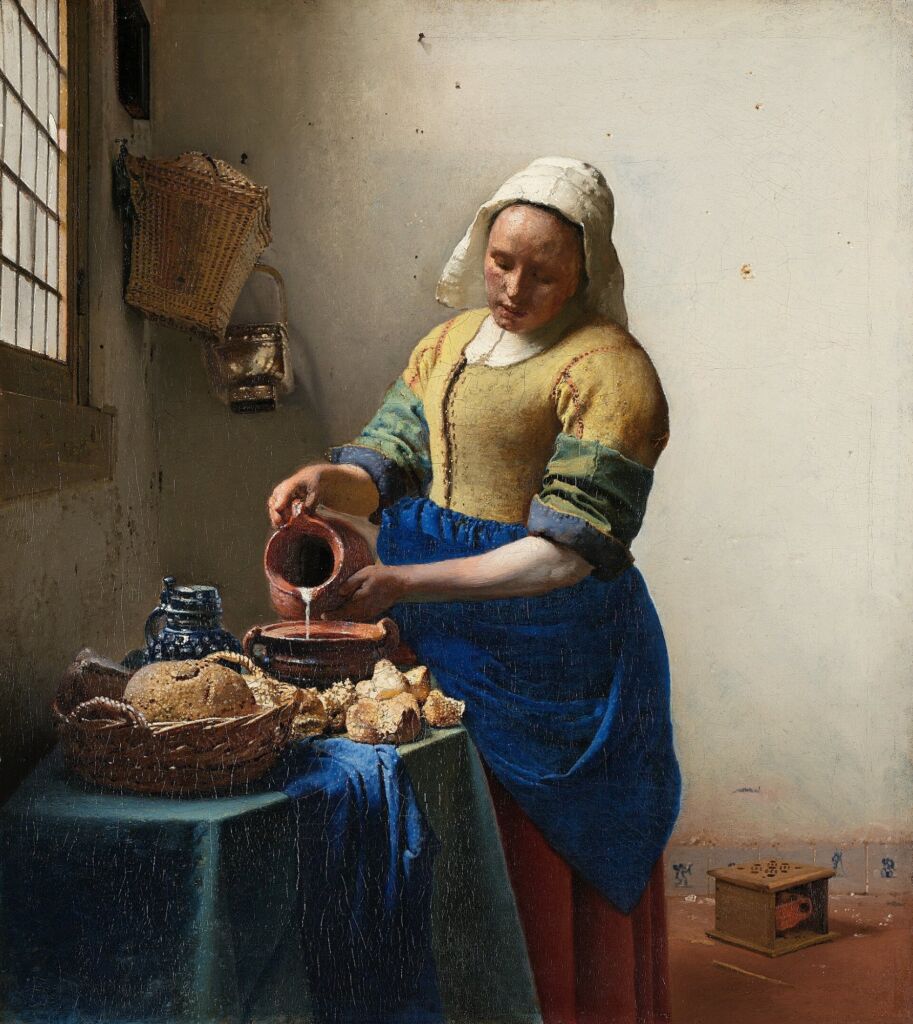
A projection the size of the canvas
The architect Philip Steadman, a professor at University College London, approached it through geometry. From the perspective he reconstructed the space of ten interiors: nearly all seem to have been painted in one room. Extend the perspective lines behind the painter to the back wall, and six pictures yield a rectangle the size of the canvas.
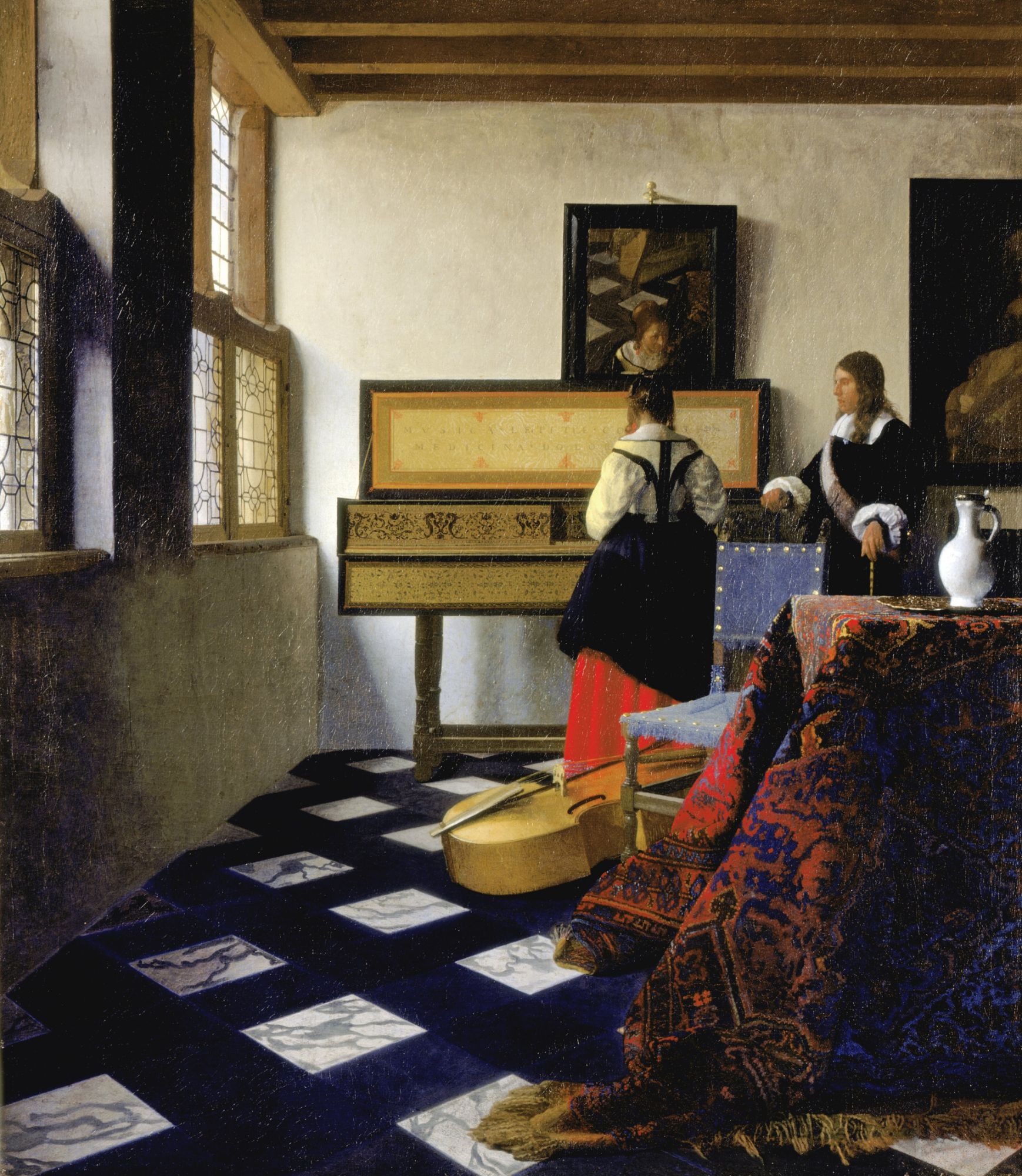
The artist David Hockney, with the physicist Charles Falco, went further. In Secret Knowledge (2001), Hockney argued that painters used optical projections as early as about 1430. For believers, Vermeer is the clearest case.
Tim Jenison, an inventor of video technology who had never painted in oils, tried it himself. He built a replica of the room in The Music Lesson, set up a lens and a small mirror for comparing the reflection with his canvas, and painted his version in 130 days. The whole project took about 1,825 days, nearly five years.
Teller’s documentary Tim’s Vermeer came out in 2013. Hockney and Steadman took the experiment as proof that the method works.
An inventory without a lens
Historians answer with documents, or their absence. No 17th-century source says Vermeer worked with optics. The inventory of his estate lists no camera and no lenses, and two visitors to his studio left records that never mention them.
That leaves Antonie van Leeuwenhoek, the Delft microscope maker. In 1676 he was appointed trustee of the estate of Vermeer’s widow, Catharina Bolnes, hence the theory that he taught the painter optics. But nothing documents their acquaintance in Vermeer’s lifetime.
Stork, Tyler and Schechner, who analyzed Jenison’s experiment, call his method “extraordinarily unlikely” for Vermeer. The professional painter Jonathan Janson repeated it and could paint only a few square inches at a time.
The debate stands where it did in 1891: the paintings seem to say yes, the archives stay silent. Perhaps Vermeer used a camera to learn to see, then painted without it. There is still no answer. What remains are points of light the eye misses on its own. Vermeer, somehow, caught them.
Comments
For Hroniki readers
Comments are open to readers with an account. Signing up is free and takes a few seconds.
No comments yet. Start the conversation.