Suprematism: from embroidery designs to imperial porcelain
Suprematism began with embroidery designs and the paintings of the 0,10 exhibition, and eight years later it was decorating blanks from the former Imperial Porcelain Factory. The story of Malevich's movement, from the black square to the white, and from Vitebsk to the Bauhaus.
On the back of a porcelain dish in the Russian Museum in St. Petersburg are two marks. The green one, under the glaze, is the monogram of Nicholas II with the year 1913 and the imperial crown. The black one, painted over the glaze, is a hammer and sickle, and beside it an inscription: “N. Suetin. Suprematism. 1923.”
A blank from the tsar’s factory had been painted with the signs of an art born eight years earlier. Kazimir Malevich’s Suprematism, from the Latin supremus, “highest,” was nonobjective painting: squares, circles, crosses and bars on a white field, with no subject, top or bottom. As painting it lasted a few years; as a way of making things, far longer.
Embroidery designs and 0,10
The public first met Suprematism not at a painting show but at an exhibition of embroidery. In the fall of 1915, the Lemercier Gallery in Moscow showed cushions, scarves and rugs that peasant women from Natalia Davydova’s workshop in Verbovka, near Kyiv, had stitched to artists’ designs. Davydova organized the show with Alexandra Exter and Evgenia Pribylskaya.
Malevich sent three geometric designs, two of them for scarves. They arrived too late to be embroidered, so the drawings were hung as they were; they are now lost. According to the Leonard A. Lauder Research Center at the Met, these were the first public glimpses of Suprematism, a month and a half ahead of the canvases.
The reviewer Sergei Glagol found “almost nothing we could call folkloric” in the work. He was right: on the walls hung a language that did not yet have a name.
Two years later Verbovka staged a second show. It had more than 400 pieces, most sold at auction, and its designers now included Olga Rozanova, Liubov Popova and Nadezhda Udaltsova.
The canvases followed in December 1915 in Petrograd, as St. Petersburg was then called, at The Last Futurist Exhibition of Paintings 0,10. Malevich showed 39 works. The key one, Black Square, hung high across a corner of the room, where a Russian home kept its icon: the “red” corner.
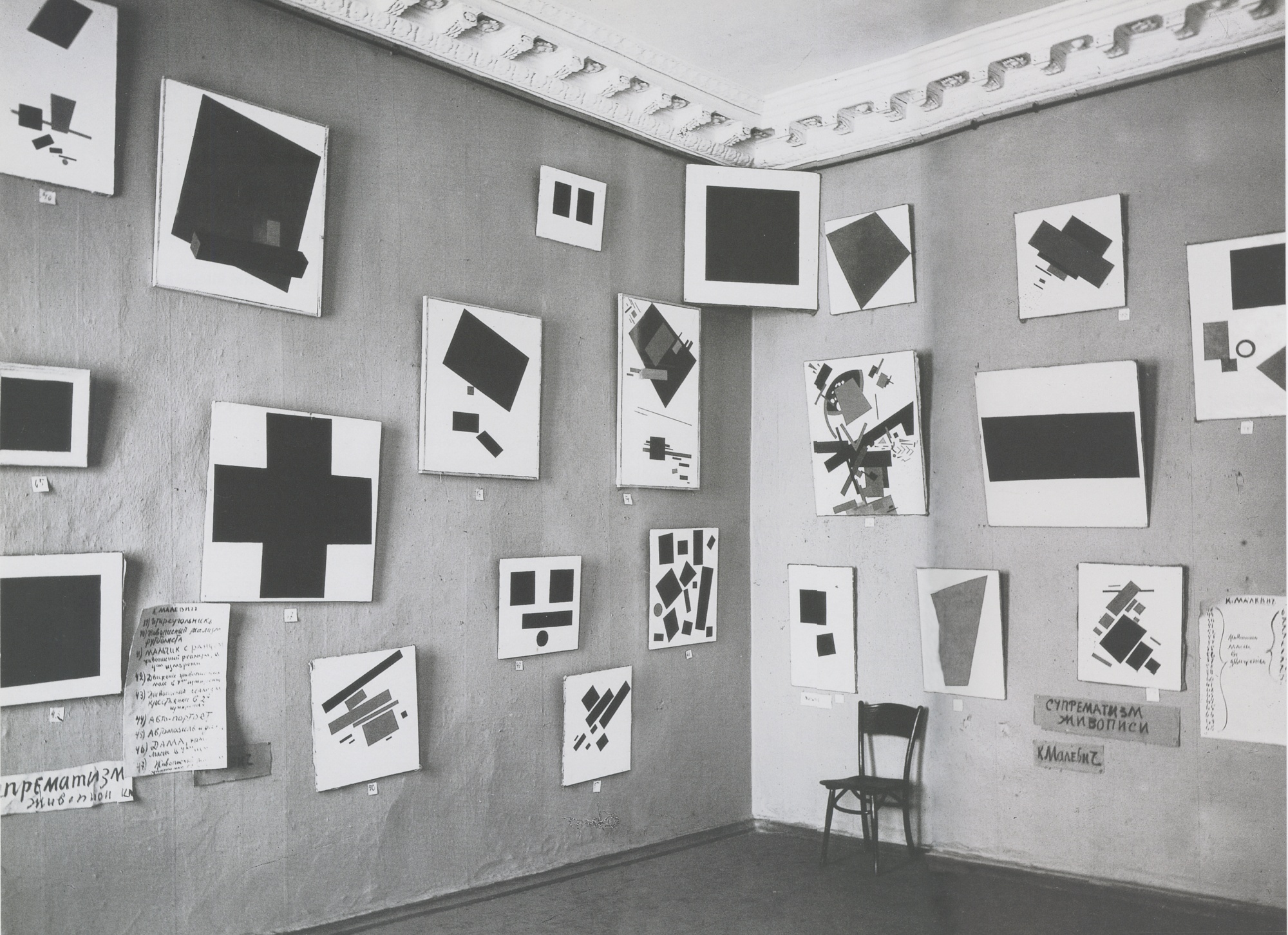
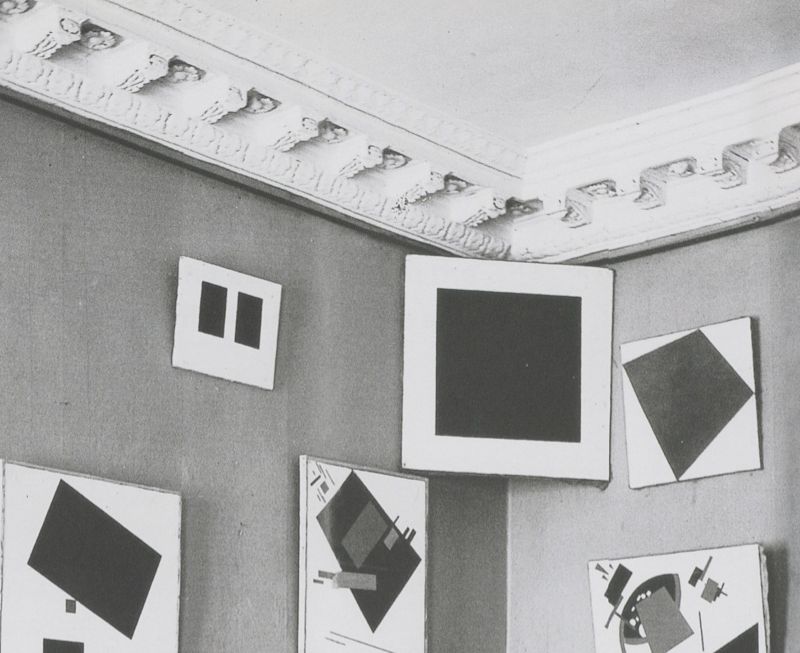
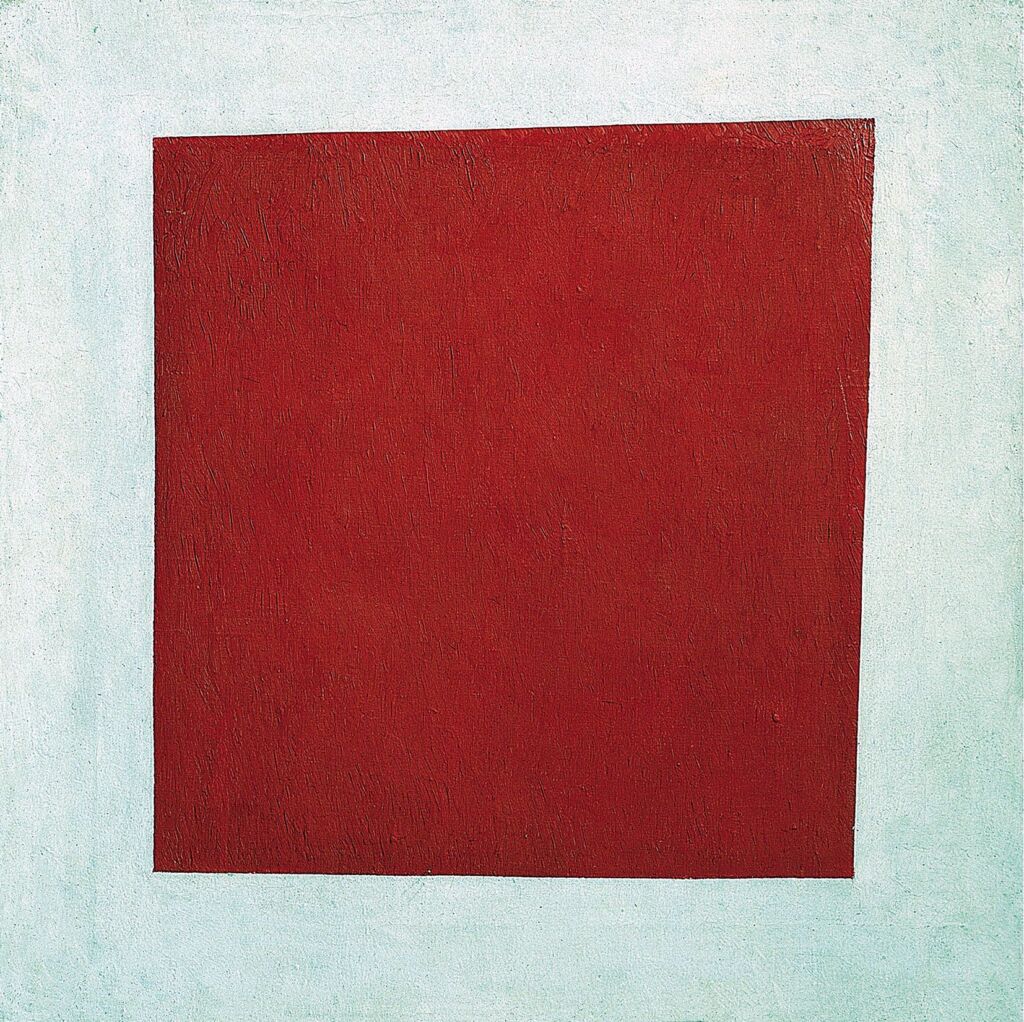
The same room held his Red Square. For the show Malevich published a pamphlet, From Cubism to Suprematism: The New Painterly Realism. It argued that an artist becomes a creator only when his forms owe nothing to nature. It also contains his famous line “I transformed myself in the zero of form.”
Malevich himself traced the square back to the theater: in 1913 he designed the Futurist opera Victory over the Sun, and later linked the square to it.
Black, color, white
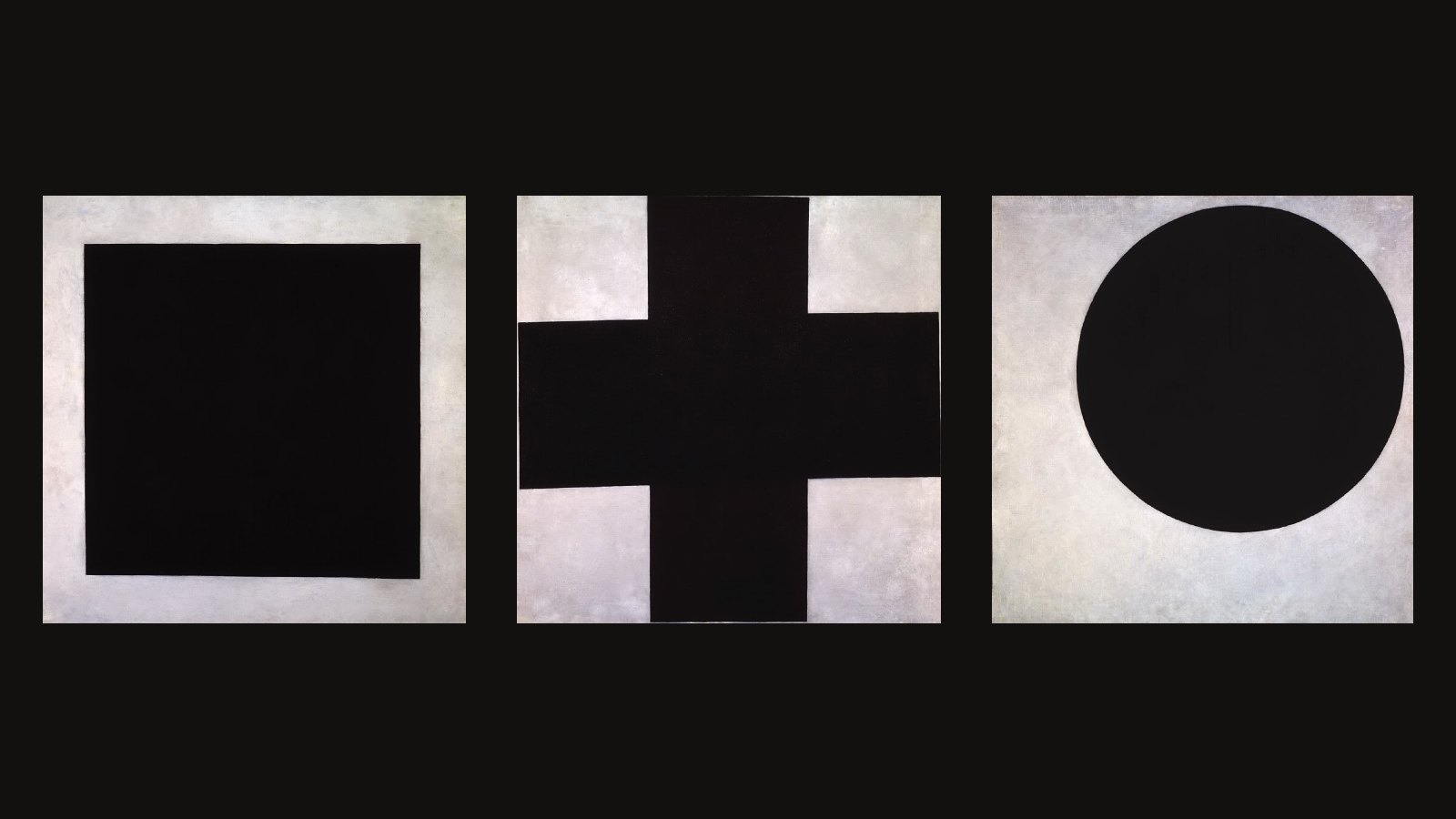
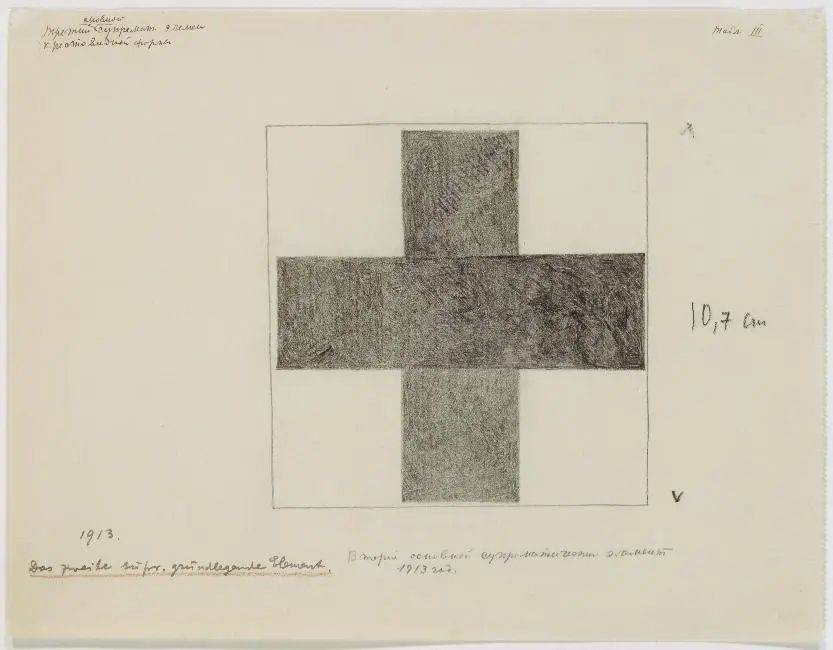
Malevich later divided his path into three stages: black, color and white. The black stage began with three shapes, the square, the cross and the circle. He called the square the zero of form, the seed from which everything else would grow.
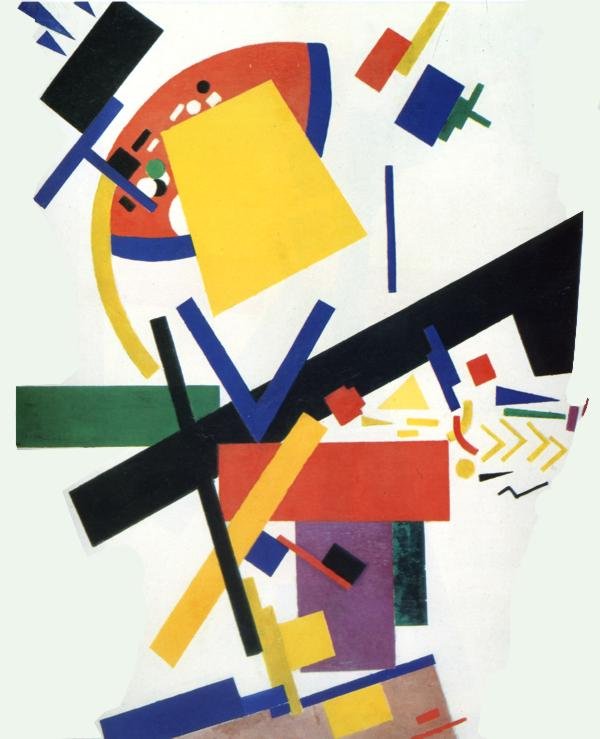
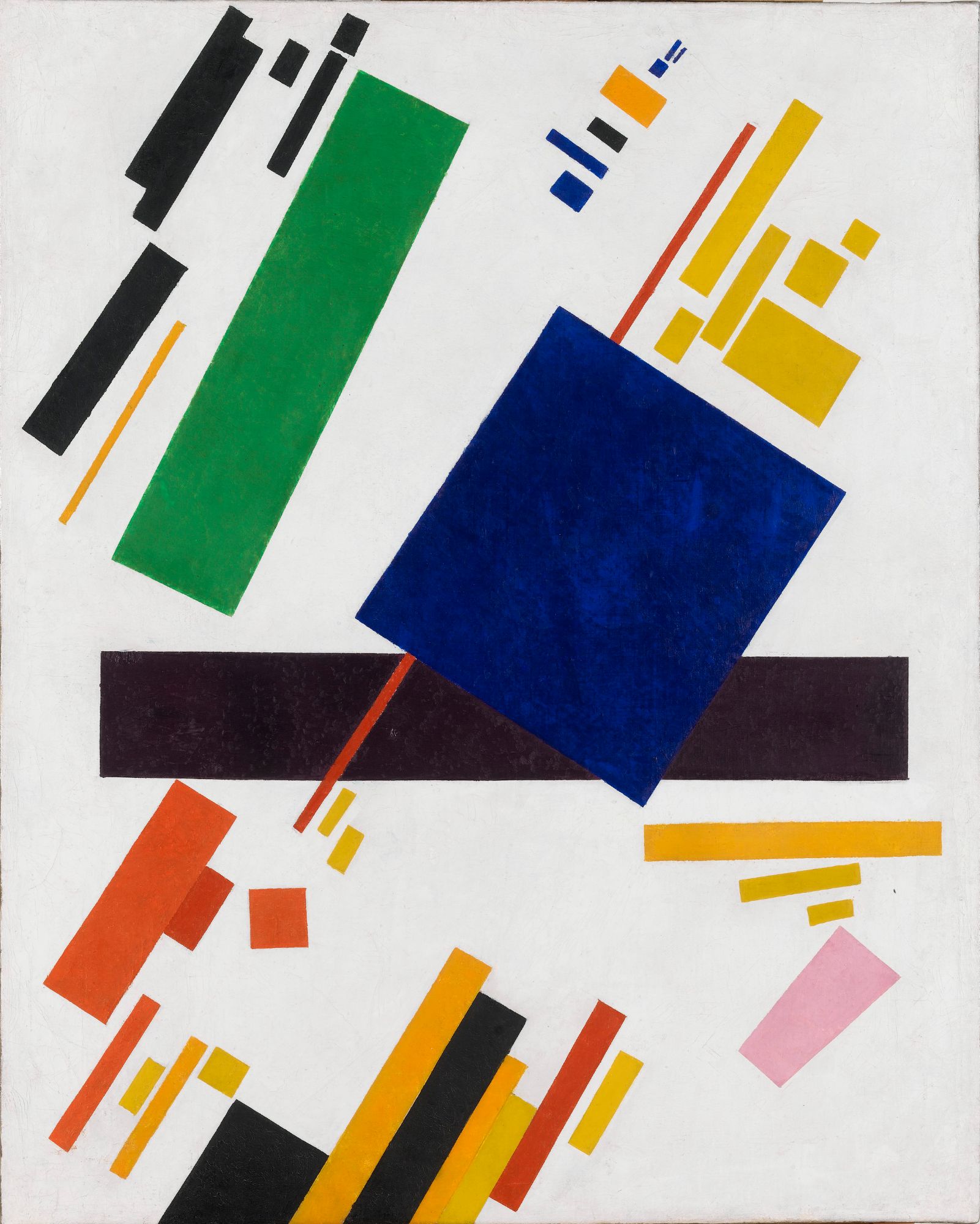
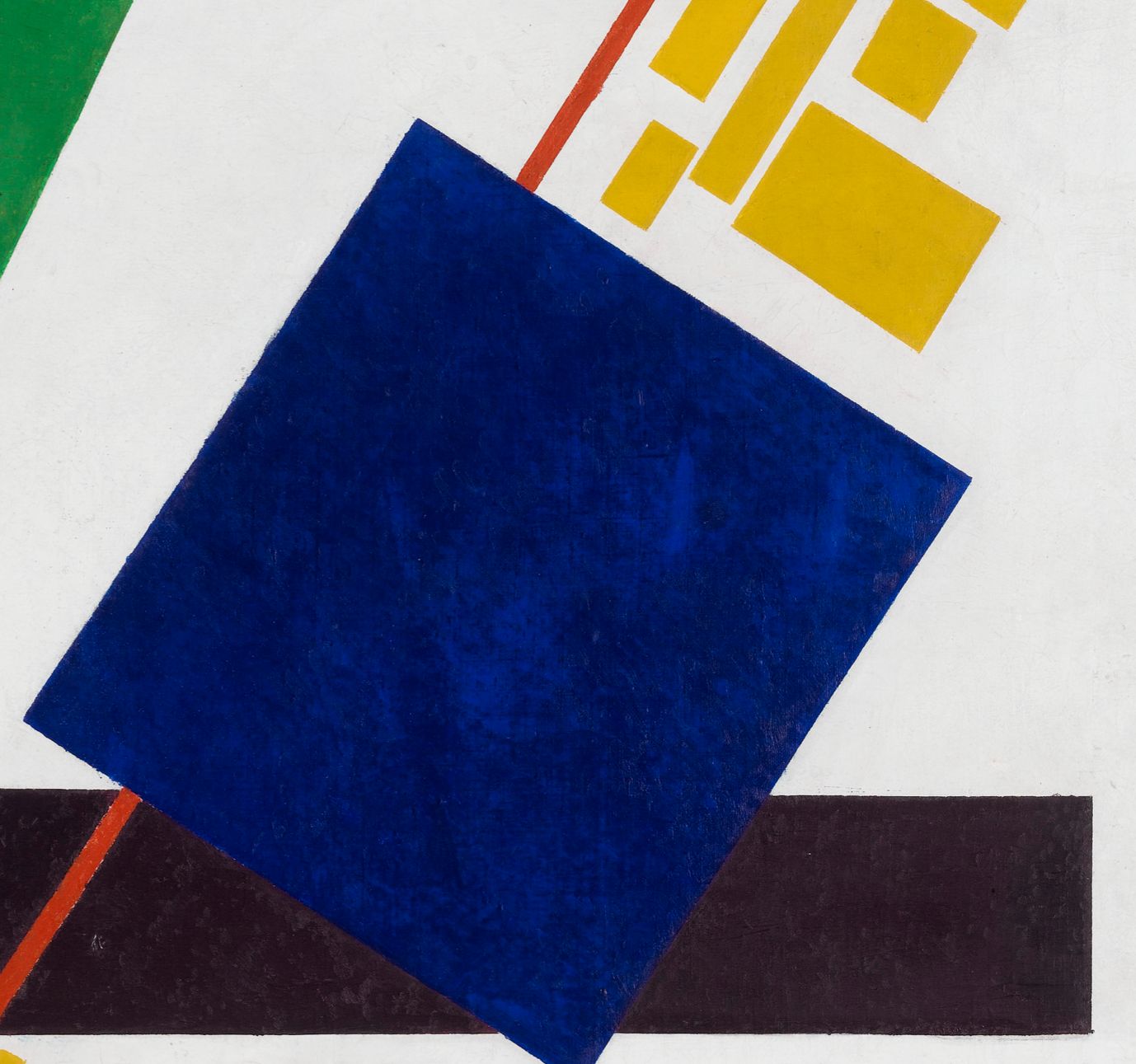
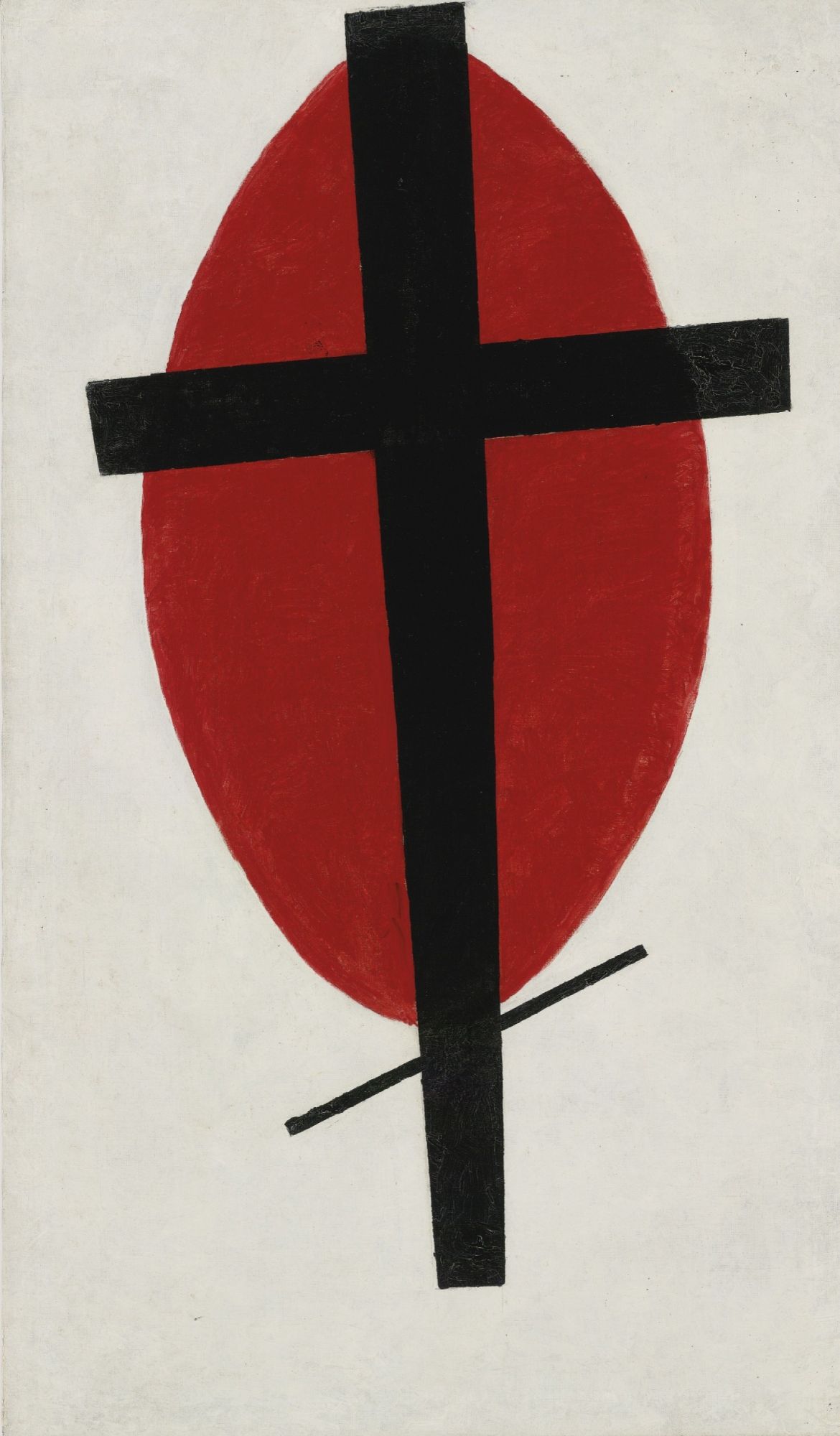
The color stage covers most of the 0,10 canvases and the next two years. Rectangles and bars of different colors cross, overlap and float in white, which for Malevich stood for infinite space. The painting at the top of this article hung at 0,10 under the title Painterly Masses in Motion.
Malevich took the absence of top and bottom literally. He refused to fix which way up his canvases hung, and in installation photos from 1920 and 1927, Painterly Realism of a Football Player, now at the Art Institute of Chicago, hangs upside down.
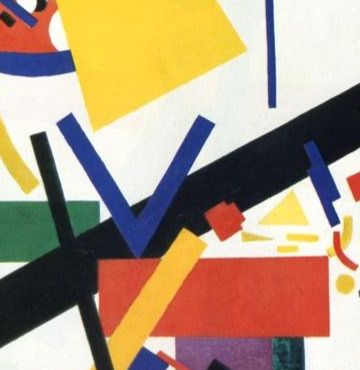
In 1916 and 1917 the compositions grew more complex. Broken arcs and tiny triangles appeared, the palette took in brown, pink and lilac, and the flat shapes began to suggest depth. They were painted in wartime: in the summer of 1916 Malevich was called up as a reservist and afterward worked in snatches.
Other artists took up the new forms almost at once.
The Supremus group
In 1916 a group called Supremus formed around Malevich. Its members included Popova, Rozanova, Ivan Kliun, Udaltsova, Ivan Puni, Ksenia Boguslavskaya and Exter. Malevich planned a journal, first called Nul (“Zero”), then Supremus. Artists and philosophers wrote for it, but the revolution kept even the first issue from appearing.
In March 1917 Rozanova became the journal’s secretary. The word tsvetopis, roughly “color-painting,” was Malevich’s coinage; Rozanova avoided it and spoke instead of transfigured color. Her Non-Objective Composition (Color Painting) of 1917 is in the Russian Museum.
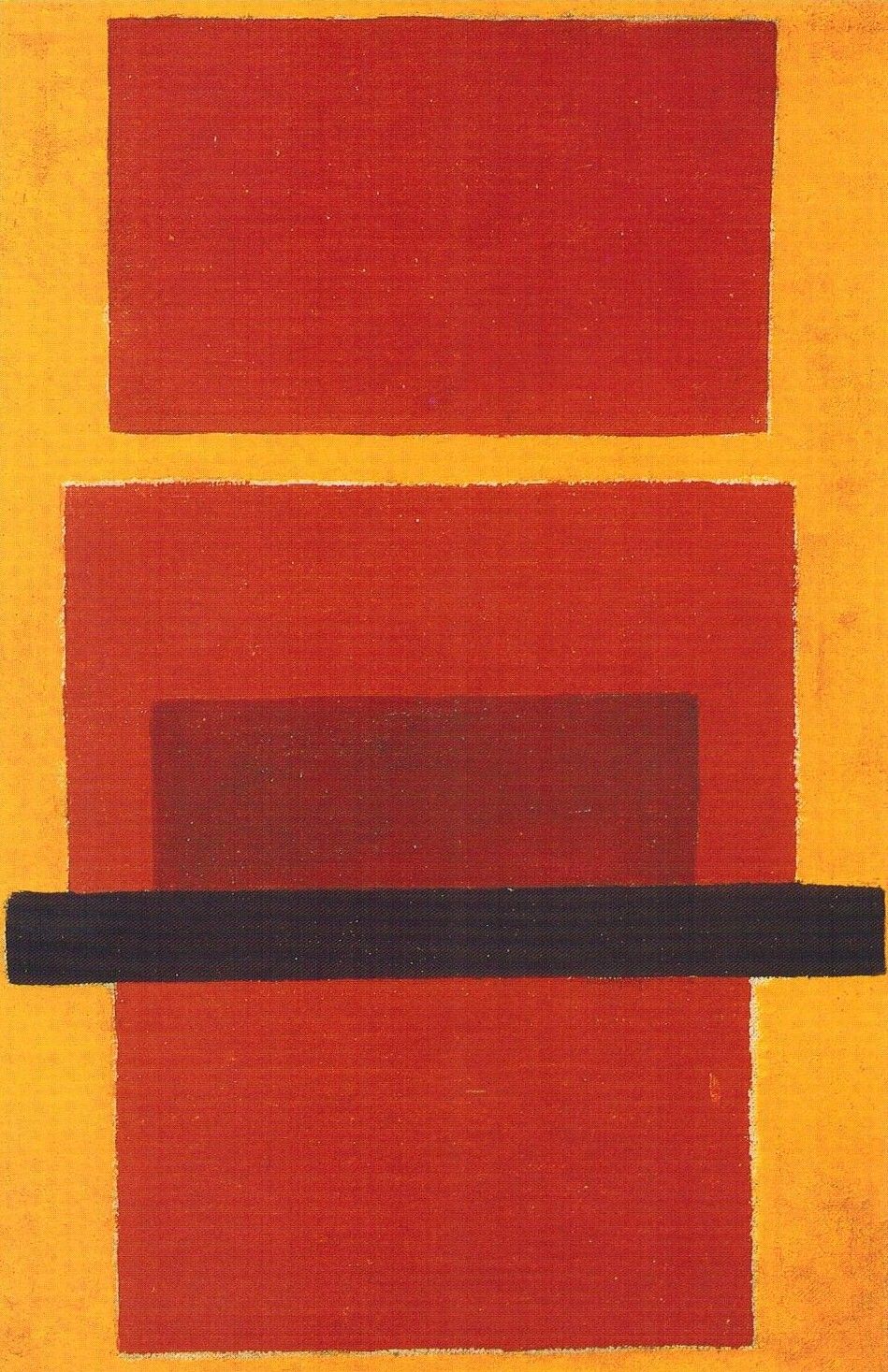
Rozanova died of diphtheria in 1918, at 32. Her work was shown posthumously in Moscow the next spring.
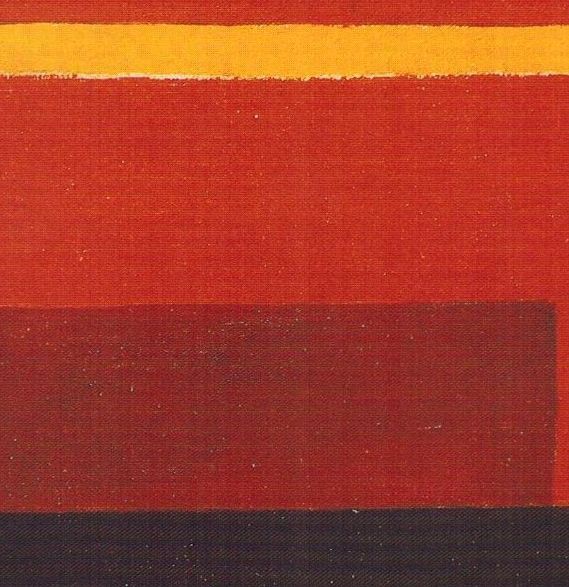
Popova, who had worked in Vladimir Tatlin’s studio, joined Malevich in 1916. MoMA describes her Painterly Architectonics series as a response to Suprematism: dense planes, like solid bodies, that shun right angles, verticals and horizontals.
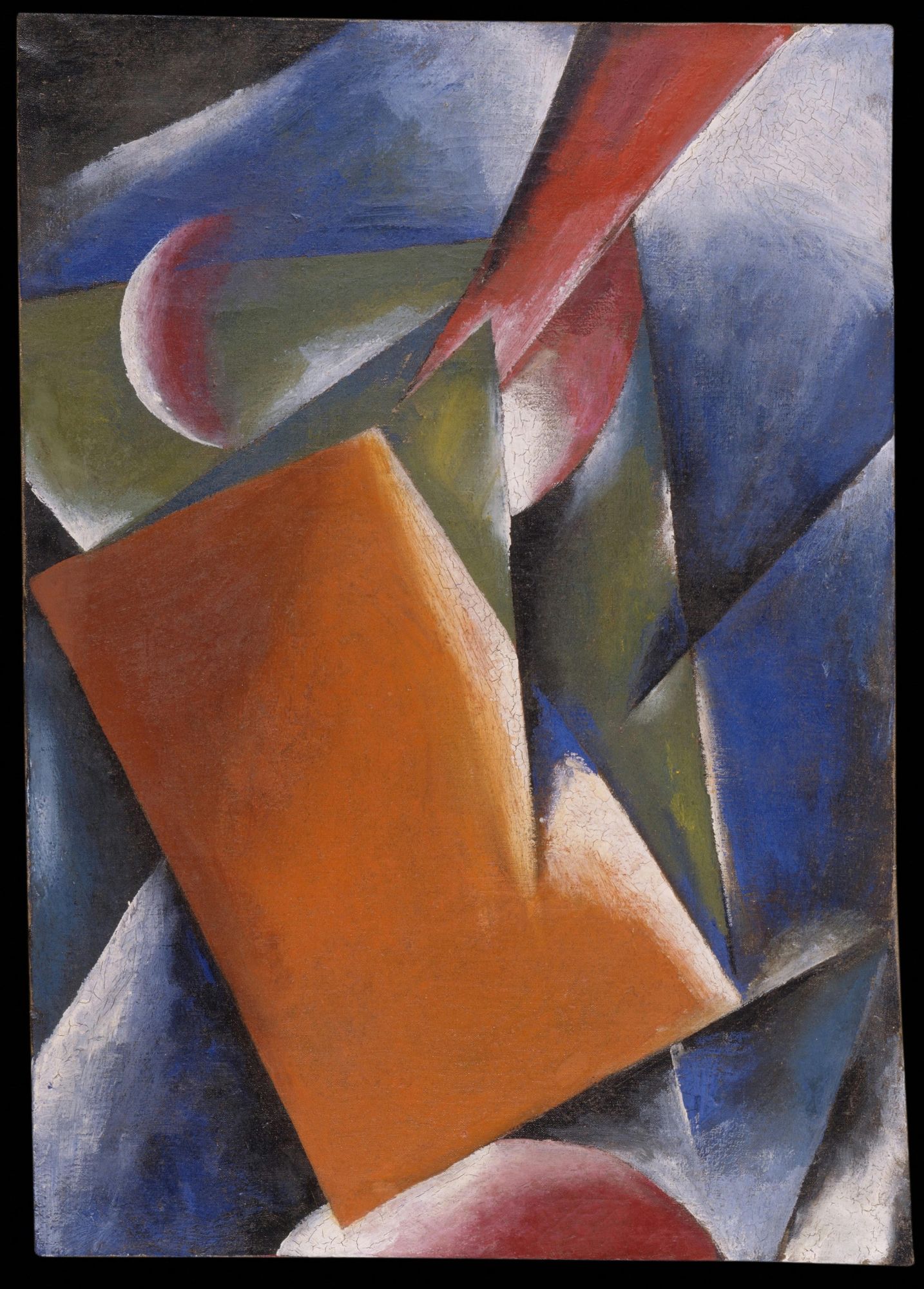
The group did not hold together for long. Kliun signed the Declaration of the Suprematist Color-Painters, then in 1919 turned on Malevich with his manifesto The Art of Color.
White on White
By 1918 color had drained out of the pictures. In Suprematist Composition: White on White, a tilted white square rests on a slightly warmer white ground.
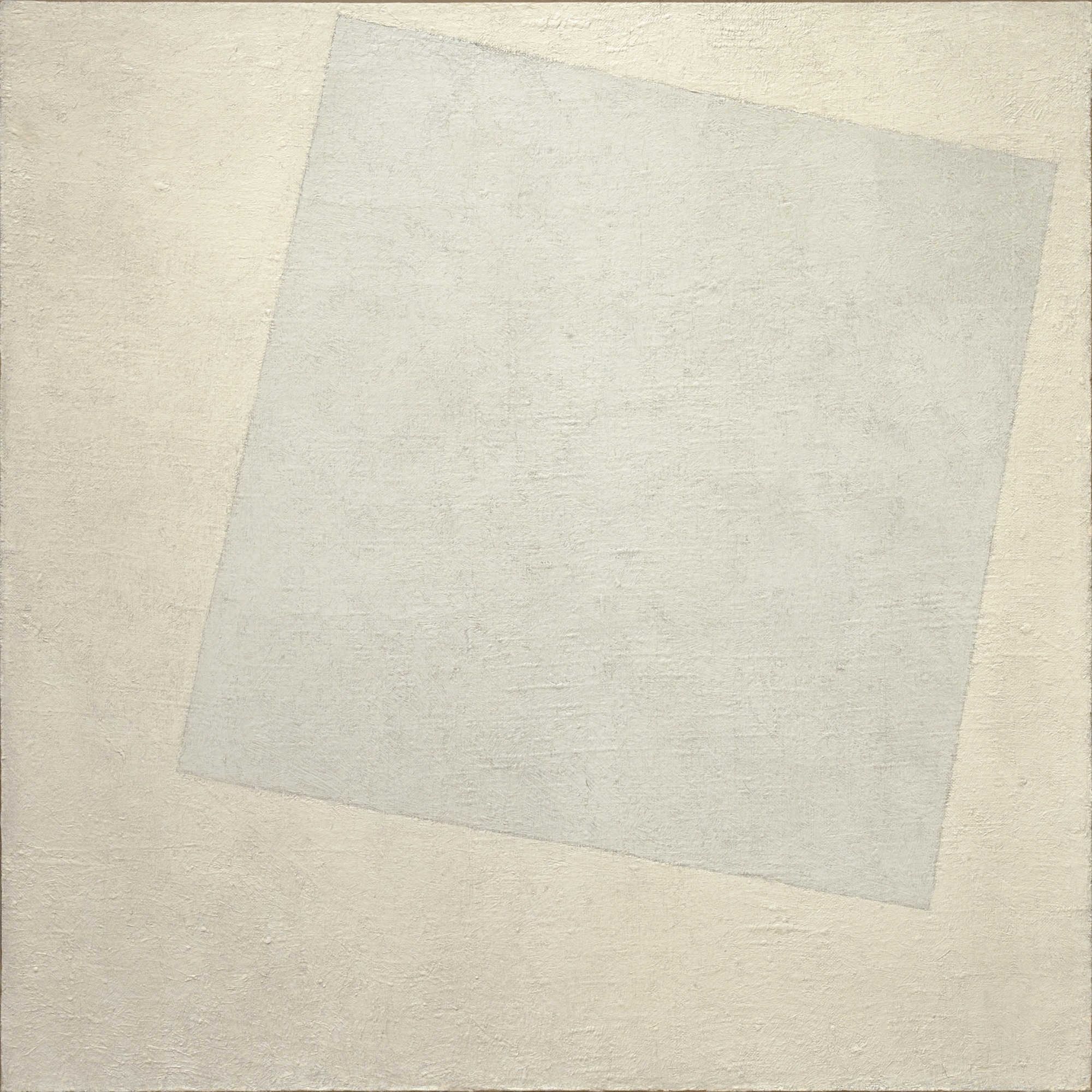
The white is not even. The brushstrokes show, and only tone and texture separate the square from the ground. The scholar Alexandra Shatskikh found that it was painted over another composition.
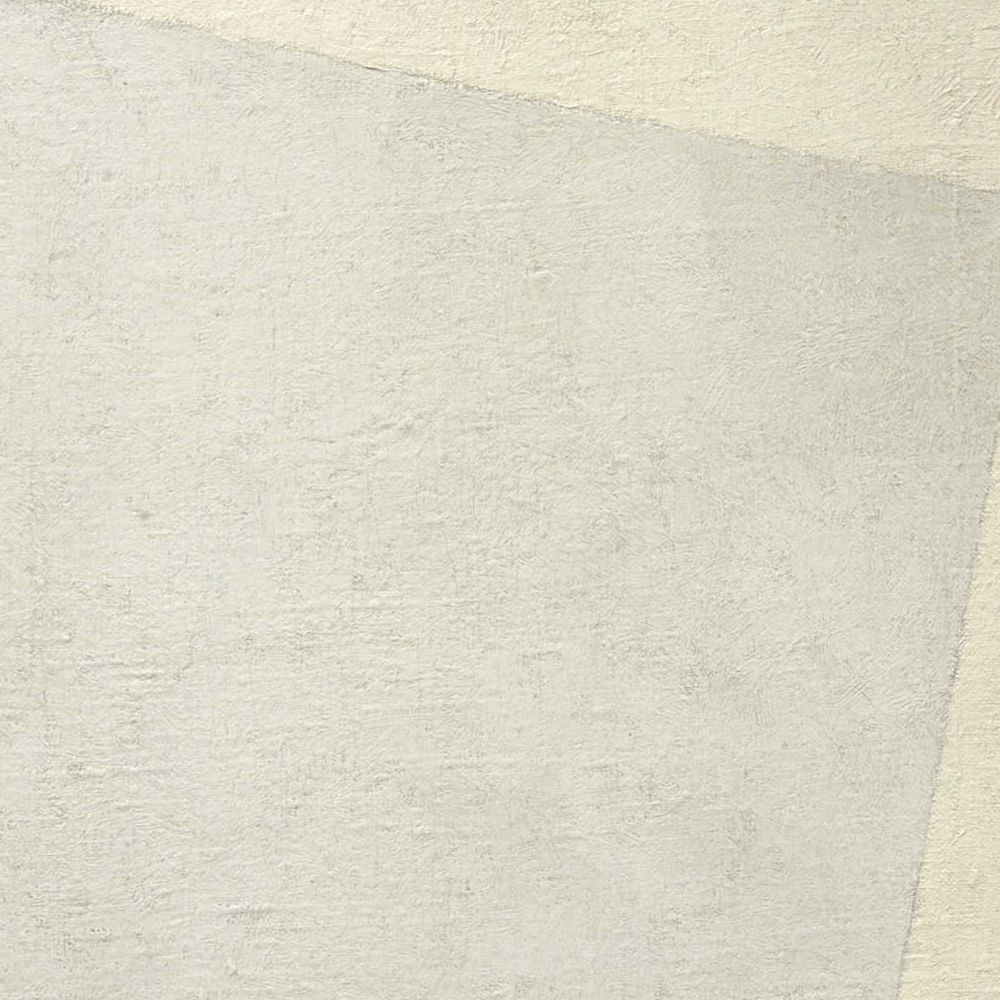
Malevich first showed his white-on-white paintings in Moscow in the spring of 1919, at the Tenth State Exhibition. Alexander Rodchenko answered them with his Black on Black paintings. That same year Malevich wrote, as Tate’s translation has it, “Painting died, like the old regime, because it was an organic part of it,” and declared Suprematism in painting finished.
Suprematism began by refusing to depict things, and ended by setting out to make them.
A square instead of a signature
In November 1919 Malevich moved to Vitebsk, in today’s Belarus, to teach at the People’s Art School that Marc Chagall had founded a year earlier. The civil war made life hard, but there Malevich found devoted students.
On February 14, 1920, a student circle took the name UNOVIS, Russian shorthand for “Champions of the New Art.” Members signed their work with a black square instead of names. In a 1921 photograph, Nikolai Suetin wears one sewn on his sleeve. The aim, Tate notes, was to take Suprematism into the street, factory and home.
By August 1920 UNOVIS had about forty members, among them Vera Ermolaeva, Lazar Khidekel, Anna Kagan and Lev Yudin, while Nina Kogan staged a Suprematist Ballet. Chagall soon left. On paper Ermolaeva ran the school, but its central figure was Malevich.
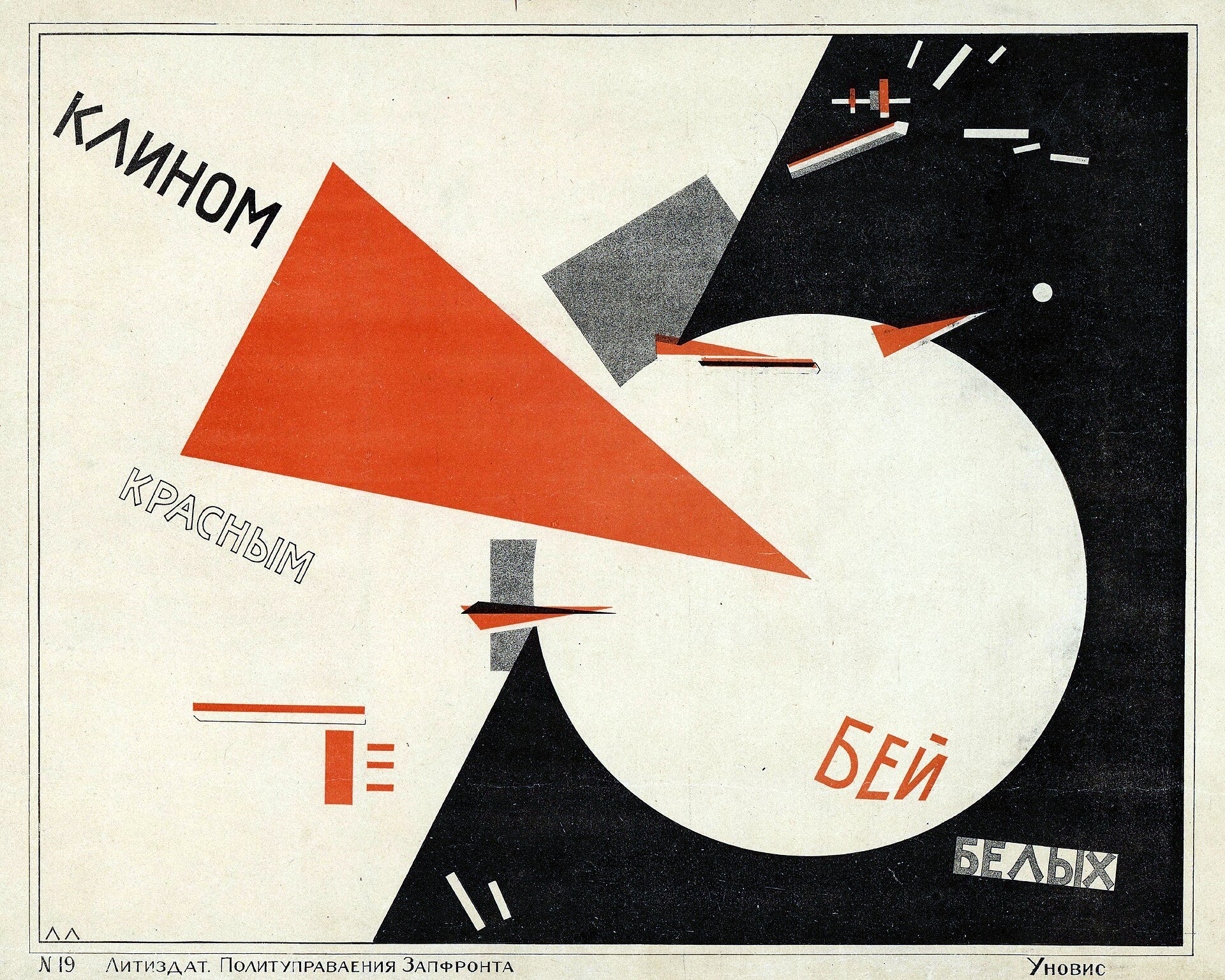
El Lissitzky, who fell under Malevich’s influence after meeting him in 1919, carried the shapes into the poster: in Beat the Whites with the Red Wedge, a red triangle drives into a white circle. He probably also printed Malevich’s lithographed book Suprematism: 34 Drawings. In it Malevich muses on a Suprematist “satellite” in orbit, almost forty years before Sputnik.
The students painted shapes on the city’s walls for the anniversary of the revolution. The most loyal were Suetin and Ilya Chashnik: when Malevich returned to Petrograd in 1922, they went with him.
Porcelain and architectons
In Petrograd Malevich headed the Museum of Artistic Culture and the institute that grew out of it, the future GINKhUK. Around 1923 he repainted Black Square, Black Cross and Black Circle for the Venice Biennale, but they never made it there.
The same year saw Suprematist wares from the State Porcelain Factory. Before the revolution it had been the Imperial Porcelain Factory, and its stock still held white blanks made under the tsar. The Suprematists painted those too. So one object can carry two eras: an imperial mark under the glaze and a Soviet one on top.
Hence the dish with the imperial mark that opens this story. Its design echoes a sketch for a wall painting made in Vitebsk in 1920. For the factory, Malevich designed a teapot and, with Chashnik, a “half-cup,” a cup sliced down the middle.
A plate by Chashnik in the British Museum uses only black, gray and white, and its solid black rim seems to erase the familiar shape of the dish. The blank was made in 1917 and painted in 1923. Chashnik died six years later, still in his twenties.
Next came the architectons, models built from blocks and slabs, with no function and no site: Suprematist architecture in general. Malevich spoke of cosmic cities floating above the Earth. Gota, in the Russian Museum, is an upright plaster tower about 85 centimeters tall.
Through Berlin to Dessau
In late 1921 Lissitzky moved to Berlin and became a key go-between for the Russian avant-garde and the West. Through him and Wassily Kandinsky, geometric abstraction reached the Bauhaus in the early 1920s. László Moholy-Nagy worked under Suprematism’s influence, and in 1922 the Dutch magazine De Stijl gave Malevich pride of place in its survey of Russian art.
Yet a few years later the same magazine ran a mocking note, “Bazar Bazar Bazar Bazar,” about Suprematist household objects. The quarrel over where art ends and decoration begins went back to the Verbovka embroideries.
Malevich went abroad only once. In March 1927 he took paintings, manuscripts, teaching charts and models to Warsaw and Berlin, and in April he visited the Bauhaus in Dessau. That year the Bauhaus Books series published his The World as Non-Objectivity.
About three months later he was recalled home, and everything he had brought stayed in Germany. MoMA bought White on White in 1935, but the agreement with the artist’s heirs came only in 1999.
A cavalry with a borrowed date
Around 1928 Malevich returned to painting and to the peasants of his early work. Now the figures have colored planes or blank ovals for faces, like the characters of Victory over the Sun. For his 1929 retrospective at the Tretyakov Gallery, he repainted pictures left behind in Berlin.
Many late canvases show the countryside during collectivization and famine. Malevich turns the peasant into a faceless mannequin set among empty bands of earth and sky.
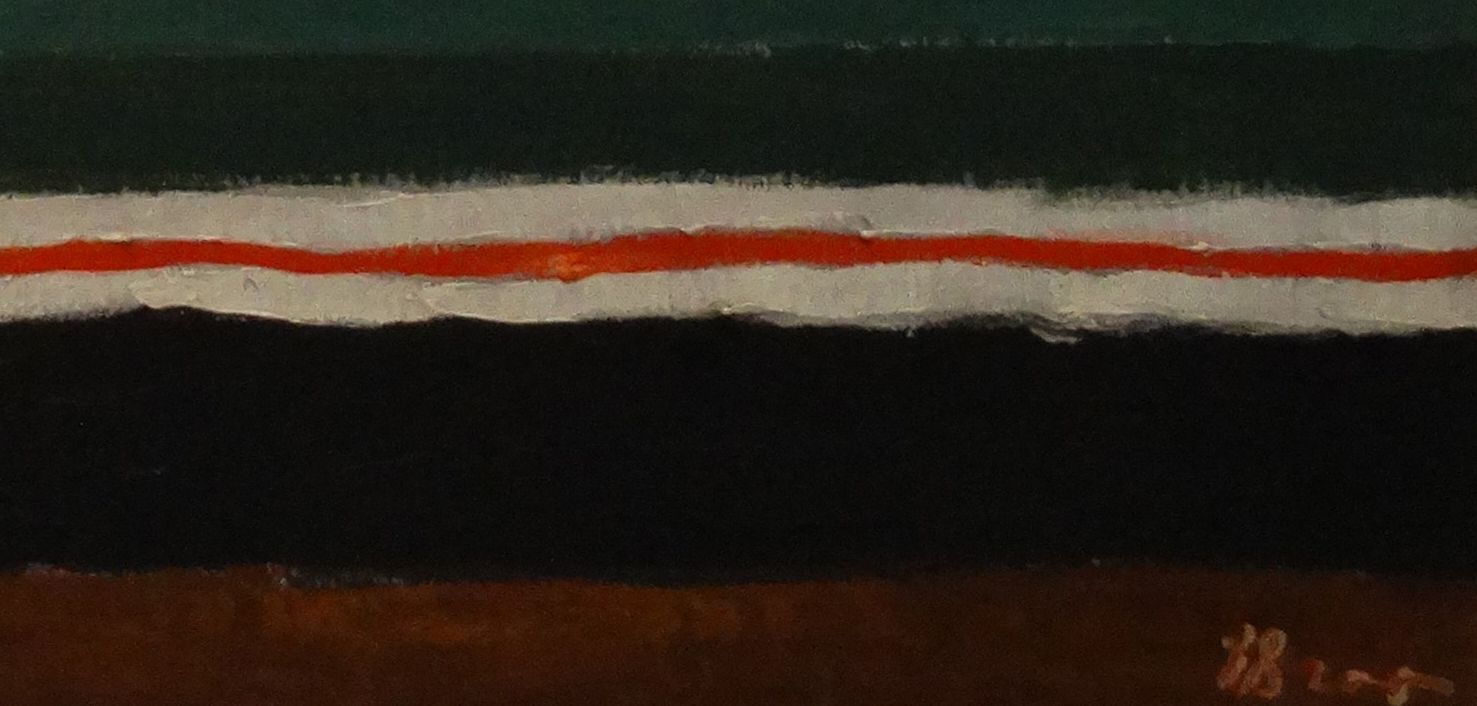
Red Cavalry in the Russian Museum was painted around 1932, but the corner of the canvas reads “1918.” On the back Malevich wrote: “The red cavalry gallops from the October capital to defend the Soviet border” (translated here by Hroniki). For years it was his only work that official Soviet art history acknowledged.
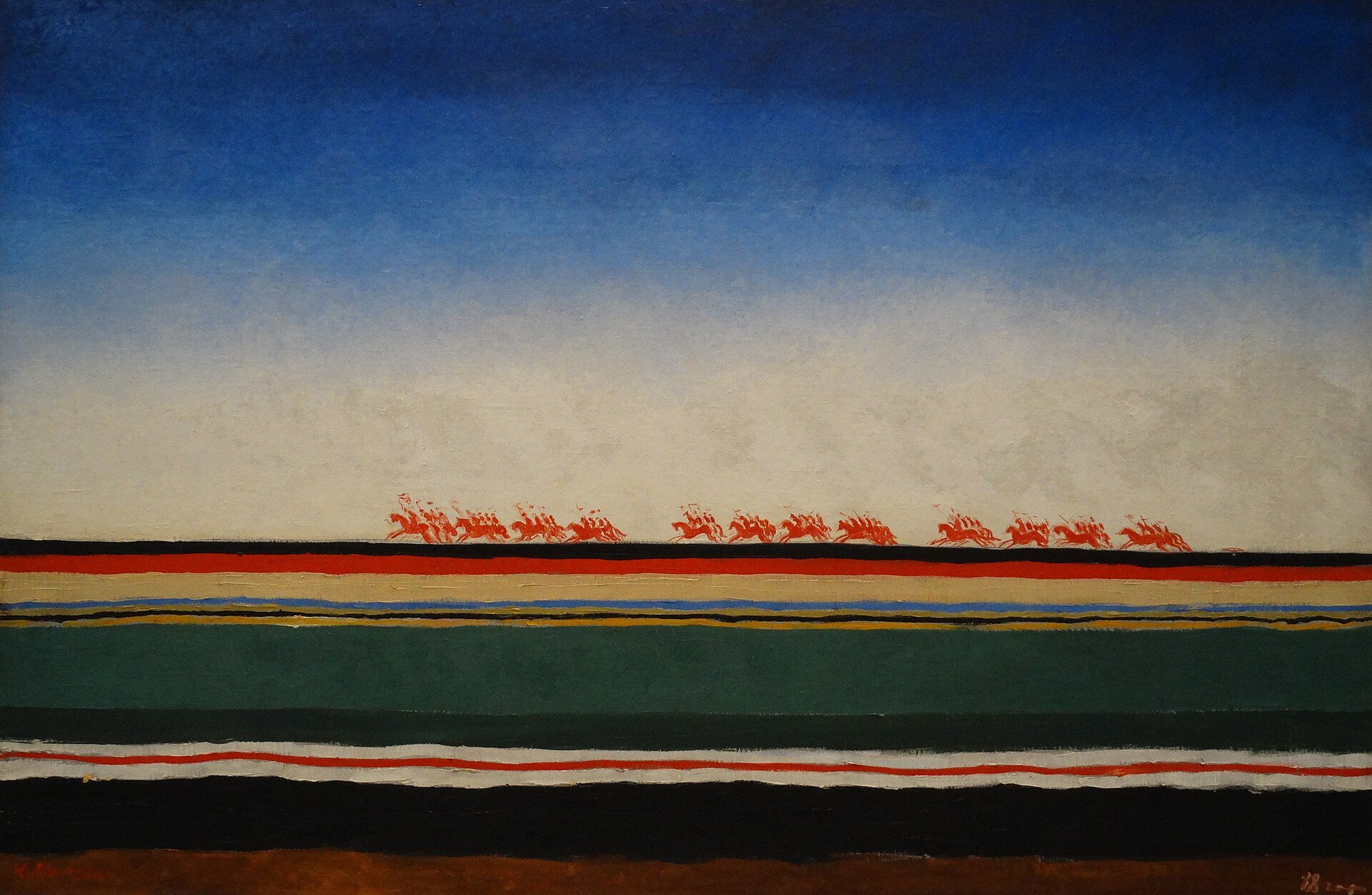
With the date and the inscription, Malevich seems to have steered viewers toward the “correct” reading. The times were dangerous: in 1930 he was held for several months in the “Big House,” the secret police building on Liteyny Avenue in Leningrad. His last paintings, from 1933, are portraits in a Renaissance manner, signed with a small black square.
Malevich died in Leningrad in 1935. Suetin made his coffin and later a monument with a black square for his grave outside Moscow; it was destroyed in World War II. The square that twenty years earlier had hung in the red corner at 0,10 now rode on the front of the vehicle carrying the artist’s body.
Comments
For Hroniki readers
Comments are open to readers with an account. Signing up is free and takes a few seconds.
No comments yet. Start the conversation.