Why Malevich claimed the Black Square was born on a 1913 opera stage
The 1913 Futurist opera Victory over the Sun is often called the birthplace of Malevich's Black Square. The surviving sketches and letters tell a more complicated story, one the artist edited himself.
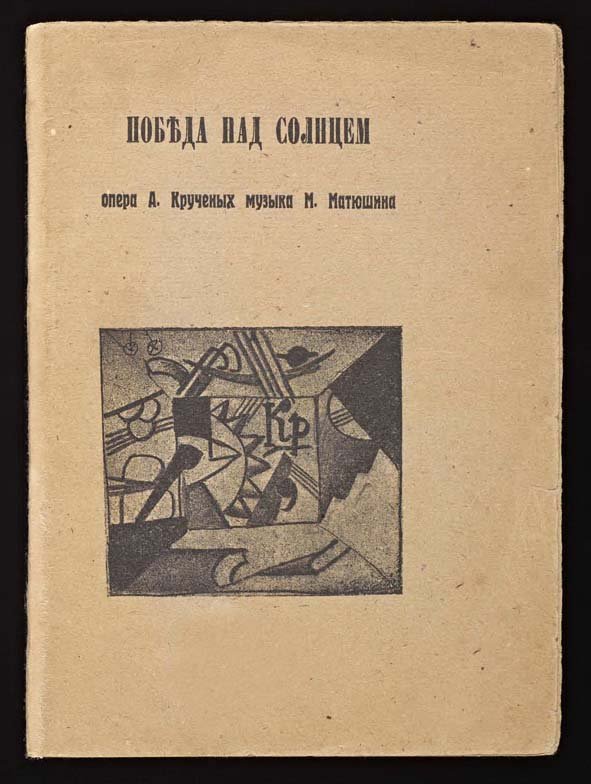
In December 1913 the Luna Park theater on Ofitserskaya Street in St Petersburg twice gave its stage to an opera sung in a nonexistent language. The poet Alexei Kruchenykh wrote the libretto in zaum, an invented “transrational” tongue. Mikhail Matyushin wrote the music, Velimir Khlebnikov the prologue, and Kazimir Malevich designed the sets and costumes.
Victory over the Sun played on December 3 and 5; on December 2 and 4 the same stage hosted the tragedy Vladimir Mayakovsky. The two opera evenings are now called the birth of the Black Square, two years before the 0,10 exhibition. That is half true. Malevich supplied the other half himself, after the show.
Cardboard armor under the blades of the spotlights
The first act opened with two Futurian Strongmen tearing the curtain apart. Then the heroes captured the Sun and abolished time: the old world, with its beauty and logic, was declared defeated.
There was hardly anyone to perform it. The cast was mostly amateur students, with two experienced singers for the two leads. There was no orchestra: Matyushin’s score was played on a piano delivered on the day of the show, and participants recalled just two rehearsals.
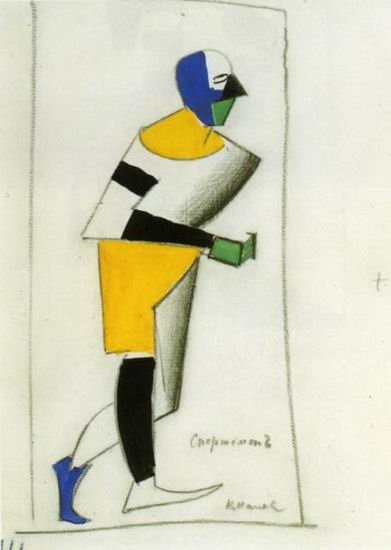
In Malevich’s cardboard-and-wire costumes the actors moved heavily and awkwardly, like Cubist drawings come to life. But the real protagonist was light: spotlights caught the figures piece by piece. The poet Benedikt Livshits recalled bodies sliced by the blades of the beams, vanishing into the set.
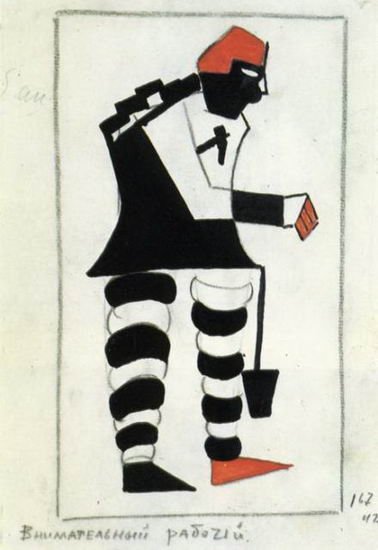
The audience was unforgiving. Matyushin wrote of a constant, terrible scandal, with whistling even from the director’s box. Those who applauded were a clear minority, and reviewers confirmed it: laughter, shrieks, and whistles went on all evening.
A square cut by a diagonal
More than twenty sketches for the production survive. Most came from the patron Levky Zheverzheev’s collection and are now in the St Petersburg State Museum of Theatre and Music; a few are in the Russian Museum.
One set design, for act 2, scene 5, shows a square split diagonally into black and white halves. A Victoria and Albert Museum blog post names it among the sheets that preceded and inspired the Black Square.
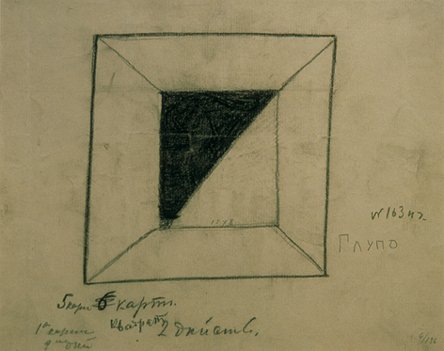
Half a square is not yet a square. It turns fully black later, in Malevich’s 1915 letters to Matyushin, who was planning to republish the opera. On May 27 Malevich asked: “I will be very grateful to you if you include one of my drawings of the curtain in the act where the victory took place” (translated here by Hroniki).
He then sent three drawings, supposedly as they “had been made in 1913.” The first showed a curtain with a black square, “the embryo of all possibilities,” which, he said, marked the beginning of the victory in the opera. The letters appear in the two-volume Malevich on Himself and are analyzed in a study by the Vitebsk museum (in Russian).
By 1915 Malevich was painting non-objective canvases for 0,10, and the old curtain came in handy: it gave the new painting a pedigree.
A date Malevich chose for himself
What is confirmed: in 1913 a black-and-white square motif appeared on stage. The State Russian Museum notes that the sun in the opera appeared as a black square.
What has not been found: any photograph of the stage, or a review describing a solid black curtain. Even the act is unclear: the letters call the black square the “first curtain,” while the surviving diagonal sketch is for act 2.
In 1927 Malevich went further. In The World as Non-Objectivity, published in the Bauhaus Books series, he claimed to have exhibited a black square on a white field in 1913. Nobody saw such a picture then: it was first hung just below the ceiling at 0,10, in December 1915.
According to Tate, the early date on the Black Square was also added later. It stuck so firmly that reference books still name 1913 as the start of Suprematism.
In December 1913 the audience jeered the cardboard armor and probably missed the diagonal square. A year and a half later its author noticed it, painted it solid black, and put it back on the stage after the fact.
Comments
For Hroniki readers
Comments are open to readers with an account. Signing up is free and takes a few seconds.
No comments yet. Start the conversation.