Las Meninas: what is hidden in Velázquez’s mirror
An infanta, two meninas, two dwarfs, a dog, a courtier in the doorway and the king and queen in a mirror: who is who in Velázquez’s Las Meninas, and why the picture still resists a final explanation.
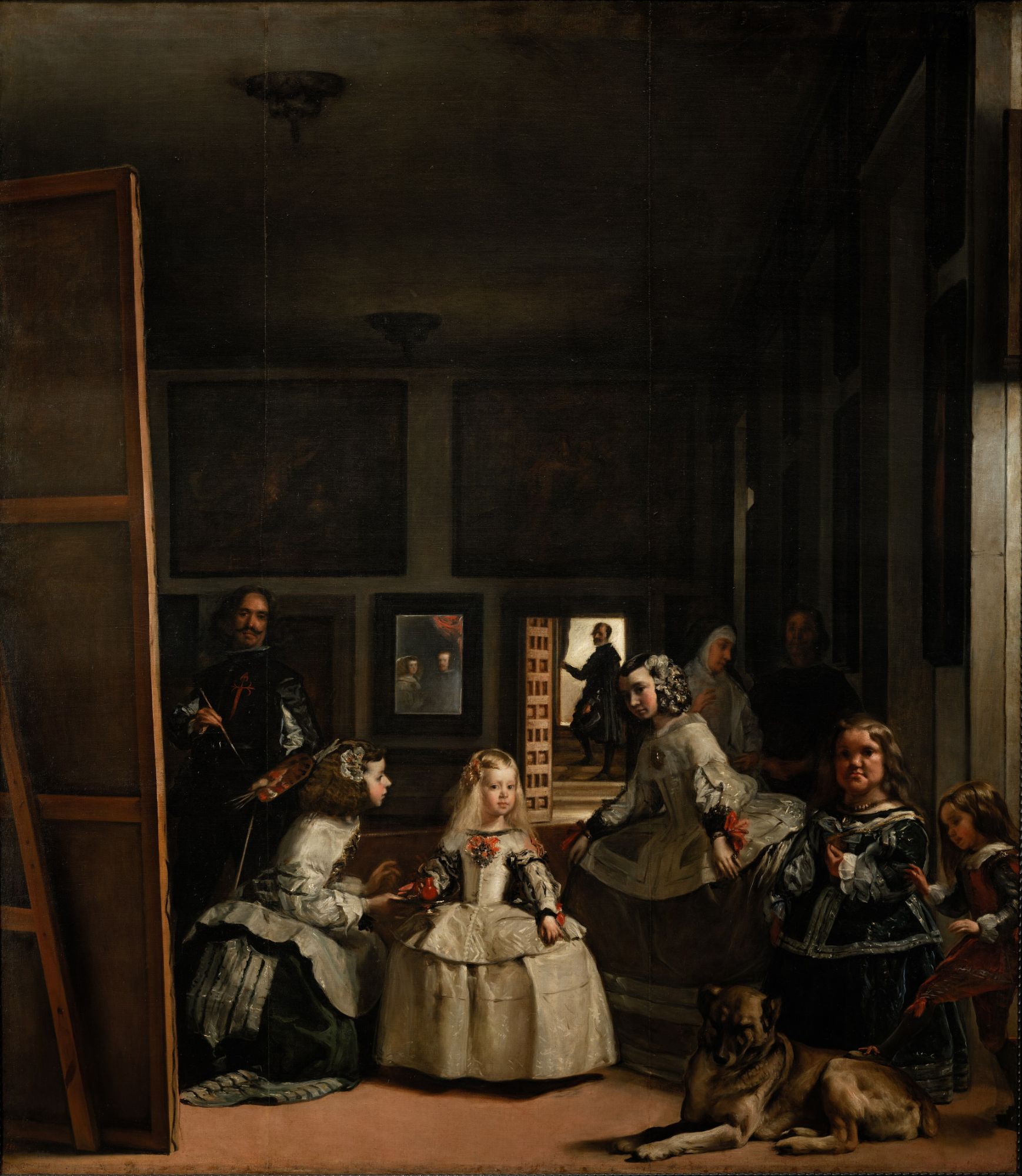
For almost two centuries this painting went without the name the world now knows it by. To the court it was a portrait of the king’s family; it became Las Meninas only once it hung in a museum.
The word is Portuguese. At the Spanish court, meninas were noble girls who served the royal children. The picture has two. In all, the room holds nine people and a dog, with two more figures in the mirror on the back wall.
Painted in 1656, it is one of Velázquez’s largest pictures, over three meters (ten feet) tall, and hangs in Madrid’s Museo del Prado.
A five-year-old infanta at the center of the room
The room is real: the Cuarto del Príncipe, the crown prince’s quarters in Madrid’s royal palace, the Alcázar, where Velázquez worked. At the center is the Infanta Margarita Teresa, daughter of Philip IV and his second wife, Mariana of Austria. She is five.
Almost everything we know about the sitters comes from one man, the painter and biographer Antonio Palomino. In 1724 he gave Las Meninas its own chapter in his treatise and named every figure. Without it, most of these faces would be anonymous.
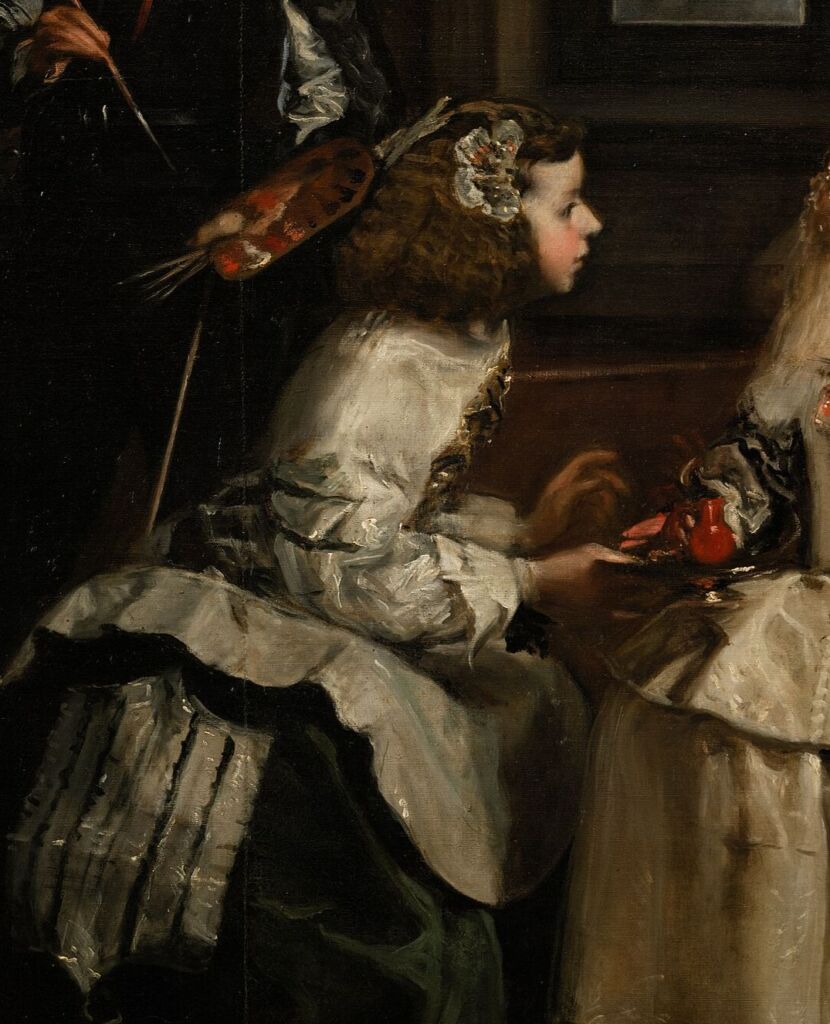
The kneeling menina is Doña María Agustina Sarmiento, daughter of Don Diego Sarmiento. The vessel she holds is a búcaro, a red clay cup for water.
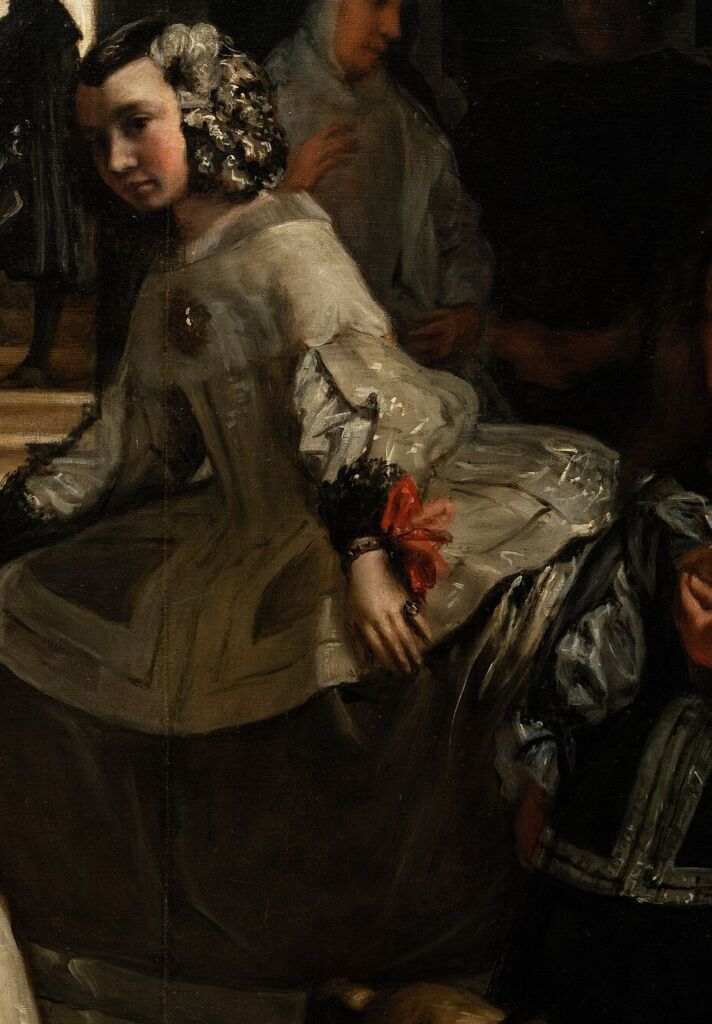
The second is Doña Isabel de Velasco, who, Palomino writes, later became a lady of the court. Of the two girls, she is the one looking out at us.
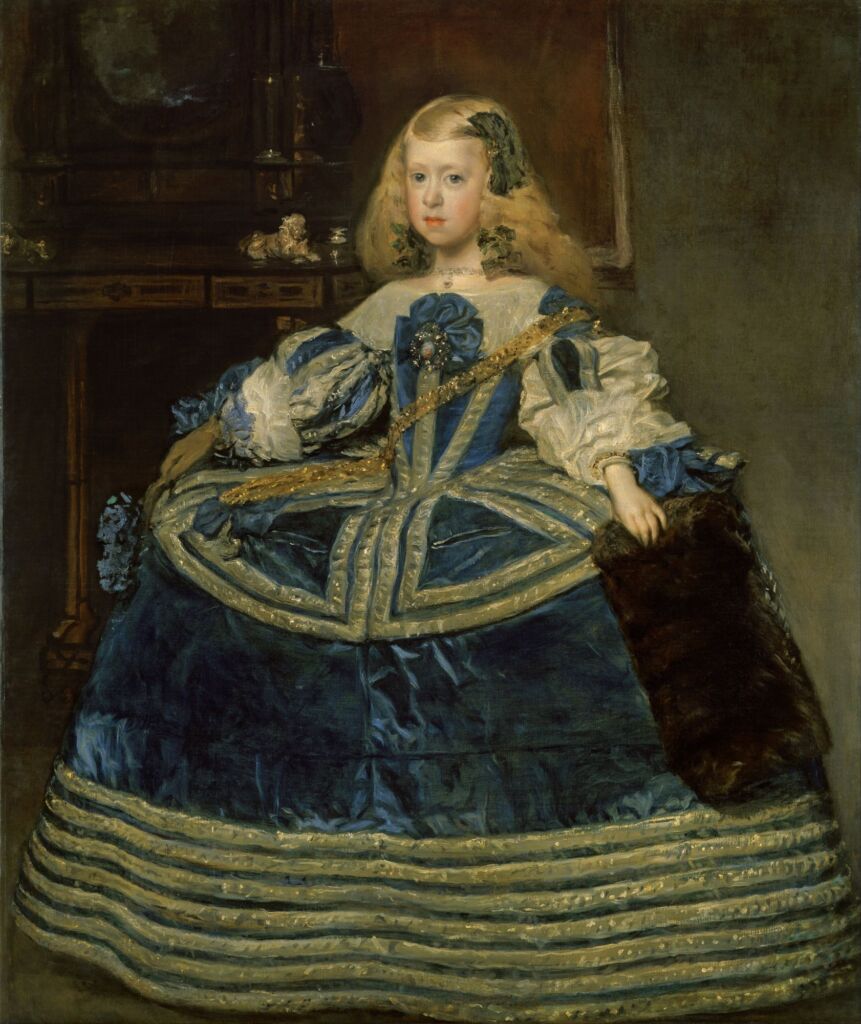
Margarita mattered to two courts. From childhood she was promised to her uncle, the future Emperor Leopold I, and portraits were sent regularly to Vienna so the court there could watch its bride grow up. One of them, Velázquez’s Infanta Margarita Teresa in a Blue Dress of 1659, went to Vienna at once and stayed.
The wedding came in 1666. In six years of marriage Margarita bore four children, lost two pregnancies and died during her seventh, at twenty-one. What survives of the Viennese bride is mostly her portraits.
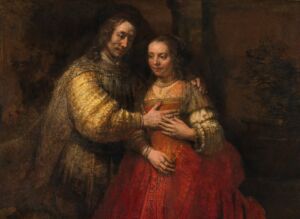
Two figures at the right edge
The right side belongs to those kept at court to amuse and accompany the royal children. Palomino names them as matter-of-factly as he names the meninas: the dwarfs Mari Bárbola and Nicolasito Pertusato, who has his foot on the dog.
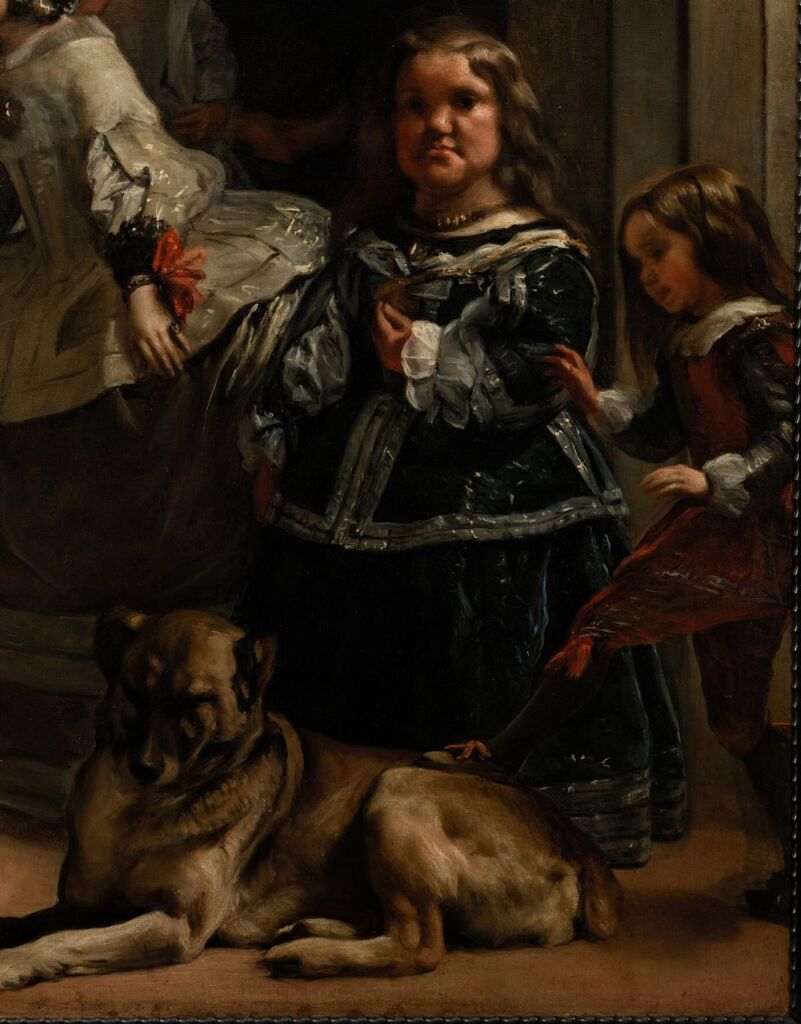
Mari Bárbola has the gaze of a woman long used to being stared at. Nicolasito is her opposite: the dog interests him more than whoever has walked in. Velázquez often painted court jesters and dwarfs, never to mock them. These two are painted as seriously as the infanta.
The dog is the one point of stillness. Everything in the room is about to move; he dozes on, and no king will change that.
Behind them, in half-shadow, are two adults. Doña Marcela de Ulloa is, Palomino says, the señora de honor, the senior lady of the infanta’s retinue. Beside her is a guardadamas, a courtier who escorted the ladies; Palomino gives no name.
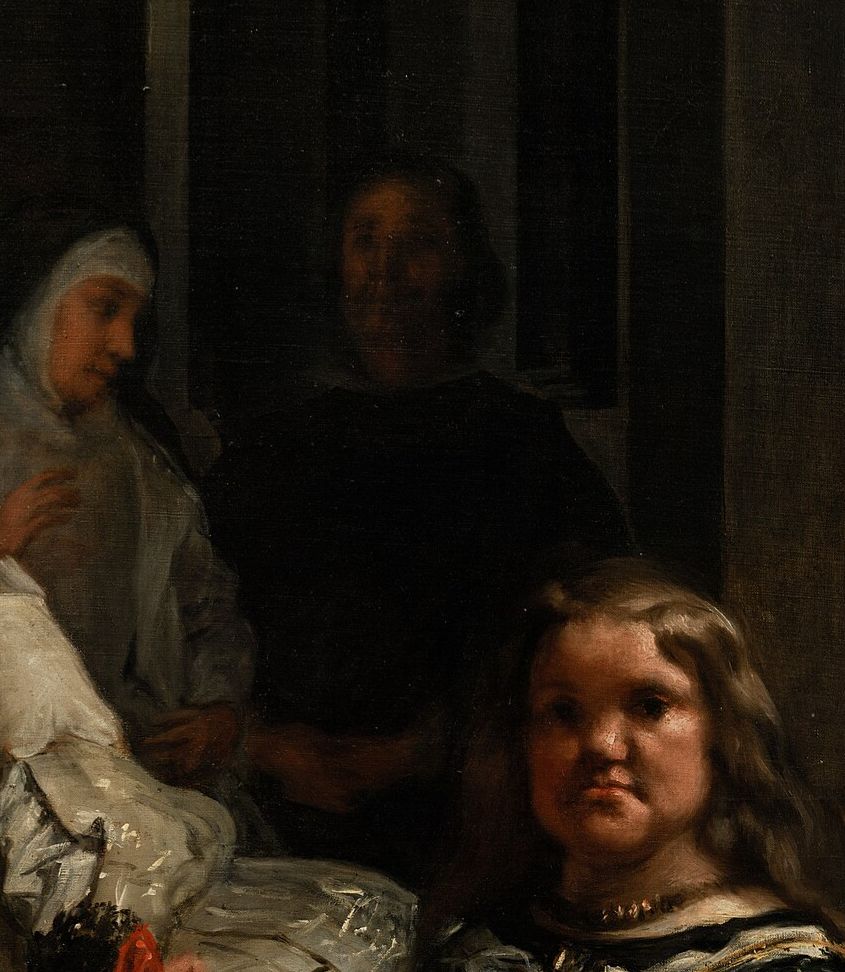
Marcela speaks; he listens. It is the picture’s only conversation, nearly invisible, as if Velázquez had deliberately left the people on duty in shadow.
The king and queen appear only in the mirror
The man on the steps in the doorway is José Nieto, “the Queen’s Chamberlain,” as Palomino calls him — in Spanish, the queen’s aposentador. He ran the palace apartments, and his duties included opening and closing doors for the queen.
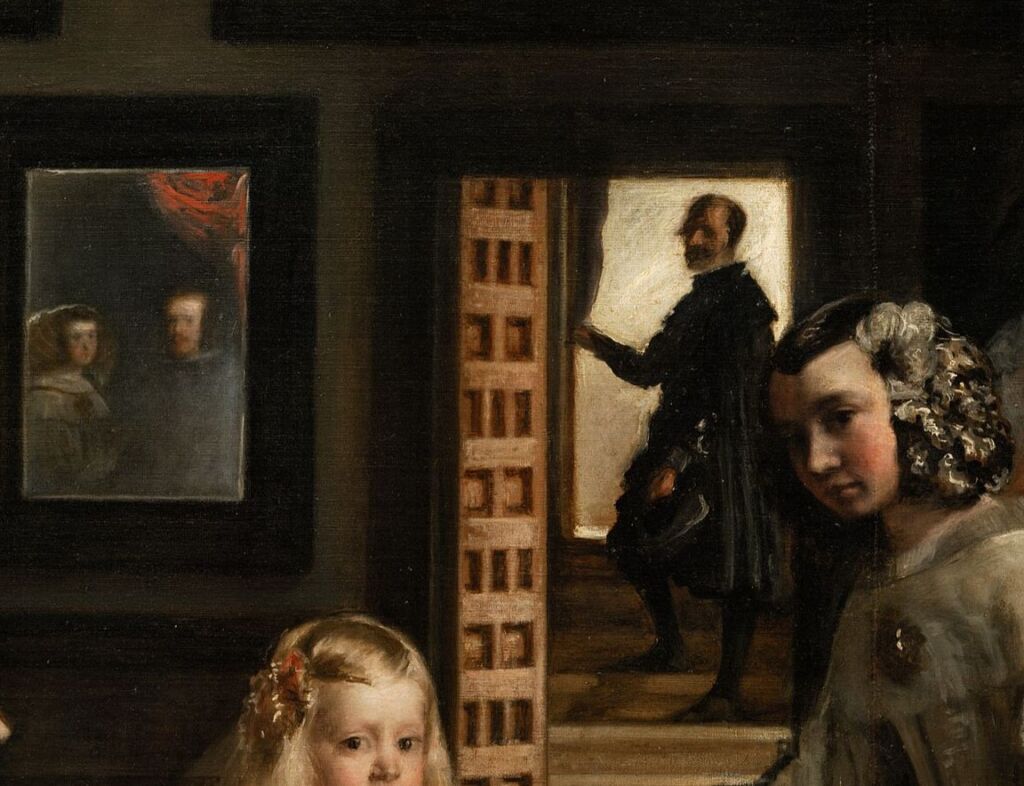
The mirror holds the blurred faces of Philip IV and Queen Mariana. If we trust it, they stand where we stand, and the infanta, Mari Bárbola and Velázquez look at them. The scene is then a single moment: the royal couple have just entered, and Nieto waits on the stairs to escort them on.
That was Palomino’s reading: the painter had found a way to show whom he was painting, though the canvas is turned away from us. In 1980 the American scholars Joel Snyder and Ted Cohen calculated the perspective and proposed another: the mirror reflects the monarchs’ image on the large canvas.
Whether Velázquez had a model is unknown, but a candidate hung in the same palace. The Arnolfini Portrait by Jan van Eyck, with its convex mirror, reached Spain in 1556 and stayed in the royal collection throughout the 17th century. The National Gallery in London, its home today, suggests it may have given Velázquez the idea.
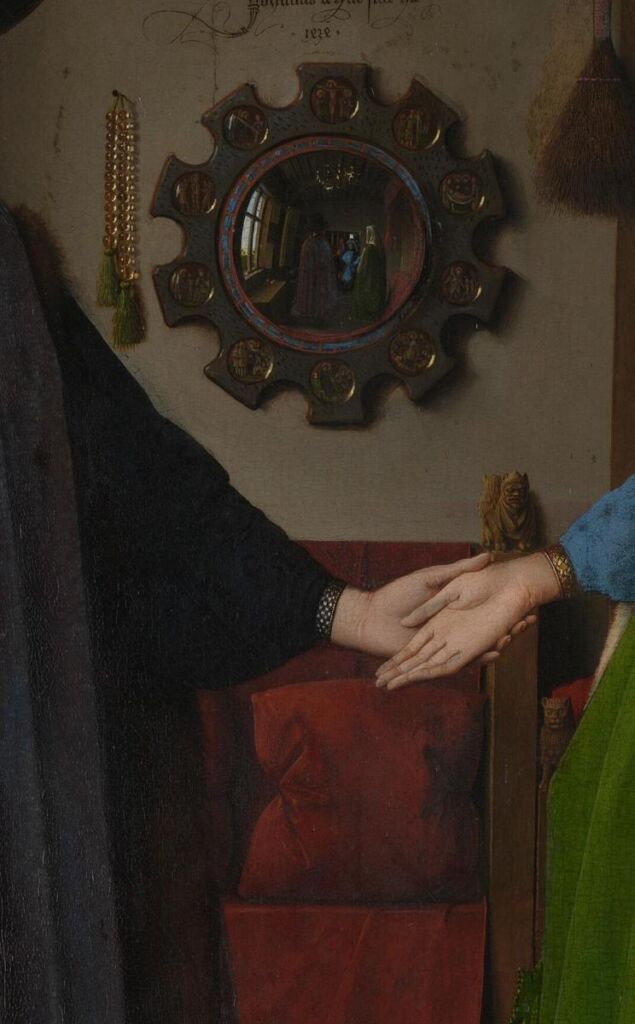
Van Eyck’s mirror shows two people at the door, usually read as witnesses, one of them the painter himself. Velázquez’s shows his patrons. More than two centuries on, the reflection has changed its meaning: now it holds power.
In Las Meninas everyone looks at people we can barely see: out toward the place where the viewer stands.
A canvas turned away from us
Velázquez never shows us the front of the huge canvas.
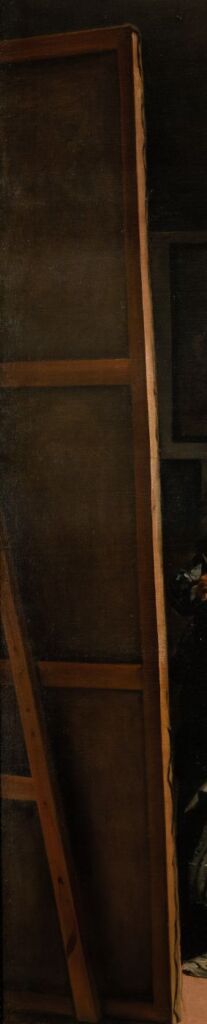
If the mirror reflects the monarchs posing, the canvas holds their double portrait, yet no such portrait by Velázquez is known. If they have just come in, he could be painting the infanta, or this very scene: Las Meninas itself. There is no sure answer, and that seems to be what the painter wanted.
For Michel Foucault, this reticence was the point. He opened The Order of Things (Les Mots et les choses, 1966) with Las Meninas: the picture shows everyone except those for whom it is all arranged, and at its center is an empty place, taken by the viewer. Philosophers have argued over it ever since.
Palomino describes the two dark pictures above the mirror as scenes from Ovid’s Metamorphoses. Scholars usually identify them as copies by Velázquez’s son-in-law, Juan Bautista Martínez del Mazo: Pallas and Arachne after Rubens, and Apollo’s contest with a satyr after Jordaens.
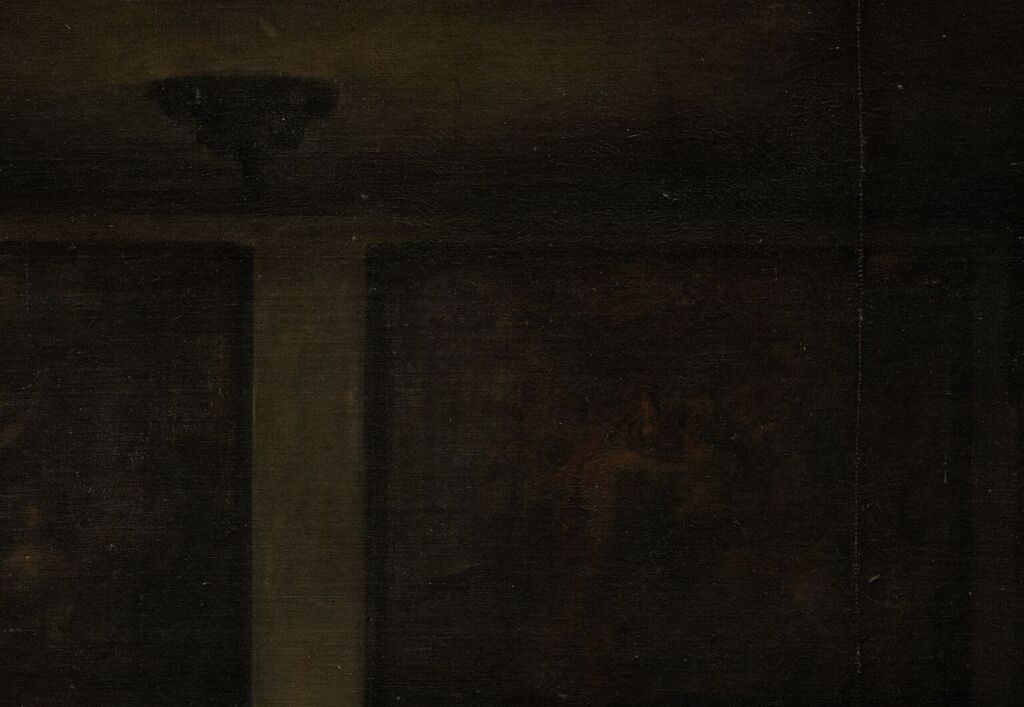
Both myths concern those who dared to rival the gods in art and were punished. Above a painter at work on the royal family hang two punishments for skill. Many scholars see a hint: who decides what is presumption and what is art?
In 1656, Velázquez was not yet a knight
The key at Velázquez’s belt marks his court office; the cross on his chest is the cross of the Order of Santiago, one of Spain’s great orders of knighthood. And that cross is the best-known inconsistency in Las Meninas.
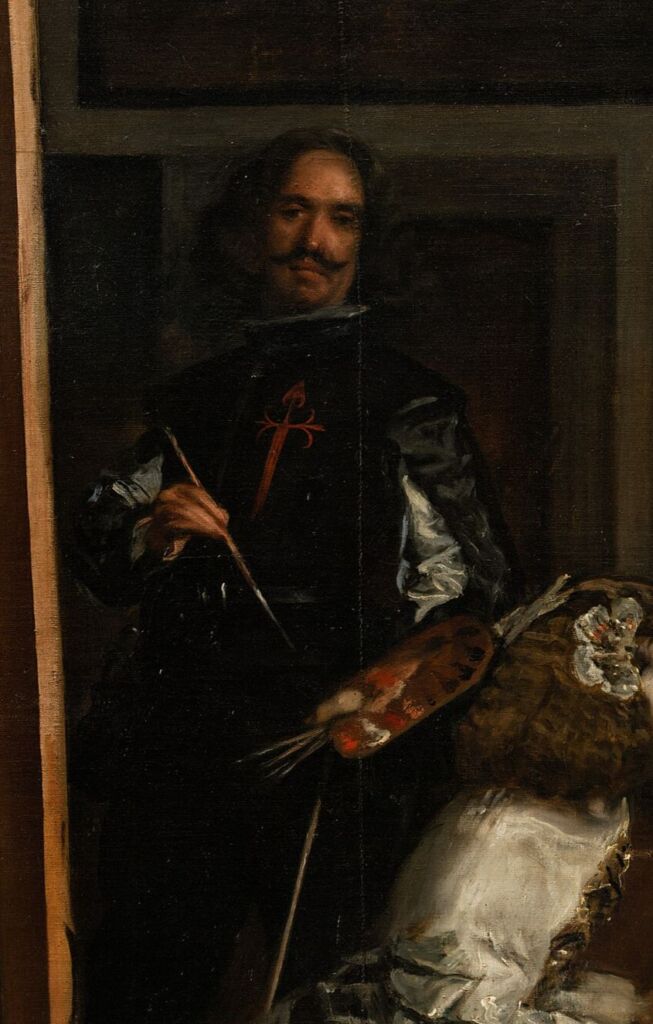
Knighthood took nearly a year and a half. The king granted him the habit of Santiago in the summer of 1658, but the order’s council demanded proof of noble ancestry. Almost 150 witnesses were questioned in Galicia, Madrid and Seville.
The council never accepted the nobility of some forebears (his paternal grandmother and both maternal grandparents), and a dispensation from Pope Alexander VII was needed. Velázquez was knighted in November 1659 and died within a year.
He had sought this all his life. The order’s statutes expressly barred anyone who painted for money, and witnesses swore that Velázquez worked only for the king and sold nothing. The historian Jaime de Salazar calls this testimony “utterly unreal” (translated here by Hroniki).
The art historian Jonathan Brown read the whole picture as a claim for the nobility of painting. The artist shares a room with the infanta and wears a courtier’s key; the king and queen appear only as a reflection in his studio.
So who added the cross? None of the theories is proven. Palomino says it was painted in after the artist’s death by the king’s order: “Some say that it was His Majesty himself who painted it.” The legend of Philip IV knighting his friend on canvas with his own hand persists. Salazar dismisses it (in Spanish) as “merely a legend.”
A Portuguese treatise of 1696 already describes the self-portrait with the cross. The simplest explanation is that Velázquez added it himself; he had more than eight months between knighthood and death. Later observers noted that the cross was laid down with at least seven confident strokes, the work of a practiced hand.
The Alcázar fire of Christmas 1734
On Christmas Eve 1734 fire broke out in the Alcázar. It burned for four days and took more than five hundred paintings with the palace. Las Meninas, the story goes, was pulled from its frame and thrown out of a window. The frame was lost, the canvas damaged.
The painter Juan García de Miranda restored it. As the art historian José López-Rey established, Miranda repainted nearly all of the infanta’s left cheek. The canvas was also trimmed on both sides, more on the right; when and why is unknown.
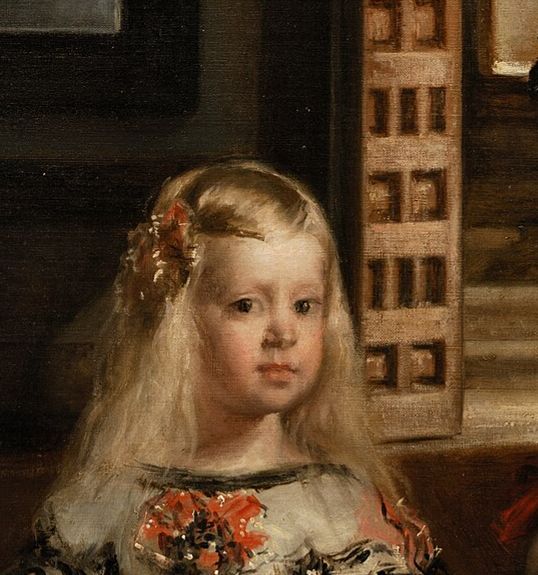
So the face admired as a model of Velázquez’s brushwork was partly painted by another artist in the 18th century, which is easy to forget up close.
In the inventory of 1666 the picture was listed as the infanta with “her ladies-in-waiting and a female dwarf.” Later it was called The Family of Philip IV, or simply The Family: the 1794 inventory records a “picture called the Family of Philip IV.”
The name Las Meninas first appeared in print in the Prado catalog of 1843. The museum’s inventory of 1857 settles on a compromise: “picture called Las Meninas.”
A new name meant a new way of seeing. The court cared about the king’s family; for the 19th-century public, the heroes were the girls, who had upstaged the king in his own family portrait.
“The theology of painting”
The most famous praise of Las Meninas was also recorded by Palomino (in Spanish). Luca Giordano, the Neapolitan painter who came to the Spanish court in 1692, was shown the picture, and King Charles II asked what he thought. “Sire, this is the Theology of Painting,” Giordano replied. As theology ranks above the other sciences, Palomino explained, so this picture is the summit of painting.
Palomino himself thought it “reality, and not painting.” Light sustains the illusion: it gathers on the infanta and the meninas, fades toward the mirror wall and flares again in the doorway behind Nieto.
For 19th-century painters, Velázquez was a revelation. Édouard Manet went to Madrid in 1865 to see Velázquez in the Prado and afterward called him “the painter of painters.”
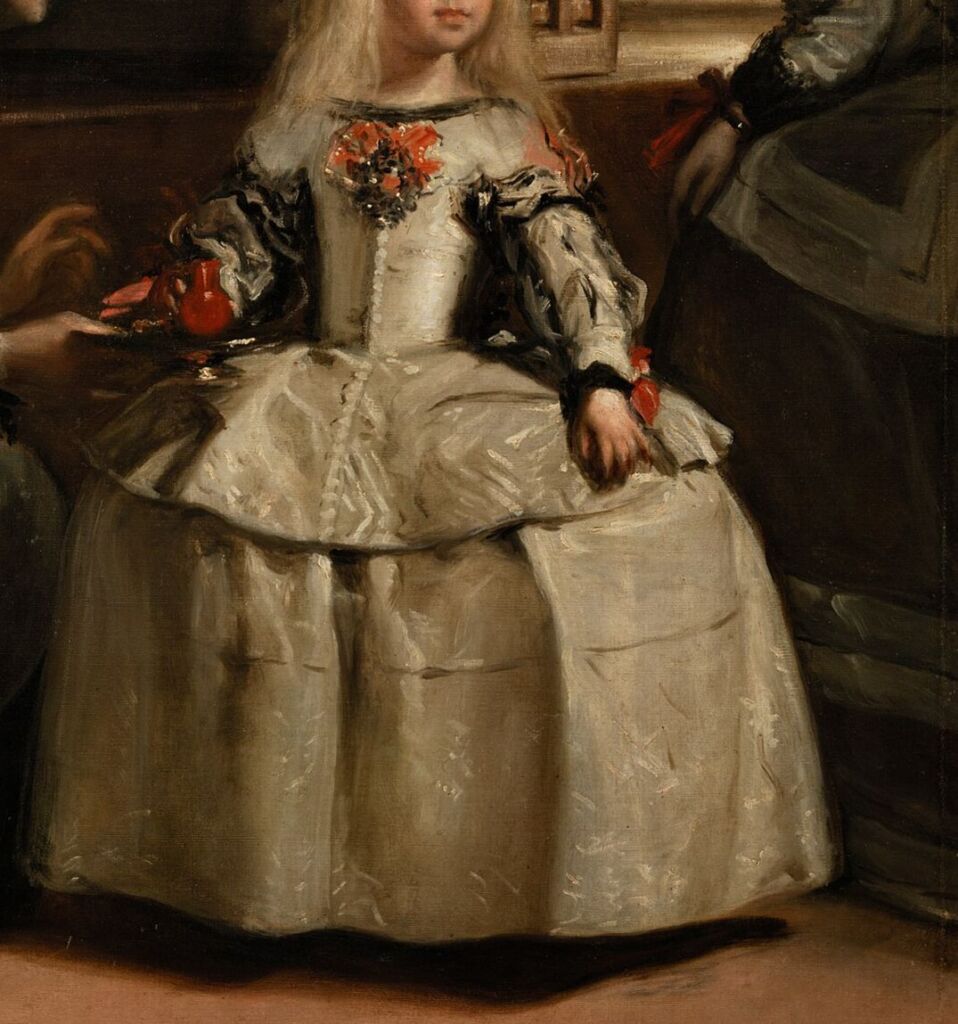
Up close, the infanta’s dress dissolves into quick, separate strokes; from a distance it becomes silk and ribbons. That loose handling put Velázquez closer to Manet than to the academic painting of Manet’s own day.
In the second half of 1957 Pablo Picasso painted 45 variations on Las Meninas and later gave the whole series to the Museu Picasso in Barcelona so it would not be split up. He rearranged the figures, changed their scale and reduced the infanta to a few planes of color, yet she is recognizable in every one.
In the Prado’s Room 012 a crowd nearly always stands before Las Meninas. Step aside and stand where, by the picture’s logic, the king and queen should be, and you see why in more than 350 years no one has fully explained it. Velázquez filled the room to the brim and left only one place empty: the one where the viewer stands.
Comments
For Hroniki readers
Comments are open to readers with an account. Signing up is free and takes a few seconds.
No comments yet. Start the conversation.