Clara Peeters: seven self-portraits hidden in reflections
In a 1611 still life at the Prado, Clara Peeters appears seven times, reflected in a goblet and a jug. In Karlsruhe she shows up with a palette in a gold cup; in The Hague her name is engraved on a knife.
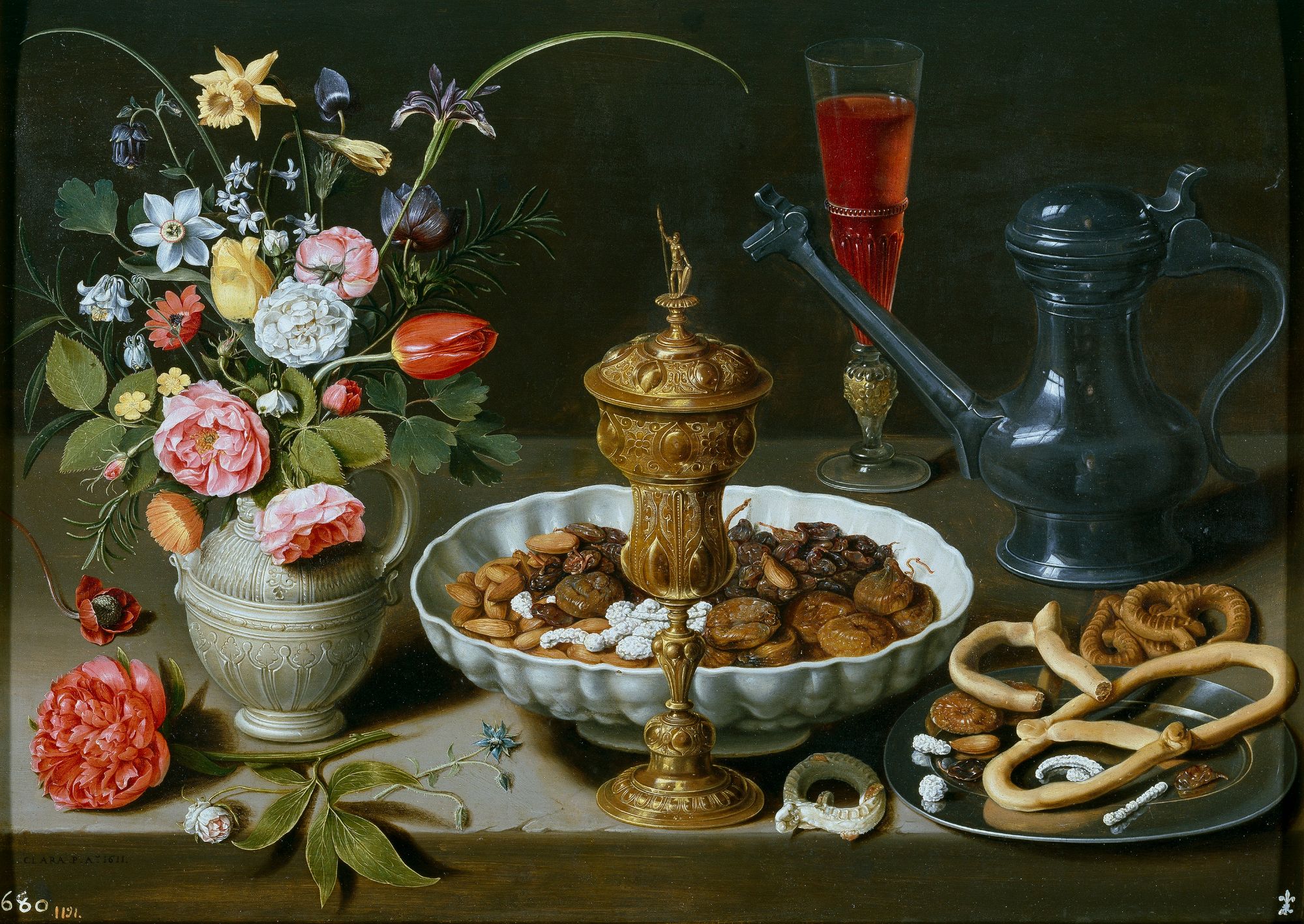
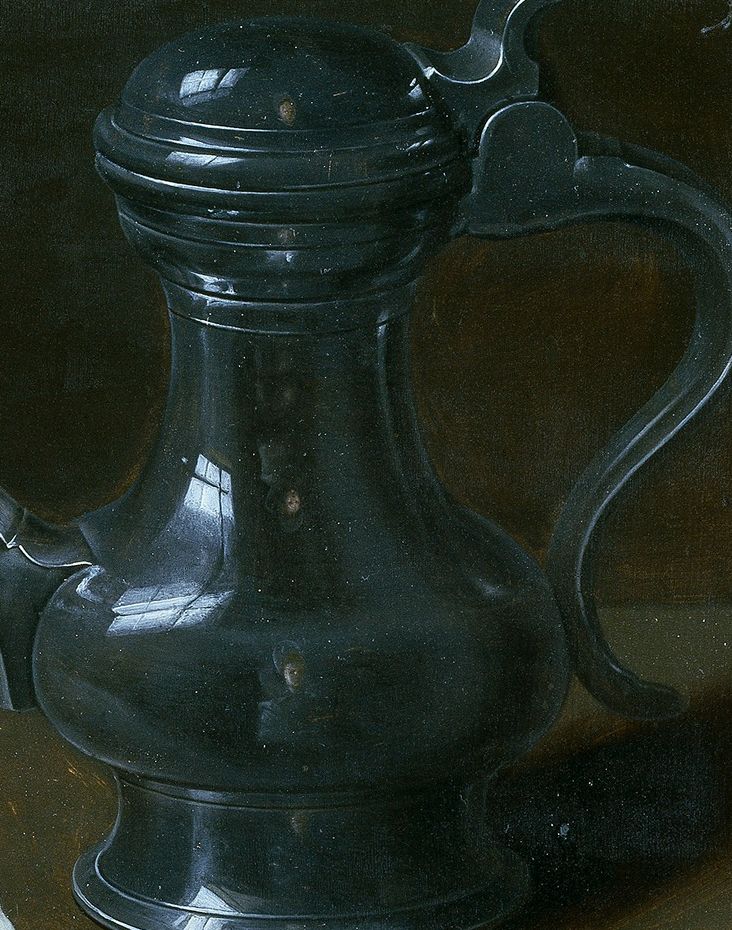
Clara Peeters’s still life in the Prado holds flowers, wine, pretzels, a silver-gilt goblet and, seven times over, the painter herself: three tiny self-portraits reflected in the goblet, four on a pewter jug. From a few steps back, they pass for highlights.
Little is known about her. Born around 1588–90, she seems to have worked in Antwerp: her panels are stamped with the Antwerp mark, and a document describes her as an Antwerp painter. Her earliest dated pictures, of 1607 and 1608, were painted when she was still very young. Her name is missing from the surviving records of the Antwerp painters’ guild, so the paintings do most of the talking.
Seven faces on one table
The Prado’s catalog entry reads the reflections two ways. Painting herself heightens the illusion, as if we had caught her at work. It was also a way of asserting herself in a profession with almost no women.
The panel, 52 by 73 centimeters and signed “CLARA. P. A° 1611,” later entered the collection of Isabella Farnese, queen of Spain. Her collector’s mark, a fleur-de-lis, is still visible at lower right. The painting now hangs in Room 082.
In the fall of 2016, Peeters became the first woman painter to be given an exhibition at the Prado. One room held 15 of her roughly 40 known still lifes. The curator, Alejandro Vergara, told NPR: “So she’s really trying to be seen.”
A palette in a gold cup
The Madrid picture is not a one-off. Reflected self-portraits turn up on vases and goblets in at least eight of her paintings. They are easiest to see in a panel of 1612 at the Staatliche Kunsthalle Karlsruhe. On the right stands a tall cup studded with bosses, each a small convex mirror, and in several of them the artist appears, each time from a slightly different angle. The museum’s own note is simple: Peeters immortalized herself in the gold cup.
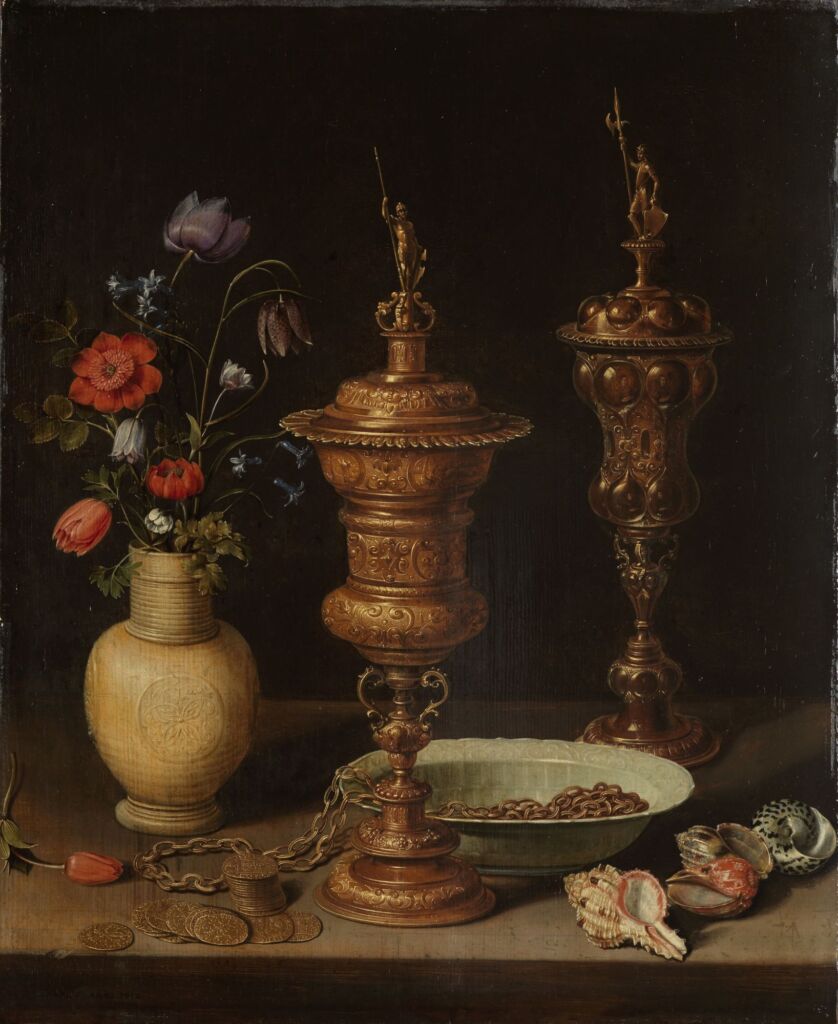
In one of those reflections she holds a palette and brushes, a credential as much as a likeness. Beside her, a reflected window glows in the gold.
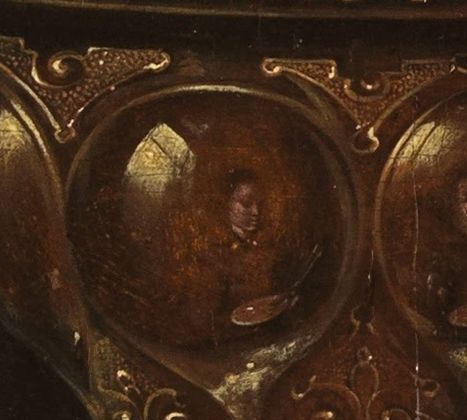
Coins, shells and wilting flowers on the same table hint at how quickly wealth slips away, the vocabulary of Dutch vanitas still lifes.
A name on a knife, a face on a lid
Around 1615 she painted a small panel of cheeses, almonds and pretzels; the Mauritshuis in The Hague acquired it in 2012. The pewter lid of an earthenware jug catches her face, and a second, far more distorted one can be made out on the rim of the lid.
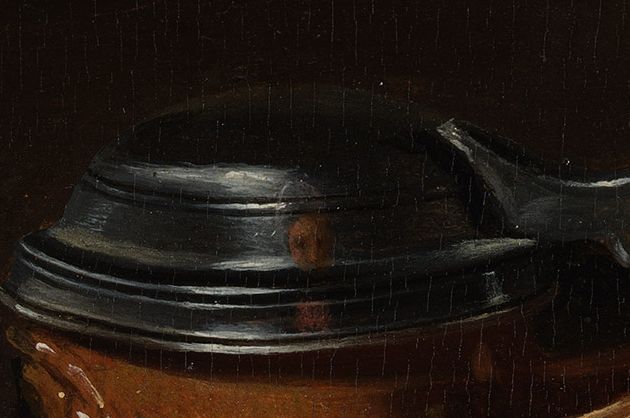
On the same table lies a silver wedding knife with “.CLARA.PEETERS.” engraved on the handle. She usually signed just “CLARA P.,” so the full name is rare. The knife appears in at least five of her still lifes. It may have been a wedding gift to her, though no marriage is documented. Three knives in her paintings also bear the Antwerp mark on their blades.
The Mauritshuis counts Peeters among the first painters to use a reflected self-portrait as a second signature. The idea of leaving oneself in a picture is older: think of Jan van Eyck’s inscription above the mirror in The Arnolfini Portrait.
A generation later in Haarlem, Judith Leyster signed her work with a monogram and a star, yet one of her pictures was sold for years as a Frans Hals. A signature can be painted over or forged. A face dissolved into the glints of gold has to be noticed first. Peeters seems to have understood that: in a single still life at the Prado, she painted herself seven times.
Comments
For Hroniki readers
Comments are open to readers with an account. Signing up is free and takes a few seconds.
No comments yet. Start the conversation.