Albrecht Dürer: from a boy at the mirror to the Four Apostles
At 13 he drew himself from a mirror; at 28 he painted himself the way icons showed Christ. The life of Albrecht Dürer, from his father's goldsmith shop to Venice, an imperial pension and a last gift to Nuremberg.
In 1484 the 13-year-old son of a Nuremberg goldsmith sat before a mirror and drew himself in silverpoint. A metal stylus leaves a line on prepared paper that cannot be erased, so every stroke had to be final. The sheet is in the Albertina in Vienna, and the museum calls it the earliest known drawing by a child.
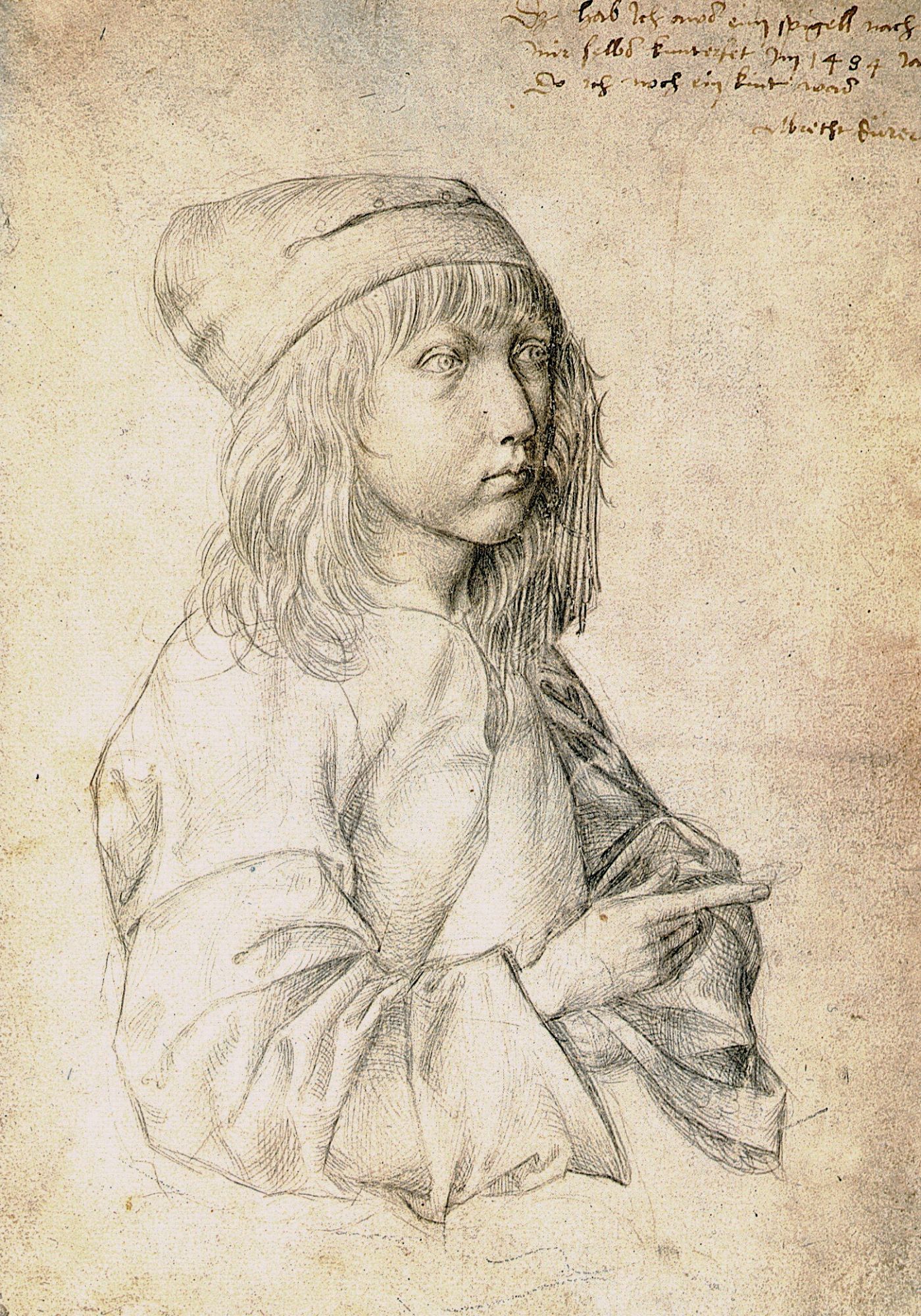
The inscription in the corner came much later, probably in the 1520s: “This I drew of myself from a mirror when I was still a child. Albrecht Dürer” (translated here by Hroniki). It is how a man labels an old sheet once he knows what his beginnings are worth.
By then collectors across Europe knew his monogram, A and D, and Italian engravers were trying to fake it.
Hungarian roots and Wolgemut’s workshop
The artist’s father, Albrecht Dürer the Elder, came from Gyula in Hungary; his forebears lived in the nearby village of Ajtós. In Hungarian ajtó means “door,” in German Tür. Hence Türer, then Dürer: a surname translated from one language into another. His son and namesake was born in Nuremberg on May 21, 1471.
In Nuremberg the Hungarian goldsmith, after years of travel, joined the workshop of Hieronymus Holper and married his daughter Barbara. They had eighteen children; three lived to adulthood. Young Albrecht first learned his father’s craft of cutting metal. That goldsmith’s hand would show in every one of his copperplates.
In 1486 the boy was apprenticed to the painter Michael Wolgemut. The workshop made woodcuts for big printed books, and Dürer entered a craft he would overturn twelve years later.
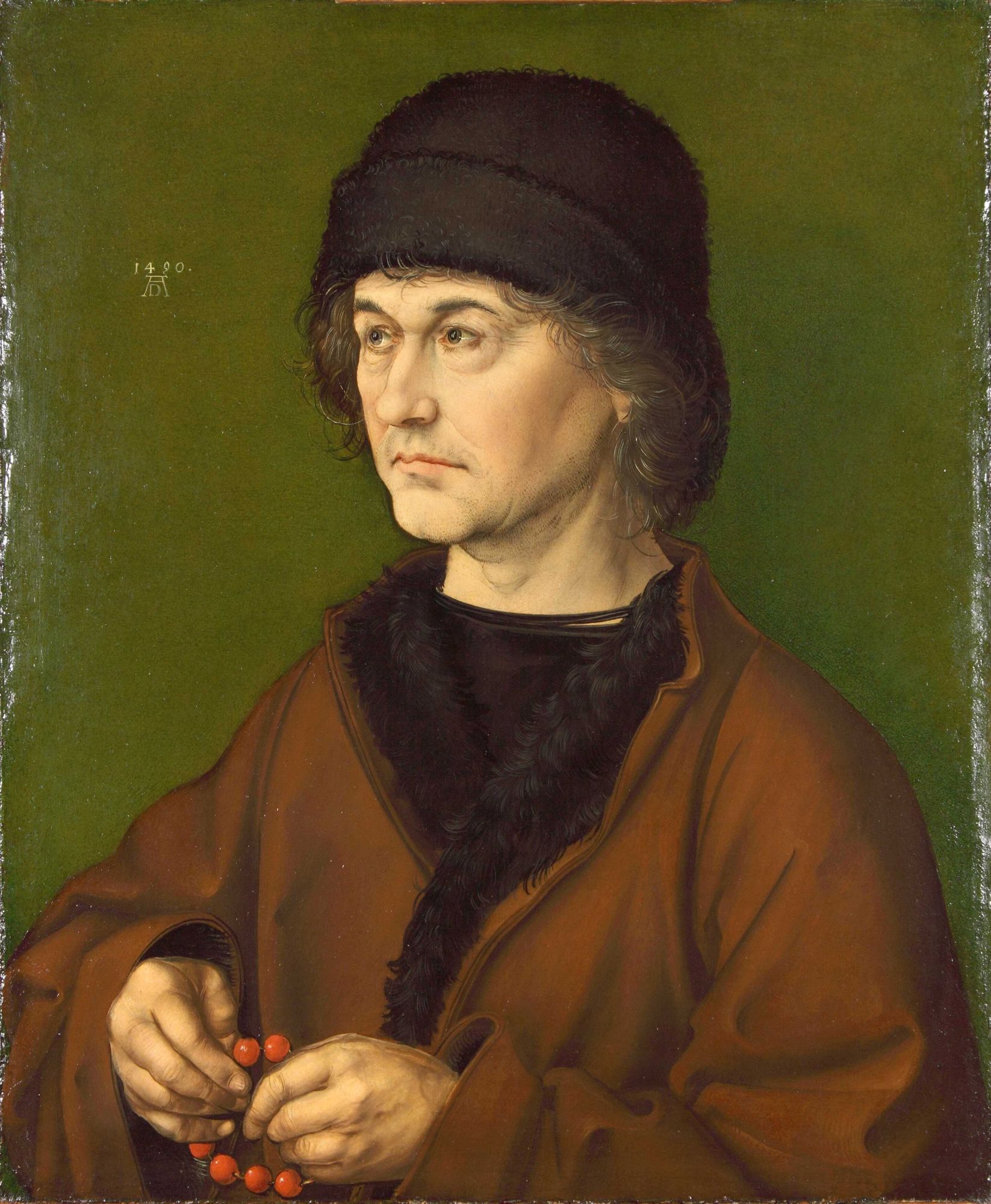
His earliest known painting is a portrait of his father from 1490, now in the Uffizi in Florence. The old goldsmith fingers a rosary; on the back of the panel are the joined arms of the Dürers and the Holpers. It probably had a pendant portraying his mother.
A sprig of sea holly in the bridegroom’s hand
In 1490, as custom required, the young journeyman set off on his travels. He made for Colmar, hoping to find Martin Schongauer, the finest engraver in Germany, then went on to Basel and Strasbourg. Schongauer died before he arrived. In Basel Dürer cut his first securely attributed woodcut: Saint Jerome pulling a thorn from a lion’s paw.
In 1493, still far from home, he painted himself on parchment holding a prickly sprig of sea holly. In German the plant was called Männertreu, “men’s fidelity,” and the picture is often read as a gift for his bride. Another reading: the spines recall the crown of thorns. The inscription above strikes a humble note: “My affairs go as ordained on high.”
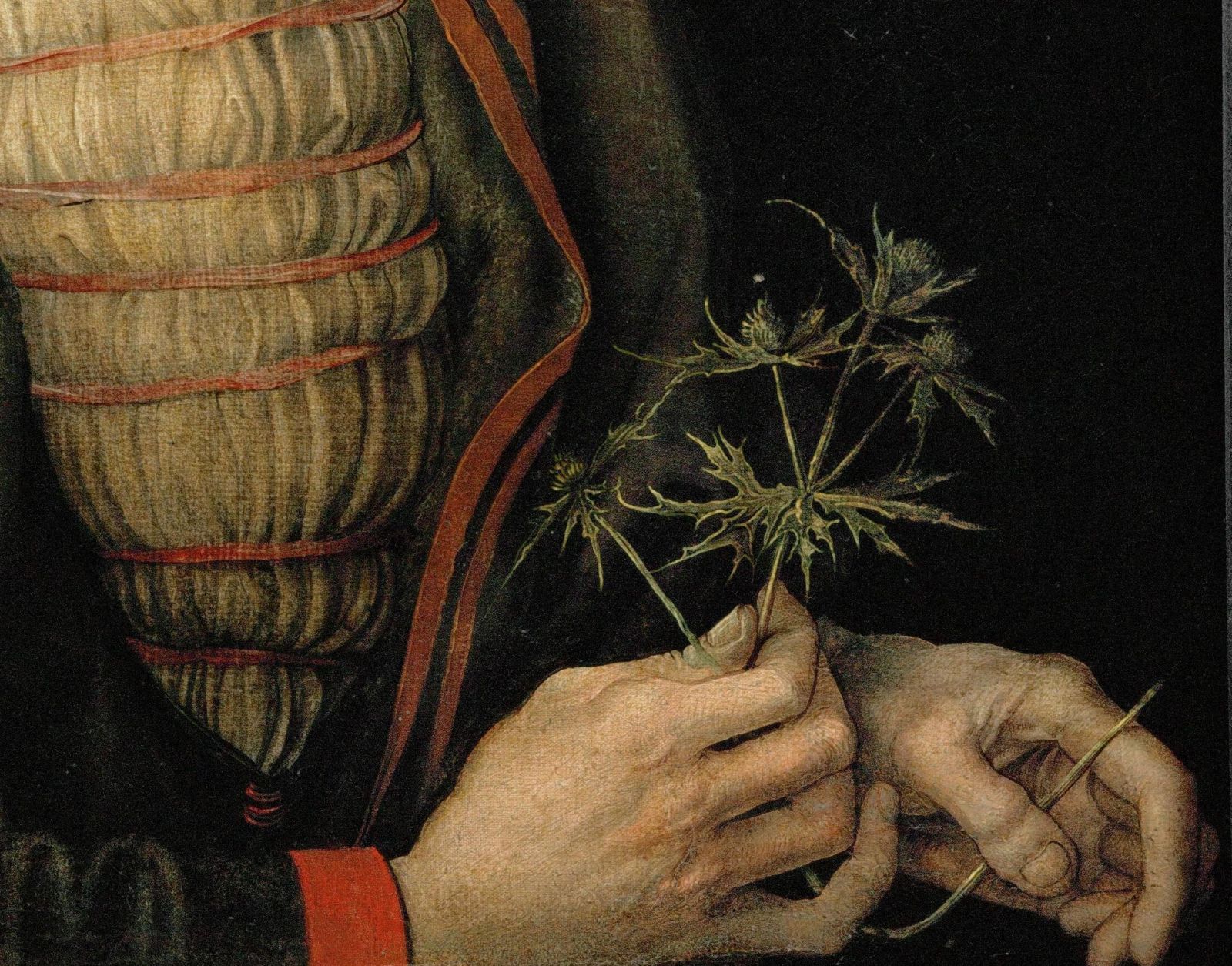
The wedding came in summer 1494; the bride was Agnes Frey, daughter of a prosperous Nuremberger. That autumn plague broke out, and the young husband left for Venice. There he saw Italian painting and prints at close range and came to know the work of Giovanni Bellini, returning home in spring 1495.
The Apocalypse and the AD monogram
Home again in 1495, Dürer opened his own workshop, and in 1498 came the book that made him famous, the Apocalypse. Its fifteen large woodcuts on the Revelation of Saint John appeared when many expected the world to end with the century. Dürer published it himself, in Latin and German.
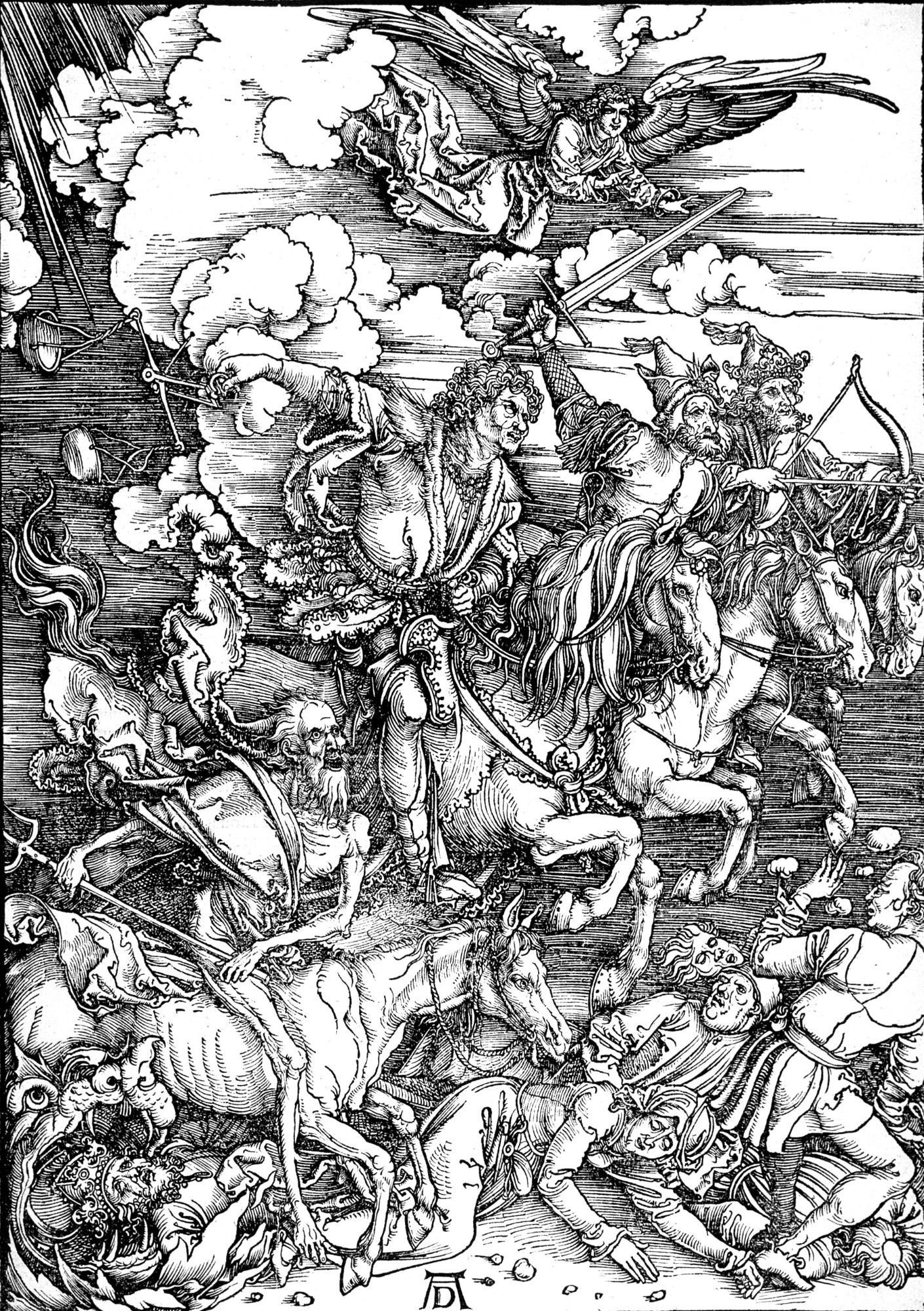
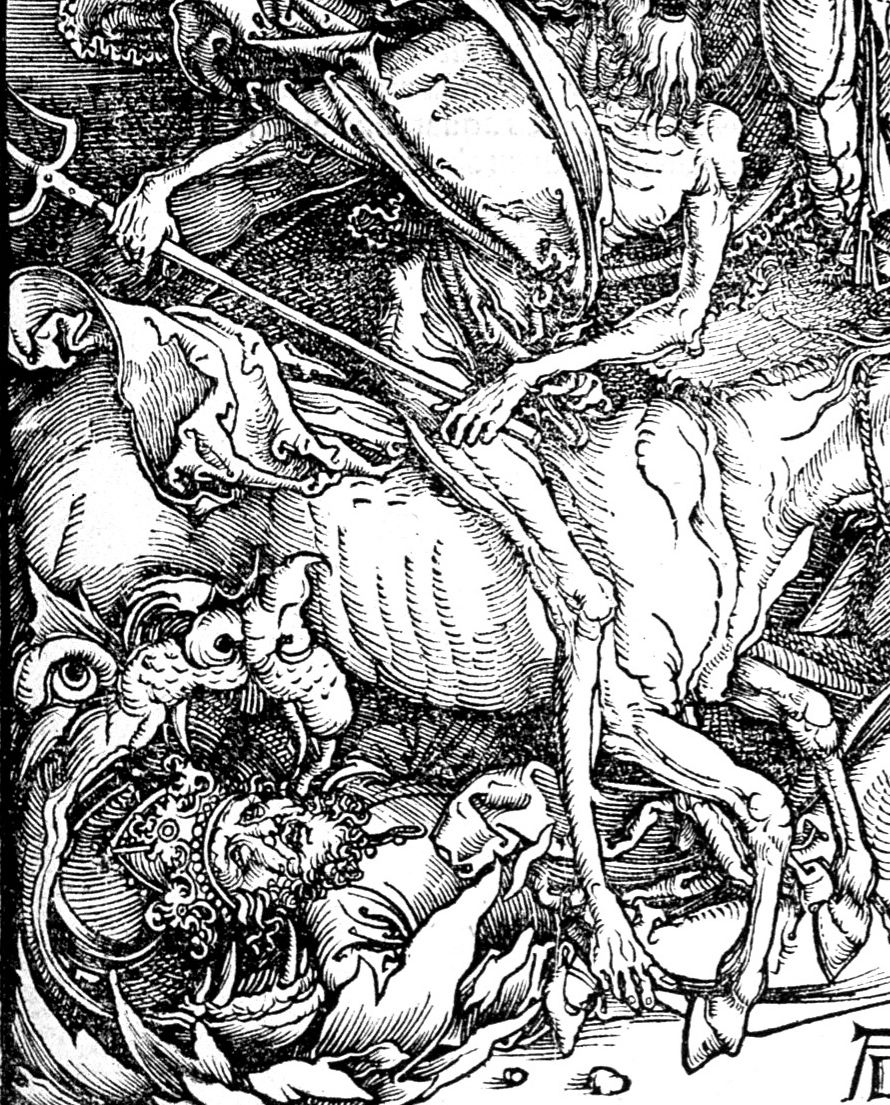
The best-known sheet is The Four Horsemen. Before Dürer, a woodcut was usually a book illustration in plain outline. Here the line acts like a burin on copper, modeling volume, making wind and light. In the lower corner the jaws of hell swallow a bishop in his miter: not even the clergy escape judgment.
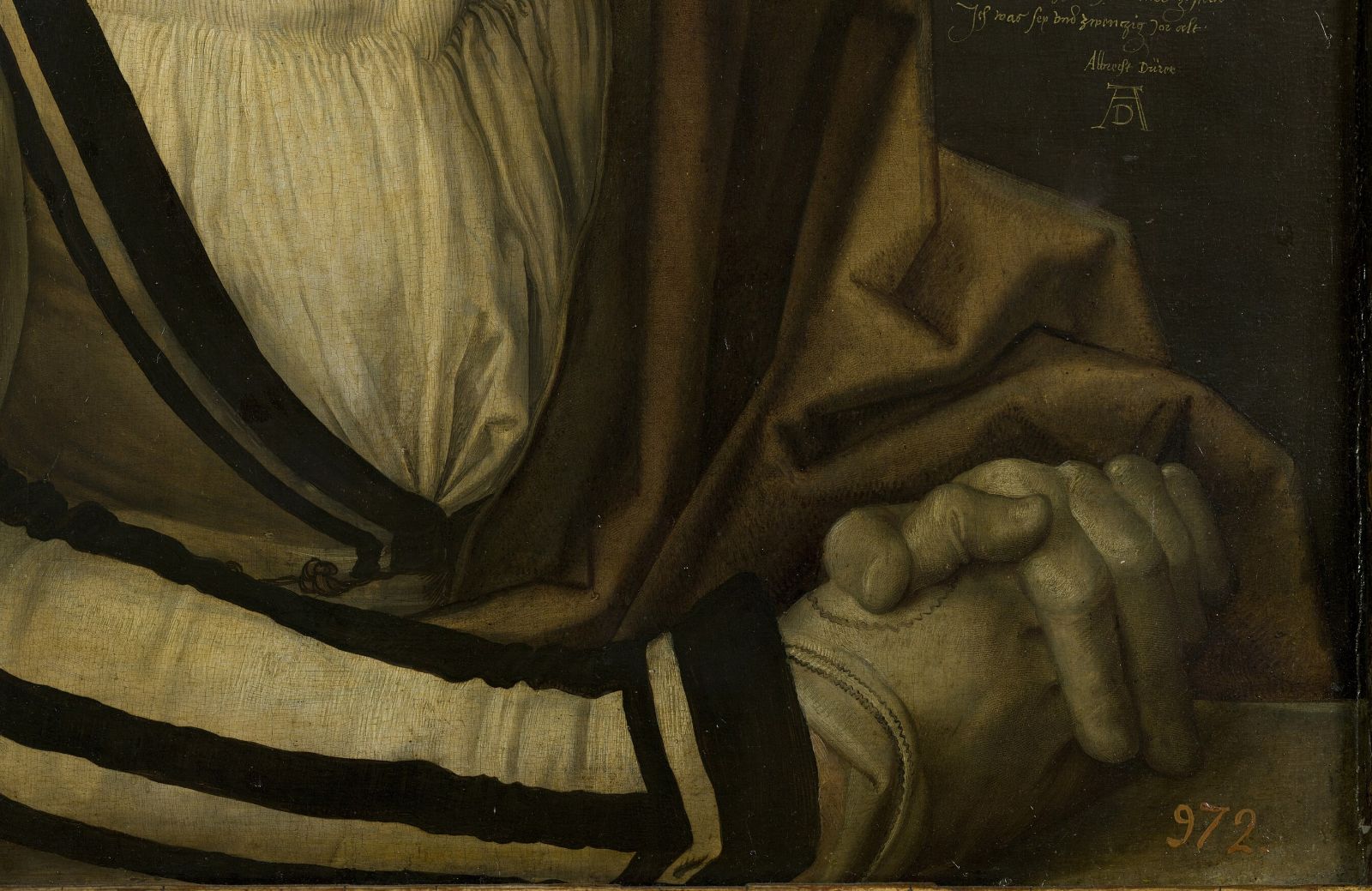
In these years the monogram settled onto his sheets: a D between the legs of a large A. The letters served as a workshop mark and a guarantee of quality, which is exactly why they would be forged.
In 1498 he painted himself as anything but a craftsman. In the self-portrait now in the Prado he wears a fine doublet, a striped cap and gray kid gloves. The museum explains that the gloves signaled high standing: a learned artist, not a tradesman.
The Munich self-portrait and the hare
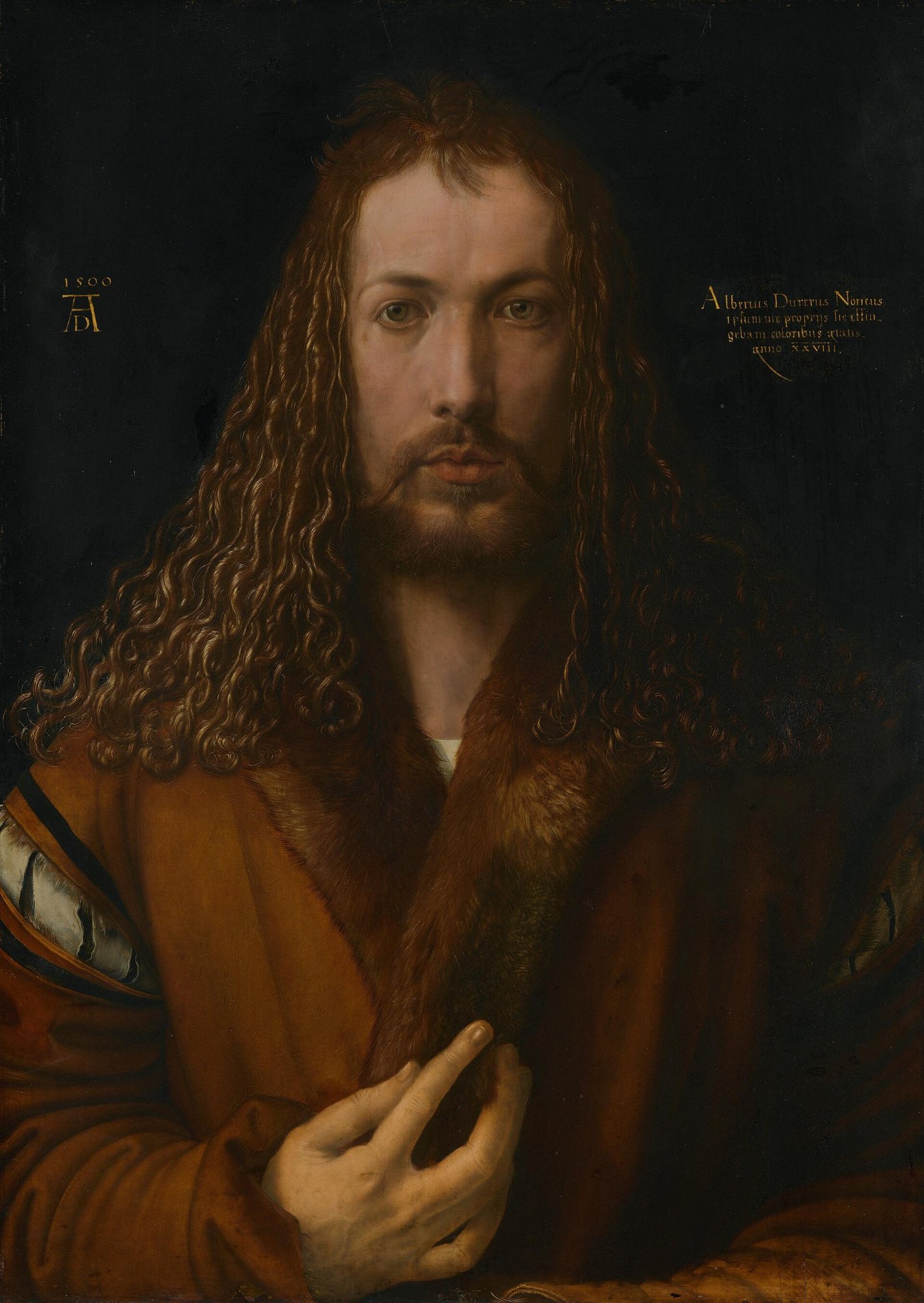
In 1500 Dürer painted Self-Portrait at Twenty-Eight, now in the Alte Pinakothek in Munich. Strict frontality, symmetry, long hair: this is how icons showed Christ. The 28-year-old is not blaspheming but declaring that the gift of creation comes from above.
The Pinakothek stresses two things, the direct gaze and the hand. The eye sees, the hand makes: that is the whole program. The Latin inscription at right says that Albrecht Dürer of Nuremberg portrayed himself “in appropriate colors.” Propriis means both “his own” and “appropriate”: his own paints, and those that befit the subject.
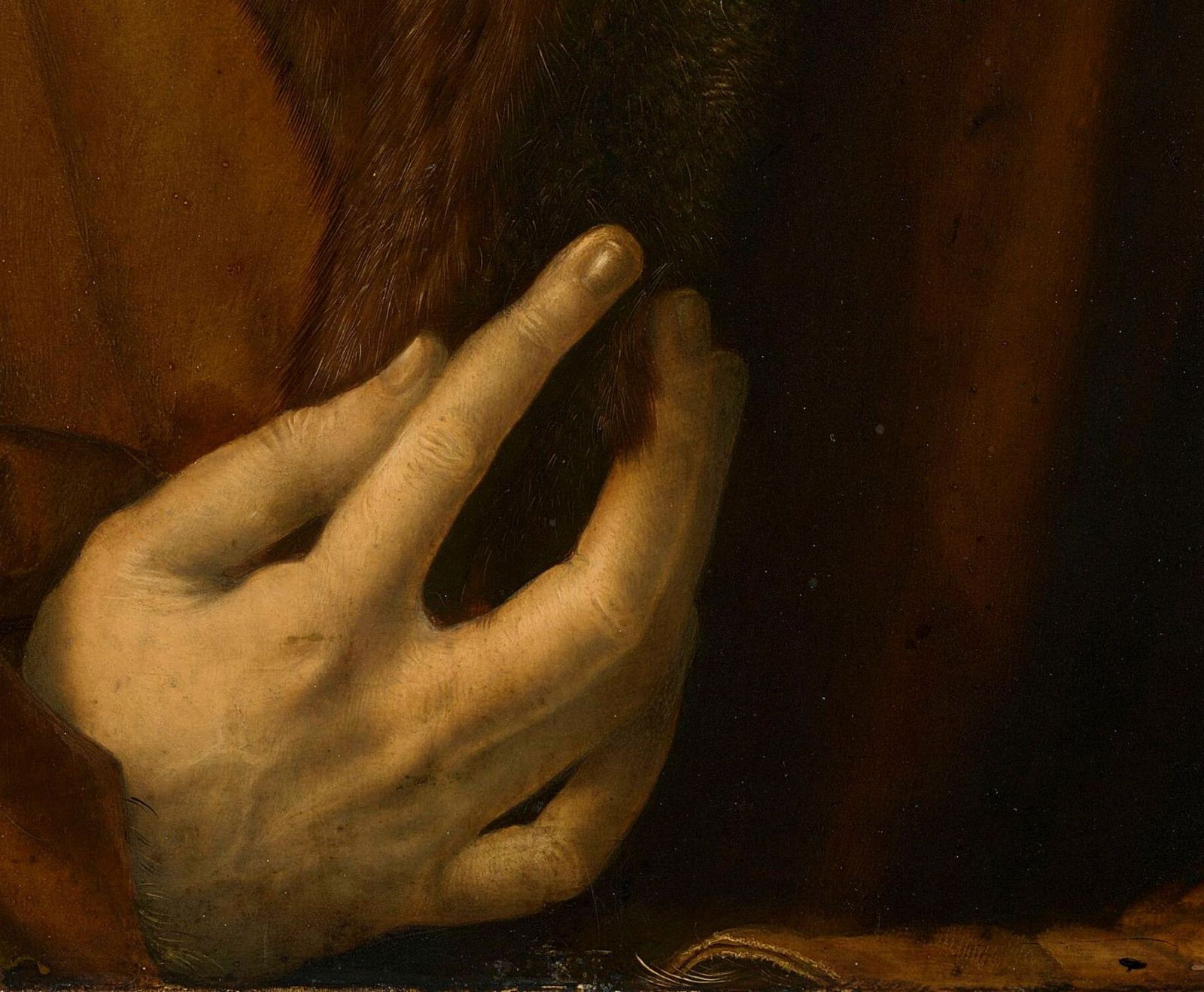
The painting apparently hung on view in Nuremberg for a long time; the city sold it to the Bavarian collection only in 1805, nearly three centuries after his death.
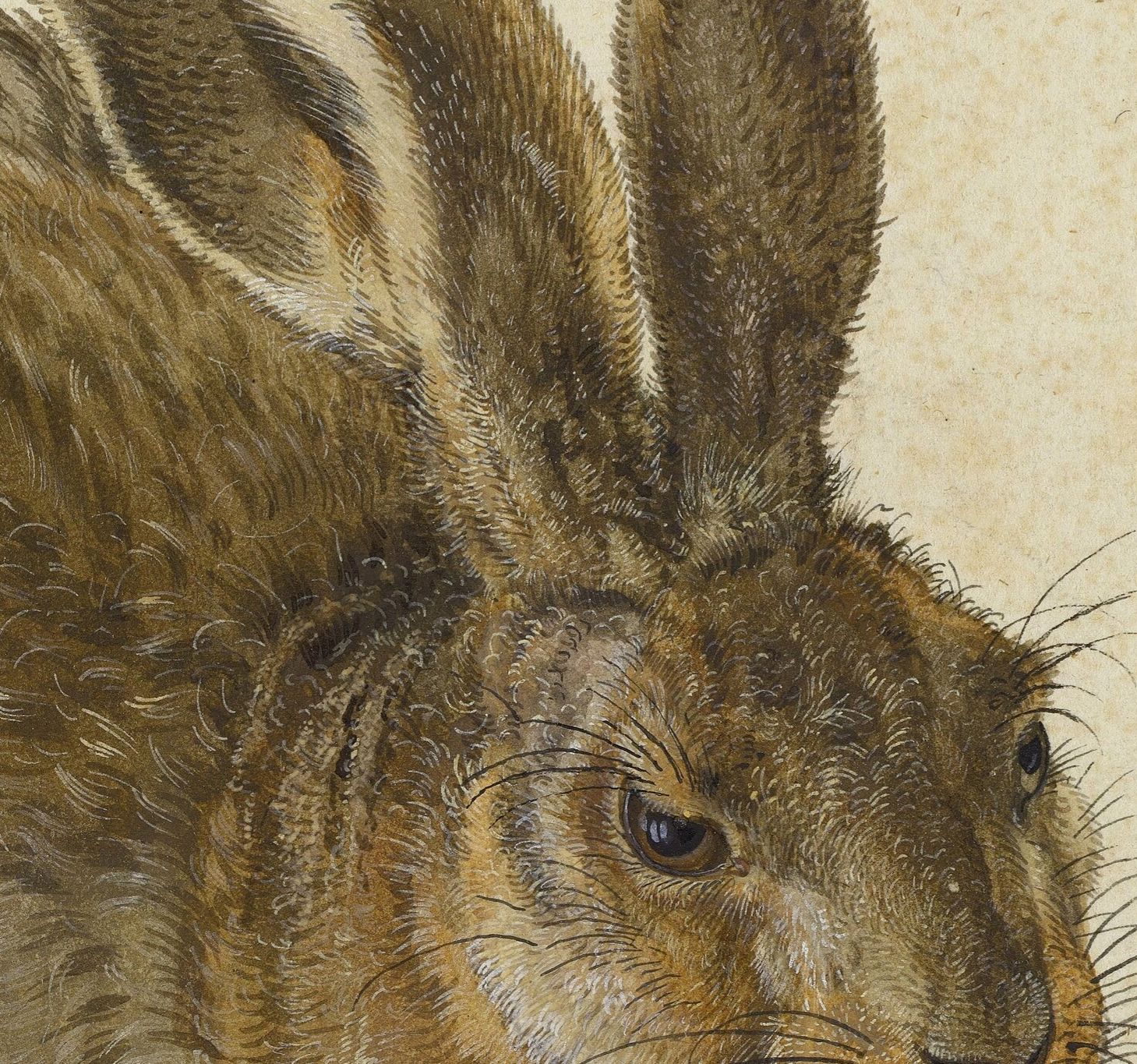
The same hand that set down every hair of that fur collar painted the watercolor Young Hare in 1502. No two strokes in its coat are alike, and the studio window is reflected in its eye. The Albertina rarely shows it: the paper is shielded from light, and the original comes out only every few years.
Venice again, and the forgers
In autumn 1505 Dürer was back in Venice, this time for a long stay. His letters to his friend, the humanist Willibald Pirckheimer, are his liveliest voice (quoted from Rudolf Tombo’s 1913 English translation).
In February 1506 he complains that many local painters are his enemies and “copy my work in the churches.” Then, of Bellini: “He is very old and yet he is the best painter of all.”
German merchants commissioned an altarpiece for their church, San Bartolomeo: the Feast of the Rose Garlands. The Virgin sets a wreath of roses on the head of Maximilian I, the future emperor. At right, under a tree, stands Dürer, holding a sheet with his name and the date. A restoration in 1839–41 altered many heads, but the artist’s face survived.
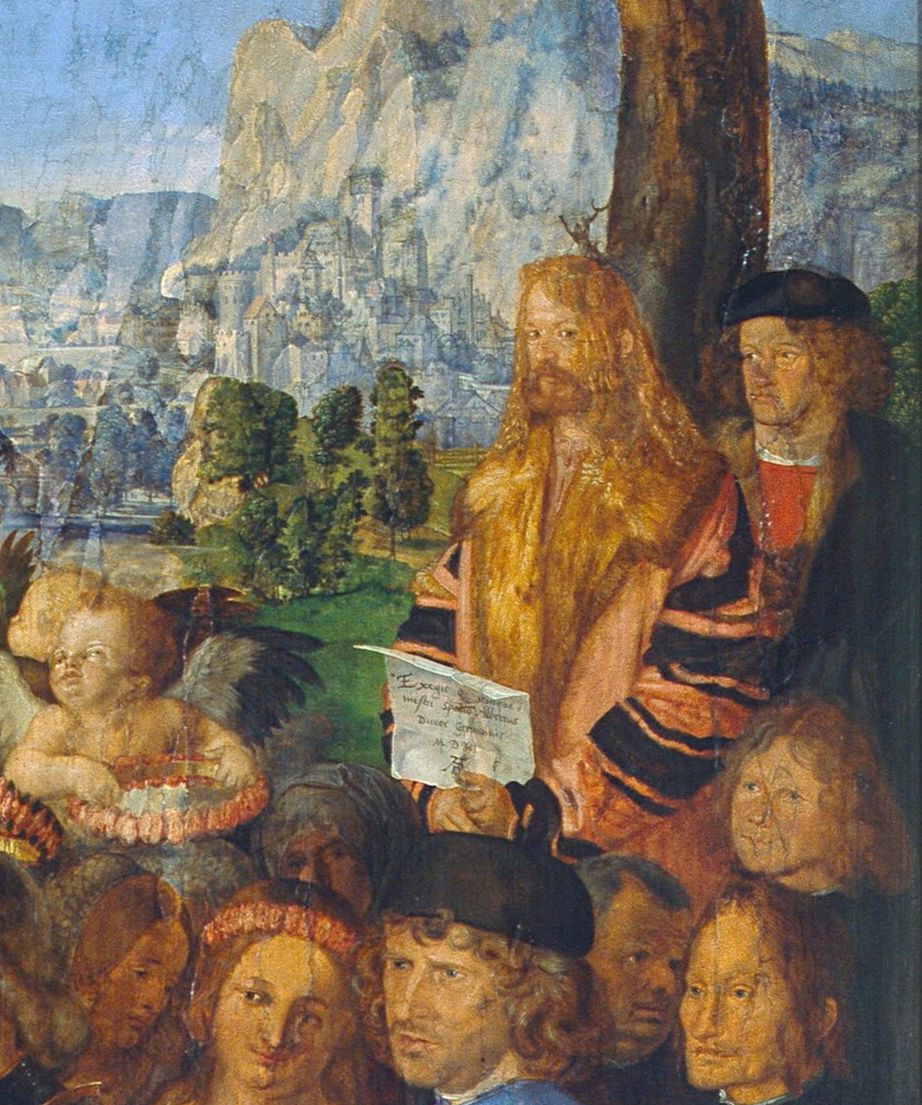
In September 1506 Dürer wrote proudly to Pirckheimer: “The Doge and the Patriarch have seen my picture.” He had silenced, he added, every painter who said he was a good engraver but could not handle color. Before leaving, in October, came his most quoted line: “How I shall freeze after this sun! Here I am a gentleman, at home a parasite.”
Exactly a century later Emperor Rudolf II bought the altarpiece and took it to Prague, where it hangs today in the National Gallery.
Also in Venice, according to Giorgio Vasari, Dürer ran into a young Bolognese, Marcantonio Raimondi, who was copying the woodcuts of Dürer’s Life of the Virgin on copper, monogram and all. Dürer complained to the Venetian authorities. The result was a half measure: the monogram was banned, but copying the compositions was allowed.
Dürer answered five years later. In 1511 he published the Life of the Virgin as a book and, in the colophon, addressed the copyist directly as “thou”: a crafty thief of other men’s labor and wit, forbidden to touch his works. Behind the words stood an imperial privilege threatening forgers with confiscation of their property.
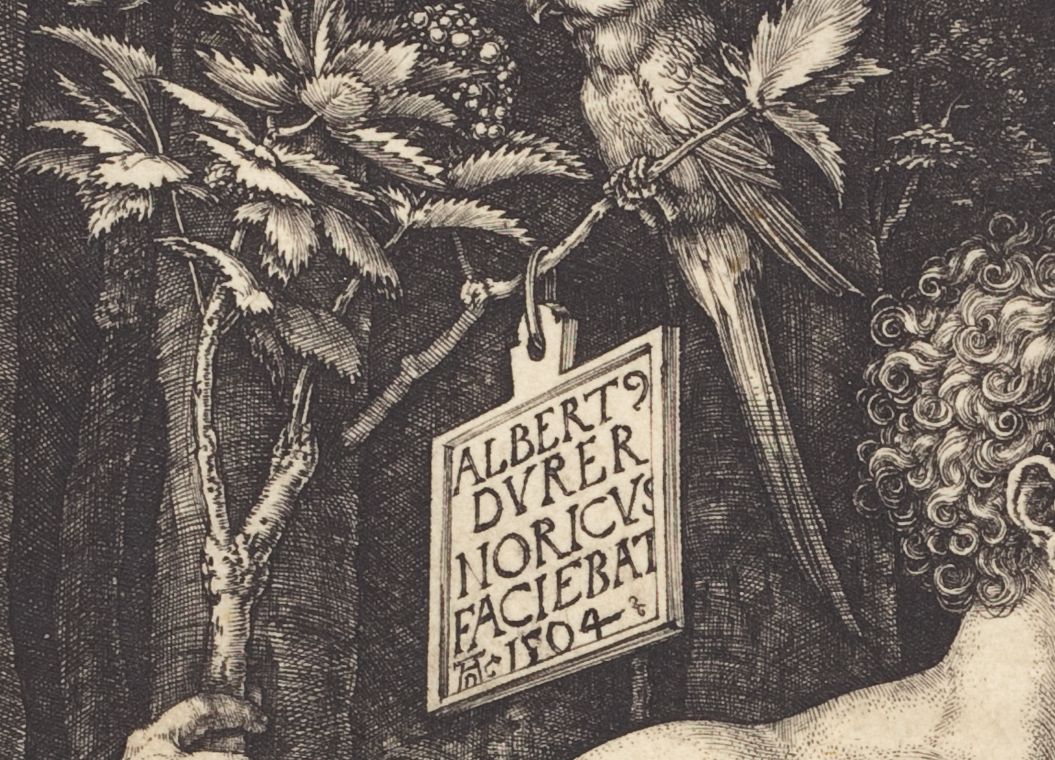
Earlier, in 1504, he made the engraving Adam and Eve, the only one he signed with his full name. A tablet hangs from a branch beside Adam: “Albrecht Dürer of Nuremberg made this.” A monogram can be copied; a full name written into Eden reads like a signature on a deed.
The master engravings and service to Maximilian
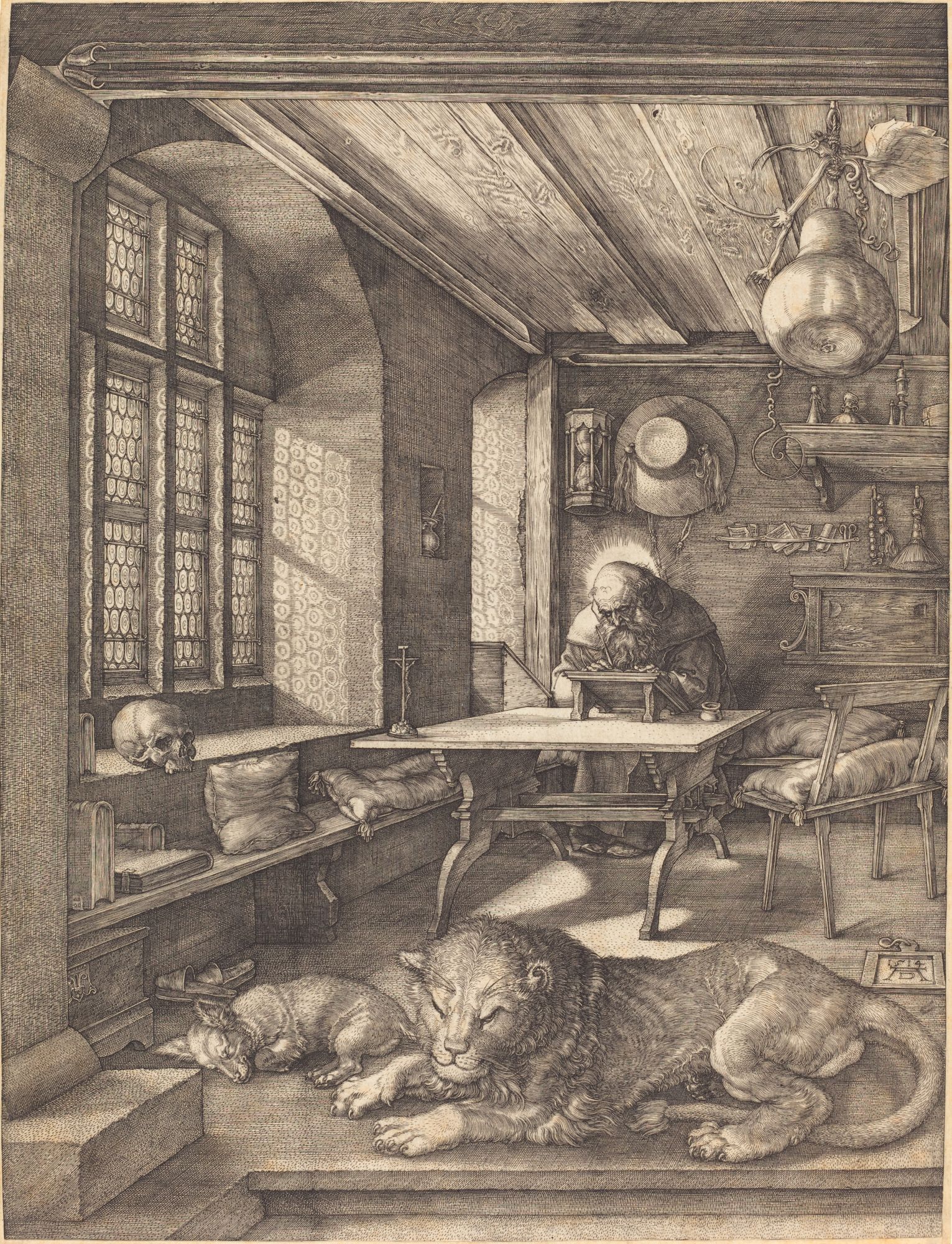
In 1513–14 Dürer engraved three plates later called his master engravings: Knight, Death and the Devil, Saint Jerome in His Study and Melencolia I. They were made not for pious buyers at a fair but for connoisseurs ready to study every line.
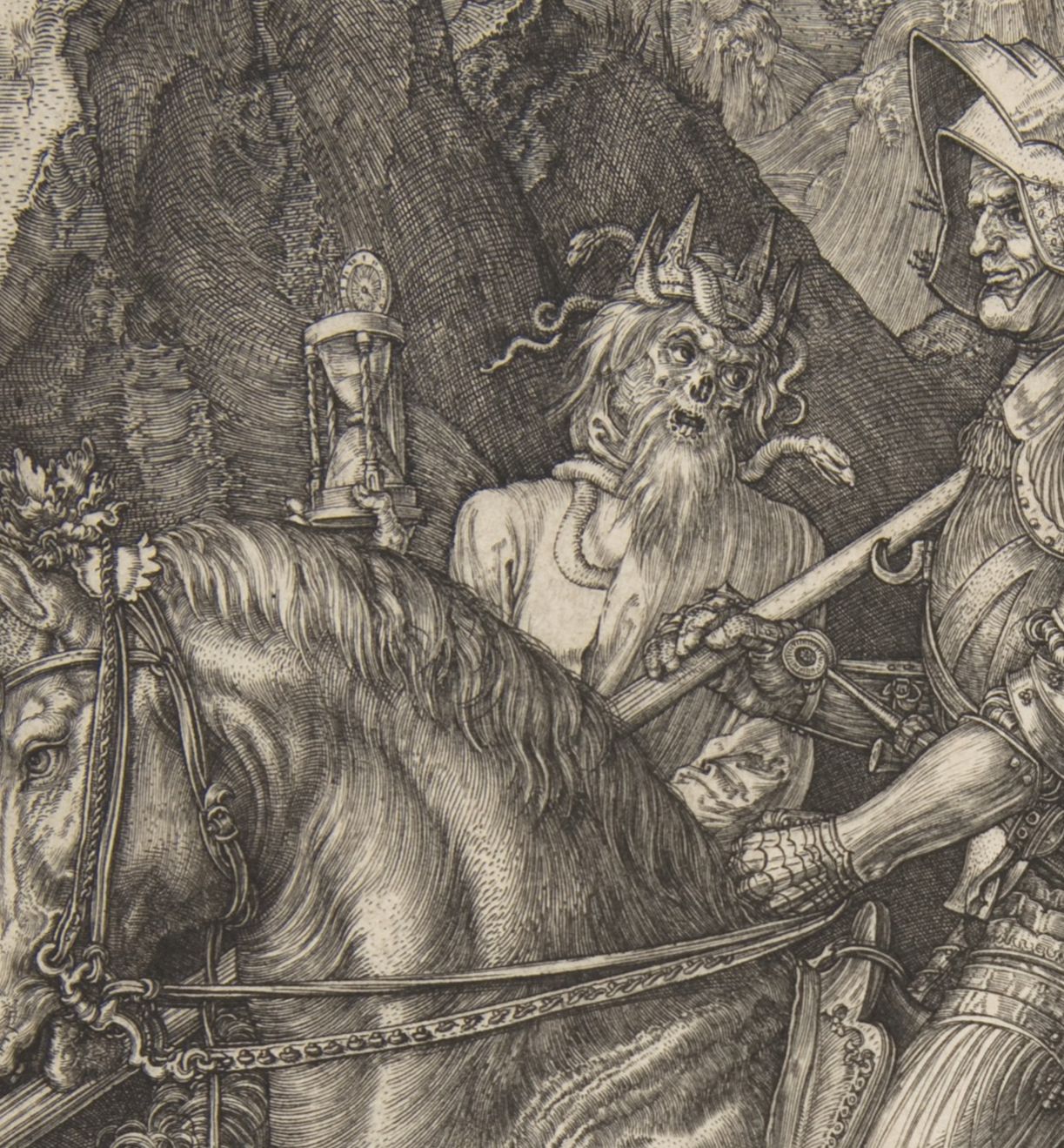
In the Knight, Death holds up an hourglass to the rider, who rides on without turning his head. Melencolia I is the most puzzling of the three, down to the magic square in which Dürer worked the date 1514.
From 1512 Dürer worked for Emperor Maximilian I, drawing marginal decorations for a prayer book and giant woodcuts glorifying the Habsburgs. The emperor asked Nuremberg’s council to exempt him from taxes.
In 1515 Maximilian granted him a lifetime pension of 100 guilders a year. That year Dürer also made a woodcut of a rhinoceros he had never seen, a story for another day.
A year in the Netherlands
Maximilian died in January 1519, and the pension needed confirming by his successor, Charles V. In July 1520 Dürer and his wife set out for the Netherlands, where the court was gathering. His diary there is essentially an account book: what a meal cost, who got a print, what earned him a guilder or two.
In Antwerp the painters’ guild gave a banquet in his honor: “everyone on both sides stood up as if they were leading some great lord.” In Brussels he saw the gold and weapons sent to Charles from Mexico: “all the days of my life I have seen nothing that reaches my heart so much as these.”
Prints were his currency. To Margaret of Austria, regent of the Netherlands, he gave a seated Jerome; an acquaintance got the Knight for a snail shell and some coins. The pension was confirmed in November 1520. Later Margaret so disliked his portrait of the late emperor that Dürer took it away again.
In December he went to Zeeland to see a stranded whale. “I wanted to get sight of the great fish, but the tide had carried it off again,” the diary notes dryly.
There, he wrote, “a strange illness overcame me such as I never heard of from anyone.” The fevers would recur for the rest of his life. Later scholars suspect malaria; there is no firm diagnosis.
In spring 1521 came a rumor that Luther had been seized. Dürer wrote a long prayer in the diary: “O God, if Luther be dead, who will henceforth expound the Holy Gospel so clearly to us!”
Antwerp offered him a house and 300 guilders a year, but he went home. The diary’s verdict: “for the greater part of my work I have received nothing.”
Four apostles for the town hall
In his last years Dürer worked with a pen more than a brush. In 1525 came his Instruction in Measurement, the first scholarly treatment of perspective by an artist north of the Alps; two years later, a book on fortifying towns. His treatise on human proportion appeared only after his death.
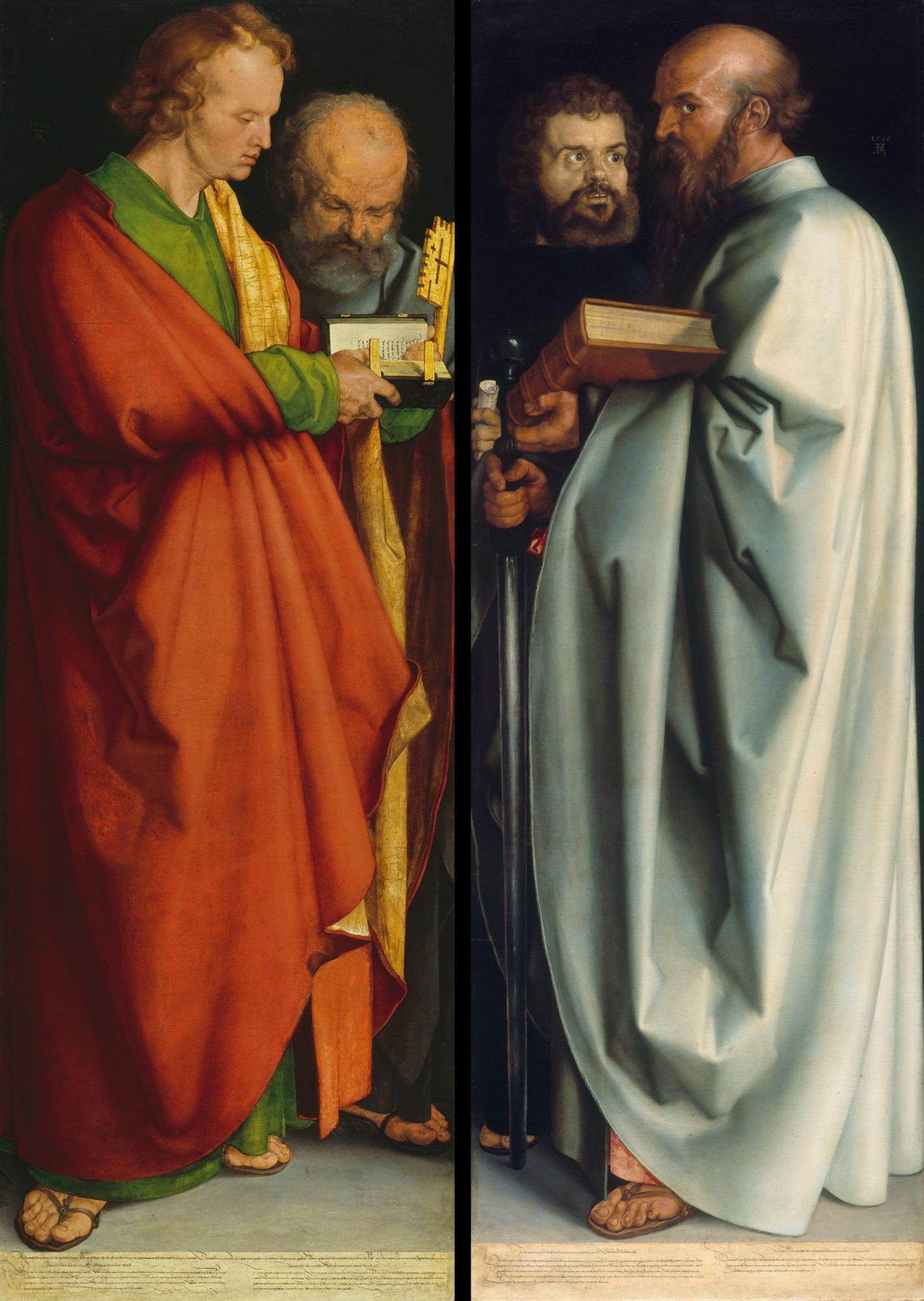
In 1526 he gave his city two tall panels, John and Peter, Mark and Paul: The Four Apostles. Their faces, says the Munich museum, follow the four temperaments. Below run quotations from Luther’s Bible addressed to “worldly rulers”: beware of false prophets. Nuremberg had embraced the Reformation, and the artist urged the council to stay the course. It paid him 100 guilders.
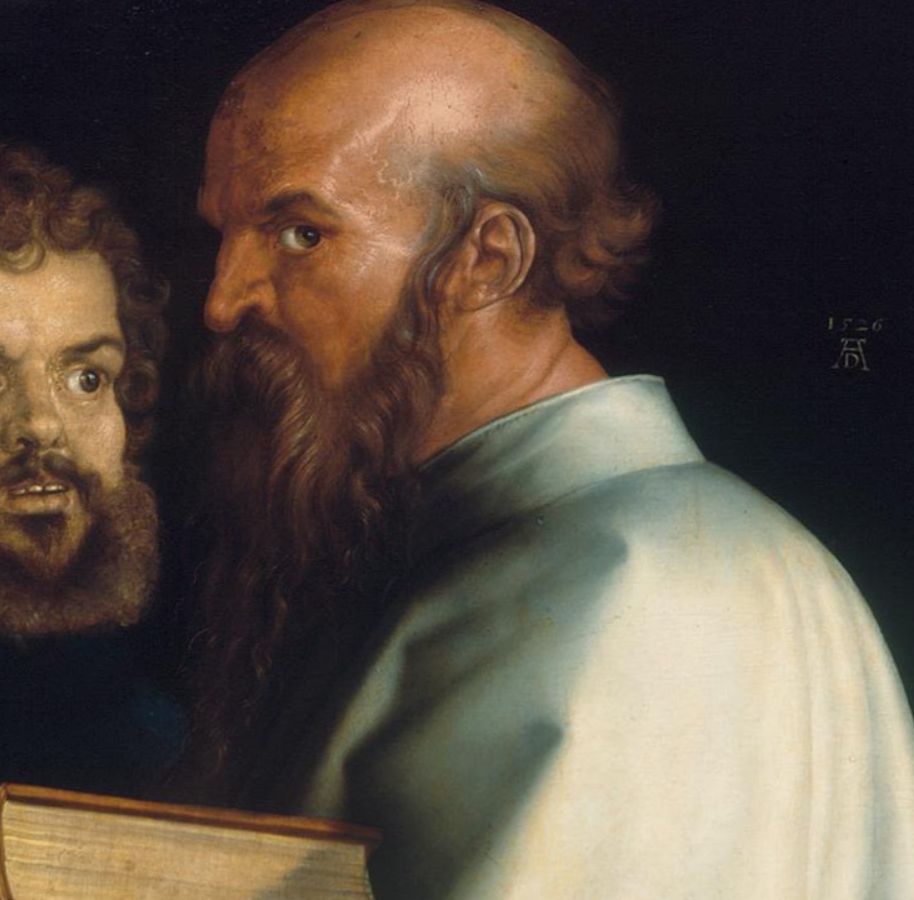
Dürer probably took the idea of tall figures from Venice, from Bellini’s triptych in the Frari church. Twenty years on, the old Venetian he had called the best of all painters echoes in the Nuremberg master’s last major work. In 1627 Elector Maximilian I of Bavaria took the panels to Munich, where they still hang.
The boy at the mirror and the old man giving his apostles to the town hall were doing the same thing: leaving a face that could not be forged.
Albrecht Dürer died on April 6, 1528, and was buried in Nuremberg’s St John’s Cemetery. Pirckheimer wrote the epitaph: “Whatever was mortal of Albrecht Dürer lies beneath this mound.” The key word is “mortal.” The rest, as the boy at the mirror intended, remained on paper and panel.
Comments
For Hroniki readers
Comments are open to readers with an account. Signing up is free and takes a few seconds.
No comments yet. Start the conversation.