Michelangelo’s Creation of Adam: who repainted two of Adam’s fingers
Two fingers on the most famous hand in art were painted not by Michelangelo but by a painter from Modena who repaired the ceiling half a century later. The story of a fresco seen through soot for four centuries.
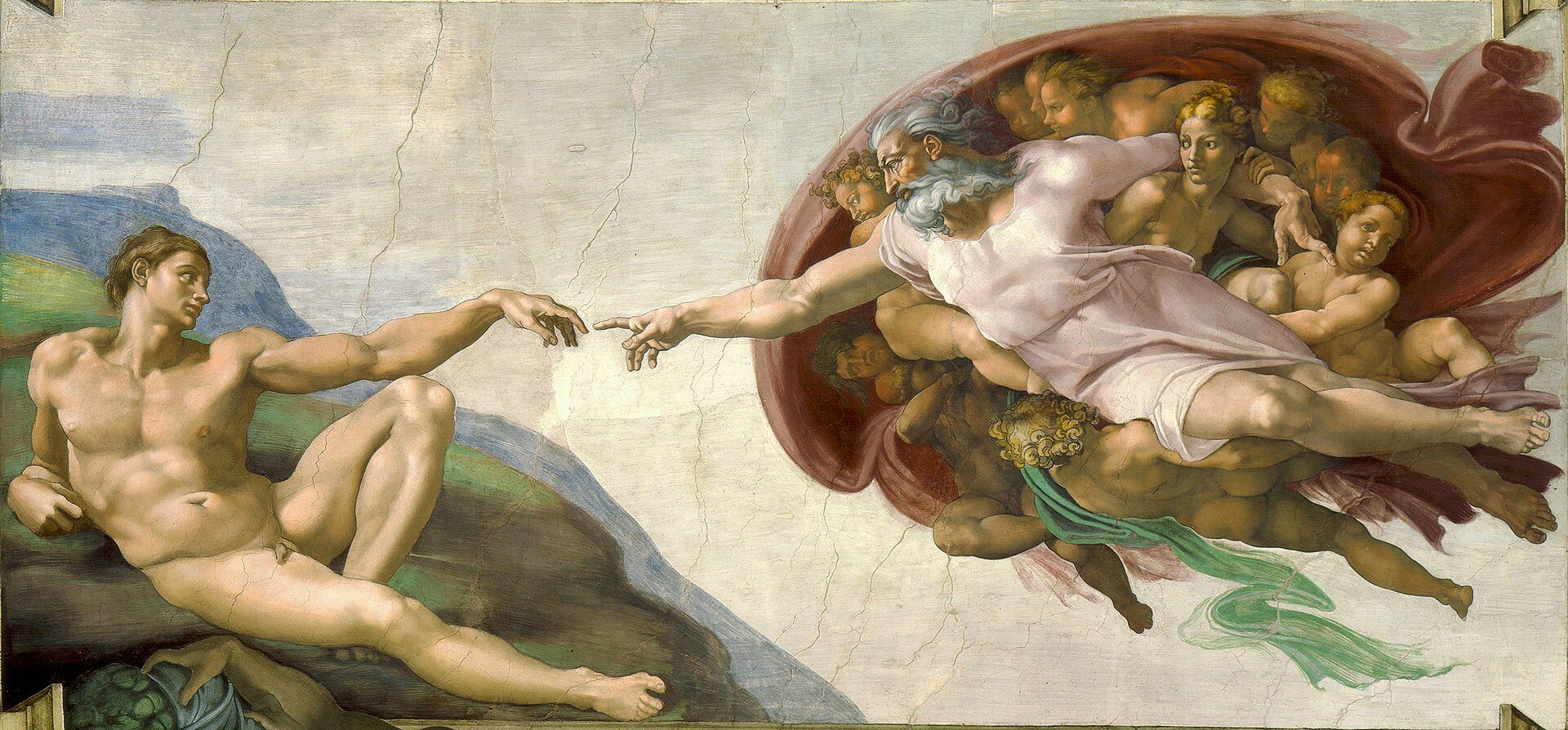
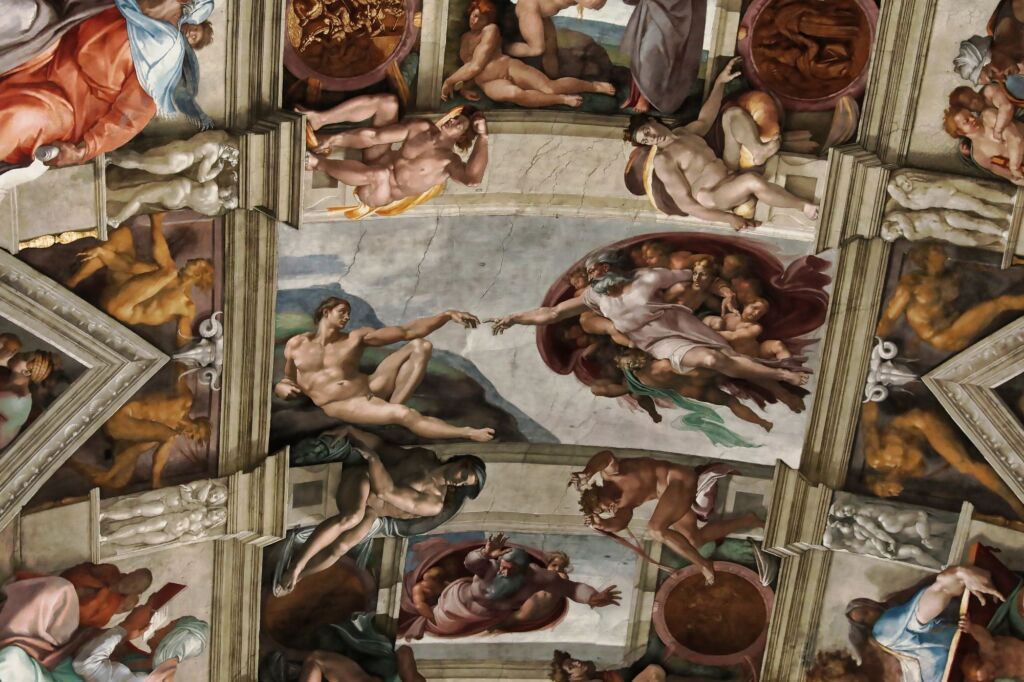
The nearly touching fingers in The Creation of Adam may be the most reproduced detail in European painting, on T-shirts, posters and logos. Yet two of Adam’s fingers are not Michelangelo’s. They were repainted in the 1560s by Domenico Carnevale, a painter from Modena, after cracks spread across the Sistine Chapel ceiling.
That was revealed in 1995 by Gianluigi Colalucci (in Spanish), the Vatican’s chief restorer, who led the chapel’s fourteen-year cleaning.
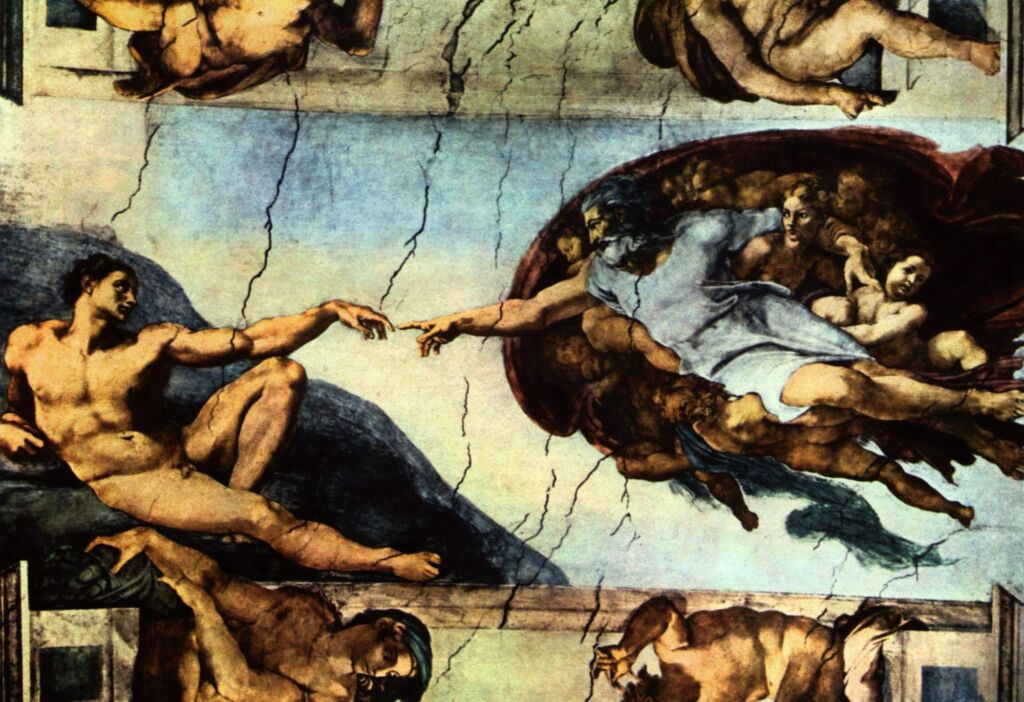
The fresco is one of nine scenes from Genesis on the Sistine Chapel ceiling in the Vatican, which Michelangelo painted from 1508 to 1512. The fingers are one of many stories to emerge when nearly five centuries of soot and glue came off.
A sculptor under the vault
Michelangelo did not want the job. A sculptor at heart, he longed to return to the tomb of Julius II, which the pope had halted in 1506.
According to Giorgio Vasari, the architect Bramante and his circle steered the pope toward the commission, hoping that Michelangelo, a novice in fresco, would fail or fall out with his patron. The artist tried to refuse and even proposed Raphael instead.
It did no good, and Bramante set up the scaffolding: he hung it from ropes through holes in the vault. Asked how the holes would be filled, Bramante said “they would think of that when the time came.” Michelangelo built his own, on brackets that never touched the walls, Vasari says. He painted standing, head tipped back, not lying down as often imagined.
His pupil and biographer Ascanio Condivi claimed in 1553 that Michelangelo finished the ceiling in twenty months (in Italian) “without any help at all, not even someone to grind his colors.” (translated here by Hroniki, like later quotes from Condivi, the sonnet and Colalucci)
Vasari repeated the formula and added that painter friends summoned from Florence to help were sent home, their work scraped off. In fact he had help, at least plasterers and color grinders. The legend of the lone genius was born in his lifetime, and he never denied it.
Condivi also recorded Julius II asking when it would be finished. “When I can,” Michelangelo replied. The hot-tempered pope struck him with his staff, repeating, “When I can, when I can!” The ceiling was unveiled on All Saints’ Day, 1512. For a long time afterward the artist could read letters only by holding them above his head.
Julius wanted it touched up with gold, or the chapel would look poor. “Those who are painted there,” Michelangelo answered, “were poor too.” He was paid 3,000 ducats for the whole job and spent twenty or twenty-five on pigments.
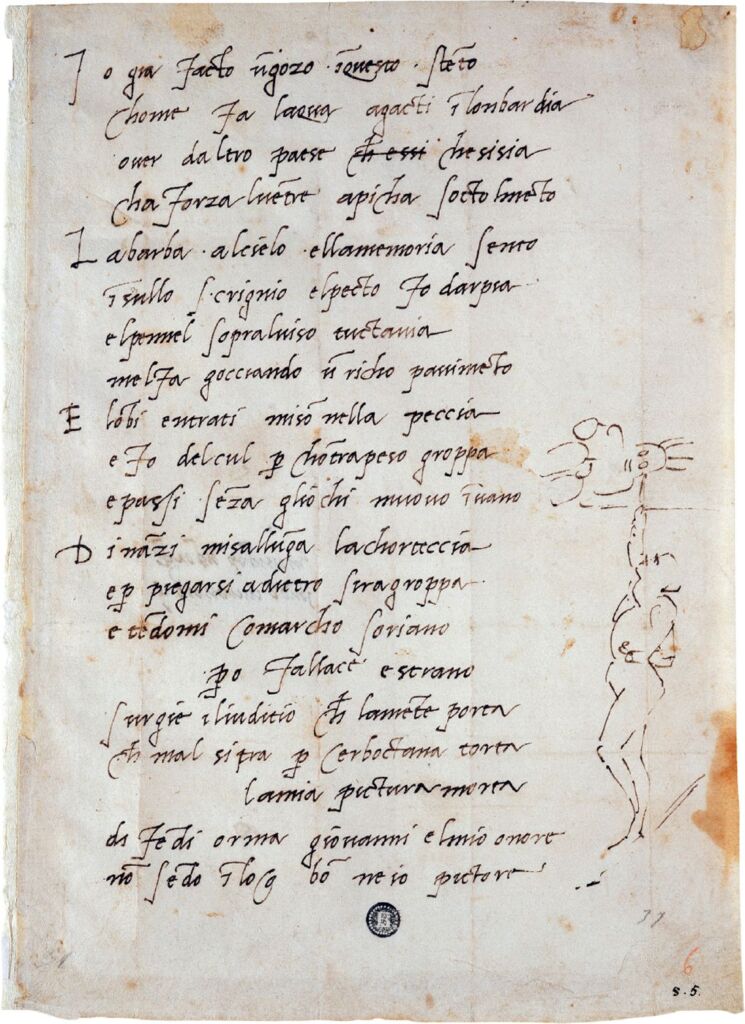
He described the ordeal himself in a comic sonnet to his friend Giovanni da Pistoia. His beard points at heaven, and his dripping brush turns his face into “a rich pavement,” a mosaic of paint. In the margin, a little figure stretches up toward the vault. The poem ends by asking Giovanni to defend his “dead painting” and his honor, since he is “not in a good place, nor a painter.”
Condivi saw commandments, Vasari saw a body
Today The Creation of Adam is read as God passing life to man. Its first viewers saw otherwise. Condivi, who wrote down Michelangelo’s own stories, calls it the fourth scene from the altar and reads it in a surprising way: God, arm outstretched, seems to be giving Adam “precepts, as to what he must do and not do.”
Condivi’s Adam is already alive; God is telling him how to live. Vasari looked at the body. Adam, he wrote, seems “just newly created by the great Father of all,” not “the mere production of the mind and pencil even of such a man as Michelagnolo.”
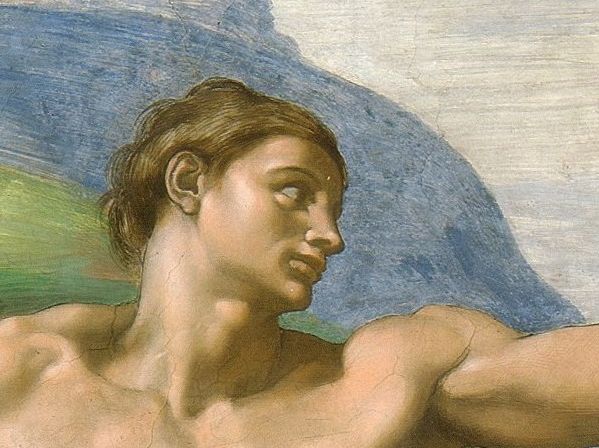
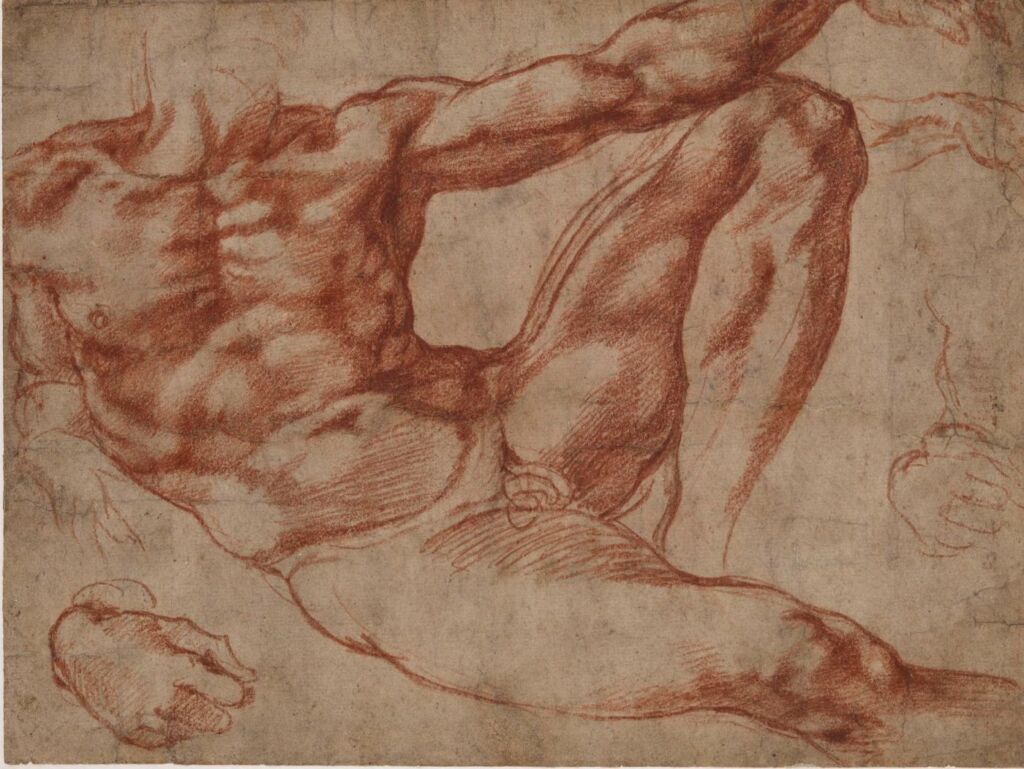
Behind the figure lies study from life. The British Museum holds a red chalk sheet from around 1511 with a model in Adam’s pose. For anatomy he went further: Condivi writes that the prior of Santo Spirito in Florence gave the young sculptor a room and corpses to dissect.
Two fingers from the 1560s
The vault cracked from the start. Colalucci explained that “very serious cracks” in the walls ran into the ceiling and endangered the whole building. Some of the painting along them was lost. Between 1564 and 1570 Domenico Carnevale of Modena repaired the vault, repainting the losses in fresco, on fresh plaster.
Colalucci’s list of Carnevale’s work: two figures in the Sacrifice of Noah; part of the Separation of Land and Water, including God’s left hand; part of the Punishment of Haman. And “two fingers of Adam’s hand in the scene of the creation of man.” In the same years Carnevale worked on the Last Judgment on the altar wall, signing “D.C. 1566” on the handle of Charon’s oar.
There his task was different. In 1564 the nudes of the Last Judgment were ordered covered, a job given first to Daniele da Volterra, after his death to Girolamo da Fano, and finally to Carnevale.
The man who finished Adam’s fingers was covering bodies on the next wall.
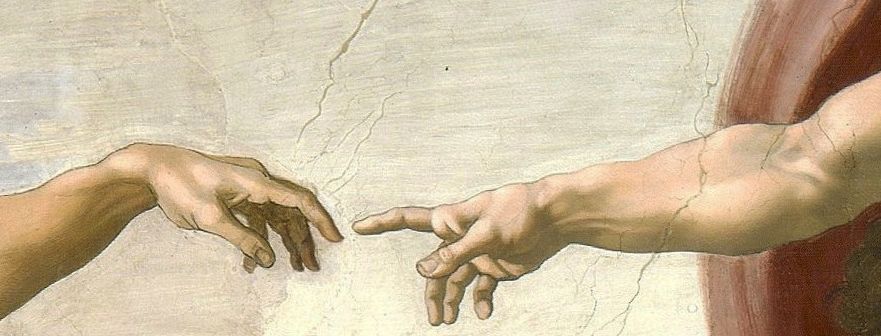
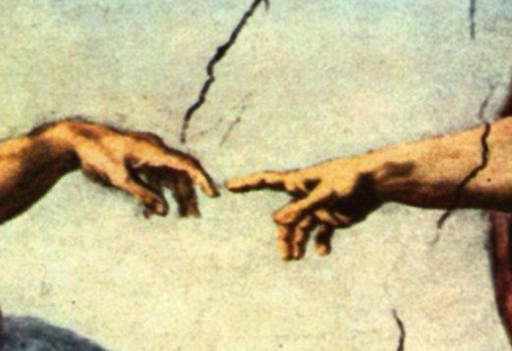
Colalucci did not say which joints are not Michelangelo’s. An Italian blog on Michelangelo credits Carnevale with the tips of the middle and index fingers and part of the ring finger, more than two. No document confirms it. But if Colalucci, who saw that plaster up close, is right, the most famous hand in art is the work of two painters half a century apart.
Soot, glue and Japanese money
Vasari called the ceiling “the very light of our art,” shining on a world “which had lain in darkness for so many hundreds of years.” By the 20th century that light had dimmed so far that historians took Michelangelo for a somber painter, sparing with color.
Cleaning began in 1980 with the lunettes above the windows; the ceiling was done by 1989, the Last Judgment by 1994. Japan’s Nippon Television paid more than $4 million for exclusive photographic rights and filmed the work from start to finish.
What came off? Soot from candles, torches and braziers, settling on the vault from the start. And glue: earlier restorers had coated the darkened paint with animal glue and gum arabic to revive it. Drying, the glue contracted and tore away flakes of paint.
Michelangelo, Colalucci said, worked in “true fresco,” on wet plaster that locks in the pigment, and added touches on dry plaster, a secco, only “very sparingly.” Fresco goes on in patches: only as much plaster as can be painted before it dries. Each patch is a giornata, Italian for “day,” about six hours of work.
Under the grime was another artist: pale sky, a lilac tunic on God, a cool green hill beneath Adam. Colalucci’s strongest evidence was a chance find. In a crack in the chest of a nude youth above the Persian Sibyl, the team found a tiny piece of Michelangelo’s painting that Carnevale had stuffed in as filler.
No soot had reached it in four hundred years. Its color was “exactly the same” as what the cleaning had recovered.
“The soul of the fresco had been stripped away”
Not everyone liked the new Michelangelo. The chief opponent was James Beck, an art historian at Columbia University. “It looked as if the soul of the fresco had been stripped away,” he told People magazine in 1987. Michelangelo, he argued, had added shadows and glazes, thin transparent layers, on dry plaster, and the restorers were washing off his final layer with the soot.
That year artists including Andy Warhol and Robert Rauschenberg signed a letter asking the pope to halt the work.
The restorers’ champion was John Pope-Hennessy, a leading Renaissance scholar, who called Beck “the most culpable of the critics.” Yet even he conceded in The New York Review of Books that the scaffolding had reached only mid-chapel, with The Creation of Adam still uncleaned, and that “the acid test of the whole enterprise is still to come.” Would the scene turn out “marginally more pedestrian”?
Beck called the restoration an “artistic Chernobyl” and founded ArtWatch International, which monitors restorations worldwide. He likened the cleaning to a face-lift: the old look could never be restored.
Colalucci answered that scholars had simply grown used to a brooding Michelangelo, painter of figures sunk in shadow. The quarrel still resurfaces, but for conservators it is long settled.
A mantle shaped like a brain
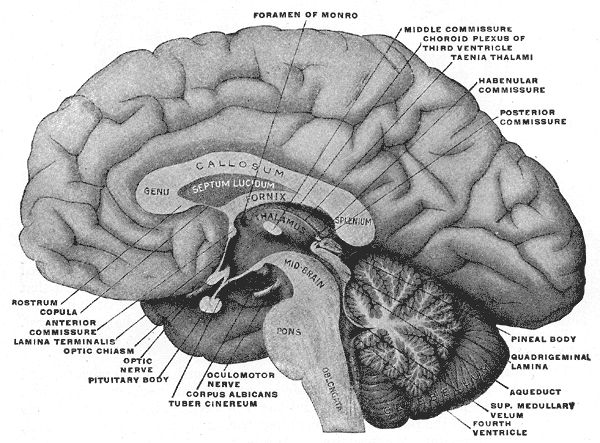
The brighter the fresco, the bolder the readings. In October 1990 Frank Meshberger, a physician from Indiana, published a paper in JAMA, “An Interpretation of Michelangelo’s Creation of Adam Based on Neuroanatomy,” matching the outline of the red mantle and its angels to a cross-section of the human brain.
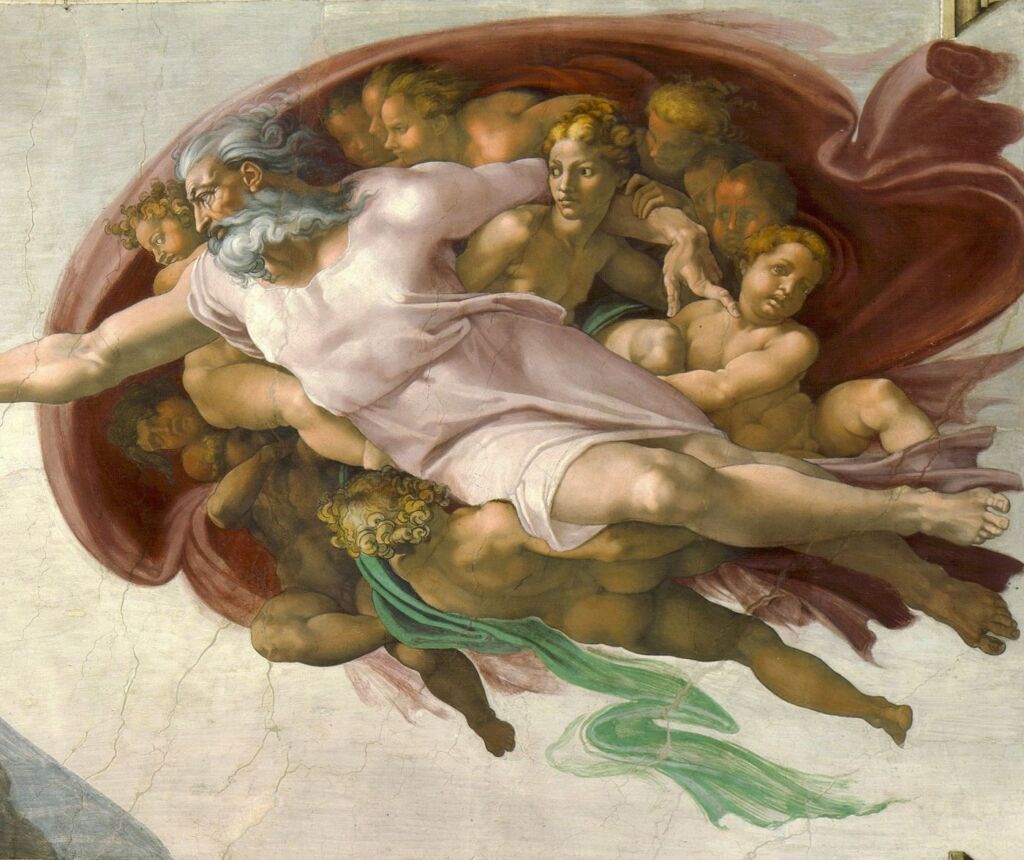
The match, he argued, extends to the sulci, brain stem, pituitary gland and optic chiasm. His conclusion was theological: “what God is giving to Adam is the intellect.” The theory is elegant, but no document says Michelangelo intended it.
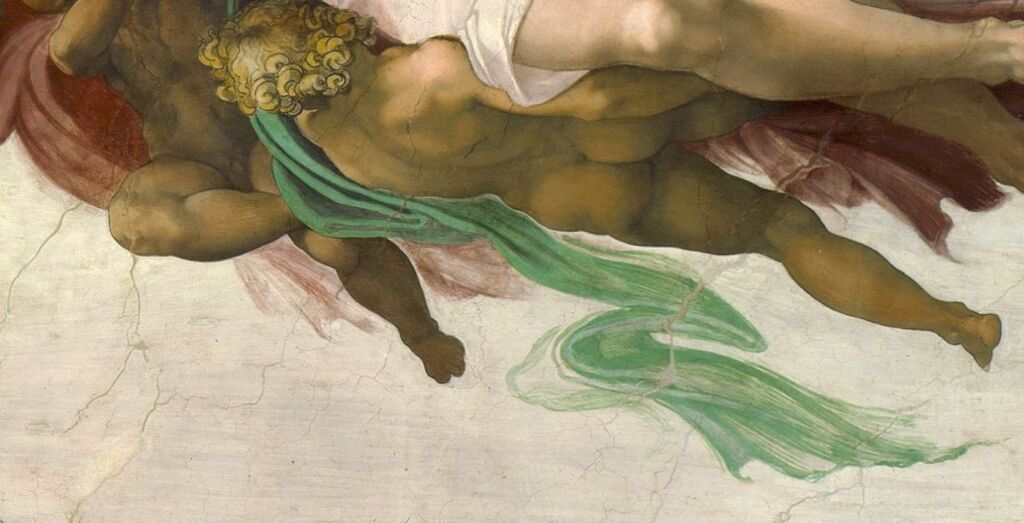
The brain has rivals. In 2015 Italian physicians saw a postpartum uterus in the mantle and read the scene as the birth of mankind. The “birth” reading is older: the Italian art historian Enrico Bruschini wrote about it in 2004. Its supporters see the green scarf below as a cut umbilical cord.
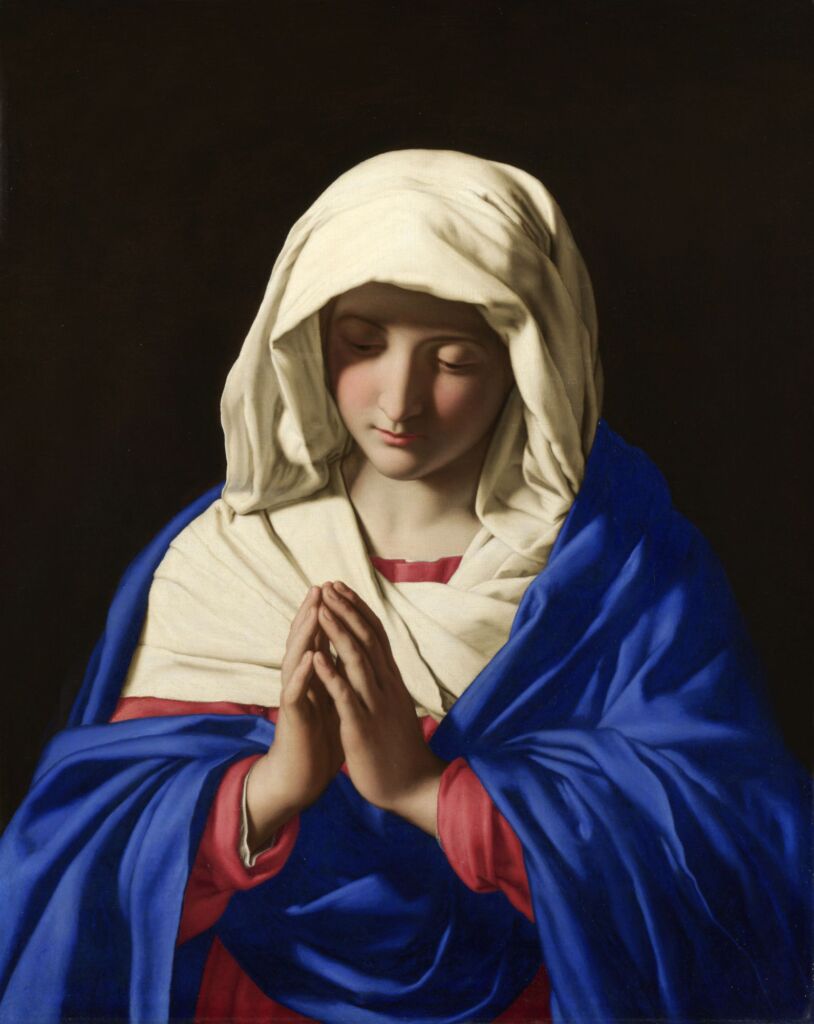
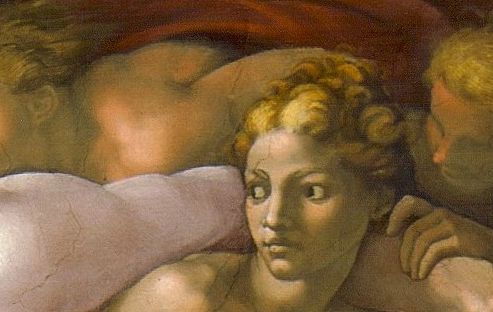
The woman in the crook of God’s left arm is debated even more. Condivi saw only “little angels” there. The 19th-century English critic Walter Pater called her Eve, not yet created but already in God’s mind, and that reading is now the most widely accepted.
Others see the Virgin Mary or Divine Wisdom. Michelangelo explained neither the mantle nor the woman.
Sixty-five feet from the fingers
The fresco can be seen only as it was in 1512: from below. The vault is some 20 meters (about 65 feet) up. The scene measures roughly 2.8 by 5.7 meters (9 by 19 feet), yet from the floor it looks like a postcard. Stand mid-chapel facing the Last Judgment: counting from the altar, it is the fourth scene, the second of the large panels.
Photography, filming and phones are not allowed in the chapel, and guards ask for silence. The Vatican Museums open Monday to Saturday, 8 a.m. to 8 p.m. (last entry 6 p.m.). On the last Sunday of the month entry is free, 9 a.m. to 2 p.m. (last entry 12:30 p.m.).
Today the main threat is visitors, whose breath and sweat act on the paint as candles once did. Five to six million come each year. In February 2026 the Last Judgment went back behind scaffolding for the removal of a whitish film of calcium lactate. Barbara Jatta, director of the Vatican Museums, linked it to the presence of people, “even if we have a very sophisticated climate system.”
Unlike Leonardo’s Last Supper, which began to decay almost at once, the ceiling has lasted five centuries. But it too needed repairs, and each left a trace. Looking up at Adam’s hand, a visitor sees Michelangelo and Carnevale at once. From 65 feet below, no one can tell them apart.
Comments
For Hroniki readers
Comments are open to readers with an account. Signing up is free and takes a few seconds.
No comments yet. Start the conversation.