Why buying Vermeer’s Milkmaid meant buying 38 other paintings too
In 1696 The Milkmaid sold for 175 guilders; in 1907 a minister, cartoonists and parliament were fighting over it. How Vermeer's picture nearly went to America, and why the Dutch had to buy 38 more paintings to keep it.
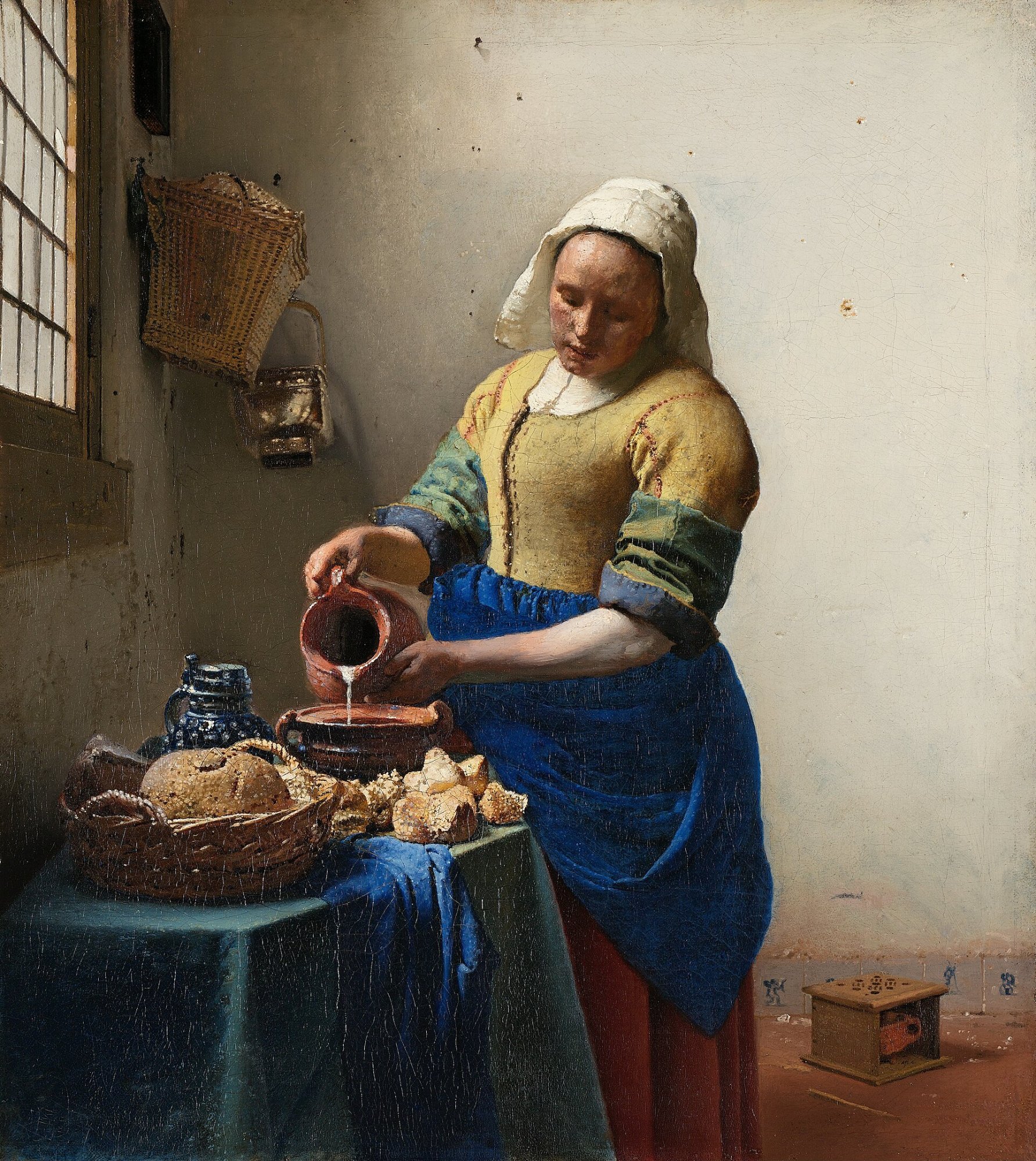
At an Amsterdam auction in 1696, The Milkmaid sold for 175 guilders; only View of Delft fetched more. Two centuries later a minister, cartoonists and parliament fought over it, with sums in the hundreds of thousands.
Painted around 1660, the canvas has hung in the Rijksmuseum since 1908. How it got there is a story of price, and of who decides what is a national treasure.
Thirty-nine paintings in one deal
For most of the 19th century The Milkmaid belonged to the Six family of Amsterdam, through the collector Lucretia van Winter, who married into it in 1822. After Jonkheer Pieter Six van Vromade died in 1905, his heirs decided to sell.
They offered the Rembrandt Association 39 paintings for 750,000 guilders, The Milkmaid only as part of the lot. According to the historian F. J. Duparc (in Dutch), the society would pay 200,000 and the state the rest. Most of the society’s share came from the banker and collector Daniël Franken, on condition that it go only to Six pictures.
Abraham Bredius, director of the Mauritshuis, did the valuation. He held The Milkmaid to be Vermeer’s greatest work and was sure the American banker J. Pierpont Morgan was after it. No document shows a real offer from Morgan. For the newspapers, the rumor was enough.
Uncle Sam is turned down
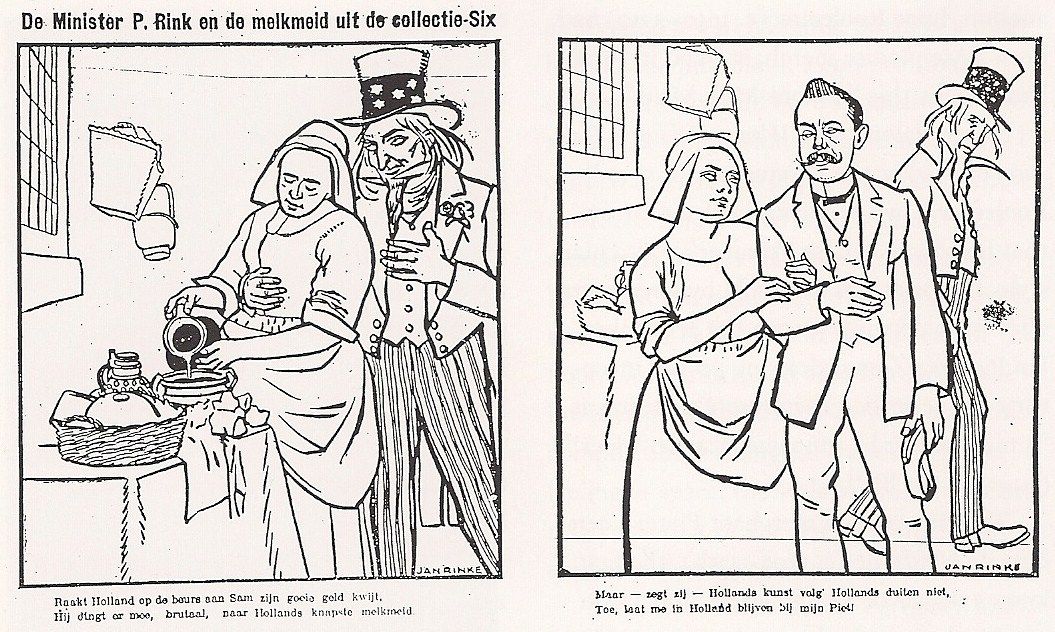
On November 9, 1907, Het Vaderland ran a two-panel cartoon by Jan Rinke. In the first, Uncle Sam courts the milkmaid; in the second, she leaves on the arm of the interior minister, Pieter Rink.
It was no joke. Frits Lugt, 23, of the auction house Frederik Muller, published a pamphlet: the valuation was inflated, and the museum could do without most of the other 38 pictures. The critic Willem Steenhoff called the price “unheard-of” (translated here by Hroniki) and ranked The Milkmaid below the Rijksmuseum’s own Woman Reading a Letter.
Lugt ranked Dresden’s Girl Reading a Letter at an Open Window, and a large picture the Berlin collector James Simon had just paid a fortune for, alongside The Milkmaid. In the journal De Gids the painter Jan Veth replied that the young expert’s taste was still unformed and Bredius’s experience weighed more.
Veth, too, found it awkward to buy lesser pictures with a masterpiece. But under Franken’s condition the extras could not go to other museums: everything from the Sixes had to stay in the Rijksmuseum.
In parliament the socialist Pieter Jelles Troelstra objected: the state had enough old art, and living artists needed the money. Victor de Stuers, the chief champion of Dutch heritage, wanted the painting kept at any cost. The lower house passed the bill 67 to 17.
On January 13, 1908, the 39 Six paintings went on view in one room of the Rijksmuseum. The state had paid over half a million guilders.
A wall full of nail holes
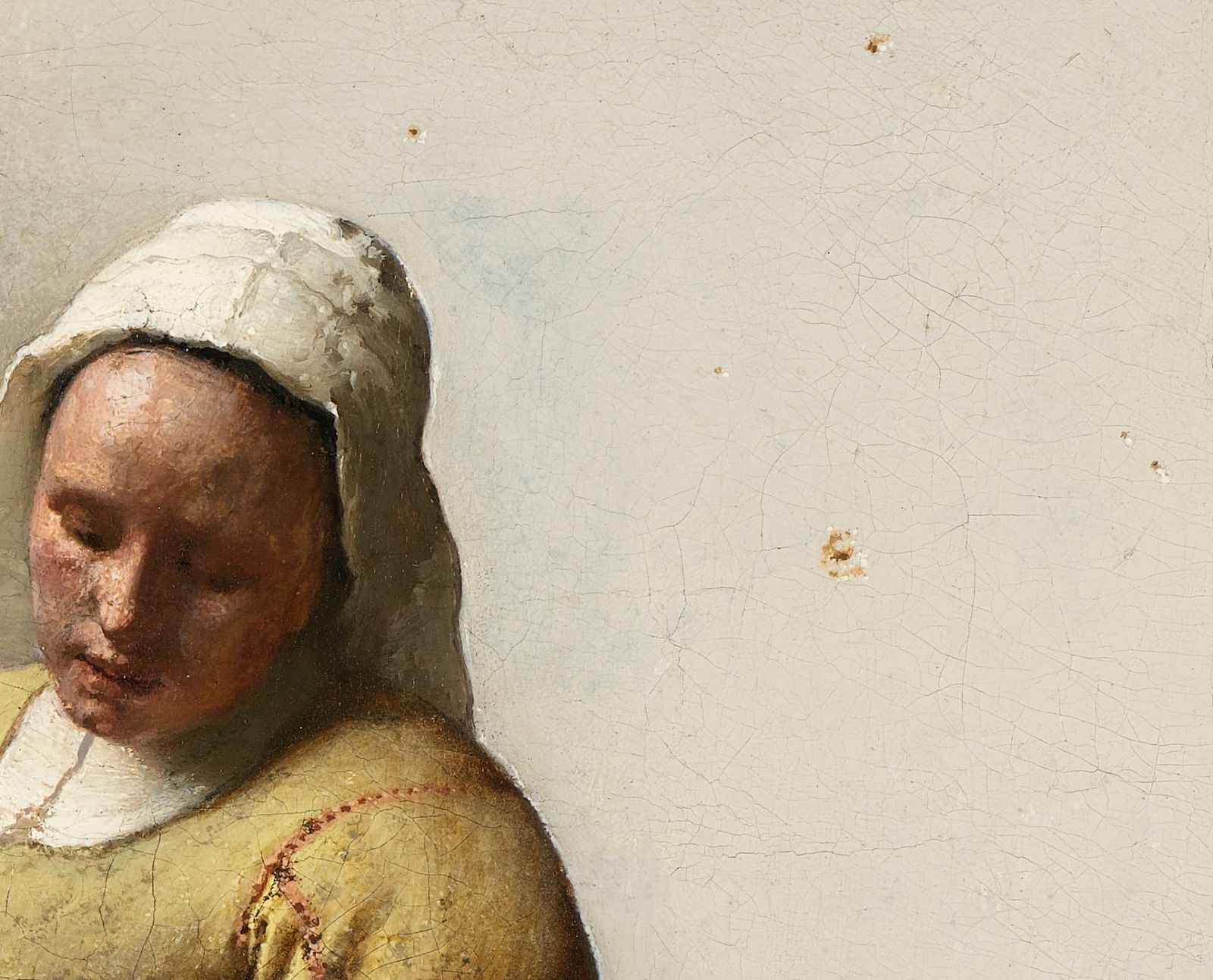
The strangest thing in the picture parliament voted on is its wall: a nail with a short shadow and, to the right of the maid’s head, several empty holes. Hand-forged nails were expensive in the 17th century; they were evidently pulled out and moved, and the plaster remembered where things had hung.
Vermeer sketched a shelf of jugs on this wall, then painted it out, but left the nail holes. For what researchers found beneath the paint in 2022, see our biography of Vermeer.
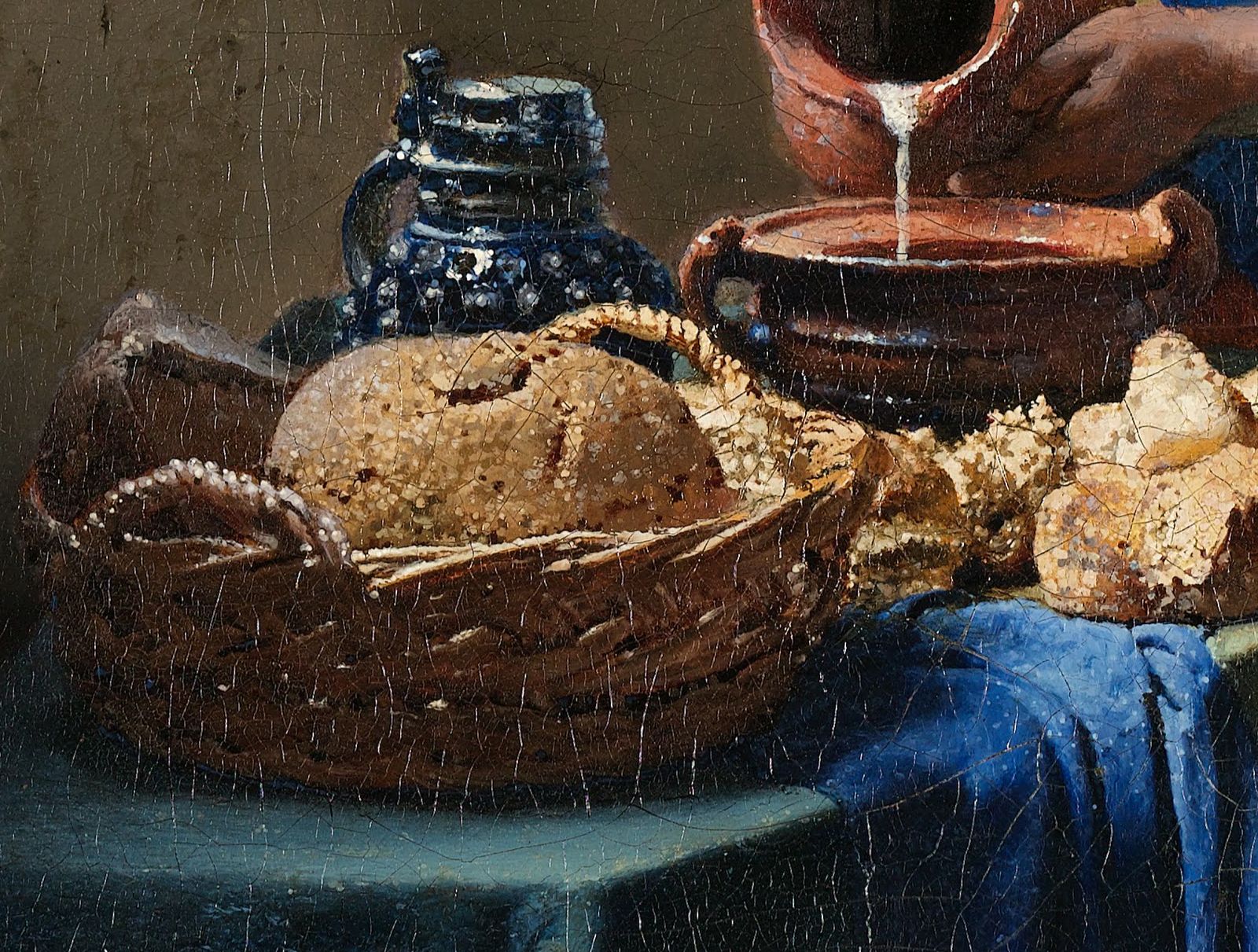
The bread in the basket is beaded with pale dots of thick paint. The Rijksmuseum counts hundreds of these points of light. They are often linked to the camera obscura, but that is a hypothesis.
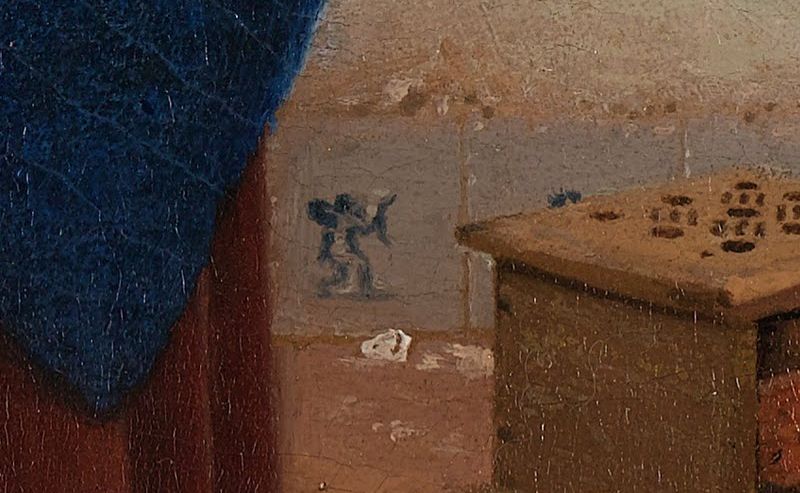
Low down, between the skirt and the foot warmer, a Delft tile shows Cupid with a drawn bow. The American curator Walter Liedtke saw a hint in it: the maid as “a discreet object of desire.” The Rijksmuseum’s director, Taco Dibbits, counters that such Cupids were on tiles all over Holland and may be here by chance.
A nation paid over half a million guilders for a kitchen with a pockmarked wall and perhaps an accidental Cupid. People argued about the price, the 38 pictures thrown in, the money for living artists. The maid, meanwhile, has not spilled a drop.
Comments
For Hroniki readers
Comments are open to readers with an account. Signing up is free and takes a few seconds.
No comments yet. Start the conversation.